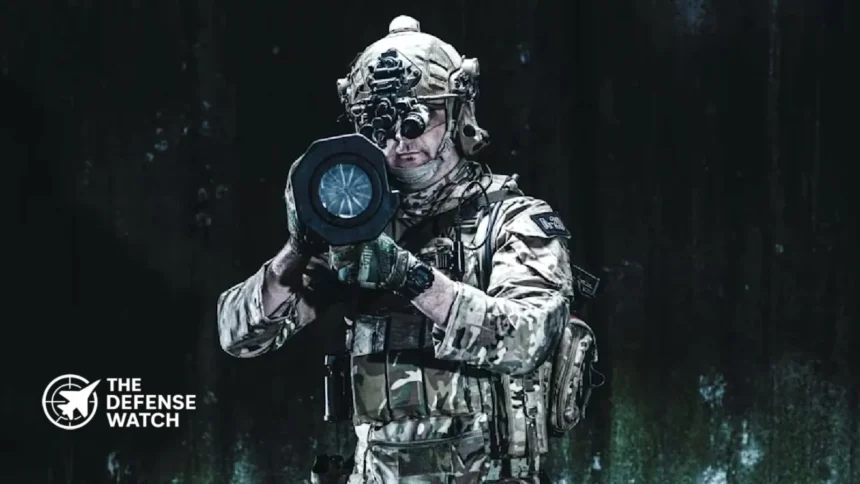
The U.S. Army has placed a new $60.3 million order with Saab for its AT4CS TW shoulder-fired weapon, designated the XM919 Individual Assault Munition (IAM), adding to a procurement program intended to consolidate several infantry weapons into a single multi-purpose system.
Saab announced the order on November 16, 2026. Deliveries are scheduled for 2029 and 2030 under a five-year contract awarded by the Army in 2024.
The order covers the AT4 Confined Space Tandem Warhead (AT4CS TW), a disposable, shoulder-fired weapon designed for dismounted infantry operating in close-combat environments. Its ability to operate from both open positions and confined spaces is intended to give infantry squads additional options when engaging targets in built-up areas and other restrictive environments.
A $60.3 Million Order Under a Larger Procurement Agreement
The latest purchase falls under an indefinite-delivery, indefinite-quantity (IDIQ) contract awarded to Saab in August 2024.
The original agreement established a maximum potential value of approximately $494 million over five years. This is a contract ceiling, not an upfront purchase of that amount. Individual orders are placed separately, with their values determined when the Army exercises the agreement.
The November 2026 order is therefore a specific procurement action within the wider agreement.
The distinction matters when assessing the program’s financial scale. The $60.3 million order represents additional equipment procurement, while the larger contract provides the Army with a framework for ordering XM919 systems over the agreement’s duration.
Saab has not disclosed the number of weapons included in this latest order. The company also has not provided a detailed breakdown of the order’s associated equipment, training devices or other support requirements.
Why the Army Selected the AT4CS TW
The XM919 program addresses an infantry requirement for a shoulder-launched weapon capable of handling different target types without requiring soldiers to carry several separate launchers.
Traditional infantry formations may need different shoulder-fired weapons for attacking armored vehicles, defeating fortified positions and engaging targets inside buildings. Carrying multiple systems can increase the weight soldiers must transport and add complexity to training, maintenance and logistics.
Saab’s AT4CS TW was selected to address this requirement through a multi-target weapon configuration.
According to Saab, the XM919 combines several capabilities in a single disposable system. Its confined-space design also allows soldiers to employ the weapon in locations where conventional shoulder-fired systems may be unsuitable.
The Army’s Joint Program Executive Office Armaments and Ammunition describes the XM919 as a single-use shoulder-launched munition with multi-target capability.
Its published fact sheet identifies light armor, earth-and-timber bunkers, reinforced concrete, adobe structures and brick walls among the intended target types. The document also identifies a fire-from-enclosure capability.
These requirements are particularly relevant to urban combat, where infantry may encounter fortified buildings, obstacles and light armored vehicles within relatively short engagement distances.
Replacing Multiple Infantry Weapons
The XM919 is part of a broader effort to simplify the Army’s shoulder-launched munition inventory.
Army documentation identifies the AT4 Confined Space Reduced Sensitivity (AT4CS-RS) and the M141 Bunker Defeat Munition (BDM) as systems the XM919 is intended to replace.
Combining several target-engagement functions into one weapon could reduce the number of separate systems infantry squads need to transport. It may also simplify ammunition management, training requirements and logistical support.
However, replacing existing weapons requires more than purchasing the tactical munition itself.
The Army’s XM919 program includes associated training equipment, including the XM922 sub-caliber trainer, field handling trainers, field tactical trainers and soldier virtual training systems. These components are intended to prepare soldiers for the weapon’s use without relying exclusively on live tactical ammunition.
The program therefore involves a wider training and support package alongside the launcher and munition.
Army Procurement Plans Show Continued Investment
The Army’s fiscal year 2026 ammunition procurement budget provides additional context for the XM919 program.
In its June 2025 budget justification, the service requested approximately $31.89 million for 3,081 Individual Assault Munitions in fiscal year 2026. The same document identified 9,818 XM919 systems under a 2024 procurement entry, with Saab Dynamics listed as the contractor.
The budget also described the IAM as a training-standard item intended for both training and combat, with procurement supporting annual training requirements and the development of war-reserve inventories.
These figures illustrate that the Army’s investment extends beyond the latest $60.3 million order. The service has been building its procurement and training arrangements around the XM919 as part of its close-combat modernization effort.
The budget figures are historical planning and procurement information, however. They should not be treated as a confirmed account of the Army’s current inventory or the quantity covered by the November 2026 order.
What the Order Means for Saab
The contract also reinforces Saab’s position in the U.S. infantry weapons market.
The company has supplied AT4 weapons to American forces for decades. In its August 2024 announcement, Saab said it had delivered more than 700,000 AT4 systems to the United States and produced more than one million systems for 15 countries.
The XM919 builds on that established relationship, but the new procurement is also tied to a more specific Army requirement: consolidating multiple shoulder-launched weapon capabilities.
For Saab, continued orders under the IDIQ agreement provide a route to maintain its position in the Army’s close-combat weapons inventory. For the U.S. Army, the procurement supports a transition toward a more consolidated infantry munition system.
The scheduled 2029-2030 deliveries mean the latest order will contribute to the Army’s longer-term equipment plans rather than provide an immediate increase in fielded weapon numbers.
The number of XM919 systems to be delivered under this order, their unit cost and the Army’s final procurement quantity remain undisclosed.
Enjoying our coverage?
Make The Defense Watch a preferred source on Google to see more of our geopolitical and defense insights when relevant to you.