• Home
  • About
  • Defense Systems
  • Manufacturer
  • Comparisons
  • Compare 
  • Tools
TheDefenseWatch.com
  • Aerospace & Aviation
  • Military & Ordnance
  • Naval & Maritime
  • Cyber & Space Defense
  • Policy & Strategy
  • Global News
  • Tools Library
    • Smart Calculator
    • Drone Flight Time Calculator
    • Drone Range Calculator
    • Counter-Drone Jammer Effective Range Calculator
    • Counter-Battery Radar Detection Calculator
    • Artillery Fire Correction Calculator
    • Thermal Camera Detection Range Calculator
    • Missile Range & Time-of-Flight Calculator
    • Radar Detection Range Calculator
    • FPV Strike Drone Payload vs Range Calculator
    • Loitering Munition Endurance Calculator
    • Sniper Ballistic Drop & Windage Calculator
    • Bullet Drop Calculator
    • U.S. Army Combat Fitness Test (ACFT) Calculator
    • Military Pension Calculator
    • Military Retirement Calculator
    • Military Pension Calculator
    • Large Number Calculator
Font ResizerAa

TheDefenseWatch.com

The Defense Watch | U.S. & Global Defense News, Analysis & Military Updates

Search
  • Home
  • About
  • Defense Systems
  • Manufacturer
  • Comparisons
  • Compare 
  • Tools

Stay Updated

Get the latest update

Subscribe

Explore

  • Drone
  • Fighter Jets & Military Aircraft
  • Hypersonic Weapons
  • Aircraft Carriers
  • Strategic History & Missions
  • Tools Library
Home » Greece Announces $3.5 Billion Deal with Israel for Missile Systems under “Achilles Shield” Air-Defense Program
Global News

Greece Announces $3.5 Billion Deal with Israel for Missile Systems under “Achilles Shield” Air-Defense Program

TeamDefenseWatch
Last updated: November 13, 2025 12:32 am
TeamDefenseWatch
Share
2 Min Read
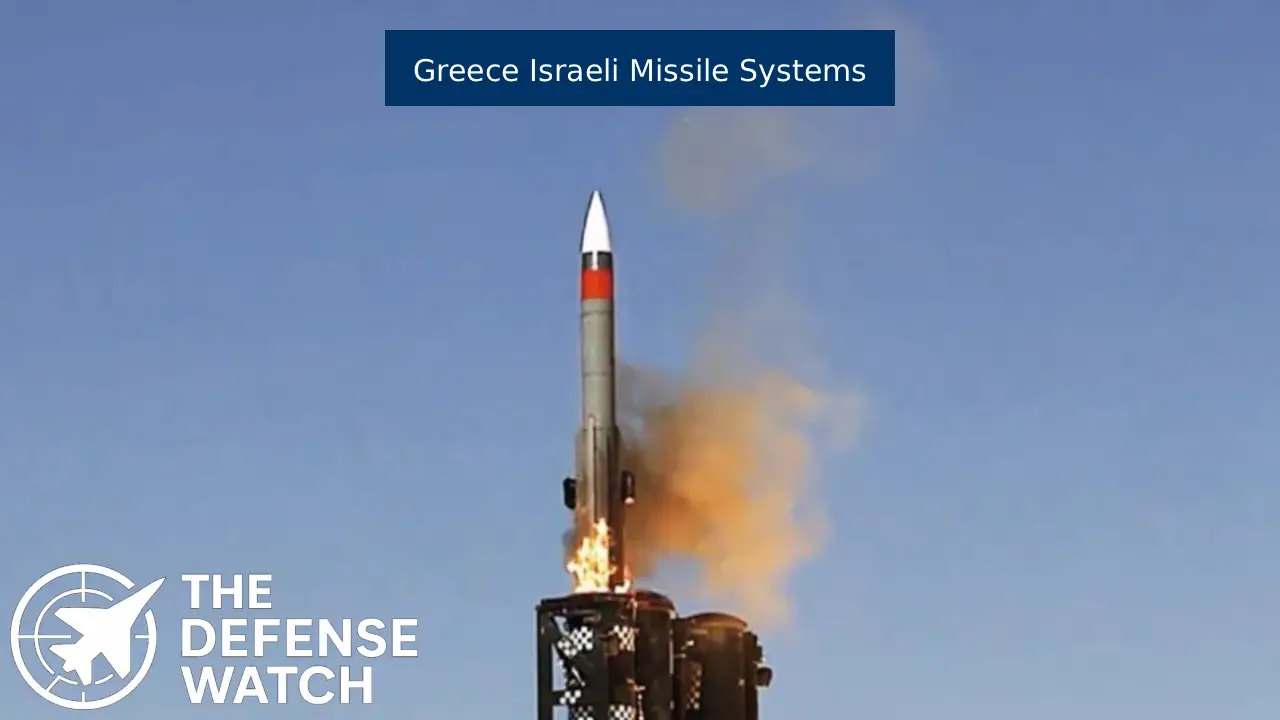
Greece Israeli Missile Systems
SHARE

Athens, Greece – 12 November 2025 – The Achilles Shield national air-defense program will see the Hellenic Republic purchase approximately US $3.5 billion worth of missile systems from Israeli defense firms, according to a report by Army Recognition published on 12 November. The deal marks a significant step in Greece’s efforts to modernize its ageing air-defense infrastructure and shift towards networked, layered missile capabilities.

Contents
Background: Why “Achilles Shield”?Details of the ProcurementImplications and Strategic PerspectiveWhat’s Next

Background: Why “Achilles Shield”?

In April 2025, Greece launched the Achilles Shield program under its broader 12-year defense modernization plan, with an initial budget of roughly €2.8 billion (approximately US$3 billion) and up to €25 billion envisaged for the full program through to 2036. The aim: replace outdated Soviet- and U.S.-built air-defense systems operated by the Hellenic Armed Forces and build a modern, multi-layer missile defense posture aligned with the nation’s strategic environment in the Eastern Mediterranean.

Details of the Procurement

The report indicates that Greece intends to source primarily Israeli systems for each tier of air defense under Achilles Shield.

  • For short-range defense: the Israeli SPYDER (Surface-to-air PYthon and DERby) system—developed by Rafael Advanced Defense Systems and Israel Aerospace Industries (IAI)—is slated to succeed Greece’s current Russian-made OSA-AK and TOR-M1 platforms. The SPYDER includes rapid reaction time and mobility suited for countering low-flying UAVs, cruise missiles and aircraft.
  • For medium range: Greece is looking at the Israeli Barak MX system to replace its legacy U.S.-supplied MIM-23 Hawk batteries. Barak MX is a modular, software-defined launcher integrating multiple interceptors across threat domains.
  • For long range: The selection reportedly leans toward the Israeli SkyCeptor (a variant of the “Stunner” missile co-developed by Rafael and Raytheon) to replace the Russian S-300 PMU-1 systems in Hellenic service. SkyCeptor is designed for ballistic and cruise missile threats and marks the shift toward NATO-standard equipment.

Greece’s shift from Russian-origin systems to Israeli platforms reflects both operational necessity and geopolitical recalibration. Older systems such as the S-300 and TOR-M1 are increasingly difficult to maintain and may not meet evolving threats posed by drones, precision-guided munitions and advanced cruise missiles.

- Advertisement -

The report emphasizes that Israel’s systems were chosen in part for shorter delivery lead times, lower life-cycle costs and opportunities for local industrial participation. For example, IAI’s past acquisition of the Greek defense-firm Intracom Defense in 2023 reportedly enhances Athens’ ability to integrate domestic content into the Achilles Shield rollout.

While contract signatures, delivery schedules and integration timelines have not been publicly disclosed, sources indicate the first tranche of systems is expected to begin deployment in 2026, with full operational capability targeted by end-2028. If the deal proceeds at the reported value, it will represent the largest missile procurement in Greek history.

Implications and Strategic Perspective

From a policy and strategic viewpoint, this procurement has multiple implications:

  • Enhanced deterrence: By transforming its air-defense posture, Greece aims to reinforce national sovereignty and bolster its deterrence in a region marked by complex threats and tensions, notably with neighboring Turkey.
  • NATO and interoperability: Choosing Israeli systems compatible with NATO standards signals Athens’ intent to align more closely with Western defense infrastructures and reduce reliance on ageing Russian systems.
  • Industrial benefits: The local content participation element may stimulate Greece’s defense industry and support longer-term sustainment of the air-defense network.
  • Regional signaling: The decision may reverberate across the Eastern Mediterranean defense market, potentially influencing future acquisitions by other states and reshaping regional supplier relationships.

What’s Next

As Greece moves forward with the Achilles Shield program, key milestones to monitor include: the formal contract award, delivery schedules for the Israeli systems, integration testing with existing Hellenic Armed Forces capability, and how the Achilles Shield architecture meshes with Greece’s broader 12-year modernization plan. The success of deployment will hinge on maintaining coverage during the transition, training personnel, and integrating multiple layers of sensor-shooters into a coherent national network.


TAGGED:Achilles Shieldair-defence procurementGreece defenceGreece DefenseHellenic Armed ForcesIsrael missile systems
Share This Article
Facebook Copy Link Print
ByTeamDefenseWatch
TeamDefenseWatch is the official editorial byline of TheDefenseWatch.com. Working under one umbrella, TheDefenseWatch.com, the team delivers verified, factual reporting on global defense, military technology, aerospace systems, and security developments. Articles are sourced from official statements, defense industry releases, and trusted media, with editorial review to ensure accuracy and clarity.Contact: info@TheDefenseWtach.com
7 Comments
  • Pingback: Seventh-Generation Fighter Vision Pushes Speed to Mach 5 and Beyond
  • Pingback: Greece Signs €982M Deal for Fourth French FDI Frigate to Boost Naval Power
  • Pingback: Damaged B-2 Spirit Stealth Bomber Returns to Service After Four-Year, $23.7 M Repair — Restores U.S. Strategic Bomber Capacity
  • Pingback: Philippine Army Awards Contract to South Korea for 15,600 DSAR-15 Carbines | TheDefenseWatch.com
  • Pingback: UK Project Nightfall Ballistic Missile for Ukraine, Deep-Strike Weapon Development | TheDefenseWatch.com
  • Pingback: Missile Defense Agency Expands SHIELD Contract With 340 New Awards Under $151 Billion Ceiling | TheDefenseWatch.com
  • Pingback: France Air and Space Force Technical School 2026 Recruitment Begins | TheDefenseWatch.com

Leave a Reply Cancel reply

Your email address will not be published. Required fields are marked *

Search Defense Systems

Latest Defense Systems

  • B61 Nuclear Bomb B61 Nuclear Bomb
  • Japan E-767 Airborne Japan E-767 Airborne
  • Remington 870 Shotgun Remington 870 Shotgun
  • RUTA B1 Cruise Missile RUTA B1 Cruise Missile
  • XQ-67A Drone XQ-67A Drone
  • B-25 Mitchell Bomber B-25 Mitchell Bomber
  • F-100 Super Sabre F-100 Super Sabre
  • North American F-86 Sabre North American F-86 Sabre
  • North American XB-70 Valkyrie North American XB-70 Valkyrie

Recent Compares

  • J-10C vs JF-17 Thunder: Which Fighter Is More Capable? J-10C vs JF-17 Thunder: Which Fighter Is More Capable? View Comparison →
  • Tejas vs Gripen: Key Differences and Capabilities Tejas vs Gripen: Key Differences and Capabilities View Comparison →
  • Tejas vs MiG-21 Bison: How India Replaced Its Iconic Supersonic Fighter Tejas vs MiG-21 Bison: How India Replaced Its Iconic Supersonic Fighter View Comparison →
  • F-35 vs F-16: Stealth, Sensors and Combat Roles F-35 vs F-16: Stealth, Sensors and Combat Roles View Comparison →
  • Tejas Fighter Jet vs F-16 Fighting Falcon: Capability Compared Tejas Fighter Jet vs F-16 Fighting Falcon: Capability Compared View Comparison →
  • Rafale Fighter Jet vs F-16 Fighting Falcon : Which Fighter Has the Edge? Rafale Fighter Jet vs F-16 Fighting Falcon : Which Fighter Has the Edge? View Comparison →
  • Su-57 Fighter Jet vs J-20 Fighter Jet: Stealth and Air Combat Compared Su-57 Fighter Jet vs J-20 Fighter Jet: Stealth and Air Combat Compared View Comparison →
  • Mirage 2000 vs Tejas Mk1A: Legacy Combat Power vs Indigenous Modernization Mirage 2000 vs Tejas Mk1A: Legacy Combat Power vs Indigenous Modernization View Comparison →
  • Rafale Fighter Jet vs F-22 Raptor: Which Air Dominance Fighter Has the Edge? Rafale Fighter Jet vs F-22 Raptor: Which Air Dominance Fighter Has the Edge? View Comparison →
  • Tejas Fighter Jet vs. Rafale Fighter Jet: India’s Indigenous Fighter Meets France’s Proven Multirole Combat Aircraft Tejas Fighter Jet vs. Rafale Fighter Jet: India’s Indigenous Fighter Meets France’s Proven Multirole Combat Aircraft View Comparison →

Recent Posts

  • General Atomics to Supply Components for U.S. Army and Navy Hypersonic Weapons
  • Lockheed Martin Tests Mk21A Reentry Vehicle for Sentinel ICBM
  • Lockheed Martin Wins $122.4 Million Trident II Navigation Contract
  • Pentagon Prepares Review of Military Legal System and JAG Corps
  • U.S. and Colombia Launch Southern Vanguard 2027 Exercise

You Might Also Like

MQ 28A Ghost Bat
Global News

Japan, Australia Expand Manned-Unmanned Teaming With MQ-28A Ghost Bat Collaboration

May 1, 2026
Trump effective leader seeking peace
Global News

Russia’s Medvedev Calls Trump an Effective Leader Seeking Peace Amid Ukraine War Talks

September 7, 2026
North Korea live fire drills
Global News

North Korea Conducts Live Fire Drills With Missiles and Artillery

September 14, 2026
Hellfire missile sale Denmark
Global News

US Clears $45 Million Hellfire Missile Sale for Denmark’s MH-60R Seahawk Fleet

January 9, 2026

Logo

Copyright © 2026 TheDefenseWatch.com

Helpful Links

  • Home
  • About Us
  • Privacy Policy
  • Terms of Use / Disclaimer
  • U.S. Privacy Notice – CCPA Compliance

Defense Systems

  • Defense Systems
  • Comparisons 
  • Manufacturer
  • Tactical Calculators

Popuplar

Which 5 Air Forces Possess the Costliest Fighter Jet Fleets in the World
Evolving Strategic Value: Carrier Strike Groups in the Indo-Pacific’s Future Security Architecture
Autonomous Weapon Systems Spark U.S. Ethics Debate Amid Rapid Military AI Integration

We report on developments involving military forces, governments, defense companies, research organizations, and security institutions around the world. 

Welcome Back!

Sign in to your account

Username or Email Address
Password

Lost your password?