• Home
  • About
  • Defense Systems
  • Manufacturer
  • Comparisons
  • Compare 
  • Tools
TheDefenseWatch.com
  • Aerospace & Aviation
  • Military & Ordnance
  • Naval & Maritime
  • Cyber & Space Defense
  • Policy & Strategy
  • Global News
  • Tools Library
    • Smart Calculator
    • Drone Flight Time Calculator
    • Drone Range Calculator
    • Counter-Drone Jammer Effective Range Calculator
    • Counter-Battery Radar Detection Calculator
    • Artillery Fire Correction Calculator
    • Thermal Camera Detection Range Calculator
    • Missile Range & Time-of-Flight Calculator
    • Radar Detection Range Calculator
    • FPV Strike Drone Payload vs Range Calculator
    • Loitering Munition Endurance Calculator
    • Sniper Ballistic Drop & Windage Calculator
    • Bullet Drop Calculator
    • U.S. Army Combat Fitness Test (ACFT) Calculator
    • Military Pension Calculator
    • Military Retirement Calculator
    • Military Pension Calculator
    • Large Number Calculator
Font ResizerAa

TheDefenseWatch.com

The Defense Watch | U.S. & Global Defense News, Analysis & Military Updates

Search
  • Home
  • About
  • Defense Systems
  • Manufacturer
  • Comparisons
  • Compare 
  • Tools

Stay Updated

Get the latest update

Subscribe

Explore

  • Drone
  • Fighter Jets & Military Aircraft
  • Hypersonic Weapons
  • Aircraft Carriers
  • Strategic History & Missions
  • Tools Library
Home » Two U.S. Navy Aircraft Crash in South China Sea During Carrier Operations
Global News

Two U.S. Navy Aircraft Crash in South China Sea During Carrier Operations

TeamDefenseWatch
Last updated: September 8, 2026 4:40 am
TeamDefenseWatch
Share
2 Min Read
U.S. Navy aircraft crash
SHARE

Crash incidents during routine operations

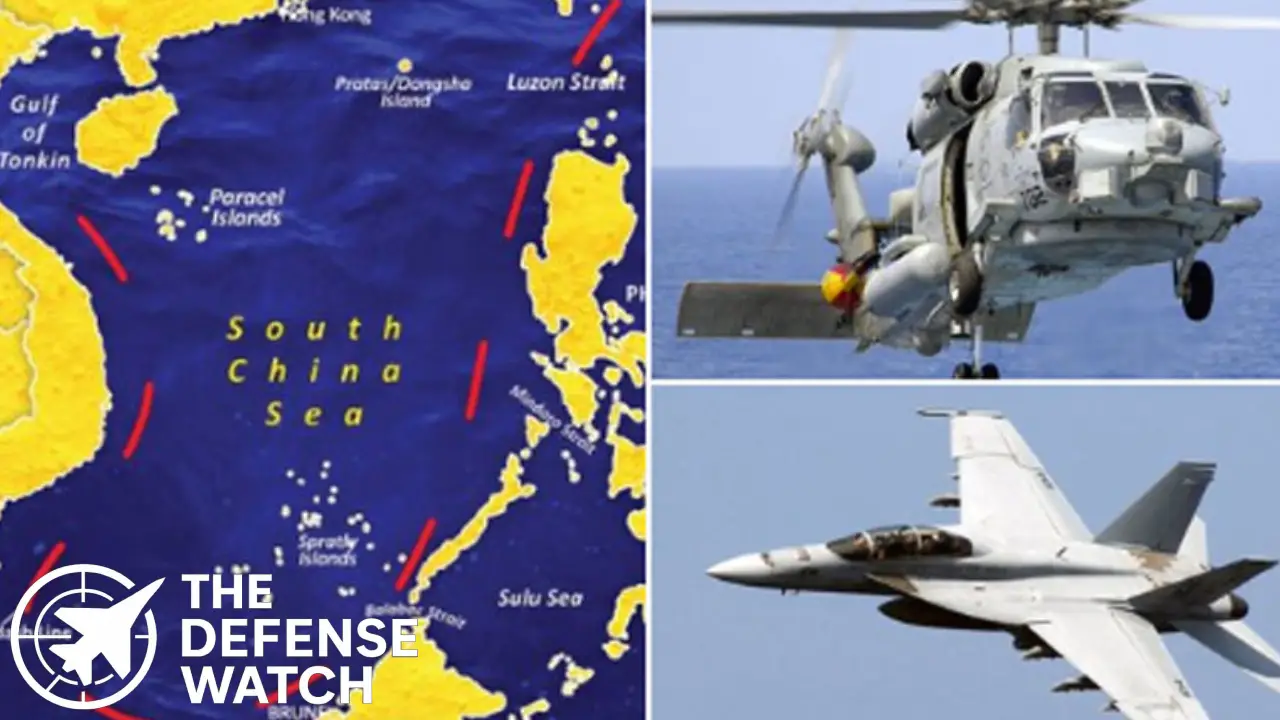
The USS Nimitz (CVN-68), currently operating in the Indo-Pacific, experienced two separate aircraft losses on Sunday afternoon, 26 October 2025, according to a statement by the U.S. Pacific Fleet.

Contents
Crash incidents during routine operationsOperational context and carrier statusTechnical and safety implicationsAnalysis: What this means for U.S. defense, regional posture and aerospace trendsConclusion: Looking ahead

The first incident occurred at approximately 2:45 p.m. local time when an MH-60R Sea Hawk helicopter assigned to Helicopter Maritime Strike Squadron 73 (“Battle Cats”) went down in the waters of the South China Sea during routine flight operations from the Nimitz. All three crew members were rescued by search-and-rescue assets from Carrier Strike Group 11.

Roughly 30 minutes later, an F/A-18F Super Hornet fighter jet attached to Strike Fighter Squadron 22 (Fighting Redcocks) also crashed into the same sea region while returning to or conducting an approach to the carrier. Both aviators ejected safely and were recovered.

Breaking news: Two more US Navy aircraft fell off aircraft carriers into the South China Sea yesterday, US Navy command said. One was a Sea Hawk helicopter and the other an F18 fighter jet.

Both tumbled into the ocean in separate accidents just 30 minutes apart on Sunday… pic.twitter.com/MlVnVvJWxe

— Nury Vittachi (@NuryVittachi) October 27, 2025

In both incidents the Navy stated all five personnel involved are safe and in stable condition, and that the causes of the crashes are under investigation.

- Advertisement -

Operational context and carrier status

The Nimitz is conducting its final deployment before scheduled decommissioning, and recently returned from Middle East operations supporting maritime security amid Houthi attacks on commercial shipping.

These incidents occur as the U.S. maintains a heightened presence in the South China Sea — a vital sea-lane and contested region amid growing strategic competition with the People’s Liberation Army Navy. U.S. carrier-based air operations aim to uphold freedom-of-navigation and regional deterrence.

In recent months the U.S. Navy has experienced a spate of aviation mishaps: another F/A-18 fell off the deck of the USS Harry S. Truman in April, and one went overboard in May; no fatalities resulted.

Technical and safety implications

Both aircraft involved are workhorses of the carrier air wing. The MH-60R Sea Hawk is a multi-mission maritime helicopter tailored for anti-submarine and surface‐warfare roles. The F/A-18F Super Hornet remains the U.S. Navy’s primary carrier‐based fighter/attack platform until fielding moves to future systems. Continued losses of Super Hornets — each aircraft costing upwards of $60 million — raise questions about aircraft readiness, maintenance burdens, pilot training tempo, and fleet aging.

Given two unrelated aircraft from the same carrier went down within a half-hour window, investigations will likely explore common root causes: deck operations tempo, maintenance/inspection cycles, pilot fatigue, environmental conditions, or systemic component failure. The carrier’s ongoing deployment tempo and proximity to contested airspace may also increase operational risk.

Analysis: What this means for U.S. defense, regional posture and aerospace trends

The twin crashes have several implications for U.S. defense and global security:

  • Carrier air wing reliability & readiness: These incidents underscore that even in peacetime “routine operations,” carrier aviation involves high risk. The Nimitz is the U.S. Navy’s oldest nuclear-powered carrier; using legacy platforms amid increasing high-tempo deployments may stretch maintenance and pilot margins. Any loss of air-capability affects deterrence posture.
  • Regional signaling and credibility: Deploying a carrier strike group to the South China Sea is a strong signal to China and regional allies. Aircraft losses, however, may reduce the visible readiness of the strike group, possibly emboldening adversaries or complicating coalition confidence in U.S. presence.
  • Aging fleet & transition to next-gen platforms: The Super Hornet has served as the backbone of carrier air wings for decades, but the Navy is gradually transitioning toward future fighters (e.g., NGAD or later Block upgrades). The accidents may accelerate scrutiny of current fleet health, spare-parts availability, and the imperative to modernise faster.
  • Safety culture and operational risk management: Multiple incidents in short succession can trigger major safety reviews. The U.S. Navy may adjust training hours, deck operations tempo, or maintenance scheduling to mitigate risk — but doing so could impact operational readiness.
  • Geopolitical context – contested maritime theatre: Operating in the South China Sea places U.S. assets in a complex environment of contested airspace, maritime claims and dense civilian traffic. While the official cause is not yet disclosed, the environment adds variables (e.g., weather, sea state, threat of jamming or interference) that can exacerbate standard mishaps.

Conclusion: Looking ahead

While all aircrew were safely recovered, the loss of two aircraft in quick succession from the same carrier will prompt detailed investigations and potentially policy adjustments across the carrier aviation community. The U.S. Navy must ensure that carrier strike groups deliver on deterrence and presence missions without sacrificing safety or readiness. As the Navy transitions to new aircraft and grapples with high operational tempo in contested waters, the lessons from these crashes may shape budget priorities, training regimes and force posture. The coming weeks will reveal whether systemic factors demand a broader operational pause or redesign — or if the incidents will be treated as coincidental. In either case, stakeholders from Pentagon leadership to allied partners will watch closely for how the Navy responds.

TAGGED:F/A-18 Super HornetMH-60R Sea HawkSouth China SeaUS NavyUSS Nimitz
Share This Article
Facebook Copy Link Print
ByTeamDefenseWatch
TeamDefenseWatch is the official editorial byline of TheDefenseWatch.com. Working under one umbrella, TheDefenseWatch.com, the team delivers verified, factual reporting on global defense, military technology, aerospace systems, and security developments. Articles are sourced from official statements, defense industry releases, and trusted media, with editorial review to ensure accuracy and clarity.Contact: info@TheDefenseWtach.com
22 Comments
  • Pingback: Why the U.S. Navy Can Still Dominate Undersea Nuclear Deterrence — And What Smaller Powers Can Learn from China’s Type 094 Challenge
  • Pingback: China’s Type 094 SSBN Operations Highlight Expanded Sea-Based Nuclear Deterrence
  • Pingback: navy seals submarine training pacific
  • Pingback: China Unveils YJ-1000 Precision-Guided 1-Ton Bomb for Advanced Fighter Fleet
  • Pingback: Turkey Grounds Entire C-130 Fleet After Fatal Georgia Crash | TheDefenseWatch.com
  • Pingback: US Aircraft Carrier Nears Venezuela in Strategic Show of Force | TheDefenseWatch.com
  • Pingback: Top 10 Most Powerful Navies in the World 2025: Gauging Maritime Dominance Through Aggregate Displacement
  • Pingback: Top 5 U.S. Fighter Jets: America’s Most Advanced Combat Aircraft Ranked
  • Pingback: Will Nuclear Weapons Actually Stop a U.S.–China War Over Taiwan?
  • Pingback: Top 15 Best Fighter Jets in the World in 2025: An Updated Air Power Snapshot
  • Pingback: U.S. Navy Aircraft Carriers 2025: Ford-Class Leads Fleet Modernization
  • Pingback: Ford Class vs Nimitz Class: Key Differences Between U.S. Navy Carriers
  • Pingback: Boeing Secures US$4.7 Billion Foreign Military Contract to Build AH-64E Apache Helicopters
  • Pingback: Ukraine Claims First Russian MiG-29 Destroyed in Crimea Strike
  • Pingback: US Navy Recovers Crashed Super Hornet and Seahawk from South China Sea
  • Pingback: China Aircraft Carrier vs US: Who Leads in Naval Air Power in 2025
  • Pingback: Ukraine Claims First Underwater Drone Attack on Russian Kilo Class Submarine | TheDefenseWatch.com
  • Pingback: Sikorsky Wins 9.5 Million Navy Contract for CH 53K Maintenance Tooling | TheDefenseWatch.com
  • Pingback: Air Force and Navy Aircraft to Perform Super Bowl LX Flyover Commemorating America's 250th Birthday | TheDefenseWatch.com
  • Pingback: War Secretary Pete Hegseth Signs Anduril DIVE LD Autonomous Underwater Vehicle During Facility Visit | TheDefenseWatch.com
  • Pingback: Best Non-American Fighter Jets 2026: Global Military Aviation Excellence | TheDefenseWatch.com
  • Pingback: Blue Water Autonomy Launches Liberty Class Autonomous Ship For U.S. Navy Operations | TheDefenseWatch.com

Leave a Reply Cancel reply

Your email address will not be published. Required fields are marked *

Search Defense Systems

Latest Defense Systems

  • TRML-4D Radar TRML-4D Radar
  • F-47A Fighter Jet F-47A Fighter Jet
  • China DF-61 Missile China DF-61 Missile
  • B61 Nuclear Bomb B61 Nuclear Bomb
  • Japan E-767 Airborne Japan E-767 Airborne
  • Remington 870 Shotgun Remington 870 Shotgun
  • RUTA B1 Cruise Missile RUTA B1 Cruise Missile
  • XQ-67A Drone XQ-67A Drone
  • B-25 Mitchell Bomber B-25 Mitchell Bomber

Recent Compares

  • J-10C vs JF-17 Thunder: Which Fighter Is More Capable? J-10C vs JF-17 Thunder: Which Fighter Is More Capable? View Comparison →
  • Tejas vs Gripen: Key Differences and Capabilities Tejas vs Gripen: Key Differences and Capabilities View Comparison →
  • Tejas vs MiG-21 Bison: How India Replaced Its Iconic Supersonic Fighter Tejas vs MiG-21 Bison: How India Replaced Its Iconic Supersonic Fighter View Comparison →
  • F-35 vs F-16: Stealth, Sensors and Combat Roles F-35 vs F-16: Stealth, Sensors and Combat Roles View Comparison →
  • Tejas Fighter Jet vs F-16 Fighting Falcon: Capability Compared Tejas Fighter Jet vs F-16 Fighting Falcon: Capability Compared View Comparison →
  • Rafale Fighter Jet vs F-16 Fighting Falcon : Which Fighter Has the Edge? Rafale Fighter Jet vs F-16 Fighting Falcon : Which Fighter Has the Edge? View Comparison →
  • Su-57 Fighter Jet vs J-20 Fighter Jet: Stealth and Air Combat Compared Su-57 Fighter Jet vs J-20 Fighter Jet: Stealth and Air Combat Compared View Comparison →
  • Mirage 2000 vs Tejas Mk1A: Legacy Combat Power vs Indigenous Modernization Mirage 2000 vs Tejas Mk1A: Legacy Combat Power vs Indigenous Modernization View Comparison →
  • Rafale Fighter Jet vs F-22 Raptor: Which Air Dominance Fighter Has the Edge? Rafale Fighter Jet vs F-22 Raptor: Which Air Dominance Fighter Has the Edge? View Comparison →
  • Tejas Fighter Jet vs. Rafale Fighter Jet: India’s Indigenous Fighter Meets France’s Proven Multirole Combat Aircraft Tejas Fighter Jet vs. Rafale Fighter Jet: India’s Indigenous Fighter Meets France’s Proven Multirole Combat Aircraft View Comparison →

Recent Posts

  • Hensoldt Targets €10 Billion in Annual Revenue by 2035, Doubles TRML-4D Radar Capacity
  • Somalia’s Reported JF-17 Deal Raises Questions Over Airpower and Regional Security
  • Navy Awards General Dynamics Subsidiary $20 Million Undersea Warfare Research Contract
  • U.S. Air Force Awards $26 Million Contract for Flyways AI Air Operations Software
  • Hegseth Orders Major Overhaul of U.S. Military Education System

You Might Also Like

UK arms broker jailed 16 years
Global News

British Arms Broker Jailed 16 Years Over Illegal Missile and Fighter Jet Deals

September 24, 2026
T-7A Red Hawk arrival
Global News

US Air Force Officially Welcomes First T-7A Red Hawk, Ushering New Era in Pilot Training

September 8, 2026
US withdrawal from Al Asad Airbase
Global News

US Completes Al Asad Airbase Withdrawal in Iraq, Pentagon Confirms End of Mission

January 20, 2026
Fatah-4 extended-range missile
Global News

Pakistan Tests Extended-Range Fatah-4 Cruise Missile

October 7, 2026

Logo

Copyright © 2026 TheDefenseWatch.com

Helpful Links

  • Home
  • About Us
  • Privacy Policy
  • Terms of Use / Disclaimer
  • U.S. Privacy Notice – CCPA Compliance

Defense Systems

  • Defense Systems
  • Comparisons 
  • Manufacturer
  • Tactical Calculators

Popuplar

Which 5 Air Forces Possess the Costliest Fighter Jet Fleets in the World
Evolving Strategic Value: Carrier Strike Groups in the Indo-Pacific’s Future Security Architecture
Autonomous Weapon Systems Spark U.S. Ethics Debate Amid Rapid Military AI Integration

We report on developments involving military forces, governments, defense companies, research organizations, and security institutions around the world. 

Welcome Back!

Sign in to your account

Username or Email Address
Password

Lost your password?