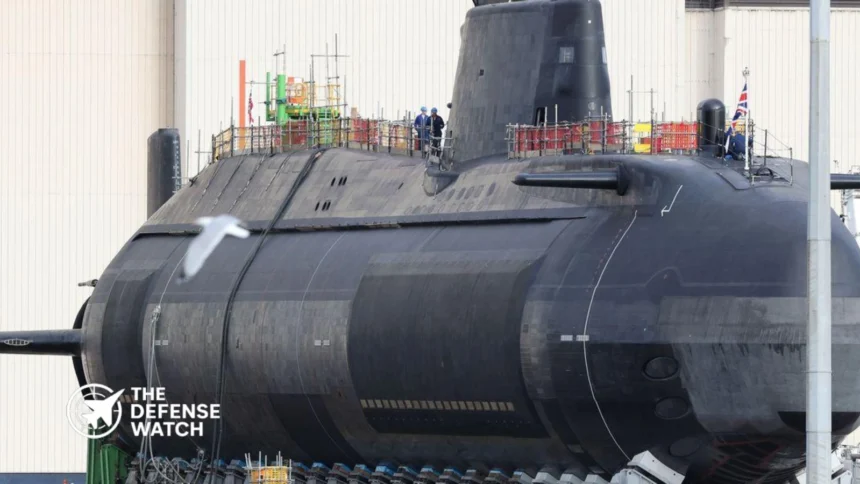
The United Kingdom has awarded Babcock International a major submarine support agreement aimed at reducing maintenance delays, expanding dockyard capacity and improving the operational availability of the Royal Navy’s nuclear-powered submarine fleet.
Announced on November 26, 2026, the Gateway Agreement is valued at £8.7 billion over an initial five-year period, according to Babcock. The Ministry of Defence (MoD) describes the investment as approximately £8 billion.
The agreement covers submarine maintenance, engineering, technical support and naval base services at HMNB Devonport and HMNB Clyde. Its central objective is to increase the amount of time Royal Navy submarines can spend available for operational duties rather than undergoing extended maintenance.
The award comes as Britain seeks to address longstanding submarine maintenance backlogs and strengthen the industrial infrastructure supporting its nuclear deterrent and conventional undersea operations.
Gateway Agreement replaces previous submarine support arrangement
The new agreement builds on the existing Future Maritime Support Programme (FMSP), whose extended contract is scheduled to end on November 30, 2026.
Babcock confirmed that the Gateway Agreement will take effect on December 1, 2026, initially running for five years. The wider contractual relationship could extend to an aggregate period of up to 15 years.
Importantly, the £8.7 billion figure includes £8 billion in contract backlog and a separate £700 million framework component, according to Babcock’s disclosure. It should therefore not be interpreted as an entirely new £8.7 billion cash payment or an immediate allocation of that amount.
The agreement has been awarded to Devonport Royal Dockyard Limited, a Babcock subsidiary, and establishes a consolidated framework for submarine support and naval base services.
According to the UK government’s written statement to Parliament, the arrangement will directly support the First Sea Lord’s Submarine Maintenance Recovery Plan.
The government also intends to introduce a stronger performance framework, linking contractual accountability to maintenance output, productivity and delivery. This is intended to give the MoD greater oversight of the time and resources required to return submarines to operational service.
Maintenance capacity is the central operational challenge
The Royal Navy depends on a relatively small nuclear-powered submarine fleet to perform several demanding missions.
Its submarine force includes four Vanguard-class ballistic missile submarines responsible for the UK’s Continuous At-Sea Deterrent (CASD), alongside five in-service Astute-class nuclear-powered attack submarines, according to the Ministry of Defence’s 2026 Defence Nuclear Enterprise update.
The Vanguard boats maintain the UK’s continuous nuclear deterrent patrols, while the Astute class provides conventional undersea warfare capabilities.
These attack submarines undertake missions including anti-submarine warfare, intelligence collection, maritime force protection and conventional strike operations.
Both roles depend on reliable maintenance infrastructure. Nuclear submarine servicing requires specialist engineering facilities, highly trained personnel, nuclear safety controls and access to an extensive industrial supply chain.
When maintenance periods extend beyond planned schedules, fewer submarines may be available to meet operational commitments. This places additional pressure on the remaining vessels and reduces flexibility for deployment, training and other naval activities.
The Gateway Agreement is intended to address this problem by increasing maintenance capacity and improving the coordination of engineering and support services.
Reuters reported that Britain has faced submarine availability pressures, with maintenance limitations contributing to longer deployments for some operational vessels. The new agreement is designed to improve the situation, although the government has not published a quantified reduction target for maintenance delays.
£2.4 billion supply-chain investment and 3,000 new jobs
The agreement also has a substantial industrial component.
According to the Ministry of Defence and a written ministerial statement, the programme is expected to generate:
- 3,000 additional jobs across the UK, including 1,600 in Devonport, 900 at Clyde and 500 in Bristol and other locations.
- Around 2,500 apprenticeship and graduate opportunities over five years.
- 8,500 existing jobs supported through the contract.
- £2.4 billion in wider UK supply-chain spending, including approximately £1 billion directed towards small and medium-sized businesses.
These figures reflect the government’s and company’s expectations rather than completed employment outcomes.
The investment is intended to strengthen specialist engineering skills, expand maintenance capacity and improve the resilience of companies supplying Britain’s submarine enterprise.
For Babcock, the agreement provides a long-term framework for its role in supporting the Royal Navy’s nuclear submarine fleet. It also gives the company a more predictable basis for investing in facilities, technical expertise and workforce development.
How the agreement fits into Britain’s wider submarine programme
The Gateway Agreement is part of a much larger effort to modernise Britain’s submarine infrastructure.
The government is also pursuing Project Royal Oak, a 10-year programme involving approximately £26 billion in investment across HMNB Devonport, HMNB Clyde and HMNB Portsmouth.
The programme is intended to modernise naval facilities, accommodation and supporting infrastructure. Its scope extends beyond submarine maintenance to the wider requirements of the Royal Navy.
At Clyde, which serves as the home of the Royal Navy’s Submarine Service, the Clyde Transformation Programme includes Programme Euston. This initiative is intended to establish a resilient out-of-water submarine engineering capability during the 2030s.
Such infrastructure will be important as Britain transitions from its existing submarine classes to future platforms.
The four Dreadnought-class submarines will eventually replace the Vanguard class in the nuclear deterrent role. Meanwhile, the UK is developing the SSN-AUKUS nuclear-powered attack submarine with Australia and the United States to replace the Astute class.
The maintenance system must therefore support both the current fleet and increasingly complex future submarine programmes.
The government’s 2026 Defence Nuclear Enterprise report identifies Babcock as the provider of through-life submarine support, while BAE Systems is responsible for submarine construction and Rolls-Royce Submarines supplies and supports nuclear reactor plants.
What the contract means for Royal Navy readiness
The agreement addresses an important but often less visible element of naval power: the ability to maintain complex platforms and return them to service on schedule.
Submarine availability is not determined solely by the number of vessels in a fleet. It also depends on dockyard capacity, engineering workforce availability, spare parts, nuclear infrastructure and the efficiency of maintenance programmes.
For Britain, these factors have direct implications for NATO commitments, maritime security in the North Atlantic and the protection of its nuclear deterrent.
The Gateway Agreement also supports the UK’s growing submarine commitments under AUKUS, although the contract itself does not constitute an order for new submarines or a direct expansion of the operational fleet.
Its effectiveness will ultimately depend on whether Babcock and the Ministry of Defence can translate additional resources and contractual incentives into shorter maintenance periods and more predictable submarine availability.
The December 1 start date establishes the beginning of the new contractual arrangement. However, the government has not publicly specified how quickly the agreement will eliminate existing maintenance backlogs or how many additional submarines will become available in each year.
That distinction matters. A larger maintenance budget and additional engineering personnel can improve the conditions for readiness, but they do not automatically translate into more operational submarines.
For the Royal Navy, the main test will be whether the new arrangement delivers measurable improvements in maintenance throughput while sustaining the technical standards required for nuclear-powered submarine operations.
Enjoying our coverage?
Make The Defense Watch a preferred source on Google to see more of our geopolitical and defense insights when relevant to you.