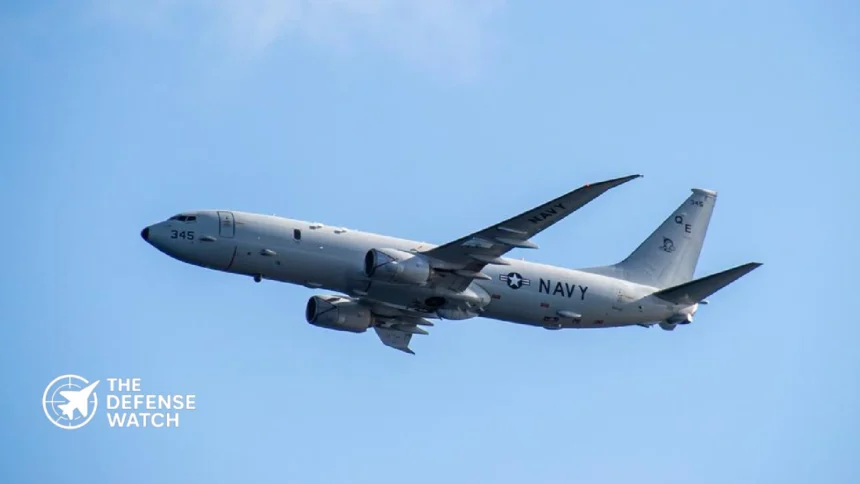
BAE Systems has received a $104.7 million U.S. Navy contract modification to update the design architecture of the Advanced Survivability Pod (ASP) being developed for the P-8A Poseidon maritime patrol aircraft. The work will support continued engineering and manufacturing development, including hardware and software upgrades, with completion expected in January 2030.
The award extends an existing Navy development effort aimed at improving the aircraft’s protection against radar-guided threats. Naval Air Systems Command (NAVAIR), based in Patuxent River, Maryland, is managing the contract.
According to the November 19, 2026, Department of Defense contract announcement, BAE Systems Information and Electronics in Nashua, New Hampshire, received a $104,686,379 cost-plus-fixed-fee modification under delivery order N0001924F0095.
The modification increases the order’s value and formally establishes the scope of additional work.
What the $104.7 Million Contract Covers
The latest award focuses on updating the ASP’s design architecture while the system remains in its engineering and manufacturing development (EMD) phase.
The work includes development and integration of additional pod capabilities, together with associated hardware and software improvements.
The Navy has not publicly disclosed a detailed breakdown of the architectural changes, the specific electronic warfare technologies being upgraded, or the individual hardware components covered by the modification.
The contract identifies three principal work locations:
- Nashua, New Hampshire: 91.5%
- Austin, Texas: 6.3%
- Patuxent River, Maryland: 2.2%
The majority of the work will therefore take place at BAE Systems facilities in New Hampshire.
The contract also identifies $10.7 million in fiscal 2027 Navy research, development, test and evaluation funding as the amount obligated at the time of award.
This distinction is important. The $104.7 million represents the value of the contract modification, not the amount of funding immediately obligated.
The modification was not competitively procured.
Why the P-8A Needs an Advanced Survivability Pod
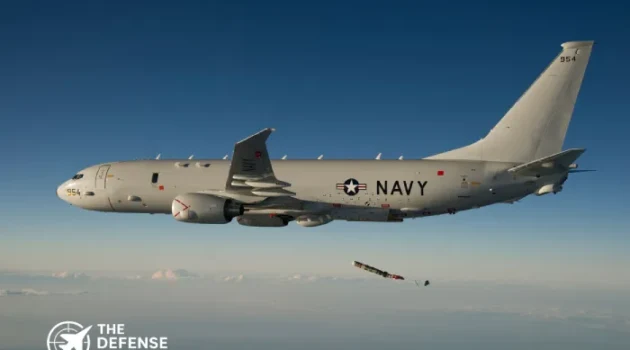
The P-8A Poseidon is the U.S. Navy’s principal land-based maritime patrol and reconnaissance aircraft. Developed by Boeing, it performs anti-submarine warfare, anti-surface warfare, maritime surveillance and intelligence missions.
These missions can require the aircraft to operate in environments where hostile radar systems and surface-to-air missile batteries present a threat.
Unlike dedicated combat aircraft, the P-8A is primarily designed for maritime patrol and surveillance rather than penetrating heavily defended airspace. Its operational effectiveness therefore depends partly on its ability to detect and respond to threats while performing missions over contested maritime areas.
The Advanced Survivability Pod is intended to strengthen this aspect of the aircraft’s protection.
BAE Systems describes the system as an electronic warfare countermeasure solution designed to detect and counter incoming threats. Its open-architecture approach is also intended to accommodate future threat-detection technologies, decoy systems and third-party electronic warfare techniques.
The distinction is operationally relevant. Improving aircraft survivability can help preserve the availability of valuable maritime patrol platforms without changing their primary mission.
Inside the Advanced Survivability Pod

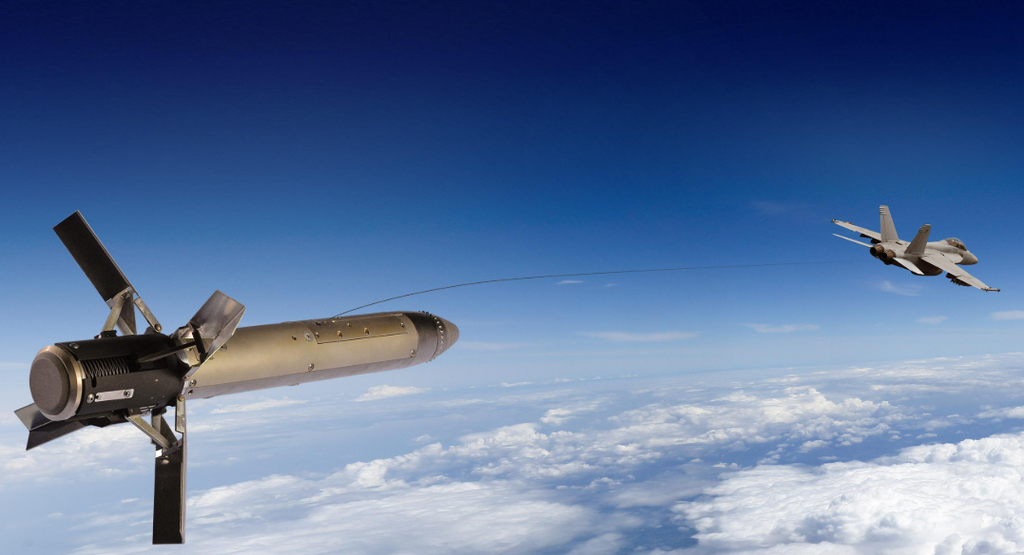
Image : BAESystems Public information provides some insight into the ASP’s technology.
A June 2024 report by Janes identified the AN/ALE-55 fiber-optic towed decoy as one of the pod’s components, alongside an additional radio-frequency countermeasure system.
The AN/ALE-55 is an established electronic countermeasure technology also used on U.S. Navy F/A-18 aircraft. Its role is to provide a decoy capability against radar-guided threats.
A towed decoy operates behind an aircraft and is designed to present an alternative target to an incoming radar-guided missile, potentially drawing the weapon away from the aircraft.
The additional RF countermeasure system is intended to complement this protection. However, BAE Systems and the Navy have not publicly provided a complete technical description of the ASP’s electronic warfare architecture.
The pod’s open architecture is another important feature.
Rather than relying exclusively on a fixed set of countermeasures, the design is intended to accommodate future upgrades. This could allow the Navy to adapt the system as radar-guided threats and electronic warfare requirements change.
The latest contract modification’s focus on design architecture, hardware and software integration is consistent with the need to develop and maintain that upgrade flexibility.
However, the Navy has not disclosed whether the modification introduces a new countermeasure technology, changes the pod’s physical configuration, or primarily addresses integration and system architecture requirements.
Development History and Program Timeline
The ASP program predates the latest contract modification.
BAE Systems said its development effort followed an earlier U.S. Navy rapid-response contract in 2021 to demonstrate the survivability technology.
The company subsequently designed, built and tested a demonstration pod. According to BAE Systems, the prototype completed airworthiness and effectiveness testing before the engineering and manufacturing development phase advanced.
In June 2024, BAE Systems announced a $95 million Navy contract for advanced countermeasure pods intended to protect P-8A aircraft.
Janes reported that the Navy’s development effort included the integration of the pod with the aircraft and preparations for initial operational fielding. Its reporting also identified late 2027 as the previously planned initial operational capability target.
The November 2026 modification now extends the associated development work through January 2030.
That completion date should not automatically be interpreted as the date when the entire ASP capability will enter service. Contract completion and operational fielding are separate program milestones.
What the Upgrade Means for Naval Aviation
The P-8A operates in a maritime environment where modern anti-access and area-denial systems can complicate surveillance and reconnaissance missions.
Long-range radar networks, mobile surface-to-air missile systems and increasingly sophisticated electronic warfare capabilities can threaten aircraft operating near contested coastlines and maritime approaches.
An external survivability pod provides one approach to addressing this challenge.
For the Navy, the objective is to improve the protection available to an aircraft that performs important intelligence, surveillance and reconnaissance missions alongside anti-submarine and anti-surface warfare operations.
The development also reflects a wider requirement within military aviation: electronic warfare systems must evolve alongside the threats they are designed to counter.
Radar-guided missiles continue to present a challenge for aircraft, particularly when operating in environments supported by integrated air defense networks. A flexible electronic warfare architecture can provide opportunities to introduce updated countermeasures without requiring a complete redesign of the aircraft.
Nevertheless, an electronic warfare pod does not make an aircraft immune to modern air defenses. Its effectiveness depends on threat detection, countermeasure performance, system integration and the specific operational environment.
The latest contract does not disclose new performance figures, operational test results or a revised initial operational capability date.
For now, the confirmed milestone is continued development and architectural work, with BAE Systems expected to complete the contracted effort by January 2030.
Enjoying our coverage?
Make The Defense Watch a preferred source on Google to see more of our geopolitical and defense insights when relevant to you.