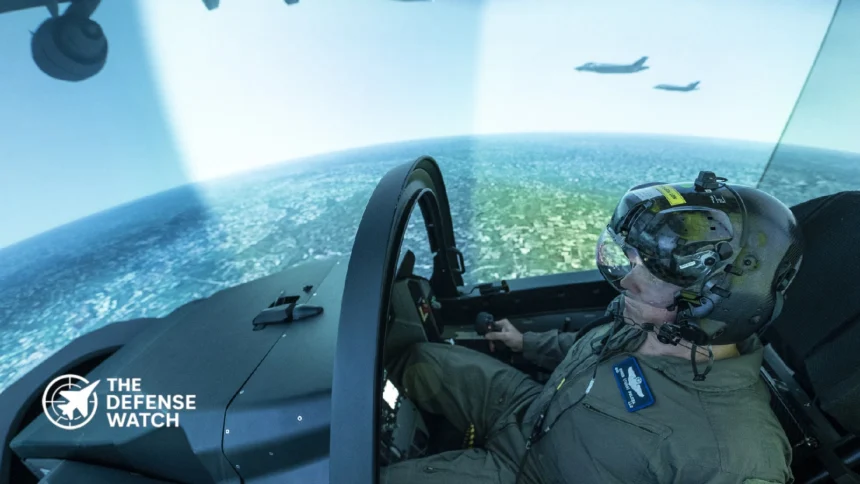
Four F-35 full-mission simulators at Naval Air Station (NAS) Lemoore, California, have demonstrated real-time connectivity with six airborne F/A-18 aircraft, allowing ground-based simulated forces and operational fighter aircraft to participate in a shared training environment.
Announced by Lockheed Martin on November 17, 2026, the demonstration used the U.S. Navy Continuous Training Environment and Link-Inject-to-Live ground station systems.
The exercise brought together 10 training participants across two different environments: four F-35 simulators on the ground and six F/A-18 aircraft in flight. Lockheed Martin described the event as a first for this type of joint training integration.
The demonstration points to an approach that combines conventional flight training with high-fidelity simulation, allowing pilots to rehearse complex mission scenarios without requiring every participating aircraft to fly.
Connecting Ground-Based Simulators With Operational Aircraft
The central achievement was establishing real-time connectivity between F-35 full-mission simulators and aircraft operating in actual flight.
Traditional simulator training allows pilots to practice mission procedures, tactical decisions and emergency responses in a controlled environment. However, the training experience can be limited when simulated participants cannot interact directly with aircraft operating in the air.
The Lemoore demonstration addressed that separation by connecting simulated F-35 participants with airborne F/A-18s.
According to Lockheed Martin, the system also allows pilots to train alongside virtual adversaries, creating scenarios that combine live aircraft, simulated platforms and computer-generated opposing forces.
This arrangement provides additional flexibility for mission rehearsal. Training planners can introduce different scenarios and simulated threats without requiring every participating aircraft to be physically present.
However, Lockheed Martin has not publicly disclosed the technical architecture, communication protocols, latency measurements or specific tactical scenarios used during the demonstration.
Why Live and Simulated Training Matter
Modern fighter operations increasingly involve coordination between different aircraft types, sensors, command networks and supporting forces.
Preparing pilots for these environments requires more than individual aircraft handling skills. Aircrews must also make tactical decisions, coordinate with other platforms and respond to changing battlefield conditions.
Combining live aircraft with simulators can help address these training requirements.
The approach offers several practical advantages:
- More complex scenarios: Virtual adversaries can introduce additional threats without requiring corresponding real-world aircraft.
- Repeatable training: Simulators allow instructors to recreate mission scenarios for repeated practice.
- Live operational experience: Pilots flying actual aircraft experience the physical demands of flight, including high-G maneuvering.
- Joint coordination: Different aircraft and simulated participants can operate within a shared training scenario.
- Training flexibility: Some mission elements can be rehearsed without organizing a full-scale live exercise.
Lockheed Martin’s F-35 Training and Logistics vice president, Ken Garrett, said connecting live aircraft, high-fidelity simulators and virtual adversaries allows instructors to create more realistic scenarios and evaluate pilot decision-making under pressure.
The combination is particularly relevant for advanced fighter training, where mission success can depend on coordination and tactical judgment rather than individual aircraft performance alone.
NAS Lemoore’s Role in F-35 and Super Hornet Operations
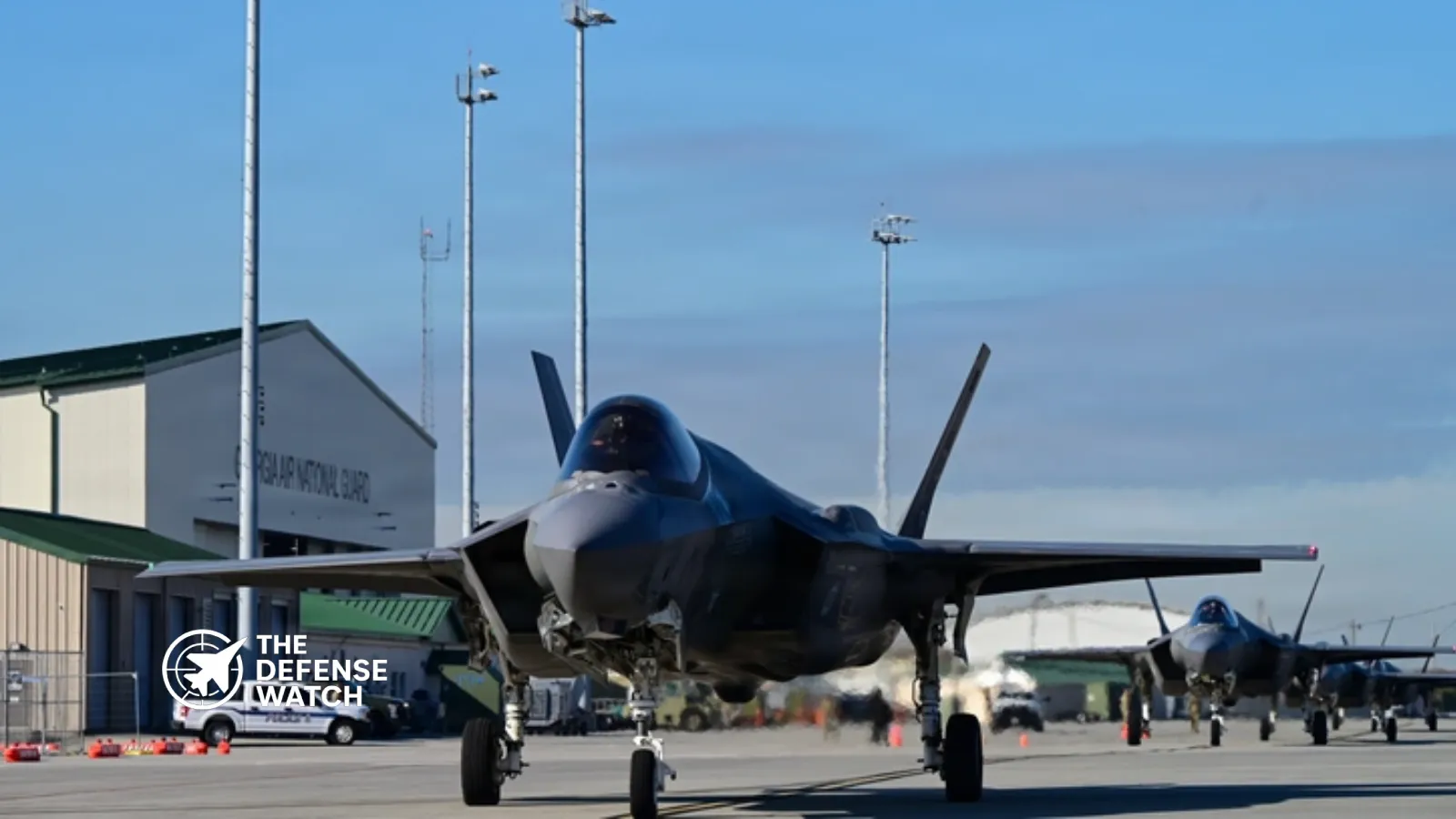
Naval Air Station Lemoore is an important U.S. Navy strike-fighter installation in California’s Central Valley.
The base supports the Navy’s carrier-based fighter community, including F/A-18 Super Hornet and F-35C Lightning II operations.
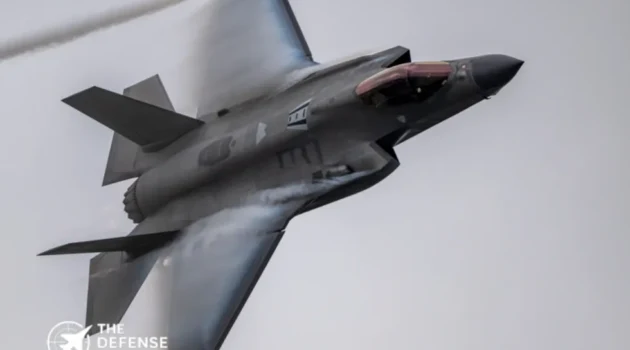
The F-35C is the carrier-capable variant of the Lightning II family. It combines low-observable design, advanced sensors and integrated mission systems for operations from aircraft carriers.
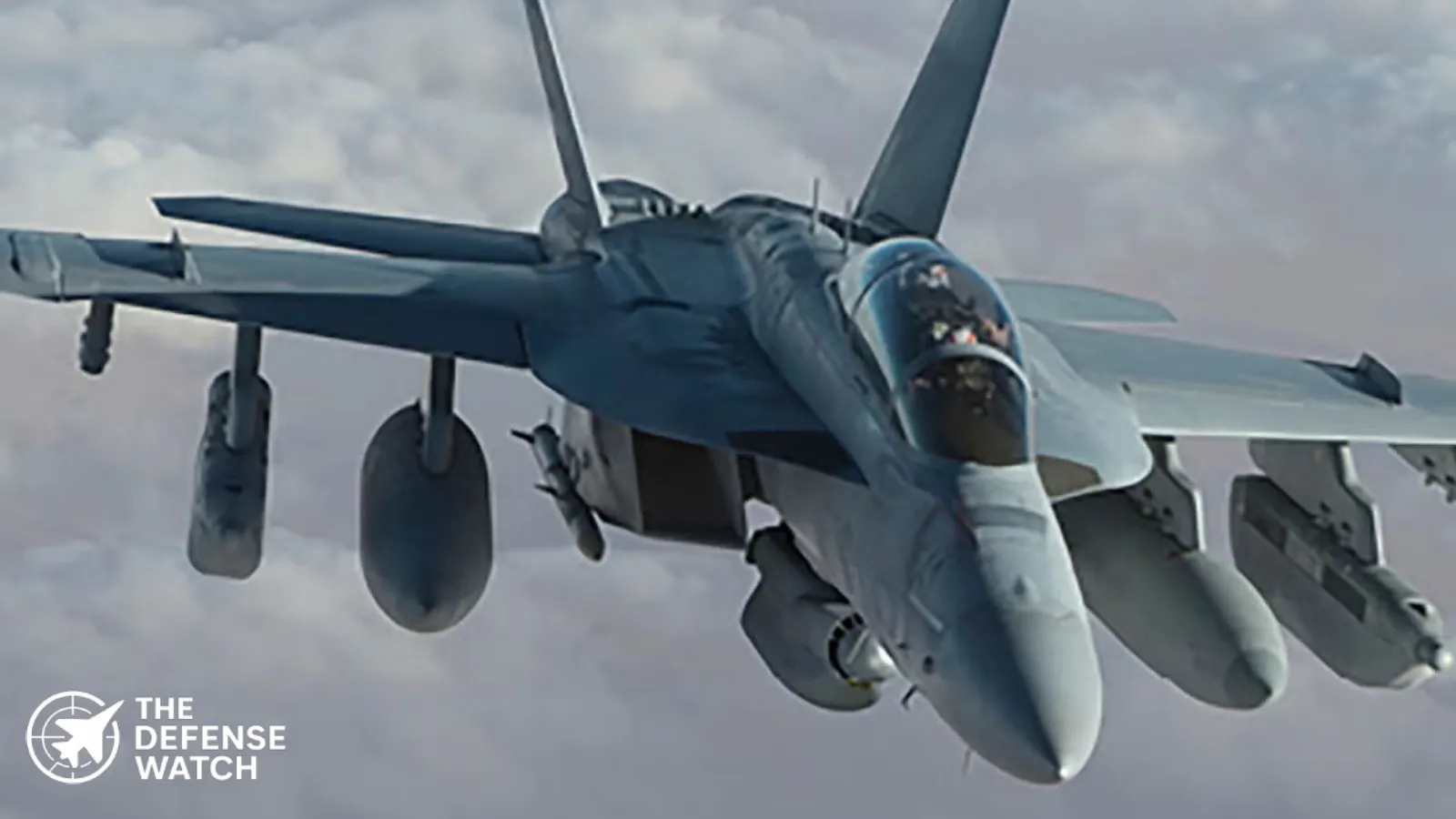
The F/A-18E/F Super Hornet, meanwhile, remains a major component of the Navy’s carrier air wings. It performs fighter, strike and other multirole missions.
Training these aircraft communities together has practical value because carrier air operations depend on coordination among different aircraft types and mission roles.
The Lemoore demonstration provides a way to incorporate both platforms into connected training scenarios without requiring the F-35 simulator participants to operate actual aircraft during every exercise.
It also illustrates how existing fighter training infrastructure could support more integrated exercises.
A Wider Shift Toward Distributed Military Training
The demonstration fits into a broader effort to make military training more distributed and less dependent on large numbers of aircraft flying simultaneously.
The U.S. Navy and other military services have invested in live, virtual and constructive training environments. These systems combine real personnel and platforms with simulated aircraft, threats and battlefield conditions.
The Navy’s Joint Simulation Environment is another example of this approach. It provides a high-fidelity simulated environment for advanced aircraft testing, tactics development and training.
However, the Joint Simulation Environment and the Lemoore demonstration should not be treated as the same system. They represent different applications of simulation technology.
Lockheed Martin has also previously demonstrated distributed F-35 mission rehearsal involving 16 full-mission simulators across multiple locations. That September 2026 event showed the potential for connecting geographically separated training facilities.
The November demonstration adds another dimension by incorporating actual aircraft flying outside the simulator environment.
For the Navy, the ability to connect simulated participants with live aircraft could help make training scenarios more representative of complex operational missions.
What Remains Undisclosed
Despite the successful demonstration reported by Lockheed Martin, several important technical details remain unavailable.
The company has not identified:
- The specific F/A-18 variants involved.
- The exact mission scenario or tactical objectives.
- The communication architecture used between aircraft and simulators.
- The number or type of virtual adversaries.
- The performance and latency characteristics of the connection.
- Whether the capability is scheduled for routine operational training.
- Any planned expansion to additional Navy installations or aircraft types.
These details matter because demonstrating connectivity is different from establishing a fully operational training capability across multiple units and locations.
The available announcement confirms the demonstration, but does not establish whether the system has entered regular Navy training operations.
For now, the Lemoore event provides evidence of progress in connecting live naval aviation assets with ground-based F-35 simulation systems. Its longer-term value will depend on how reliably the technology can support recurring training, larger exercises and more demanding mission scenarios.

Enjoying our coverage?
Make The Defense Watch a preferred source on Google to see more of our geopolitical and defense insights when relevant to you.