China’s People’s Liberation Army Rocket Force has reportedly moved its new DF-61 intercontinental ballistic missile (ICBM) into routine military training, according to a November 5 report by Chinese state media. The disclosure suggests that the missile has progressed beyond its public unveiling in September 2025, although important details about its deployment, capabilities and operational status remain undisclosed.
The report, published by China’s Global Times, cites a China Central Television (CCTV) broadcast marking the 66th anniversary of the country’s first successful launch of a domestically manufactured short-range ballistic missile.
The report says the DF-61 has been inducted into the PLA Rocket Force and is participating in regular training activities. However, Beijing has not publicly disclosed the number of missiles delivered, the units operating them or the locations of their deployment.
From parade appearance to military training
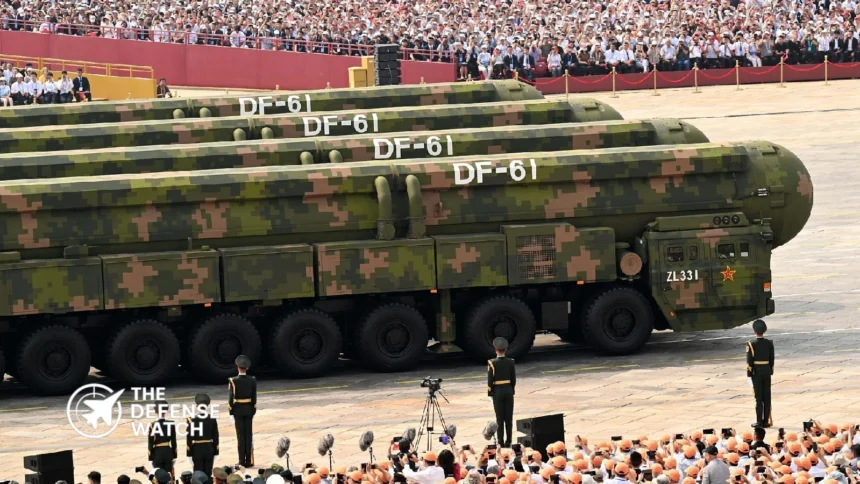
The DF-61 first appeared publicly during China’s September 3, 2025, military parade in Beijing, which commemorated the 80th anniversary of the end of World War II.
China’s Ministry of National Defense identified the missile as part of the country’s land-based strategic nuclear force. It appeared alongside the JL-1 air-launched missile, JL-3 submarine-launched ballistic missile and another land-based system, the DF-31 series.
The presentation was part of China’s first public parade display of its land-, sea- and air-based strategic missile forces together as a nuclear triad.
The November 2026 disclosure provides a new indication of the DF-61’s development progress. Nevertheless, the interval between its parade appearance and reported entry into routine training should not be interpreted as the missile’s complete development timeline.
Chinese military commentator Shao Yongling told CCTV that the system had already completed development, finalization, trial deployment and reliability verification before its public appearance.
That assessment suggests the September 2025 parade was not the beginning of the missile’s development or testing process. However, it remains an assessment reported through Chinese state media rather than independently documented evidence of every development milestone.
What routine training means for the DF-61
According to the Global Times report, DF-61 training involves several activities associated with operating a mobile strategic missile system.
These include:
- Field mobility exercises.
- Movement between launch positions.
- Preparation and execution of launch procedures.
- Familiarization with the missile’s supporting command and logistical arrangements.
Shao Yongling said the missile was designed to work with existing Rocket Force command, communications and logistical support networks.
If this integration is functioning as described, it could reduce the time needed for missile crews to become familiar with the new equipment. Existing infrastructure and personnel experience would also help the Rocket Force introduce the system without having to establish an entirely separate support structure.
However, routine training does not automatically establish that every missile unit has achieved full operational readiness. The Chinese report provides no independent assessment of deployment scale, crew proficiency or the number of operational launchers.
DF-61 and China’s evolving land-based nuclear force
The DF-61’s reported induction comes as China continues to modernize its strategic missile inventory.
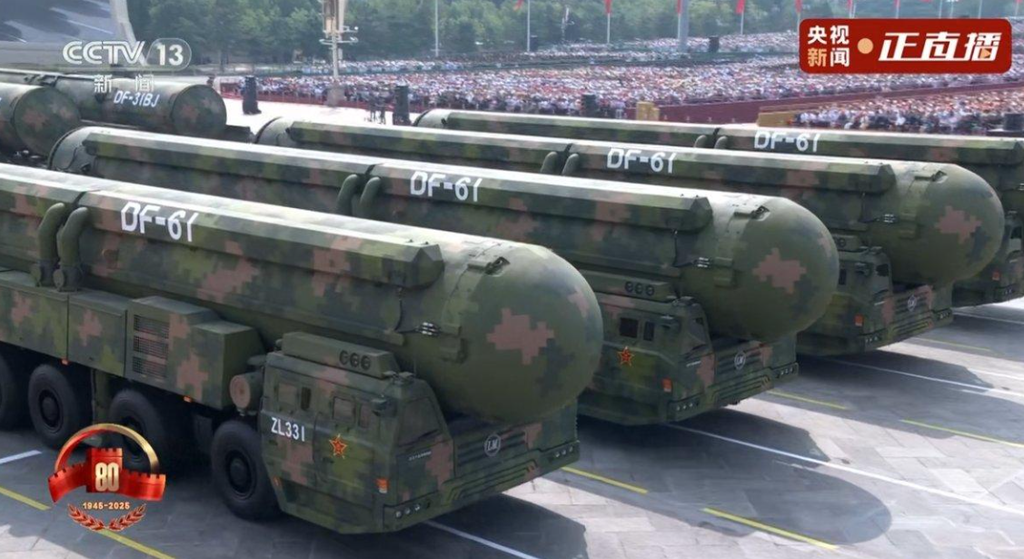
The appearance of the DF-61 at the 2025 parade attracted attention because of its apparent similarities to the DF-41, another Chinese road-mobile intercontinental ballistic missile.
A September 2025 assessment by the Federation of American Scientists (FAS) identified the DF-61 as a new land-based strategic missile and noted that its launcher appeared nearly identical to the DF-41 launcher previously displayed by China.
FAS also cautioned that the appearance of a new designation does not necessarily establish the precise relationship between the two systems. Publicly available information does not confirm whether the DF-61 represents a direct successor, a substantially modified design or a separate development within China’s ICBM inventory.
Road mobility is particularly relevant to strategic missile forces because it allows launchers to operate away from fixed launch facilities.
Dispersing mobile launchers across different locations can complicate an adversary’s efforts to identify, monitor and target missile units before they launch. However, the actual survivability of a mobile missile force also depends on communications, concealment, logistics, command arrangements and the ability to operate under surveillance.
The DF-61’s reported participation in field mobility and position-change exercises is therefore relevant to understanding how China intends to integrate the system into its wider nuclear force.
Implications for U.S. strategic planning
China’s expanding strategic missile capabilities remain an important consideration for U.S. defense planning.
The U.S. Department of Defense’s 2025 annual report on China’s military and security developments describes continued improvements in the PLA’s nuclear delivery systems, command and control, early-warning capabilities and strategic force structure.
The report also discusses China’s development of more mobile missile systems and efforts to improve the survivability of its nuclear forces.
The DF-61’s reported transition into routine training adds another development to that modernization picture.
For U.S. strategic planners, the important issue is not simply the introduction of another missile designation. It is how China combines mobile launch platforms, established command networks, early-warning systems and operational training to maintain a credible retaliatory capability.
A more mobile and better-integrated force could complicate intelligence collection, surveillance and targeting during a crisis.
However, the available information does not establish how much the DF-61 changes China’s overall nuclear balance or whether it introduces capabilities substantially different from those already associated with the DF-41.
The system’s actual contribution will depend on its technical characteristics, deployment numbers and operational integration, none of which have been fully disclosed.
Important capabilities remain undisclosed
Despite the latest announcement, several questions about the DF-61 remain unanswered.
| Capability | Publicly available information |
|---|---|
| Classification | Land-based intercontinental ballistic missile |
| Operator | PLA Rocket Force |
| Public debut | September 3, 2025 |
| Reported status | Entered routine training, according to Chinese state media |
| Launcher configuration | Road-mobile launcher displayed publicly |
| Maximum range | Not officially disclosed |
| Warhead configuration | Not officially disclosed |
| MIRV capability | Not independently established |
| Number deployed | Not disclosed |
| Operational bases | Not disclosed |
The absence of these details limits independent assessments of the missile’s performance and strategic significance.
In particular, speculation about its range, warhead capacity and multiple independently targetable reentry vehicle (MIRV) configuration should not be treated as confirmed technical information.
The DF-61’s similarities to the DF-41 provide a basis for comparison, but visual similarities alone cannot establish that the two missiles share the same propulsion, guidance, payload or performance characteristics.
For now, the clearest development is the reported transition from public display to routine Rocket Force training. Whether this signals a broader expansion of China’s deployed ICBM inventory will require additional evidence from official disclosures and independent assessments.