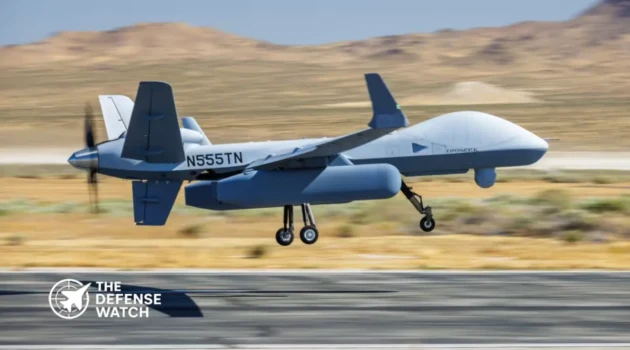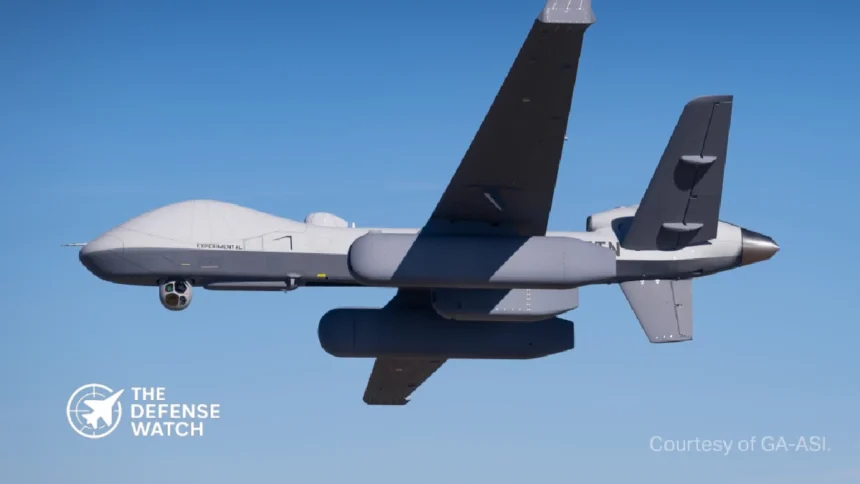
Saab and General Atomics Aeronautical Systems Inc. (GA-ASI) have advanced their unmanned airborne early warning programme after flight testing Saab’s LoyalEye radar on the MQ-9B remotely piloted aircraft. The test demonstrated the integrated system’s ability to detect, track and classify airborne targets, according to the companies.
The flight took place at GA-ASI’s Desert Horizon Flight Operations Facility in Southern California. The latest milestone follows the system’s first flight in May 2026 and moves the joint development effort further into its evaluation phase.
GA-ASI also reported that the wider flight-testing campaign demonstrated simultaneous tracking of multiple airborne and maritime targets, including instrumented fighter aircraft and commercial aircraft. The companies have not publicly disclosed radar detection ranges, detailed performance figures or the complete results of the evaluation.
Turning the MQ-9B Into an Airborne Surveillance Platform
The integration combines Saab’s LoyalEye airborne early warning radar with the MQ-9B, an uncrewed aircraft developed by GA-ASI for long-endurance, remotely piloted operations.
Airborne early warning systems use radar sensors carried by aircraft to monitor airspace, track potential threats and provide information to other elements of a military force. Operating above the ground can give these sensors a wider surveillance perspective than ground-based radars, although actual performance depends on radar characteristics, flight conditions, terrain and the targets being observed.
According to GA-ASI, Saab’s LoyalEye radar is installed on the MQ-9B using external payload pods. The companies intend to combine the aircraft’s endurance with an airborne radar capability that can support persistent surveillance over land and maritime areas.
The distinction is operationally important. The MQ-9B would not simply be carrying a sensor for occasional reconnaissance flights. The proposed configuration is intended to support airborne early warning missions, in which radar information helps operators maintain awareness of activity across a broad area.
The companies have demonstrated progress in target detection and tracking, but the public announcements do not establish the system’s performance against every class of aircraft, cruise missiles, low-flying threats or small unmanned aircraft.
Why Unmanned Airborne Early Warning Matters
Airborne early warning and control, commonly abbreviated as AEW&C, traditionally relies on crewed aircraft equipped with powerful radar systems and mission-management equipment.
Examples include Saab’s GlobalEye and the Boeing E-7 Wedgetail. These aircraft provide airborne surveillance capabilities intended to support air operations, command and control, and the coordination of military forces.
An unmanned system could provide another way to distribute these functions.
The MQ-9B LoyalEye configuration is intended to extend surveillance coverage while reducing the need to place aircrew aboard the aircraft performing the radar mission. It could also allow operators to assign some surveillance tasks to uncrewed platforms while retaining crewed AEW&C aircraft for missions that require their broader onboard capabilities.
Saab says LoyalEye can operate independently or alongside crewed airborne early warning and control aircraft. GA-ASI has also described potential applications involving distributed battle management and command and control, using available infrastructure on the ground, at sea or aboard an existing crewed aircraft.
However, an uncrewed aircraft carrying an early warning radar does not automatically provide all the functions of a fully equipped AEW&C platform. Radar surveillance is only one part of the mission. Effective operational use also depends on secure communications, the distribution of sensor data, integration with command networks and the ability of operators to interpret and act on the information.
The companies have not publicly established the full extent of these functions in the tested configuration.
A Potential Option for Maritime Surveillance
The MQ-9B’s existing maritime applications make the LoyalEye integration relevant to naval forces as well as air forces.
GA-ASI produces the MQ-9B SkyGuardian and SeaGuardian configurations, while the United Kingdom operates its MQ-9B variant under the name Protector. The company is also developing a short takeoff and landing configuration intended for naval operations.
Adding an airborne early warning radar could help operators monitor air activity around maritime formations, coastal approaches and other areas where continuous surveillance is required.
For naval forces, an airborne radar can help extend awareness beyond the immediate coverage available from shipboard sensors. An uncrewed aircraft could potentially maintain surveillance while crewed aircraft remain available for other missions.
This is particularly relevant where a force needs to monitor large maritime areas or operate without access to established land-based surveillance infrastructure.
GA-ASI has previously identified aircraft-carrier operations and regions with limited access to airborne early warning as potential applications for the MQ-9B-based capability. The company’s November 2025 announcement outlined plans to demonstrate AEW&C integration during 2026.
Nevertheless, the latest test does not establish that the system has been cleared for carrier operations or deployed operationally at sea. Those applications would require further evidence of suitability, integration and operational readiness.
Development Timeline and Remaining Questions
The joint programme has progressed through several publicly announced milestones.
- 2025: Saab and GA-ASI announced their partnership to integrate airborne early warning capabilities with the MQ-9B.
- May 19, 2026: The MQ-9B made its first flight carrying Saab’s LoyalEye radar pods.
- October 28, 2026: The companies announced advanced flight testing to validate the integrated system’s ability to detect, track and classify airborne targets.
GA-ASI President David R. Alexander said international customer interest in the MQ-9B’s airborne early warning capability was high. Saab’s Carl-Johan Bergholm described the system as a complement to existing AEW&C solutions rather than a direct replacement for them.
Neither company has announced a confirmed operational service-entry date, a production order for the AEW configuration or a complete set of performance specifications.
Important outstanding questions include the radar’s published detection and tracking performance, the system’s endurance while carrying the AEW payload, its ability to operate in contested electromagnetic environments, and how its sensor data will be integrated into wider military command networks.
These factors will help determine whether the system can move beyond a successful flight-test programme to meet the requirements of operational air and maritime forces.
For now, the demonstrated progress establishes that Saab’s LoyalEye radar can perform airborne early warning functions aboard the MQ-9B in the tested scenarios. Its eventual operational value will depend on further testing, system integration and the requirements of prospective customers.