Saudi Arabia, Turkey and Pakistan Officials to Meet Iran
Senior security officials from Saudi Arabia, Turkey and Pakistan are expected to meet Iranian officials in Tehran on Monday, October 26, for talks on regional coordination, according to a Reuters report citing two people familiar with the matter. The planned meeting brings representatives of the three countries behind the Makkah Joint Defence Agreement into direct contact with Iran as regional military tensions continue.
Saudi Arabia is expected to send Defense Minister Prince Khalid bin Salman, while Pakistan will be represented by Army Chief Field Marshal Asim Munir. Turkey’s intelligence chief is also expected to attend, one of the sources told Reuters. The Saudi government media office and Pakistan’s military media wing did not respond to Reuters’ requests for comment.
The precise agenda, format and expected outcomes of the meeting have not been publicly confirmed. However, the planned discussions come at a sensitive point for regional security, with attacks on Saudi Arabia, the wider conflict involving Iran, Israel and the United States, and efforts to protect maritime trade placing pressure on regional governments.
Why the Tehran Meeting Matters
The significance of the planned talks lies in the relationship between the three participating countries’ new defense commitments and their efforts to manage tensions with Iran.
Saudi Arabia, Turkey and Pakistan signed the Makkah Joint Defence Agreement on August 7, 2026. The agreement establishes a framework for collective defense, including a commitment to treat an armed attack against one member as an attack against all three. It also provides for broader military cooperation.
That commitment creates a complicated diplomatic calculation. Saudi Arabia is seeking stronger protection against attacks, while Pakistan and Turkey have an interest in regional stability and avoiding a wider confrontation that could draw additional countries into the conflict.
The pact’s members have described their arrangement as defensive rather than directed against Iran. Turkey and Pakistan have also emphasized that the agreement is not intended to target any particular country.
A meeting with Iranian officials could therefore provide an opportunity to communicate security concerns, explore areas for de-escalation and reduce the risk of miscalculation. These are plausible objectives given the circumstances, but the reported agenda does not establish that any specific proposal will be discussed.
The Defense Pact Faces Its First Major Regional Test
The agreement is moving from a political commitment toward practical implementation as Saudi Arabia faces continued security threats.
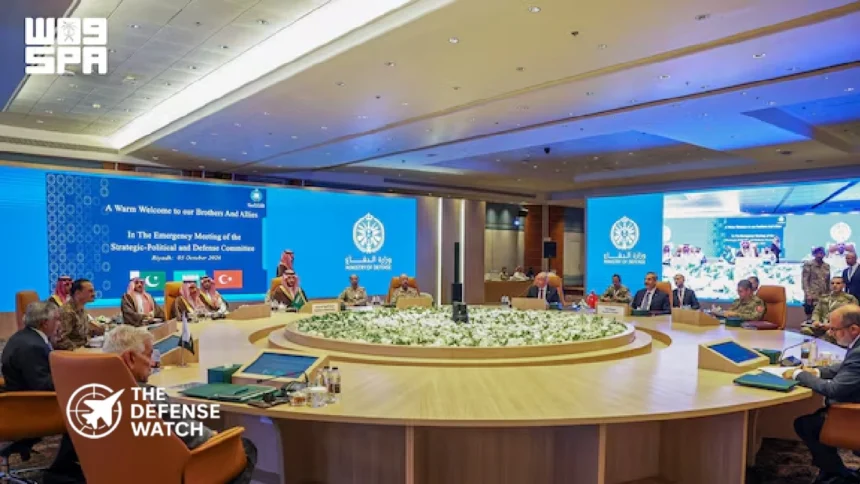
At an emergency meeting in Riyadh on October 5, the three countries’ Strategic Political and Defence Committee agreed to begin implementing their collective defense commitments, including arrangements for the rapid deployment of agreed military forces and capabilities to Saudi Arabia. The joint statement did not publicly specify the full composition, size or deployment schedule of those forces.
The immediate security concern includes attacks by Yemen’s Houthi movement, which is aligned with Iran. Reuters reported that Saudi Arabia intercepted another wave of missiles and drones on Sunday, October 25, as fighting with the group continued.
The reported Tehran meeting takes place against that backdrop. It brings together representatives of a defense partnership being developed partly in response to regional threats and officials from Iran, a country whose regional relationships are central to the current security crisis.
However, the meeting should not be interpreted as evidence that the three allies are abandoning their collective defense commitments or that Iran has agreed to accept the pact. Neither conclusion is supported by the available reporting.
Military cooperation remains an open question
The defense agreement provides a framework for cooperation in areas including intelligence sharing, joint exercises, personnel exchanges and defense-industry collaboration. Its practical military implications will depend on how the participating governments implement those commitments.
Turkey and Pakistan have also been assessing potential assistance to Saudi Arabia involving air defense, electronic warfare and technical support, according to reporting by The Associated Press. Officials have not publicly established a complete list of capabilities to be provided or confirmed all deployment arrangements.
For defense planners, these distinctions matter. An agreement to cooperate does not automatically mean that particular weapons, aircraft, radar systems or military units have been deployed. Operational arrangements require further decisions, coordination and, where applicable, national authorization.
The Tehran discussions could help clarify how the participants intend to manage their competing security interests. Whether the talks produce concrete military or diplomatic measures remains unknown.
Pakistan’s Role Extends Beyond the Defense Agreement
Pakistan occupies a particularly important position because of its security relationship with Saudi Arabia and its diplomatic engagement with Iran.
Field Marshal Asim Munir’s expected participation places Pakistan’s senior military leadership at the center of the planned discussions. His involvement also gives the meeting a direct military dimension, although the available reporting does not establish that he will negotiate any specific operational arrangement.
Pakistan has long maintained defense ties with Saudi Arabia while also pursuing diplomatic engagement with Tehran. That combination gives Islamabad an interest in preventing regional tensions from escalating into a broader conflict that could affect its security and economic interests.
Recent diplomatic activity provides additional context. On October 23, the foreign ministers of Saudi Arabia, Turkey, Pakistan and Egypt met in Istanbul as part of the R4 group. Their joint statement addressed regional conflicts, maritime security and the need for dialogue and diplomacy.
The following day, Iran’s ambassador to Pakistan, Reza Amiri Moghadam, said Tehran remained open to negotiations with Washington under a Pakistan-brokered interim arrangement. He also said Iran would study the Makkah Joint Defence Agreement before deciding whether to support it.
Those comments suggest that Iran is examining the new regional security framework rather than simply treating it as a settled strategic reality. They do not, however, establish Tehran’s position on the reported October 26 meeting or its expected outcome.
Regional Security and Maritime Trade Remain Connected
The diplomatic effort also unfolds amid concerns about shipping routes and the economic effects of the wider conflict.
The Strait of Hormuz is a critical route for international energy shipments. Disruptions there can affect oil and gas markets, maritime insurance costs and commercial shipping well beyond the immediate conflict zone.
In their October 23 meeting, the R4 foreign ministers discussed the US-Israeli conflict with Iran, maritime safety, freedom of navigation and rising tensions around the Strait of Hormuz and Bab el-Mandeb. They called for dialogue and diplomatic efforts to address the regional crisis.
For Saudi Arabia, maritime security and protection of economic infrastructure are closely linked to national defense. For Pakistan and Turkey, preventing further regional escalation also matters because instability can disrupt trade, energy supplies and wider economic activity.
The reported Tehran meeting could therefore have implications beyond the immediate security relationship between Iran and the three defense pact members. Yet it would be premature to conclude that the talks will produce an agreement on shipping, military deployments or the broader conflict.
What Remains Unconfirmed
Several important details remain outstanding.
First, the precise agenda has not been publicly disclosed. Second, the available report does not identify all Iranian participants or specify whether the meeting will produce a joint statement. Third, no agreement on military deployments, de-escalation measures or changes to the Makkah defense pact has been announced in the reporting reviewed for this article.
The distinction between diplomatic contact and a substantive agreement is important. A meeting can create channels for communication without resolving disagreements or changing military planning.
For now, the reported gathering is best understood as an effort at regional coordination during a period of heightened security pressure. Its significance will depend on what the participants discuss, whether they reach common positions and whether any commitments are subsequently confirmed by their governments.