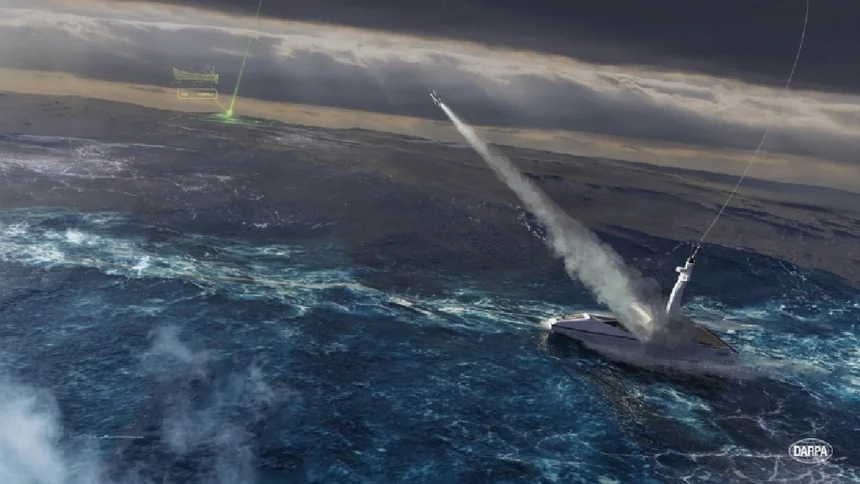
The United States, Australia and the United Kingdom are using a multinational maritime demonstration in San Diego to test how crewed ships, uncrewed vessels and autonomous systems can work together across allied naval forces. The event, conducted under the AUKUS Pillar II partnership, focuses on integrating emerging technology into practical maritime operations rather than demonstrating individual platforms in isolation.
Known as Maritime Big Play Pacific, the demonstration is scheduled to run from Oct. 5 through Oct. 25, 2026, in the Southern California operating area. More than 40 government and industry technologies from the three countries are participating, according to official reporting by the U.S. Navy and Royal Navy.
The central challenge is interoperability: ensuring that systems developed by different countries can exchange information, coordinate tasks and support joint operations without relying on separate, incompatible command structures.
Four operational priorities shape the demonstration
The Royal Navy identifies four main areas of activity: anti-submarine warfare, coordinated combat operations, resupply in contested environments, and subsea and seabed warfare. These priorities reflect the range of missions that allied maritime forces may need to perform in environments where communications, access and freedom of movement are under pressure.
- Anti-submarine warfare: Combining crewed and autonomous platforms for submarine tracking and surveillance.
- Integrated combat operations: Examining how different systems can operate together as a coordinated force.
- Contested resupply: Testing approaches to sustaining operations when conventional logistics face disruption or threat.
- Subsea and seabed warfare: Developing capabilities relevant to underwater operations and the protection of critical maritime infrastructure.
The United Kingdom is leading the anti-submarine warfare component, bringing uncrewed surface vessels, underwater gliders, aerial drones and subsea vehicles to the event. The participating authorities have not publicly disclosed a complete technical inventory of all systems involved.
The distinction between a technology display and an operational demonstration matters. A system may function successfully on its own but still face difficulties when connected to another nation’s communications, mission-planning software or command-and-control architecture. Maritime Big Play is intended to help identify and address those integration problems.
Why command and control matters as much as the platforms
Autonomous maritime systems can extend surveillance coverage, gather information in hazardous areas and perform selected tasks without placing a crew aboard every platform. Their operational value, however, depends on more than endurance or onboard sensors.
Commanders need reliable information about where these systems are, what they have detected and whether their observations can be incorporated into a shared operational picture. The information must also reach the appropriate decision-makers quickly enough to support a mission.
The U.S. Department of Defense described this challenge in its October 2024 reporting on earlier Maritime Big Play experimentation. Those trials examined the joint operation of uncrewed maritime systems, naval data sharing and real-time maritime domain awareness. The department also reported work on connecting U.S. Navy command-and-control software with an interoperability network developed by the three partners.
The 2026 demonstration builds on that earlier work, with the Royal Navy describing continued development of shared command-and-control solutions and secure communications linking operations from high altitude to the seabed.
This is a key test for coalition warfare. If allied systems cannot exchange usable information or coordinate missions reliably, adding more autonomous vessels may increase the volume of data without producing a corresponding improvement in decision-making.
Conversely, common interfaces, compatible procedures and dependable communications could allow the three navies to combine assets more effectively. The public announcements describe the goals of the current trials, but do not establish that every participating system has achieved operational interoperability.
AUKUS Pillar II moves beyond submarine procurement
AUKUS is best known for its plan to help Australia acquire nuclear-powered submarines, but its second pillar covers a wider set of advanced military capabilities, including autonomy, artificial intelligence, electronic warfare and undersea technologies.
Maritime Big Play falls under Pillar II, which provides a framework for cooperation on advanced capabilities among the three countries. Unlike the submarine pathway, this work can involve experimentation with software, communications networks, robotics and uncrewed platforms that may be developed and tested on different schedules.
Earlier demonstrations provide evidence of the program’s technical direction. In July 2024, the U.S. Department of Defense hosted a trilateral maritime capabilities event that tested the U.S. Navy’s Common Control System and the exchange of uncrewed vessel data across a jointly developed interoperability network. The department said selected systems would subsequently be sent to Australia for further experiments.
A separate 2024 exercise in Australia also tested autonomous and networked systems as part of the wider Maritime Big Play initiative. These activities established a foundation for continued experimentation, although they do not by themselves demonstrate that the technology is ready for routine combat deployment.
The latest demonstration is therefore part of a continuing development effort, not evidence that the three countries have completed a unified autonomous maritime warfare system.
The operational challenge: working in a contested maritime environment
For the United States and its partners, autonomous maritime technology offers a potential way to distribute surveillance and selected operational tasks across more platforms. Uncrewed systems could help collect information, monitor areas of interest and support operations in locations where deploying a crewed vessel would be costly or risky.
Submarine detection is a particularly demanding application. Anti-submarine warfare requires forces to combine information from multiple sensors and platforms, distinguish relevant signals from background noise and maintain contact with a target whose location may be uncertain. Autonomous vehicles may contribute to that process, but their effectiveness depends on sensor performance, endurance, communications, processing and the ability to integrate their findings into the wider mission.
Communications present another constraint. Underwater vehicles cannot rely on conventional radio links in the same way as surface ships or aircraft. Systems operating below the surface must use appropriate underwater communications methods, while information moving between subsea vehicles, surface vessels and aircraft must pass through suitable gateways or networks.
The Royal Navy’s emphasis on secure communications and shared command and control reflects this broader integration challenge. However, the public information released about the 2026 event does not provide comparative performance figures, detailed test results or evidence that all participating systems can operate in every contested communications environment.
What the demonstration establishes, and what remains unknown
The announced participation of more than 40 technologies shows the breadth of the effort, but the number alone does not measure military effectiveness.
The important results will be whether the systems can exchange data reliably, coordinate tasks across national boundaries and contribute useful information to operational commanders. Equally important will be whether those capabilities remain dependable when communications are degraded, software interfaces differ or autonomous platforms must operate for extended periods without direct human control.
Public announcements have not provided a comprehensive breakdown of the participating systems, a full list of successful technical milestones, or a schedule for bringing each capability into operational service. Nor do they establish that the demonstration has produced a single integrated force ready for deployment.
For the three AUKUS partners, the immediate value is the opportunity to test common procedures and identify integration problems before more advanced systems enter service. The longer-term military benefit will depend on whether the results lead to repeatable performance, compatible equipment and sustained training across all three navies.
The distinction is important: demonstrating that allied systems can work together under controlled conditions is a necessary step toward operational interoperability, but it is not the same as proving that they can do so reliably in combat.