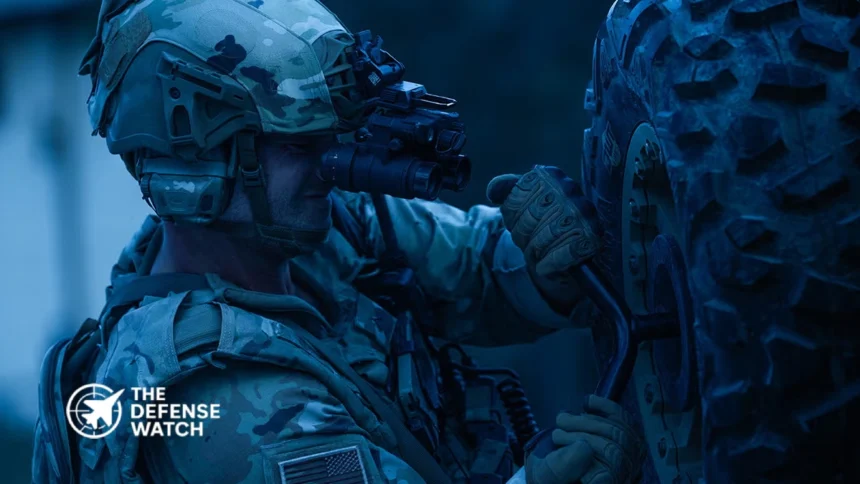
L3Harris Technologies has received a $55 million U.S. Army award to supply its NOVA binocular night-vision goggle system, advancing the service’s Binocular Night Observation Device (BiNOD) program into full-rate production.
Announced on October 12, 2026, the award supports the Army’s effort to equip soldiers with binocular night-vision equipment using image intensifier technology. L3Harris said it will move directly into full-rate production, although the company has not disclosed the number of systems covered by the award or a delivery schedule.
The contract adds a production commitment to a program intended to improve nighttime visibility for ground forces. Its operational value will depend on how quickly the Army receives the equipment, how it integrates with soldiers’ existing gear, and how widely the service fields the system.
NOVA moves from selection toward large-scale production
The October award follows an earlier Army selection announced by L3Harris on April 13, 2026. At that time, the company said it had been selected to supply NOVA under a seven-year contract worth up to $465 million. L3Harris also noted that it was one of several companies chosen to support BiNOD.
The two announcements describe different award values and stages of the procurement process. The October release does not specify whether the $55 million award is a task order or another contractual action under the earlier arrangement, nor does it clarify how the amount relates to the wider program ceiling.
That distinction matters when assessing the Army’s spending. The $55 million figure is the value of the newly announced award, while the previously disclosed $465 million represents a potential contract value over seven years. The figures should not be added together or treated as the cost of the same quantity of equipment without further contract documentation.
L3Harris says NOVA was designed to meet U.S. military requirements over the next two decades and beyond. That is the manufacturer’s stated design objective, not a confirmation of a formal Army service-life commitment.
What image intensifier technology offers soldiers
NOVA uses image intensifier technology rather than relying solely on a thermal imaging system. Image intensifiers amplify available light, including residual light from the night sky, to produce a visible image. This helps soldiers navigate, observe their surroundings and identify objects in low-light conditions.
The distinction is operationally important. Image intensification and thermal imaging provide different types of information, and their usefulness depends on lighting, environmental conditions and the target being observed. The October announcement does not establish that NOVA integrates thermal imaging or sensor fusion.
L3Harris describes NOVA as a helmet-mounted binocular device designed for military users. A binocular arrangement provides an image to both eyes, supporting natural visual perception during movement. However, the company has not disclosed the full technical specifications, including the system’s resolution, field of view, weight and battery endurance, in the October announcement.
The absence of those figures makes it difficult to compare NOVA quantitatively with other military night-vision devices. The award announcement also does not disclose the number of goggles being procured, the price per unit or the expected delivery schedule.
BiNOD addresses a broader soldier-equipment requirement
The Army’s BiNOD program is part of its effort to modernize individual soldier equipment. Night vision is particularly important for infantry and other ground forces that must navigate terrain, maintain situational awareness and conduct operations when natural visibility is limited.
The Army’s equipment portfolio identifies BiNOD within the Project Manager Soldier Warrior organization, under the Soldier Maneuver Sensors product area. That places the program within the service’s wider work on soldier-borne sensing and mission equipment.
L3Harris announced its selection for BiNOD in April alongside its existing work on the Enhanced Night Vision Goggle-Binocular (ENVG-B). The company said it had delivered more than 20,000 ENVG-B units at that time. The two systems should not be assumed to have identical capabilities or intended users simply because both are binocular night-vision devices.
For the Army, procurement decisions must balance capability with the cost of equipping a large force. A system intended for broader distribution may serve a different acquisition purpose from equipment designed around more demanding requirements for specialized combat units. Public announcements have not provided enough detail to establish the precise distribution plan for NOVA.
Production is the next key milestone
L3Harris says the new award allows it to proceed directly into full-rate production. The announcement does not provide a first-delivery date, production quantities or a schedule for fielding the system across Army units.
Those details will help determine the practical effect of the award. Production readiness is an important step, but it does not by itself confirm that equipment has been delivered, accepted or issued to operational units.
The contract also illustrates the importance of established U.S. defense suppliers in the soldier-equipment market. L3Harris already produces several night-vision products for military customers, giving it an existing position in the sector. Whether NOVA achieves widespread adoption will depend on Army requirements, procurement funding, delivery performance and the system’s performance in service.
For now, the confirmed development is a $55 million award supporting the BiNOD program and a company-reported move into full-rate production. The number of goggles, delivery timetable and expected Army-wide fielding remain undisclosed.