

China Completes Russia Center 2026 Military Drills
Chinese PLA units have completed their participation in Russia’s Center 2026 strategic exercise, returning from the Chebarkul training area after several days of multinational training that combined armored forces, unmanned systems, reconnaissance and integrated fires.
The Chinese contingent was drawn from the PLA Central Theater Command and operated alongside Russian and other foreign forces at the Chebarkul training ground in Russia’s Chelyabinsk region. Chinese military reporting said the contingent used road, rail and air transportation to reach the exercise area and began withdrawing after the closing phase.
The exercise ran from September 28 through October 3. Russia said Center 2026 involved about 47,000 personnel across multiple training areas and the Caspian Sea region. The final phase at Chebarkul involved about 6,000 personnel, including foreign participants, according to Russian and Associated Press reporting.
China’s training focus
For the Chinese contingent, the exercise was less about displaying a single weapon system than about testing how different elements could operate as part of a larger combat formation.
According to the PLA account cited by Global Times, Chinese troops trained in three-dimensional reconnaissance, command and control, integrated information and firepower operations, guided entry, attacks from multiple directions and rapid pursuit operations. The Chinese force also participated in operational planning and live-action drills with other national contingents.
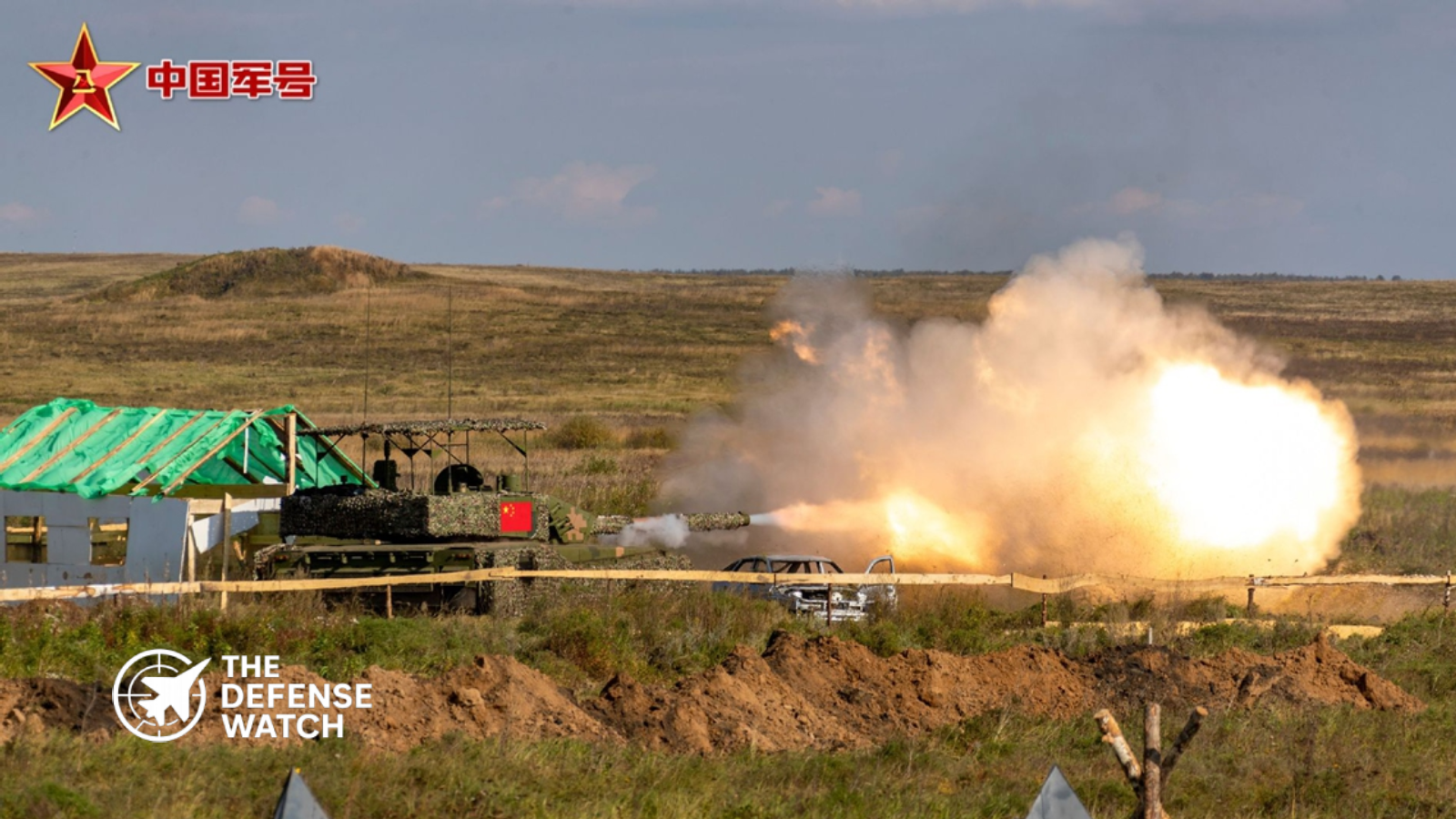
Photographs released through Chinese military media showed Type 99A main battle tanks operating during the exercise. The tank’s presence provided a visible example of China’s continued emphasis on combining conventional armored formations with newer unmanned capabilities rather than treating drones as a separate force.
Chinese state television also reported the use of drone swarms to provide target information to ground forces. Tactical unmanned aircraft, attack helicopters and unmanned ground vehicles were shown operating together against simulated targets during the exercise.
That combination is important because the battlefield problem facing armored formations has changed substantially in recent conflicts. Tanks can still provide protected firepower and mobility, but they increasingly operate under observation by inexpensive unmanned aircraft and face precision-guided weapons that can exploit exposed or predictable positions.
The PLA’s own description of the exercise therefore points toward a wider shift in land warfare. Reconnaissance, targeting, communications, fires and maneuver are increasingly being connected through unmanned systems and digital command networks.
The Ukraine war as a training reference
Russia has explicitly presented Center 2026 as an exercise informed by modern combat experience.
Russian officials said preparations for the exercise took into account lessons from Russia’s war in Ukraine and the characteristics of contemporary armed conflict. Associated Press reporting from Putin’s visit to the exercise also confirmed that the drills involved large numbers of Russian and foreign troops and included demonstrations of unmanned systems.
This gives the Chinese participation a particular military value. The PLA does not have the same scale of recent conventional combat experience as Russia, while Russian forces have accumulated extensive operational experience involving drones, electronic warfare, artillery, precision fires and rapidly changing reconnaissance and targeting methods.
China has previously used multinational exercises to examine these kinds of operational problems. In June, for example, the Chinese Ministry of National Defense said a China-Mongolia exercise included unmanned intelligence, surveillance and reconnaissance, unmanned strike operations and manned-unmanned teaming.
The Center 2026 exercise provided another setting in which Chinese personnel could examine how unmanned systems are integrated with conventional maneuver forces under more complex multinational conditions.
Why the Type 99A and drones combination matters
The significance of the Type 99A’s appearance is not simply that China deployed a modern main battle tank overseas.
The more important point is how the tank was used within the exercise architecture.
Chinese military expert Song Zhongping, quoted by Global Times, argued that recent conflicts have demonstrated the vulnerability of traditional armored forces to large numbers of drones and precision-guided weapons. He also said unmanned platforms can perform reconnaissance and higher-risk tasks ahead of manned forces, potentially reducing risks to crews while extending the surveillance and targeting reach of armored units.
That assessment is consistent with the broader direction of land warfare observed in Ukraine, although the precise effectiveness of any particular Chinese system cannot be established from exercise footage alone.
An exercise can demonstrate that a force can perform a task under controlled conditions. It does not establish how the same system would perform against a sophisticated opponent using electronic warfare, counter-drone weapons, deception, dispersed forces and persistent surveillance.
That distinction is particularly important when evaluating claims about drone swarms or manned-unmanned teaming. The available reporting establishes that these capabilities were exercised. It does not establish their performance against a peer adversary.
A multinational test of logistics and command
Center 2026 also tested a less visible part of military power: the ability to deploy forces over long distances and sustain them outside their home territory.
The PLA said its contingent reached Chebarkul through a combination of motorized movement, rail transportation and airlift. Chinese personnel also worked within a multinational command structure during the exercise.
The Chinese military described the deployment as a test of long-range strategic movement, cross-border logistical support and joint operational command. After returning home, the participating troops are expected to review multinational planning, live operations, long-distance deployment and coordination.
Those activities are relevant beyond the specific exercise. China’s military modernization has increasingly focused on joint operations, long-range mobility and the ability to coordinate forces across multiple domains. Overseas exercises provide opportunities to test parts of that system under conditions that cannot easily be replicated at domestic training ranges.
What the exercise does not demonstrate
The Center 2026 participation should not be interpreted as evidence that China and Russia have created a permanently integrated combat force.
The exercise involved multiple countries and was conducted under Russian leadership. Participation demonstrates a capacity for military cooperation and interoperability in selected training activities, but it does not by itself establish a standing combined command structure or a commitment to fight together in a future conflict.
Nor does the presence of Chinese tanks and unmanned systems demonstrate that China has adopted Russian battlefield methods wholesale.
The PLA is likely to draw lessons selectively. China’s military has its own doctrine, industrial base and operational priorities, while its geography and potential contingencies differ substantially from Russia’s experience in Ukraine.
A wider pattern in PLA training
Center 2026 fits into a broader pattern of PLA exercises involving unmanned systems and integrated operations.
In September, China, Russia and Mongolia conducted a border defense exercise in Inner Mongolia that included Chinese drone-assisted teams, with unmanned aircraft supporting detection and targeting during the scenario.
A separate PLA naval training exercise reported in September also combined manned aircraft and drones in an integrated reconnaissance network, including operations in a contested electromagnetic environment. The exercise emphasized the use of multiple platforms to detect, track and share information on simulated targets.
These activities suggest that unmanned systems are becoming increasingly embedded in PLA training rather than being treated simply as specialist equipment.
For armored forces, that could mean a future battlefield model in which crewed tanks provide protected maneuver and direct fire while unmanned aircraft and ground vehicles extend reconnaissance, targeting and communications. The exact architecture will depend on the unit, mission and communications environment.
China’s participation in Center 2026 therefore offers useful evidence of the direction of PLA training, but not proof of how the force would perform in a real peer conflict.
The most concrete takeaway is narrower. Chinese forces used the Russian exercise to practice long-distance deployment, multinational command, reconnaissance, integrated fires and the employment of unmanned systems alongside conventional armored formations. Those are precisely the areas where modern land warfare is placing increasing demands on military forces.
