• Home
  • About
  • Defense Systems
  • Manufacturer
  • Comparisons
  • Compare 
  • Tools
TheDefenseWatch.com
  • Aerospace & Aviation
  • Military & Ordnance
  • Naval & Maritime
  • Cyber & Space Defense
  • Policy & Strategy
  • Global News
  • Tools Library
    • Smart Calculator
    • Drone Flight Time Calculator
    • Drone Range Calculator
    • Counter-Drone Jammer Effective Range Calculator
    • Counter-Battery Radar Detection Calculator
    • Artillery Fire Correction Calculator
    • Thermal Camera Detection Range Calculator
    • Missile Range & Time-of-Flight Calculator
    • Radar Detection Range Calculator
    • FPV Strike Drone Payload vs Range Calculator
    • Loitering Munition Endurance Calculator
    • Sniper Ballistic Drop & Windage Calculator
    • Bullet Drop Calculator
    • U.S. Army Combat Fitness Test (ACFT) Calculator
    • Military Pension Calculator
    • Military Retirement Calculator
    • Military Pension Calculator
    • Large Number Calculator
Font ResizerAa

TheDefenseWatch.com

The Defense Watch | U.S. & Global Defense News, Analysis & Military Updates

Search
  • Home
  • About
  • Defense Systems
  • Manufacturer
  • Comparisons
  • Compare 
  • Tools

Stay Updated

Get the latest update

Subscribe

Explore

  • Drone
  • Fighter Jets & Military Aircraft
  • Hypersonic Weapons
  • Aircraft Carriers
  • Strategic History & Missions
  • Tools Library
Home » U.S. Defense Industrial Base Faces 400,000 Skilled Worker Gap As Pentagon Pushes Build Freedom
Defense Budgets & PolicyPolicy & Strategy

U.S. Defense Industrial Base Faces 400,000 Skilled Worker Gap As Pentagon Pushes Build Freedom

Samuel Drake | Defense Analyst
Last updated: September 9, 2026 12:45 am
Samuel Drake | Defense Analyst
Share
9 Min Read
U.S. defense industrial base workforce
Ryan Hughes uses a lathe to machine a submarine part in the Trident Refit Facility Bangor machinist shop at Naval Base Kitsap-Bangor, Wash., April 10, 2026. The War Department recently launched an initiative to encourage young people to choose careers in skilled trades. (Image: DoW)
SHARE

The Pentagon is treating workforce development as a core defense readiness issue as it seeks to expand U.S. manufacturing capacity.

Contents
  • U.S. Defense Industrial Base Workforce Shortage Becomes A Production Issue
  • Takeaways
    • Workforce Is Now Part Of Industrial Capacity
    • Pentagon Expands Build Freedom
    • Shipbuilding Highlights The Challenge
    • A Long-Term Defense Industrial Base Problem
    • Why The Workforce Push Matters

U.S. Defense Industrial Base Workforce Shortage Becomes A Production Issue

The U.S. defense industrial base is facing a workforce problem that Pentagon officials increasingly view as a constraint on America’s ability to expand military production.

Michael Cadenazzi, assistant secretary of war for industrial base policy, told lawmakers Sept. 4 that the United States has roughly 400,000 unfilled skilled-trade positions across the defense industrial base. He warned that the gap could reach 2.5 million workers over the next decade if the workforce pipeline does not improve.

Takeaways

The Pentagon is making skilled labor a central part of its effort to expand the U.S. defense industrial base.

1. 400,000 Skilled Jobs Are Unfilled

Assistant Secretary of War for Industrial Base Policy Michael Cadenazzi said the defense industrial base currently has about 400,000 unfilled skilled-trade positions.

2. Shortfall Could Reach 2.5 Million

Cadenazzi warned that the workforce gap could grow to 2.5 million over the next decade without stronger recruitment and training efforts.

3. Build Freedom Targets Skilled Trades

The Build Freedom Initiative brings more than 70 Industrial Base Analysis and Sustainment workforce projects under a national workforce campaign.

4. Focus Starts Before High School

Pentagon officials want to introduce students to skilled trades in elementary and middle school, arguing that interest needs to develop well before career decisions are made.

5. Program Began In Three States

Build Freedom initially launched in Texas, Michigan and Pennsylvania, with the War Department planning a nationwide expansion.

Cadenazzi made the comments during a House Appropriations Committee Defense Subcommittee field hearing in Santa Clarita, California, focused on industrial capacity and workforce development. The hearing included representatives from the War Department, Huntington Ingalls Industries and Pennsylvania College of Technology.

- Advertisement -

The issue extends beyond traditional engineering positions. The Pentagon is looking for welders, machinists, pipefitters, electricians, engineers and other workers who physically build and maintain military equipment.

Workforce Is Now Part Of Industrial Capacity

Expanding defense production requires more than adding factory space or increasing procurement contracts.

A new production line still needs workers capable of operating machine tools, fabricating components, welding structures, maintaining equipment and completing quality-control processes. Shipbuilding presents an especially clear example because many tasks cannot simply be transferred to software or automated systems.

Cadenazzi argued that the next generation of the defense workforce needs to be introduced to these careers much earlier.

He said students in elementary and middle school represent the future workforce for industries such as submarine construction. That makes education and public awareness an important part of the Pentagon’s industrial strategy.

The challenge is partly cultural. Cadenazzi said many young Americans have historically been encouraged to pursue four-year college degrees rather than skilled trades. The administration now wants to present manufacturing careers as a viable alternative, particularly for students interested in hands-on technical work.

That approach also has implications for parents and schools, which can strongly influence career decisions before students reach the labor market.

Pentagon Expands Build Freedom

The War Department is using the Build Freedom Initiative as a central vehicle for addressing the problem.

- Advertisement -

The program was formally launched in July with a $10 million award to the mikeroweWORKS Foundation to support scholarships and training for skilled trades such as welding, plumbing and electrical work. The funding is part of the department’s Industrial Base Analysis and Sustainment effort.

By September, Cadenazzi said Build Freedom had brought together more than 70 IBAS workforce projects under a single campaign.

The initiative initially launched in Texas, Michigan and Pennsylvania. The War Department says it intends to expand the effort nationally and direct prospective workers toward training, credentials, scholarships and employment opportunities.

The strategy is significant because it connects workforce development directly to defense production rather than treating employment programs as a separate policy area.

Shipbuilding Highlights The Challenge

The shortage is particularly important for the U.S. Navy, which is seeking to increase shipbuilding capacity while managing long production schedules and a highly specialized workforce.

Huntington Ingalls Industries, one of the companies represented at the September hearing, says it employs more than 45,000 people and invests more than $110 million annually in workforce development, education and training. Its programs include apprenticeship schools and training for trades such as welding, machining, pipefitting and electrical work.

HII’s experience illustrates why simply increasing defense spending does not automatically produce more military hardware. Companies must recruit workers, train them and develop sufficient proficiency before additional production capacity can translate into higher output.

HII’s Ingalls Shipbuilding division graduated 70 apprentices in March 2026 from a Department of Labor registered program combining classroom instruction, paid on-the-job training and industry-recognized credentials.

That model reflects the type of workforce pipeline Pentagon officials are seeking to expand.
U.S. defense industrial base workforce
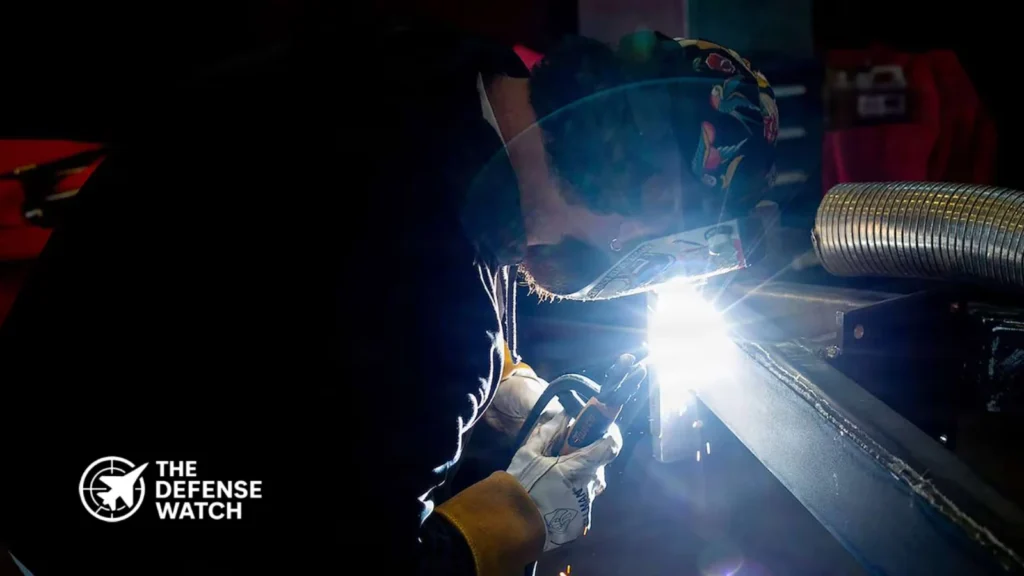
Aidan Pacheco, a welder at Portsmouth Naval Shipyard in Maine, performs a vital weld on a steel trailer, July 7, 2026. The War Department wants more young people to choose careers in the skilled trades. (Image: DoW)

A Long-Term Defense Industrial Base Problem

The workforce shortage is part of a broader challenge facing the U.S. defense industrial base.

The Pentagon is simultaneously attempting to expand production, strengthen domestic supply chains, improve industrial resilience and accelerate delivery of weapons and platforms. Those goals depend on companies having enough qualified personnel to execute the work.

Cadenazzi has previously described the workforce shortage as a structural problem tied to both skilled trades and engineering. In remarks earlier this year, he said the United States needed approximately 400,000 additional defense manufacturing workers and could require millions more over the following decade.

This creates a timing problem for policymakers. Training a machinist, welder, electrician or shipbuilder cannot be completed simply by increasing funding for a production contract. Workforce development can take years, particularly for jobs involving complex military systems and strict quality requirements.

For that reason, Build Freedom’s emphasis on students and early career awareness is intended to address the pipeline before workers reach the point where defense manufacturers need to hire them.

Why The Workforce Push Matters

The Pentagon’s workforce campaign signals that rebuilding the U.S. defense industrial base is increasingly being treated as both an economic and national security requirement.

The United States can invest in new facilities, expand procurement and provide companies with stronger demand signals, but those investments still depend on people capable of turning materials and components into operational weapons, aircraft, ships and other military systems.

The immediate target is the current pool of unfilled positions. The larger objective is to create a sustained pipeline of workers capable of supporting defense production over decades.

Build Freedom therefore represents more than a recruiting campaign. Its effectiveness will depend on whether federal funding, schools, industry apprenticeships and employers can create a continuous path from early exposure to technical training and, ultimately, long-term employment.

For the U.S. defense industrial base, that workforce pipeline could become as important as factory capacity itself.


TAGGED:Defense Industrial BaseDefense Manufacturing
Share This Article
Facebook Copy Link Print
BySamuel Drake | Defense Analyst
Follow:
Samuel Drake is a defense analyst at TheDefenseWatch.com covering naval warfare, military ordnance, maritime technology, fleet modernization, and defense procurement. His reporting focuses on documented capabilities, procurement programs, and military technology.
Leave a Comment

Leave a Reply Cancel reply

Your email address will not be published. Required fields are marked *

Latest Defense Systems

  • B-25 Mitchell Bomber B-25 Mitchell Bomber
  • F-100 Super Sabre F-100 Super Sabre
  • North American F-86 Sabre North American F-86 Sabre
  • North American XB-70 Valkyrie North American XB-70 Valkyrie
  • Northrop YF-23 Fighter Northrop YF-23 Fighter
  • P-51 Mustang Fighter Aircraft P-51 Mustang Fighter Aircraft
  • Rafale F5 Fighter Rafale F5 Fighter
  • Tomahawk Block V Missile Tomahawk Block V Missile
  • Tomahawk Block IV Missile Tomahawk Block IV Missile

Recent Compares

  • J-10C vs JF-17 Thunder: Which Fighter Is More Capable? J-10C vs JF-17 Thunder: Which Fighter Is More Capable? View Comparison →
  • Tejas vs Gripen: Key Differences and Capabilities Tejas vs Gripen: Key Differences and Capabilities View Comparison →
  • Tejas vs MiG-21 Bison: How India Replaced Its Iconic Supersonic Fighter Tejas vs MiG-21 Bison: How India Replaced Its Iconic Supersonic Fighter View Comparison →
  • F-35 vs F-16: Stealth, Sensors and Combat Roles F-35 vs F-16: Stealth, Sensors and Combat Roles View Comparison →
  • Tejas Fighter Jet vs F-16 Fighting Falcon: Capability Compared Tejas Fighter Jet vs F-16 Fighting Falcon: Capability Compared View Comparison →
  • Rafale Fighter Jet vs F-16 Fighting Falcon : Which Fighter Has the Edge? Rafale Fighter Jet vs F-16 Fighting Falcon : Which Fighter Has the Edge? View Comparison →
  • Su-57 Fighter Jet vs J-20 Fighter Jet: Stealth and Air Combat Compared Su-57 Fighter Jet vs J-20 Fighter Jet: Stealth and Air Combat Compared View Comparison →
  • Mirage 2000 vs Tejas Mk1A: Legacy Combat Power vs Indigenous Modernization Mirage 2000 vs Tejas Mk1A: Legacy Combat Power vs Indigenous Modernization View Comparison →
  • Rafale Fighter Jet vs F-22 Raptor: Which Air Dominance Fighter Has the Edge? Rafale Fighter Jet vs F-22 Raptor: Which Air Dominance Fighter Has the Edge? View Comparison →
  • Tejas Fighter Jet vs. Rafale Fighter Jet: India’s Indigenous Fighter Meets France’s Proven Multirole Combat Aircraft Tejas Fighter Jet vs. Rafale Fighter Jet: India’s Indigenous Fighter Meets France’s Proven Multirole Combat Aircraft View Comparison →

Recent Posts

  • Pratt & Whitney Begins $100 Million Polish Expansion for F-35 Engine Parts
  • Northrop Grumman Wins $43.9 Million Contract for Trident II Rocket Motor Facilities
  • Ukraine Drone Strikes Disrupt Russian Data Centers, Raising Questions About AI Infrastructure Security
  • Lockheed Martin Wins $114.6 Million Contract to Redesign F-35 Navigation Systems
  • Project Agincourt Pushes Pentagon to Speed Up Autonomous Weapons Fielding

You Might Also Like

United States military posture
Geopolitical & Strategic DoctrinesPolicy & Strategy

U.S. Military’s Global Posture at a Crossroads: Balancing Force Against Regional Powers and Allies

September 8, 2026
UK NATO Allied Reaction Force
Alliances & DoctrinesPolicy & Strategy

UK Certified to Lead NATO Allied Reaction Force Special Operations Command After Hyperion Storm Exercise

September 7, 2026
Afghan data breach secrecy
Defense Budgets & PolicyPolicy & Strategy

Shapps Defends Secrecy on Afghan Data Breach Handling in UK Defence Committee Testimony

January 26, 2026
long range precision missiles
Defense Budgets & PolicyPolicy & Strategy

Pentagon Races To Rebuild Long Range Precision Missile Stocks Amid Iran War Depletion

August 5, 2026

Logo

Copyright © 2026 TheDefenseWatch.com

Helpful Links

  • Home
  • About Us
  • Privacy Policy
  • Terms of Use / Disclaimer
  • U.S. Privacy Notice – CCPA Compliance

Defense Systems

  • Defense Systems
  • Comparisons 
  • Manufacturer
  • Tactical Calculators

Popuplar

Which 5 Air Forces Possess the Costliest Fighter Jet Fleets in the World
Evolving Strategic Value: Carrier Strike Groups in the Indo-Pacific’s Future Security Architecture
Autonomous Weapon Systems Spark U.S. Ethics Debate Amid Rapid Military AI Integration

We report on developments involving military forces, governments, defense companies, research organizations, and security institutions around the world. 

Welcome Back!

Sign in to your account

Username or Email Address
Password

Lost your password?