A small strategic investment from a U.S. intelligence-linked venture firm helped give German drone manufacturer Quantum Systems an early route into the American defense and intelligence market.
- Takeaways
- CIA-Backed Investor Helped Quantum Systems Enter U.S. Market
- In-Q-Tel Provided More Than Capital
- Quantum Systems Has Built a Larger U.S. Presence
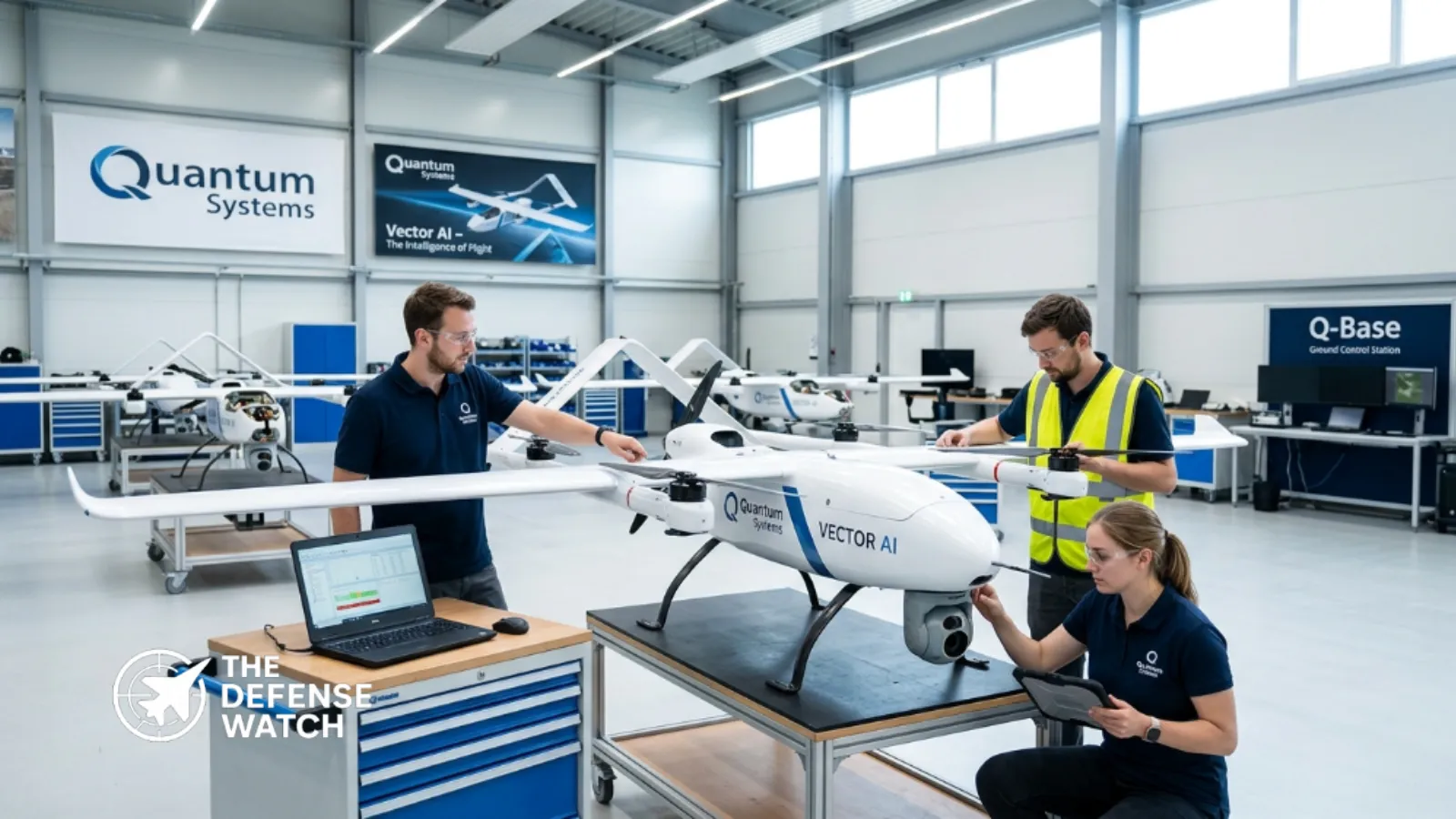
- U.S. Army Selects Vector AI
- From European Startup to Major Defense Technology Company
- Ukraine Has Helped Shape the Company’s Technology
- The Wider European Defense Industry Challenge
- What It Means for the U.S. Drone Market
Takeaways
Quantum Systems used U.S. investment and government connections to establish an early foothold in the American defense and intelligence market.
CIA-Backed Investor Helped Quantum Systems Enter U.S. Market
Quantum Systems U.S. drone market expansion accelerated with help from In-Q-Tel, a venture capital firm established to support technologies relevant to U.S. national security. The German drone manufacturer says American investors, including In-Q-Tel, helped open doors in Washington and contributed to its early work with U.S. intelligence agencies.
The development offers a notable example of how investment networks can influence the international expansion of defense technology companies. It also comes as European governments seek to strengthen domestic defense industries and reduce strategic dependence on the United States.
In-Q-Tel Provided More Than Capital
Quantum Systems co-CEO Sven Kruck told Reuters that U.S. investors played an important role in helping the company establish relationships in Washington.
According to Kruck, In-Q-Tel and other American investors helped Quantum Systems reach potential U.S. customers, including the Central Intelligence Agency and Federal Bureau of Investigation. The resulting reconnaissance work was relatively modest in revenue terms, but it provided an important reference point for the company in the U.S. market.
The significance of the relationship therefore went beyond the size of the initial business.
For a foreign defense technology company entering the world’s largest defense market, access to government customers, procurement networks and technical evaluation opportunities can be as important as the initial investment itself.
Quantum Systems lists In-Q-Tel among its strategic partners and investors.
Quantum Systems Has Built a Larger U.S. Presence
The company’s U.S. expansion has continued beyond its early intelligence relationships.
Quantum Systems established its North American headquarters in Moorpark, California, in 2022. The company says its U.S. operations support defense and security customers and cover engineering, manufacturing and other activities associated with its unmanned systems.
In August 2026, Quantum Systems announced another expansion with the opening of a 3,200-square-foot research and development facility in Huntsville, Alabama.
The Huntsville location places the company closer to major U.S. defense customers and expands its domestic engineering capabilities in areas including flight controls, computer vision, autonomy, simulation and manufacturing engineering.
That expansion indicates that Quantum Systems is no longer treating the United States simply as an export destination. It is building a more permanent industrial and engineering footprint inside the American defense ecosystem.
U.S. Army Selects Vector AI
Quantum Systems has also gained a direct U.S. military foothold.
In April 2026, the U.S. Army selected the company’s Vector AI small uncrewed aircraft system for its Company-Level sUAS Directed Requirement 2 initiative under a contract valued at $15.3 million, according to the company. The program is intended to accelerate delivery of tactical aerial intelligence capabilities to Army brigade combat teams while informing future Medium Range Reconnaissance requirements.
Vector AI is designed for reconnaissance, surveillance and target acquisition. Quantum Systems says the system can operate in GPS-denied environments using visual navigation and other onboard technologies.
The company also describes the platform as modular, allowing integration with different payloads and battlefield management systems.
This is significant because the U.S. military has increasingly sought commercially developed unmanned systems that can be introduced rapidly and adapted to changing battlefield requirements.
From European Startup to Major Defense Technology Company
Quantum Systems has expanded rapidly since its founding in Germany in 2015.
Its portfolio now includes the Vector AI, Twister and Reliant unmanned aircraft, alongside software intended to connect unmanned systems across multiple domains.
The company’s growth has also attracted substantial private investment.
In July 2026, Quantum Systems announced a $1.2 billion Series D financing round that valued the company at approximately $8 billion. The financing was led by Blackstone, Noteus, Airbus and Advent, alongside other institutional investors.
The funding gives Quantum Systems additional resources to expand production and develop autonomous capabilities across air, land and maritime domains.
Ukraine Has Helped Shape the Company’s Technology
Quantum Systems has also gained extensive operational experience through Ukraine.
Its Vector reconnaissance systems have been supplied to Ukrainian forces since 2022, with the company describing the platform as an established ISR system used under demanding battlefield conditions.
The company said in 2026 that Vector platforms had accumulated more than 20,000 operational flight hours in Ukraine. That experience has been used by the company to refine autonomy and mission capabilities, according to Quantum Systems.
The operational record has helped make the company attractive to military customers looking for unmanned systems that have already been exposed to electronic warfare, GPS disruption and other contested battlefield conditions.
The Wider European Defense Industry Challenge
The Quantum Systems case also highlights a broader issue facing Europe’s defense technology sector.
European governments are increasing defense spending and encouraging domestic production, while at the same time many European companies continue to rely on U.S. capital, technology partnerships and access to the American defense market.
For Germany and other European countries, the challenge is not simply developing advanced military technology. It is building enough capital, production capacity and government-industry connections to scale those technologies without creating new strategic dependencies.
In-Q-Tel’s involvement with Quantum Systems illustrates how U.S. strategic investment can provide European defense startups with access to American government customers and networks.
At the same time, Quantum Systems’ subsequent U.S. expansion shows that European defense companies can use those relationships to establish a sustained presence in the American market rather than remaining dependent solely on exports.
What It Means for the U.S. Drone Market
The Quantum Systems U.S. drone market expansion reflects a broader shift in military procurement toward autonomous and commercially developed systems.
The U.S. Army’s selection of Vector AI, combined with Quantum Systems’ growing American engineering footprint, gives the German company a stronger position in a market dominated by established U.S. defense contractors and a rapidly expanding group of drone startups.
The company’s experience also demonstrates the value of early government engagement.
In-Q-Tel’s role was reportedly important not because the investment itself transformed Quantum Systems financially, but because it helped connect the company with U.S. government customers. Those relationships provided an early validation point that supported subsequent expansion.
For European defense manufacturers, that model could become increasingly relevant as demand for drones, autonomous systems and battlefield intelligence technology grows on both sides of the Atlantic.