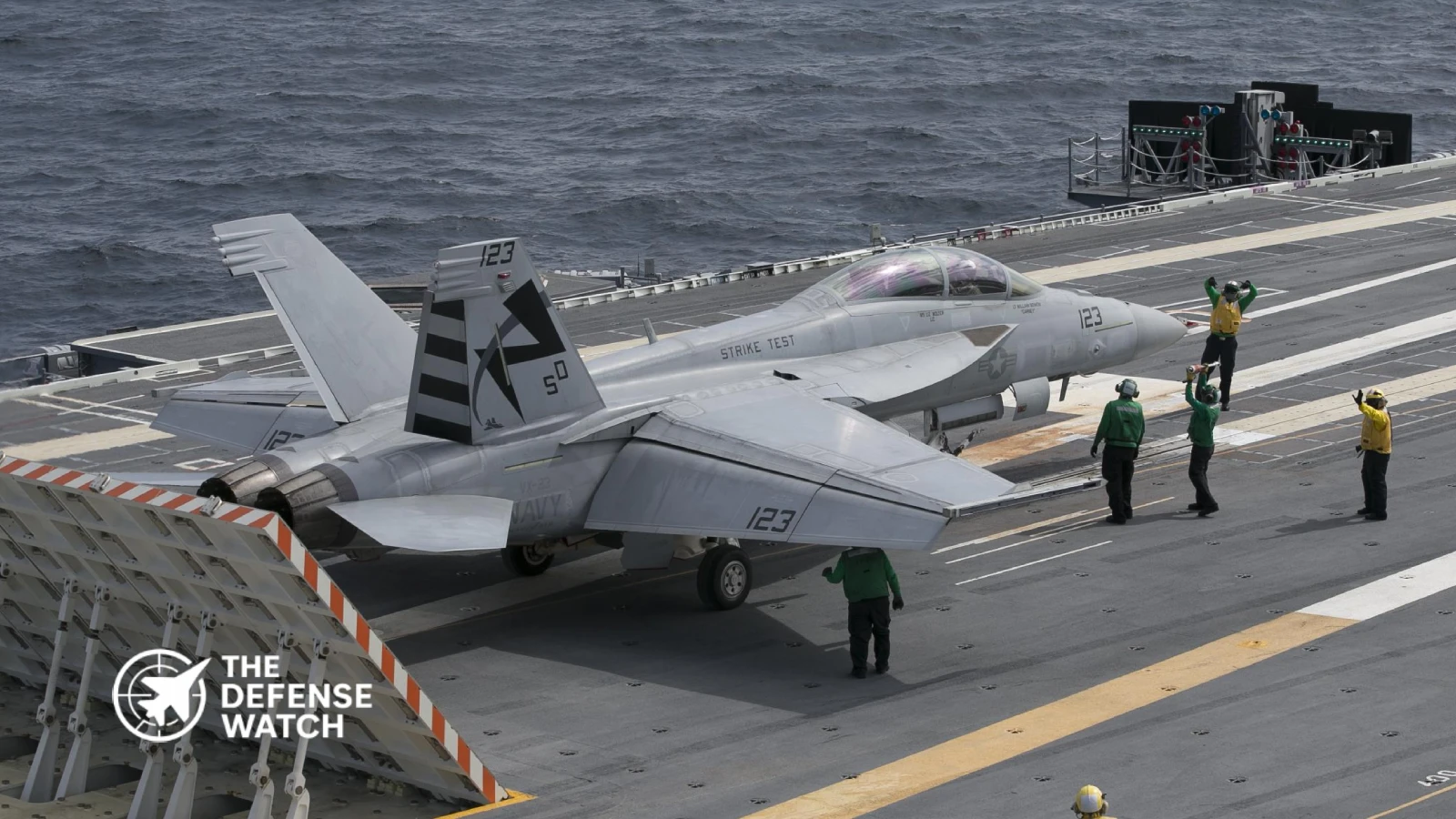
Executive Summary: President Donald Trump signed a national security memorandum on August 13 directing the Department of War and Navy to develop a plan within 60 days for replacing the Electromagnetic Aircraft Launch System, or EMALS, and advanced weapons elevators with steam and hydraulic systems on the future USS Doris Miller, CVN-81. The memorandum also calls for a fifth public Navy shipyard and creates a limited pathway for foreign shipyards to build selected U.S. warships as Washington seeks to expand naval industrial capacity.
Trump Targets EMALS On The Future USS Doris Miller
The Trump administration’s latest U.S. Navy shipbuilding directive puts the Ford-class carrier program at the center of a major technology debate, but the memorandum does not itself immediately order workers to remove EMALS from CVN-81. Instead, it requires the administration to produce a detailed plan for replacing the electromagnetic launch system and advanced weapons elevators with steam and hydraulic equipment.
The 60-day requirement is significant because CVN-81 is already part of the Ford-class production program. General Atomics received a $1.204 billion Navy contract modification in June for EMALS and Advanced Arresting Gear production, engineering, installation and certification support for the carrier through 2032.
The decision therefore reaches beyond a simple equipment swap. It raises questions about engineering changes, ship integration, supplier commitments, workforce requirements, testing and schedule risk.
The Navy’s own documentation describes EMALS as a central Ford-class technology designed to improve launch control, reduce maintenance and manpower requirements, and support aircraft ranging from lightweight unmanned systems to heavy strike fighters.
Why EMALS Was Chosen For Ford-Class Carriers
EMALS was developed to replace the C-13 steam catapults used aboard Nimitz-class carriers. Instead of using high-pressure steam to drive a launch shuttle, EMALS uses stored kinetic energy and solid-state electrical power conversion to accelerate aircraft.
NAVAIR says the system provides more precise end-speed control, smoother acceleration, reduced maintenance requirements and greater flexibility for launching different aircraft types. Its electrical architecture also fits the Ford-class design, which uses extensive electrical power distribution rather than relying on traditional steam services.
The Ford-class carrier was designed around this architecture. The Navy’s Naval Aviation Playbook identifies EMALS, Advanced Arresting Gear, all-electric auxiliary services and advanced weapons elevators as key differences from the Nimitz class.
That integration is important to understanding the potential impact of the new policy.
Replacing EMALS with steam catapults would not simply involve installing older launch equipment in the same physical space. The ship would have to accommodate the associated steam generation, distribution, control, maintenance and support requirements.
The memorandum also identifies advanced weapons elevators for replacement with hydraulic systems. That expands the scope from aircraft launch equipment to another major part of the Ford-class aircraft-handling architecture.
EMALS And Steam Catapults Compared
| Area | EMALS | Steam Catapult |
|---|---|---|
| Energy source | Stored kinetic and electrical energy | High-pressure steam |
| Launch control | Computer-controlled electronic system | Mechanical and hydraulic controls |
| Aircraft handling | Designed for lightweight and heavy aircraft | Proven primarily with conventional carrier aircraft |
| Integration | Designed into Ford-class architecture | Developed around earlier carrier designs |
| Manning | Designed to reduce manpower | Requires larger maintenance and operating support |
| Maintenance model | Electrical and electronic systems | Steam, mechanical and hydraulic systems |
| Fleet experience | Ford-class operational experience | Decades of Nimitz-class experience |
The comparison shows why the administration’s argument is centered on technological maturity and complexity, while Navy and industry assessments have emphasized the benefits of the Ford-class architecture.
The Biggest Issue Is Integration, Not The Age Of The Technology
The central engineering question is not whether steam catapults can launch aircraft. They have done so successfully for decades.
The more difficult issue is whether a mature steam system can be integrated efficiently into a carrier whose design was developed around a different power and machinery architecture.
That distinction matters for CVN-81. A carrier is an integrated system in which propulsion, electrical generation, aircraft handling, weapons movement, maintenance spaces, cooling, piping and crew requirements interact.
A change to the launch system can therefore create secondary design changes elsewhere in the ship.
The Navy has not yet released a complete engineering plan showing how those changes would be implemented on CVN-81. That makes it premature to assign a definitive cost or schedule penalty to the conversion.
However, the timing creates an obvious industrial challenge. General Atomics is already under contract for the EMALS and AAG shipset, with production and related engineering work extending through the early 2030s.
Any replacement plan would have to address existing contracts, supplier commitments and engineering work already completed.
The Policy Comes As The Navy Tries To Expand Shipbuilding Capacity
The carrier decision is only one part of the memorandum.
The administration is also directing work toward establishing a fifth public Navy shipyard. The Navy currently operates four public shipyards: Norfolk, Portsmouth, Puget Sound and Pearl Harbor. Their primary mission includes depot-level maintenance and modernization of nuclear-powered aircraft carriers and submarines.
NAVSEA has acknowledged that the existing public shipyards face aging infrastructure, outdated facilities and dry-dock limitations that contribute to maintenance costs and schedule problems.
A fifth yard would therefore address a different part of the naval industrial problem than CVN-81’s launch system.
The strategic challenge is that new shipyard capacity takes years to establish. Facilities, dry docks, specialized equipment, nuclear-qualified personnel and experienced tradespeople cannot be created quickly.
The same problem exists across private shipbuilding. The United States depends heavily on a small number of yards for complex warship construction, particularly nuclear-powered aircraft carriers and submarines.
Foreign Shipyards Enter The U.S. Naval Strategy
The memorandum also marks a notable change in policy by allowing limited foreign shipyard participation in U.S. Navy construction.
Existing U.S. law generally prohibits construction of vessels for the armed forces, including major hull or superstructure components, in foreign shipyards. Section 8679 of Title 10 provides a presidential national-security waiver, subject to statutory procedures.
Congressional Research Service analysis has previously identified Japan, South Korea and European allies as potential sources of foreign shipbuilding capacity while also noting concerns involving technology security, industrial policy and the protection of sensitive ship-design information.
The administration’s approach is therefore more limited than simply outsourcing U.S. naval construction overseas.
The memorandum’s foreign-shipbuilding concept is based on bringing foreign investment, technology and industrial capacity into the U.S. shipbuilding base. Under the policy framework, selected foreign companies could participate in building initial ships overseas while developing American production capacity for later vessels.
This is where the policy could have broader implications for European and Asian allies.
Countries such as Finland, South Korea and Japan have shipyards with large-scale commercial and military construction experience. A controlled partnership model could allow Washington to draw on that industrial expertise while requiring investment in American facilities and workers.
The security challenge will be determining which technologies and ship classes can safely be exposed to foreign production environments.
What The Steam Decision Means For U.S. Naval Aviation
The immediate operational effect remains uncertain because the Navy has been asked to develop a plan rather than execute a completed conversion.
If steam systems ultimately replace EMALS on CVN-81, the carrier would represent a significant departure from the technology architecture adopted for the Ford class.
The first three Ford-class carriers would remain important reference points. USS Gerald R. Ford, John F. Kennedy and Enterprise were designed around EMALS and related Ford-class systems. The Navy’s aviation documentation identifies EMALS and Advanced Arresting Gear as standard features of the class.
That could eventually create a mixed technology environment within the carrier fleet.
From an operational standpoint, the question will be whether the additional complexity of maintaining two generations of launch technology is offset by perceived reliability, availability or industrial benefits.
There is also an unmanned-aircraft dimension. NAVAIR specifically identifies EMALS’s ability to launch aircraft ranging from lightweight unmanned systems to heavy strike fighters.
As carrier air wings incorporate more unmanned aircraft, launch-system flexibility could become increasingly important.
The Broader Strategic Problem Is Industrial Capacity
The most consequential part of the memorandum may ultimately be its attempt to address the underlying capacity problem rather than the argument over steam versus electromagnetic launch systems.
The Navy needs more maintenance capacity, more shipbuilding throughput and a larger skilled workforce. Its existing public shipyards are already undergoing major modernization efforts because of infrastructure limitations.
Foreign industrial partnerships and a fifth public shipyard could increase capacity over the longer term, but both approaches require sustained investment and workforce development.
The carrier catapult decision presents a different challenge because it introduces a major technology change into an existing production program.
The next critical milestone will therefore be the 60-day plan required by the memorandum. That document should provide the first detailed indication of how the Navy intends to handle engineering, funding, contracts, testing, schedule and workforce requirements for CVN-81.
Until that plan is produced and funded, describing the change as a completed return to steam catapults would overstate what the August 13 memorandum actually does.
For the U.S. Navy, the central issue is broader than EMALS. The administration is attempting to change how the service balances technological modernization, industrial capacity, schedule pressure and the need for proven systems.
The outcome of the CVN-81 review will provide an important test of whether those objectives can be reconciled without creating new delays in one of the Navy’s most complex shipbuilding programs.
Key Facts At A Glance
| Item | Current Status |
| Presidential action | National security memorandum signed August 13, 2026 |
| Carrier affected | Future USS Doris Miller, CVN-81 |
| Current launch technology | EMALS |
| Proposed replacement | Steam catapults |
| Weapons elevator change | Advanced electric elevators to hydraulic systems |
| Required plan | Within 60 days |
| Existing EMALS/AAG contract | $1.204 billion modification |
| Public Navy shipyards | Four currently operate |
| New infrastructure proposal | Fifth public Navy shipyard |
| Foreign shipbuilding | Limited pathway under national-security authorities |
Why This Matters
The memorandum represents a broader test for U.S. naval modernization.
The Navy is being asked to increase fleet capacity while simultaneously dealing with aging shipyards, workforce shortages, long construction timelines and limited industrial throughput. Changing a major carrier system during production adds another layer of complexity to that challenge.
At the same time, the proposed foreign-shipyard model signals that Washington is increasingly willing to use allied industrial capacity as part of the solution to U.S. shipbuilding constraints.
For the carrier fleet, however, the immediate question is narrower: whether CVN-81 can be redesigned around steam and hydraulic systems without creating unacceptable cost, schedule or technical consequences.
That answer will not come from the August 13 memorandum alone. It will depend on the Navy’s engineering assessment, the funding decisions that follow and ultimately whether Congress supports the required changes.