

Executive Summary:
Saudi Arabia, Pakistan and Turkey signed the Mecca Joint Defense Agreement on Aug. 7, creating a trilateral framework under which an armed attack against one member is regarded as an attack against all three. The agreement strengthens collective deterrence and defense cooperation, while its signatories stress that it is defensive and not directed against any specific country.
Saudi Arabia, Pakistan And Turkey Establish New Defense Framework
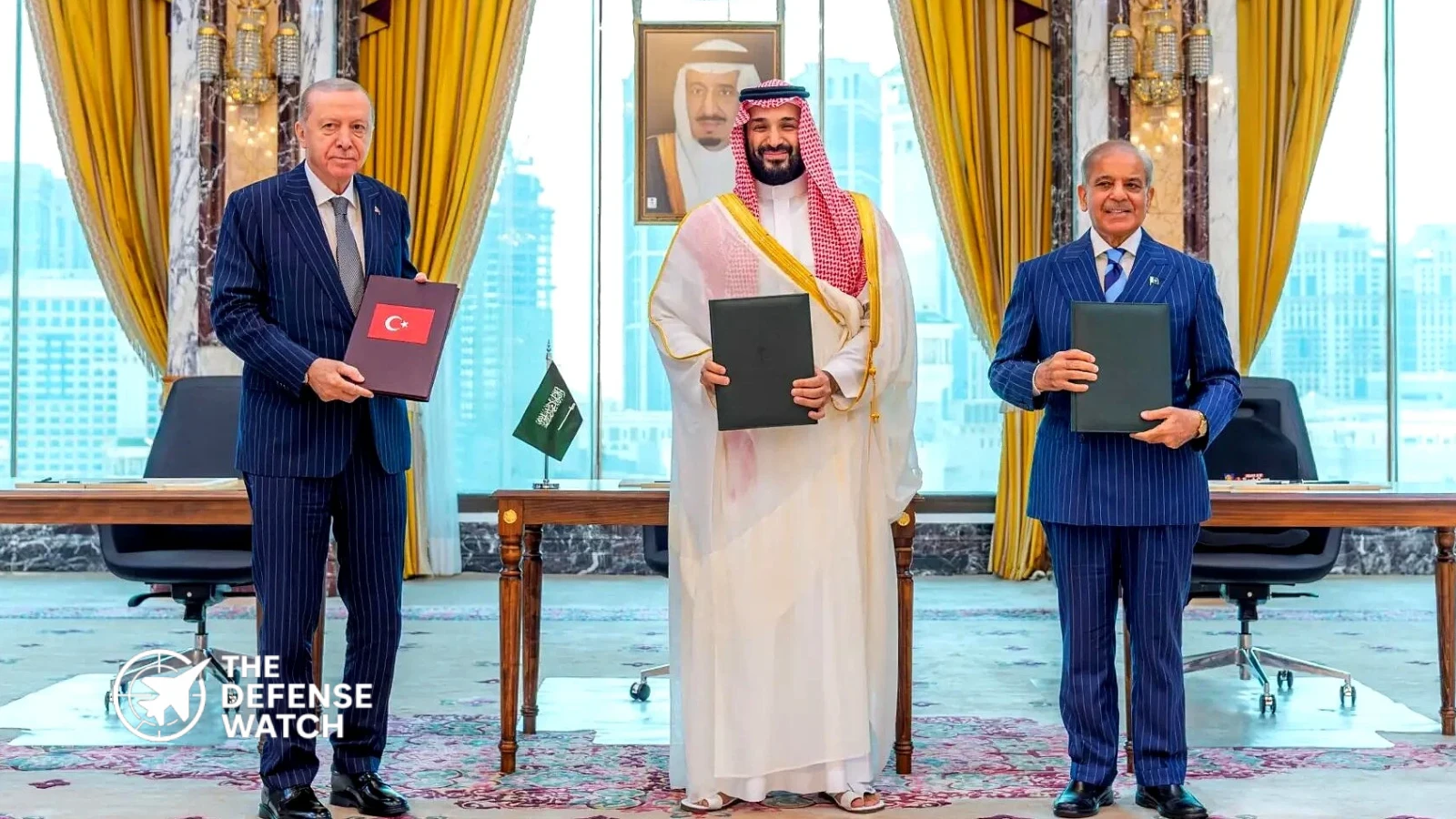
The Mecca Joint Defense Agreement brings Saudi Arabia, Pakistan and Turkey into a new collective security framework at a time of heightened instability across the Middle East. The agreement was signed in Mecca on Aug. 7 by Saudi Crown Prince Mohammed bin Salman, Turkish President Recep Tayyip Erdogan and Pakistani Prime Minister Shehbaz Sharif.
The central provision states that an armed attack against any one of the three countries will be regarded as an attack against all three. The language creates a collective-defense commitment, although the agreement does not publicly specify an automatic military response or establish detailed force commitments comparable to NATO’s integrated military structure.
The agreement is significant because it formalizes defense cooperation among three countries with different but complementary military capabilities. Turkey is a NATO member with a large conventional military and a growing domestic defense industry. Pakistan contributes extensive military experience and a nuclear deterrent, while Saudi Arabia provides substantial economic resources and a major regional security role.
From Bilateral Pact To Trilateral Security Arrangement
The new framework builds on the Strategic Mutual Defense Agreement signed by Saudi Arabia and Pakistan in September 2025. That earlier agreement also established a collective-defense principle under which aggression against either country would be treated as aggression against both.
The addition of Turkey represents a major expansion of that security relationship.
The development was not unexpected. In January 2026, Turkish officials acknowledged discussions with Pakistan and Saudi Arabia over broader defense cooperation. At the time, Turkish Foreign Minister Hakan Fidan said talks were underway but that no agreement had yet been signed.
By August, those negotiations had produced a formal trilateral agreement.
Reuters reported that the agreement had been under discussion for more than two years and that the three governments intend to establish institutional mechanisms for cooperation. Fidan said a ministerial committee would be created, alongside a permanent secretariat in Saudi Arabia.
Agreement Emphasizes Deterrence, Not A Named Adversary
The Mecca Joint Defense Agreement has attracted attention because of its collective-defense language, but officials from the three countries have been careful to describe it as defensive.
Fidan said Aug. 8 that the agreement was not directed against Iran or any other country. He said the pact is intended to provide a general security commitment and that the participating states would determine the nature and scale of assistance following an attack.
Pakistan’s Foreign Minister Ishaq Dar similarly described the agreement as purely defensive and said it was not aimed at a particular state. He also said the framework remains open to other countries that support its principles.
That distinction matters. The agreement establishes a political and strategic commitment to collective defense, but the available public information does not indicate the creation of a permanently integrated military command, standing trilateral force or automatic deployment mechanism.
In practical terms, the pact provides a framework through which the three governments can coordinate responses, share capabilities and strengthen deterrence without replacing their existing bilateral and multilateral defense arrangements.
Turkey Adds Defense Industry And Military Capacity
Turkey’s participation adds an important industrial and military dimension to the arrangement.
Ankara has developed a broad domestic defense sector spanning unmanned aircraft, air defense, precision weapons, armored vehicles, naval systems and combat aircraft programs. Turkish defense companies have also expanded their export presence across the Middle East and other markets.
Turkey’s military relationship with Saudi Arabia has grown alongside this defense-industrial expansion. The two countries have increased cooperation in areas including unmanned systems and defense technology.
For Pakistan, Turkish defense cooperation also provides another channel for military modernization and technology collaboration. Islamabad and Ankara have maintained long-standing defense ties, including cooperation involving naval platforms, aircraft and other military systems.
The trilateral framework could therefore provide a political umbrella for deeper defense-industrial cooperation, although the agreement itself does not announce specific weapons contracts.
Saudi Arabia Gains A Broader Security Partnership
For Riyadh, the agreement expands its formal defense relationships beyond the existing Saudi-Pakistani arrangement.
Saudi Arabia has invested heavily in air defense, combat aircraft, missiles, unmanned systems and other military capabilities as it seeks to protect critical infrastructure and strategic facilities. The kingdom’s security concerns have increased as regional conflicts have produced missile, drone and maritime threats.
Pakistan has already demonstrated its willingness to support Saudi security cooperation under the bilateral framework. In April, Saudi authorities confirmed the arrival of Pakistani military personnel and fighter aircraft in the kingdom to strengthen joint defense cooperation.
The new trilateral pact creates a wider political framework around those relationships.
Turkey also brings a NATO-standard military structure and experience operating alongside Western forces, while maintaining an increasingly independent defense-industrial base.
Pakistan’s Role Extends Beyond South Asia
The Mecca Joint Defense Agreement also gives Pakistan a larger formal role in a Middle Eastern security framework.
Islamabad has maintained close defense ties with Riyadh for decades and has previously deployed military personnel to Saudi Arabia. The two countries’ 2025 defense agreement already established a collective-defense relationship.
Pakistan’s position is particularly notable because it maintains relationships with Saudi Arabia, Turkey, Iran and other regional actors. Islamabad has also sought to position itself as a diplomatic channel during periods of heightened regional tension.
That balancing role could become increasingly important as the new defense framework develops.
At the same time, the agreement does not automatically mean Pakistan or Turkey would enter every conflict involving Saudi Arabia, or that Saudi Arabia would automatically participate in a future conflict involving Pakistan or Turkey. The public statements indicate that the form and scale of assistance would be determined through consultation.
Potential Expansion To Other Countries
One of the most important unanswered questions is whether the agreement will remain trilateral.
Fidan said Turkey’s leadership wants the framework to expand beyond the three founding members. He identified Egypt as a potential participant, although technical and political issues would have to be resolved before any expansion.
Expansion would significantly change the strategic weight of the arrangement.
Egypt would add another major Arab military power and give the framework a stronger geographic position linking the eastern Mediterranean, Red Sea and Gulf regions. However, there is currently no confirmed timetable for Egyptian accession.
The immediate priority appears to be establishing the institutions needed to make the existing agreement operational.
What The Pact Means For Regional Security
The significance of the Mecca Joint Defense Agreement lies less in the creation of a new military force and more in the formalization of political commitments among three major regional powers.
The agreement brings together countries with different strategic priorities and military strengths. Turkey offers defense technology and conventional military capacity. Pakistan provides military experience and strategic deterrence. Saudi Arabia contributes financial resources, regional influence and an important geographic position.
That combination could improve coordination in areas such as intelligence sharing, military planning, defense technology and counterterrorism.
However, the pact’s ultimate effectiveness will depend on how its collective-defense clause is implemented. NATO’s Article 5 operates within a much more developed institutional system, including integrated command structures, standardized procedures and decades of joint planning. The Mecca agreement is at an early stage and still needs to establish its mechanisms for consultation and implementation. Reuters reported that operational details are expected to be addressed through the planned ministerial committee.
The agreement therefore represents an important political development, but its military consequences will depend on decisions that have yet to be made.
A New Layer In Middle East Defense Cooperation
The signing of the Mecca pact marks a new stage in security cooperation between Saudi Arabia, Pakistan and Turkey.
It does not replace existing alliances or defense partnerships, and its signatories have explicitly rejected the idea that it is directed against a particular country. Instead, the agreement establishes a framework for collective deterrence and deeper defense coordination.
Its long-term importance will depend on whether the three governments translate the political commitment into regular military cooperation, shared planning and concrete defense programs.
For now, the agreement gives Saudi Arabia, Pakistan and Turkey a formal mechanism for coordinating their security interests while leaving the scope of future military cooperation open.
