• Home
  • About
  • Defense Systems
  • Manufacturer
  • Comparisons
  • Compare 
  • Tools
TheDefenseWatch.com
  • Aerospace & Aviation
  • Military & Ordnance
  • Naval & Maritime
  • Cyber & Space Defense
  • Policy & Strategy
  • Global News
  • Tools Library
    • Smart Calculator
    • Drone Flight Time Calculator
    • Drone Range Calculator
    • Counter-Drone Jammer Effective Range Calculator
    • Counter-Battery Radar Detection Calculator
    • Artillery Fire Correction Calculator
    • Thermal Camera Detection Range Calculator
    • Missile Range & Time-of-Flight Calculator
    • Radar Detection Range Calculator
    • FPV Strike Drone Payload vs Range Calculator
    • Loitering Munition Endurance Calculator
    • Sniper Ballistic Drop & Windage Calculator
    • Bullet Drop Calculator
    • U.S. Army Combat Fitness Test (ACFT) Calculator
    • Military Pension Calculator
    • Military Retirement Calculator
    • Military Pension Calculator
    • Large Number Calculator
Font ResizerAa

TheDefenseWatch.com

The Defense Watch | U.S. & Global Defense News, Analysis & Military Updates

Search
  • Home
  • About
  • Defense Systems
  • Manufacturer
  • Comparisons
  • Compare 
  • Tools

Stay Updated

Get the latest update

Subscribe

Explore

  • Drone
  • Fighter Jets & Military Aircraft
  • Hypersonic Weapons
  • Aircraft Carriers
  • Strategic History & Missions
  • Tools Library
Home » Iranian Missile Strike Damages Five US KC-135 Stratotanker Aircraft At Saudi Base
Global News

Iranian Missile Strike Damages Five US KC-135 Stratotanker Aircraft At Saudi Base

Kaleem Sheikh | Regional Defense Correspondent
Last updated: September 8, 2026 2:40 pm
Kaleem Sheikh | Regional Defense Correspondent
Share
3 Min Read
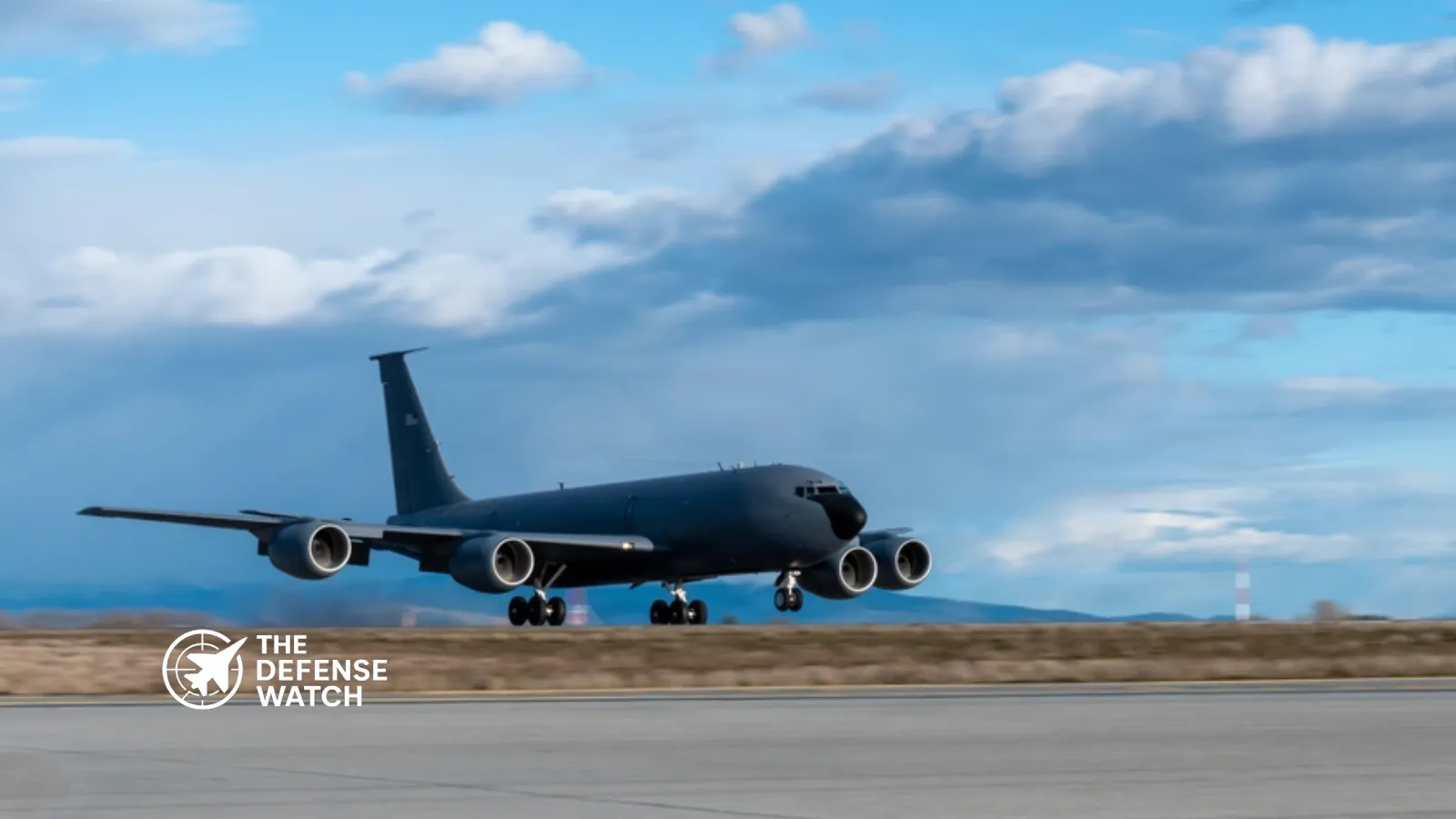
Iranian missile strike KC-135
Image: dvidshub
SHARE
KEY FACTS AT A GLANCE
  • Five US Air Force KC-135 Stratotanker aircraft were reportedly damaged during an Iranian missile strike on Prince Sultan Air Base in Saudi Arabia.
  • The aircraft were on the ground when the strike occurred and sustained varying levels of damage but were not destroyed.
  • The attack highlights the vulnerability of forward deployed support aircraft critical to US air operations in the Middle East.
  • The strike occurred amid escalating US Iranian tensions linked to ongoing military operations in the region.
  • Aerial refueling tankers remain a cornerstone capability enabling long range strike and persistent airpower.

Iranian Missile Strike Damages US KC-135 Tankers

The Iranian missile strike KC-135 incident has reportedly damaged five U.S. Air Force KC-135 Stratotanker aerial refueling aircraft at Prince Sultan Air Base in Saudi Arabia, according to U.S. officials cited in multiple reports. The aircraft were struck while parked on the ground during a missile attack linked to escalating regional tensions involving Iran and U.S. forces.

Contents
Iranian Missile Strike Damages US KC-135 TankersThe Big PictureWhat’s HappeningWhy It MattersStrategic ImplicationsCompetitor ViewWhat To Watch NextCapability GapThe Bottom Line

Officials said the tankers were damaged but not destroyed, and repair efforts are underway. No casualties were reported in the attack.

The incident represents one of the most significant reported hits on U.S. aerial refueling infrastructure during the current Middle East crisis.

The Big Picture

Aerial refueling aircraft are among the most critical enabling assets in modern air warfare. The KC-135 Stratotanker, a long serving U.S. Air Force tanker introduced in the late 1950s, allows fighters, bombers, and surveillance aircraft to remain airborne for extended missions far from their home bases.

- Advertisement -
  • KC-135 Air Refueling Tanker

    KC-135 Air Refueling Tanker

    • Maximum Speed: 530 mph
    • Range: 1500 miles with refueling mission
    • Payload Capacity: 90000 lb fuel
    • Crew: 3 to 4
    • View Details →
    6.6

    In the Middle East theater, tanker aircraft are essential to maintaining U.S. airpower projection across large operational distances. Aircraft supporting strike missions, intelligence flights, and air patrols rely heavily on mid air refueling to sustain high sortie rates.

    Forward bases such as Prince Sultan Air Base in Saudi Arabia serve as critical hubs for these operations, enabling coalition aircraft to conduct long range missions over Iraq, Syria, the Persian Gulf, and Iran.

    When these support assets are disrupted, operational tempo and mission flexibility can quickly become constrained.

    What’s Happening

    According to reporting citing two U.S. officials, five KC-135 Stratotanker aircraft were hit during an Iranian missile strike on Prince Sultan Air Base in Saudi Arabia.

    The tankers were reportedly parked on the airfield at the time of the attack. Initial assessments indicate the aircraft suffered structural or systems damage but were not completely destroyed.

    Officials said maintenance teams are working to repair the aircraft, though the timeline for returning them to service remains unclear.

    The attack occurred amid broader Iranian retaliatory strikes targeting regional infrastructure and U.S. military facilities following escalating hostilities between Iran and U.S. aligned forces.

    • KC-135 Air Refueling Tanker

      KC-135 Air Refueling Tanker

      • Maximum Speed: 530 mph
      • Range: 1500 miles with refueling mission
      • Payload Capacity: 90000 lb fuel
      • Crew: 3 to 4
      • View Details →
      6.6

      Iran has conducted missile and drone strikes against multiple targets across Saudi Arabia since the conflict began, including energy infrastructure and military installations.

      Prince Sultan Air Base hosts significant U.S. and coalition forces and has played a key role in regional air operations.

      Why It Matters

      The Iranian missile strike KC-135 incident underscores the vulnerability of high value support aircraft stationed at forward operating bases.

      Unlike hardened fighter shelters, tanker aircraft are often parked on open ramps due to their large size and operational requirements. This makes them difficult to protect during missile or drone attacks.

      While the reported damage did not destroy the aircraft, even temporary loss of tanker availability can disrupt complex air campaigns.

      Aerial refueling capacity directly affects:

      • fighter patrol duration
      • bomber strike range
      • intelligence and surveillance missions
      • rapid response capability

      When tanker availability drops, combat aircraft may need to operate closer to their bases or reduce time on station.

      This can limit operational reach during sustained conflict.

      Strategic Implications

      The damage to five U.S. tanker aircraft illustrates how adversaries increasingly target enabling infrastructure rather than frontline combat systems.

      Support assets such as tankers, surveillance aircraft, and logistics hubs are central to modern expeditionary warfare.

      Disrupting these systems can have cascading operational effects.

      Iran’s missile and drone capabilities have steadily expanded over the past decade, enabling the country to strike regional bases at long distances with increasing precision.

      • KC-135 Air Refueling Tanker

        KC-135 Air Refueling Tanker

        • Maximum Speed: 530 mph
        • Range: 1500 miles with refueling mission
        • Payload Capacity: 90000 lb fuel
        • Crew: 3 to 4
        • View Details →
        6.6

        Attacks on air bases in Saudi Arabia and the Gulf also signal Tehran’s willingness to target coalition infrastructure supporting U.S. operations.

        For U.S. planners, the incident reinforces the need for stronger base defense measures, including:

        • layered missile defense systems
        • hardened aircraft shelters
        • dispersal of high value aircraft across multiple bases
        • rapid runway and infrastructure repair capabilities

        Such measures aim to reduce the operational risk posed by missile attacks.

        Competitor View

        Iran and its regional partners likely view attacks on U.S. logistical and support assets as an effective way to challenge American military superiority.

        Rather than confronting advanced U.S. fighter aircraft directly, targeting tanker aircraft, drones, or air bases can impose operational costs on U.S. forces.

        Strategically, these attacks demonstrate that Iran retains the capability to threaten U.S. and allied military infrastructure throughout the Gulf region.

        Russia and China are also closely observing how such attacks affect U.S. expeditionary operations.

        Both countries have invested heavily in strategies designed to disrupt logistics and support systems during conflict, often referred to as anti access or area denial approaches.

        Events like the Iranian missile strike KC-135 incident provide real world examples of how such strategies could play out during major power conflict.

        What To Watch Next

        Several developments may follow in the coming weeks.

        First, the U.S. military may increase air defense deployments around key regional bases. Systems such as Patriot and THAAD are commonly used to defend against ballistic and cruise missile threats.

        • THAAD Missile Defense System

          THAAD Missile Defense System

          • Maximum Range: 200 km
          • Maximum Altitude: 150 km
          • Radar Detection Range: 1,000 km (AN/TPY-2)
          • Missile Speed: Mach 8
          • View Details →
          8.0

          Second, the U.S. Air Force may disperse tanker aircraft across additional bases to reduce the risk of concentrated losses.

          Third, maintenance assessments will determine how quickly the damaged aircraft can return to service.

          Even moderate structural damage to large aircraft like the KC-135 can require extensive inspection and repair.

          Finally, the United States may increase the deployment of newer tanker platforms such as the KC-46 Pegasus to sustain refueling capacity in the theater.

          Capability Gap

          The incident highlights a persistent challenge in modern air operations.

          Support aircraft remain large, slow, and difficult to harden against missile attack.

          While fighters and bombers benefit from hardened shelters and dispersal strategies, tanker fleets often rely on exposed ramp space.

          This creates a structural vulnerability that adversaries can exploit.

          At the same time, replacing tanker capacity quickly during wartime remains difficult. Tankers are expensive, limited in number, and critical to global U.S. airpower.

          Protecting them has become an increasingly important part of airbase defense planning.

          The Bottom Line

          The reported Iranian missile strike damaging five KC-135 Stratotanker aircraft highlights how attacks on support infrastructure can disrupt the operational backbone of modern airpower.

TAGGED:Iran conflict 2026Iran missile strikeKC-135 StratotankerMiddle East conflictSaudi Arabia air baseus air force
Share This Article
Facebook Copy Link Print
ByKaleem Sheikh | Regional Defense Correspondent
Follow:
Kaleem Sheikh is a regional defense correspondent at TheDefenseWatch.com covering defense and security developments across Asia and the Middle East, including military operations, procurement, and regional security issues.
Leave a Comment

Leave a Reply Cancel reply

Your email address will not be published. Required fields are marked *

Search Defense Systems

Latest Defense Systems

  • F-47A Fighter Jet F-47A Fighter Jet
  • China DF-61 Missile China DF-61 Missile
  • B61 Nuclear Bomb B61 Nuclear Bomb
  • Japan E-767 Airborne Japan E-767 Airborne
  • Remington 870 Shotgun Remington 870 Shotgun
  • RUTA B1 Cruise Missile RUTA B1 Cruise Missile
  • XQ-67A Drone XQ-67A Drone
  • B-25 Mitchell Bomber B-25 Mitchell Bomber
  • F-100 Super Sabre F-100 Super Sabre

Recent Compares

  • J-10C vs JF-17 Thunder: Which Fighter Is More Capable? J-10C vs JF-17 Thunder: Which Fighter Is More Capable? View Comparison →
  • Tejas vs Gripen: Key Differences and Capabilities Tejas vs Gripen: Key Differences and Capabilities View Comparison →
  • Tejas vs MiG-21 Bison: How India Replaced Its Iconic Supersonic Fighter Tejas vs MiG-21 Bison: How India Replaced Its Iconic Supersonic Fighter View Comparison →
  • F-35 vs F-16: Stealth, Sensors and Combat Roles F-35 vs F-16: Stealth, Sensors and Combat Roles View Comparison →
  • Tejas Fighter Jet vs F-16 Fighting Falcon: Capability Compared Tejas Fighter Jet vs F-16 Fighting Falcon: Capability Compared View Comparison →
  • Rafale Fighter Jet vs F-16 Fighting Falcon : Which Fighter Has the Edge? Rafale Fighter Jet vs F-16 Fighting Falcon : Which Fighter Has the Edge? View Comparison →
  • Su-57 Fighter Jet vs J-20 Fighter Jet: Stealth and Air Combat Compared Su-57 Fighter Jet vs J-20 Fighter Jet: Stealth and Air Combat Compared View Comparison →
  • Mirage 2000 vs Tejas Mk1A: Legacy Combat Power vs Indigenous Modernization Mirage 2000 vs Tejas Mk1A: Legacy Combat Power vs Indigenous Modernization View Comparison →
  • Rafale Fighter Jet vs F-22 Raptor: Which Air Dominance Fighter Has the Edge? Rafale Fighter Jet vs F-22 Raptor: Which Air Dominance Fighter Has the Edge? View Comparison →
  • Tejas Fighter Jet vs. Rafale Fighter Jet: India’s Indigenous Fighter Meets France’s Proven Multirole Combat Aircraft Tejas Fighter Jet vs. Rafale Fighter Jet: India’s Indigenous Fighter Meets France’s Proven Multirole Combat Aircraft View Comparison →

Recent Posts

  • Saab Wins SEK 2 Billion Contract to Equip Sweden’s Four New FDI Frigates
  • F-47 Fighter May Fly With Interim Engine as Next-Generation Propulsion Program Falls Behind Schedule
  • UK Says F-35 Agreement Guarantees Access to U.S. Support System
  • Pakistan and Tajikistan Conclude Dosti-III Counterterrorism Exercise at Cherat
  • Lockheed Martin Self-Funds Five Vectis Collaborative Combat Aircraft

You Might Also Like

UK denies US military base access
Global News

UK Refuses US Permission To Use Bases For Potential Iran Strike, Deepening Western Tension

February 20, 2026
France pledges Rafale jets
Global News

France pledges Rafale Jets And Air Defense As Russia Strikes Ukraine Energy Grid

September 7, 2026
Ukraine war
Global News

Europe Risks Perpetual War in Ukraine — Why Washington May Pull Back

November 27, 2025
Airlander 10 hybrid aircraft
Global News

Hybrid Air Vehicles Secures First Military Reservations for Airlander 10 Hybrid Aircraft

September 8, 2026

Logo

Copyright © 2026 TheDefenseWatch.com

Helpful Links

  • Home
  • About Us
  • Privacy Policy
  • Terms of Use / Disclaimer
  • U.S. Privacy Notice – CCPA Compliance

Defense Systems

  • Defense Systems
  • Comparisons 
  • Manufacturer
  • Tactical Calculators

Popuplar

Which 5 Air Forces Possess the Costliest Fighter Jet Fleets in the World
Evolving Strategic Value: Carrier Strike Groups in the Indo-Pacific’s Future Security Architecture
Autonomous Weapon Systems Spark U.S. Ethics Debate Amid Rapid Military AI Integration

We report on developments involving military forces, governments, defense companies, research organizations, and security institutions around the world. 

Welcome Back!

Sign in to your account

Username or Email Address
Password

Lost your password?