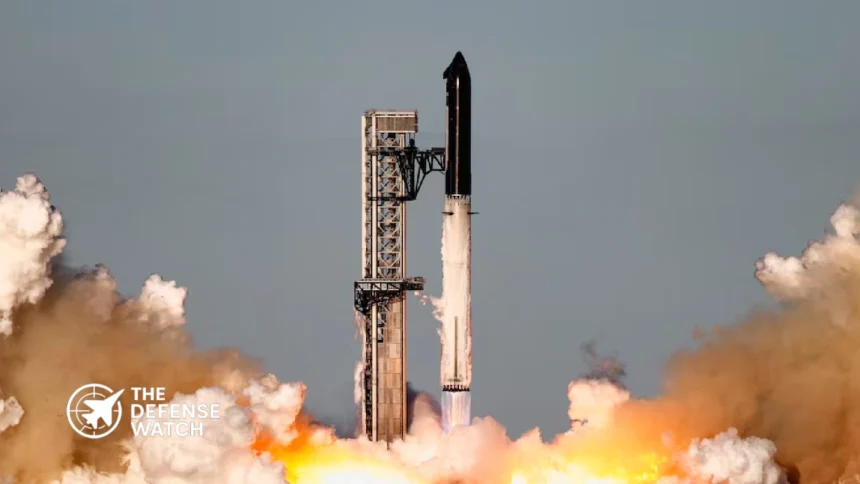
SpaceX has completed the launch phase of Starship Flight 15, bringing its largest rocket to orbit and deploying 26 Starlink satellites while attempting a major step toward fully reusable orbital spaceflight. However, the mission encountered an early setback when the Super Heavy booster failed to complete its planned return to the launch tower.
The November 13 launch from SpaceX’s Starbase facility in South Texas marked the company’s 15th Starship test flight since 2023. Its primary objective was to demonstrate the recovery of both rocket stages at the same launch site, rather than allowing them to fall into the ocean after completing their respective flight phases.
Although the booster recovery attempt failed, the upper-stage spacecraft, designated Ship 42, continued its mission. It reached orbit approximately 27 minutes after liftoff and successfully deployed all 26 Starlink satellites.
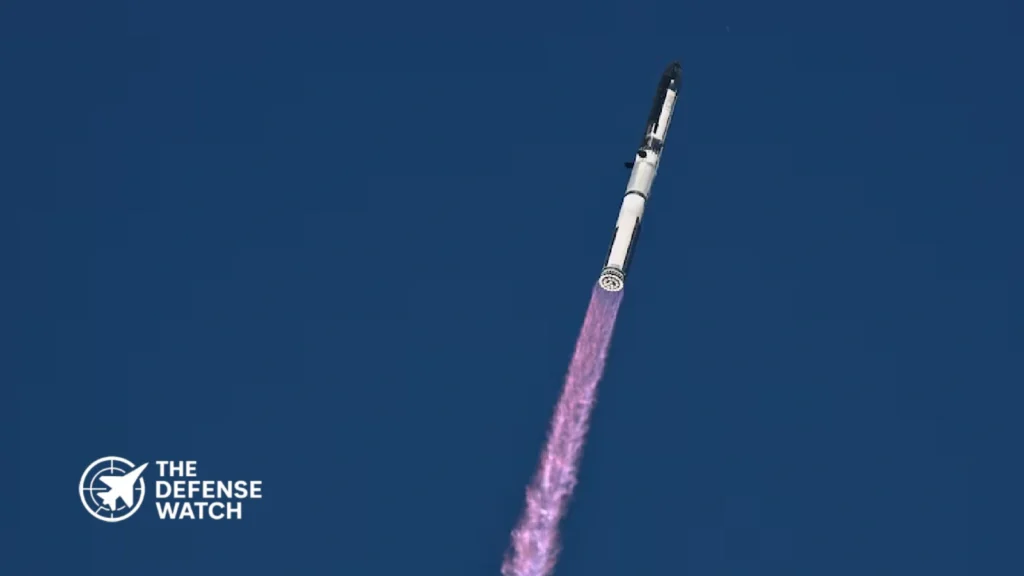
SpaceX is now preparing for the more challenging part of the test: bringing the spacecraft back from orbit and attempting to catch it using the mechanical arms attached to its launch tower. The planned landing attempt is scheduled for November 14, subject to final flight conditions and vehicle readiness.
Starship Reaches Orbit Despite Super Heavy Recovery Failure
Starship Flight 15 lifted off from Starbase on November 13, carrying Ship 42 above the Super Heavy first-stage booster.
The initial ascent and stage separation proceeded successfully. Super Heavy then began its planned return sequence, which was intended to bring the booster back to the launch complex for capture by the tower’s mechanical arms.
That recovery attempt did not go as planned.
According to Reuters, the booster was diverted from its intended return trajectory toward the Gulf of Mexico. It briefly hovered above the water before exploding shortly before reaching the surface.
SpaceX did not initially establish the precise cause of the failure. Associated Press also reported that the booster recovery attempt had been aborted, preventing the planned first-stage catch.
The setback is particularly relevant because this was the first recovery attempt involving the upgraded Super Heavy production version, Booster 22. Earlier Starship tests had demonstrated successful booster catches, including three previous recoveries at Starbase.
Despite losing the opportunity to recover the booster, SpaceX achieved several important mission objectives.
The upper stage completed its orbital insertion burn and deployed all 26 Starlink satellites within approximately two hours of launch.
This also made Flight 15 the second Starship mission to carry operational Starlink satellites into orbit.
Ship 42 Prepares for Its First Orbital Return

The most important remaining objective of Flight 15 is the attempted recovery of Ship 42.
Unlike the Super Heavy booster, which returns shortly after stage separation, Starship’s upper stage must complete an extended orbital flight before beginning its descent.
SpaceX’s original mission plan called for approximately 14 orbits around Earth at an altitude of roughly 275 kilometers, followed by a controlled return to Starbase.
The company intends to use its launch tower’s mechanical catching system, commonly known as the chopsticks, to capture the descending spacecraft.
This would be the first attempt to recover a Starship upper stage directly from orbit.
According to Space.com’s November 14 mission updates, SpaceX reported that Ship 42 remained in good health during its orbital coast. Flight controllers also decided to continue with the extended mission rather than use an earlier ocean splashdown option.
The spacecraft’s heat shield was another important consideration.
SpaceX spokesman Dan Huot said the company’s heat-shield team had examined imagery from ground-based tracking cameras and cameras aboard some of the deployed Starlink satellites.
The assessment indicated that the thermal protection system was in suitable condition for the planned atmospheric return.
The final decision to attempt a tower catch remains dependent on flight conditions and spacecraft readiness. If the company decides against the recovery, Starship can instead be directed toward a planned ocean splashdown.
Why Recovering Both Rocket Stages Matters
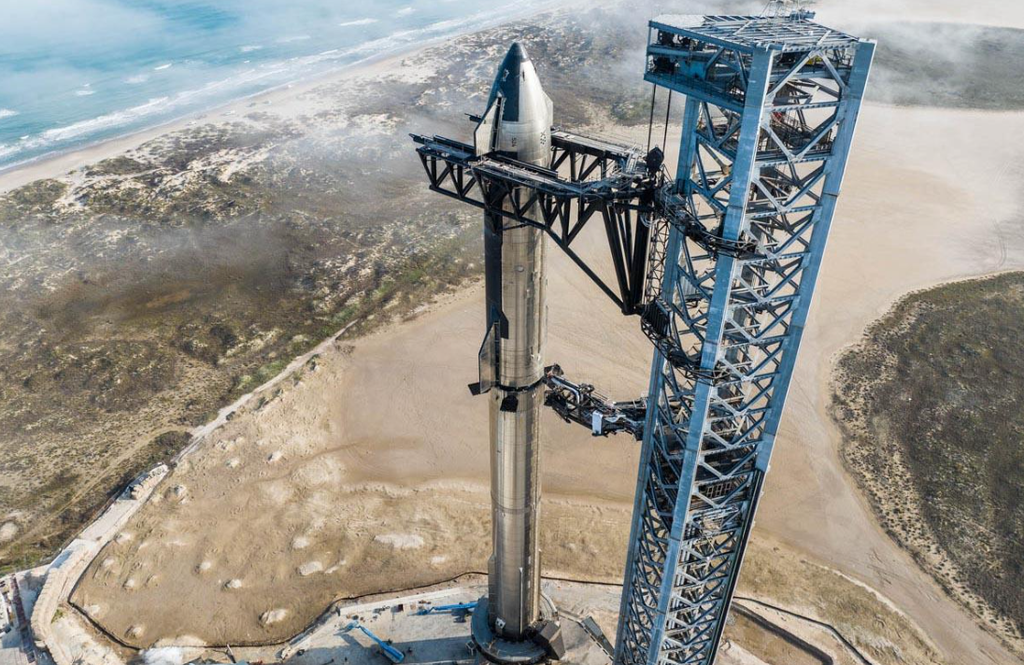
Starship’s development is based on a different approach to orbital launch operations from conventional expendable rockets.
Most traditional launch vehicles discard their stages after use. SpaceX has already demonstrated partial reusability through Falcon 9, whose first-stage boosters routinely return to landing pads or autonomous drone ships.
However, Falcon 9’s upper stage is not recovered for routine reuse.
Starship is designed to take this concept further by recovering both its Super Heavy booster and upper-stage spacecraft.
The recovery architecture relies on powered descents and mechanical catching equipment integrated into the launch infrastructure.
If both stages can consistently return to the launch site, SpaceX could reduce the need to manufacture replacement vehicles for every mission.
It could also simplify refurbishment and launch operations, although the economic benefits will depend on inspection requirements, maintenance costs, turnaround time and the actual reliability of the recovery system.
Flight 15 is therefore an important engineering test, but a successful landing alone would not establish that Starship is ready for routine commercial operations.
Repeated recoveries and reliable reuse will be necessary before the company can demonstrate the intended operational benefits.
NASA’s Artemis Program Adds Strategic Importance
Starship’s development extends beyond SpaceX’s commercial launch business.
NASA selected SpaceX in April 2021 to develop a Starship-based Human Landing System for the Artemis lunar exploration program.
The original contract was valued at approximately $2.89 billion. NASA subsequently awarded an additional $1.15 billion contract modification in November 2022 to support further development of the lunar lander.
The system is intended to transport astronauts between lunar orbit and the Moon’s surface.
However, the lunar lander is not simply the same configuration used for Starlink deployments or orbital recovery demonstrations. The Human Landing System requires additional systems and capabilities to support crewed lunar operations.
One of the most demanding technical requirements is orbital propellant transfer.
NASA’s current Starship mission architecture requires multiple tanker spacecraft to deliver cryogenic propellant to an orbital depot before the lunar lander can depart Earth orbit for the Moon.
This introduces additional launch, docking, transfer and vehicle-management requirements.
A successful orbital recovery would not demonstrate that these capabilities are ready. Nevertheless, it would provide important evidence about Starship’s ability to survive atmospheric reentry and return to a designated landing location.
NASA’s November 2026 program information identifies Starship as part of its planned Artemis human landing system architecture, with a crewed lunar landing demonstration targeted for Artemis IV in December 2028.
What Flight 15 Has Yet to Demonstrate
The booster failure illustrates the difference between demonstrating individual rocket capabilities and establishing a fully reusable launch system.
SpaceX has already shown that Super Heavy can return to its launch tower and be caught by mechanical arms. Flight 15 was intended to extend that achievement to the upgraded booster while introducing the first orbital return and catch attempt for the Starship upper stage.
The two recovery challenges involve different flight environments.
Super Heavy must execute a controlled return shortly after separation, while Ship 42 must survive the thermal and aerodynamic stresses associated with atmospheric reentry after spending an extended period in orbit.
Even if the upper-stage landing succeeds, further testing will be needed to establish how quickly the spacecraft can be inspected, refurbished and prepared for another mission.
SpaceX founder Elon Musk has previously discussed ambitions for a much higher Starship launch cadence, including weekly launches by the first half of 2027, according to Reuters.
Achieving that objective will require more than successful demonstrations. It will depend on vehicle reliability, launch-site capacity, regulatory approvals and the ability to reuse hardware without lengthy refurbishment periods.
The Next Milestone Is Ship 42’s Return
As of November 14, SpaceX’s Starship Flight 15 has demonstrated successful orbital insertion and Starlink satellite deployment, but the planned spacecraft recovery remains a separate and uncompleted milestone.
The failed Super Heavy recovery has prevented the mission from achieving its original double-catch objective.
The upcoming Ship 42 return attempt will provide a more direct test of whether SpaceX can bring an orbital Starship vehicle back to its launch site using controlled propulsion and the tower’s catching infrastructure.
For NASA, commercial satellite operators and the wider launch industry, the longer-term question is whether these demonstrations can translate into a reliable system capable of supporting frequent orbital missions and future lunar operations.
Flight 15 provides useful progress, but routine full-system reusability remains to be demonstrated.