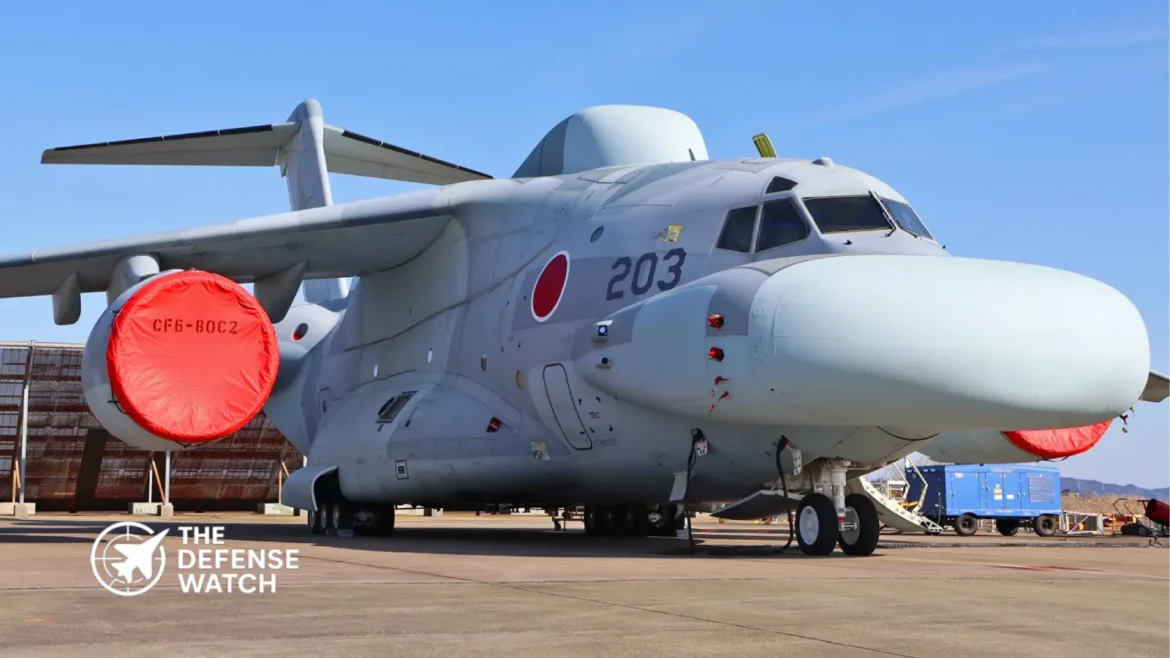
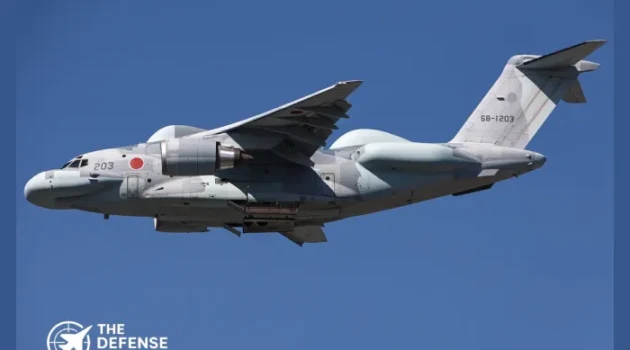
- Japan’s EC-2 electronic warfare jet has successfully completed its first flight.
- The aircraft is designed to jam enemy radar and communications from long range.
- EC-2 enables standoff electronic attack without entering contested airspace.
- The platform supports Japan’s expanding electronic warfare and network disruption capabilities.
- The development aligns with broader regional focus on electromagnetic spectrum dominance.
Japan EC-2 Electronic Warfare Jet Completes First Flight
The Japan EC-2 electronic warfare jet has completed its first flight, marking a significant step in strengthening Japan’s airborne electronic attack capabilities.
The aircraft is designed to conduct long-range jamming missions, targeting enemy radar systems and communications networks while remaining outside hostile airspace. This standoff capability reflects a growing emphasis on survivability and spectrum dominance in modern air operations.
According to defense reporting and aviation sources, the EC-2 represents a next-generation evolution in Japan’s electronic warfare fleet, supporting both defensive and offensive electromagnetic operations.
Standoff Jamming and Survivability at the Core
A key feature of the EC-2 is its ability to disrupt adversary systems without crossing into heavily defended zones. This reduces exposure to surface-to-air missile systems and advanced fighter threats.
Modern electronic warfare increasingly prioritizes range and precision. By operating at a distance, the EC-2 can degrade enemy situational awareness before kinetic operations begin.
This concept aligns with broader trends seen in U.S. and allied forces, where platforms such as the EA-18G Growler emphasize stand-in and stand-off jamming combinations. Japan’s EC-2 appears focused primarily on the latter, providing a safer and persistent electronic attack layer.
Role in Japan’s Expanding EW Doctrine
The introduction of the EC-2 comes as Japan continues to invest in electronic warfare as part of its evolving defense posture.
Over the past decade, the country has shifted toward integrated multi-domain operations, combining cyber, space, and electromagnetic spectrum capabilities. Electronic warfare aircraft like the EC-2 play a central role in this shift by:
- Disrupting enemy command and control networks
- Blinding radar systems during air operations
- Supporting joint force coordination
This reflects a broader recognition that future conflicts will depend heavily on control of the electromagnetic spectrum, not just air superiority in the traditional sense.
Regional Context and Strategic Implications
The EC-2’s first flight takes place amid rising competition in the Indo-Pacific region. Several regional powers are rapidly advancing their own electronic warfare and countermeasure systems.
Aircraft capable of long-range jamming provide a strategic advantage by shaping the battlefield before direct engagement. They can delay detection, confuse targeting systems, and reduce the effectiveness of integrated air defense networks.
For Japan, this capability strengthens deterrence by complicating adversary planning. It also enhances interoperability with allied forces, particularly the United States, which places significant emphasis on electronic attack in joint operations.
Technology and Platform Evolution
While detailed specifications remain limited, the EC-2 is expected to incorporate advanced electronic support and attack systems, including:
- Wideband jamming technologies
- Signals intelligence collection systems
- Networked electronic attack coordination
Such systems allow operators to detect, identify, and disrupt multiple threats simultaneously.
Compared to older platforms, newer electronic warfare aircraft are more software-driven, enabling faster updates and adaptability against evolving threats.
Analysis: Why the EC-2 Matters
The significance of the EC-2 goes beyond a single aircraft milestone.
First, it highlights a shift toward non-kinetic warfare capabilities. Modern militaries are investing heavily in tools that can disable or degrade enemy systems without firing a shot.
Second, it reflects changing risk calculations. Operating outside contested airspace reduces losses while still achieving operational effects.
Third, it underscores the growing importance of electronic warfare in the Indo-Pacific, where dense air defense environments make traditional penetration missions more challenging.
In this context, the EC-2 is not just a support platform. It is a frontline enabler of air and joint operations.

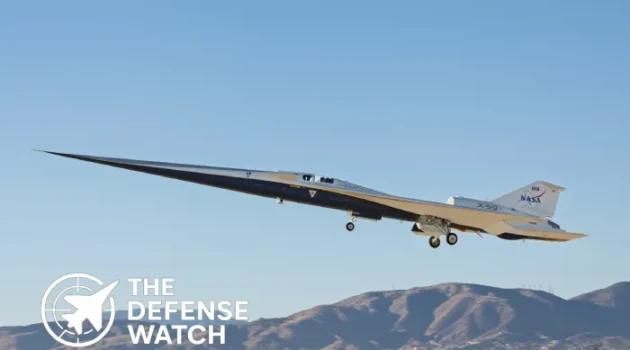
- ► NASA’s X-59 quiet supersonic aircraft completed engine run testing on March 12, 2026, at Armstrong Flight Research Center, Edwards, California — a critical final ground check before its second flight.
- ► Test pilot Jim “Clue” Less will fly the X-59 for its second flight, accompanied by NASA pilot Nils Larson in a chase F/A-18.
- ► The aircraft’s first flight took place on October 28, 2025 — followed by removal and reinstallation of the engine, lower empennage, cockpit seat, and more than 70 inspection panels.
- ► Second flight will begin envelope expansion, gradually progressing from 230 mph at 12,000 feet toward the X-59’s mission target of Mach 1.4 at 55,000 feet.
- ► The X-59 is the centerpiece of NASA’s Quesst mission, which aims to replace the traditional sonic boom with a quieter sonic “thump” and eventually open U.S. skies to commercial overland supersonic travel.
NASA’s X-59 Quiet Supersonic Aircraft Prepares for Second Flight, Targeting Mach 1.4
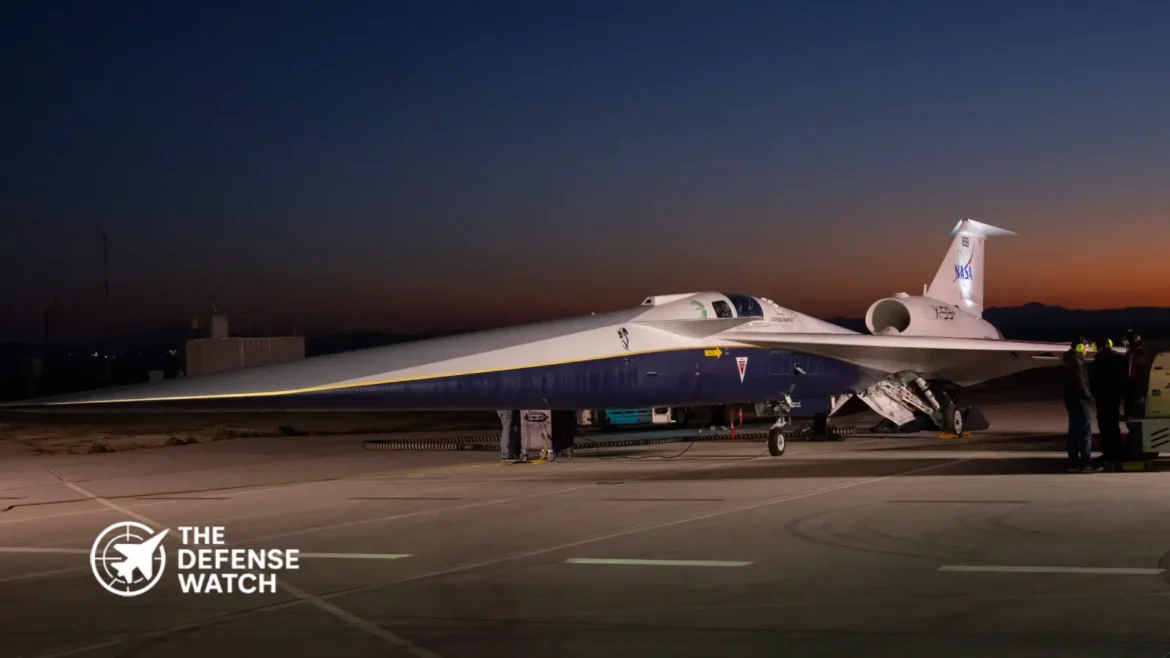
NASA’s X-59 quiet supersonic research aircraft is moving to its next major milestone: a second test flight that will launch the program into its critical envelope expansion phase. According to a NASA announcement published March 17, 2026, ground crews at Armstrong Flight Research Center in Edwards, California, completed engine run testing on March 12 — one of the final verification steps before the aircraft takes to the skies again.
The X-59, NASA’s flagship experimental platform under the agency’s Quesst mission, is designed to fly faster than the speed of sound while generating only a low-level sonic thump rather than a disruptive boom. If successful, the program could fundamentally reshape commercial aviation regulations, potentially reopening the door to overland supersonic passenger travel in the United States for the first time since the Concorde era.
A New Pilot Takes the Controls
NASA test pilot Jim “Clue” Less is set to fly the X-59 for its second sortie, marking his first time at the controls of an X-plane in his career. Less will take off and land at Edwards Air Force Base, operating out of the X-59’s home facility at Armstrong Flight Research Center.
“This will be the first time I’ve flown an X-plane,” Less said in the NASA release. “I think I’ll mostly be focused on getting the test cards done and getting them done correctly. It’ll probably sink in later that I was in the X-59.”
Flying in formation nearby will be Nils Larson — the pilot who made the X-59’s historic first flight on October 28, 2025 — operating a NASA F/A-18 aircraft in a chase and observation role. The structured crew pairing reflects the careful, data-driven methodology that defines the Quesst program. Each flight builds on the last, and no phase proceeds without meticulous review of what came before.
Post-First-Flight Maintenance: A Deep Dive
Following the October 2025 maiden flight, NASA and prime contractor Lockheed Martin undertook an extensive post-flight maintenance campaign. Technicians removed the X-59’s modified General Electric F414-GE-100 engine — the same powerplant used in the F/A-18 Super Hornet — along with a tail section known as the lower empennage, the cockpit seat, and more than 70 individual panels for thorough structural and systems inspections. All components have since been reinstalled and verified.

“These guys know what they’re doing,” Less said. “Nils trusted them for the first flight. I trust them for the second flight and every flight after that.”
Ray Castner, NASA’s X-59 lead propulsion engineer, described the March 12 engine run as an emotionally charged moment for the team. “It’s always exciting to see the X-59 come to life on the ground,” he said. For our team, it’s a moment to pause and appreciate how far this aircraft has come — and how close we are to pushing into the next phase of flight.
What Is Envelope Expansion — and Why Does It Matter?
The concept of “envelope expansion” is standard practice in experimental aircraft testing, but for the X-59 it carries outsized strategic significance. The term refers to the incremental, methodical process of pushing an aircraft progressively faster, higher, and through increasingly demanding flight conditions, verifying safety and performance at each step before advancing further.
For second flight, the X-59 will initially replicate a test condition from the first flight to confirm the aircraft behaves consistently after the maintenance interval. It will then advance to 260 mph at 20,000 feet — a modest but meaningful step beyond the first flight’s performance band.
“Second flight will look a lot like the first flight,” said Cathy Bahm, NASA’s Low Boom Flight Demonstrator project manager. We’ll start the flight at a test condition from first flight to ensure X-59 performs as expected after the maintenance phase, then we’ll start the envelope expansion by testing a little higher and faster.
The long-range mission parameters are ambitious: approximately 925 mph — or Mach 1.4 — at 55,000 feet. Getting there will require dozens of incremental test flights over the coming months, each one carefully analyzed before the next is authorized.
“From here on out, once we’re airborne, we can increase speed and increase altitude in small, measured chunks,” Less explained. Eventually we get to supersonic flight — a few more steps — and we’re out to Mach 1.4 at about 55,000 feet.
The Three Phases of Quesst: A Mission Roadmap
The broader Quesst mission is structured around three sequential phases, and the X-59’s current work represents only the first.
Phase 1 — Envelope Expansion: The ongoing series of test flights at Armstrong, gradually pushing the X-59 to its design limits while gathering performance and systems data.
Phase 2 — Acoustics Validation: Once envelope expansion is complete, engineers will closely examine how the X-59’s unique airframe design — including its elongated, carefully sculpted nose — disperses shockwaves. The goal is to confirm that these shockwaves do not merge into a conventional sonic boom, but instead produce only the intended low-level sound signature.
Phase 3 — Community Overflight Studies: In the program’s most consequential phase, NASA plans to fly the X-59 over selected U.S. communities at supersonic speed. Residents will be surveyed on how they perceive the aircraft’s quieter sound, and that data will be shared with aviation regulators — both domestic (the FAA) and international (ICAO) — to inform potential revisions to rules that have banned overland supersonic commercial flight since 1973.
Analysis: Why the X-59 Program Has Implications Far Beyond Aerospace Research
On the surface, the X-59 looks like a classic NASA research program — incremental, patient, and methodical. But its strategic implications reach well beyond the walls of Armstrong Flight Research Center.
The commercial supersonic aviation market is attracting significant private investment. Companies such as Boom Supersonic, with its Overture airliner concept, and smaller startups are betting that regulatory barriers to overland supersonic flight can eventually be removed. The X-59 is essentially the scientific and regulatory argument that makes that future possible — or blocks it. If the aircraft’s acoustic data convincingly demonstrates that supersonic flight can be made tolerable to communities below, it hands regulators the justification they need to modernize a rule set that has remained frozen since the Concorde era.
There is also a defense-industrial dimension worth noting. Lockheed Martin’s Skunk Works division — one of the most secretive and prestigious advanced aircraft development organizations in the world — built the X-59. The aerodynamic and propulsion innovations embedded in this airframe do not exist in isolation. Technologies validated through programs like the X-59 historically migrate into military applications, influencing next-generation high-speed aircraft design, advanced trainer concepts, and even the aerodynamic shaping of future strike platforms.
For the U.S. aerospace industry, the X-59 represents something larger than a single research aircraft. It is a proof of concept for American leadership in a domain — high-speed civil and military aviation — where competition from foreign programs is intensifying. The stakes of getting the science right are considerable.
Looking Ahead: A Busy 2026 for the X-59 Program
NASA has signaled that second flight is just the starting gun for an accelerating test schedule across 2026. As envelope expansion progresses and the program advances toward supersonic speeds, public and regulatory attention on the X-59 will grow accordingly. Each milestone will be watched closely — not only by aviation enthusiasts, but by airline executives, defense planners, and policymakers weighing the future of high-speed air travel.
For now, the immediate focus is straightforward: get the X-59 airborne for flight number two, execute the test cards correctly, and begin the careful, cumulative work of building toward Mach 1.4. If the aircraft performs as designed, the quiet boom of history may be just around the corner.
FAQs
What is NASA’s X-59 aircraft designed to do?The X-59 is an experimental supersonic aircraft built by Lockheed Martin’s Skunk Works for NASA. Its primary purpose is to demonstrate that a plane can fly faster than the speed of sound while producing only a quiet sonic “thump” rather than a disruptive boom, potentially enabling future overland commercial supersonic flight.
When did the X-59 make its first flight?The X-59 completed its maiden flight on October 28, 2025, piloted by NASA test pilot Nils Larson at Edwards Air Force Base, California.
What is envelope expansion and how does it apply to the X-59?Envelope expansion is the flight test process of incrementally pushing an aircraft to higher speeds and altitudes in measured steps to verify safety and performance. For the X-59, this means gradually working from its second-flight parameters toward the mission goal of Mach 1.4 at 55,000 feet.
What engine does the X-59 use?The X-59 is powered by a modified General Electric F414-GE-100 engine, the same engine family that powers the Boeing F/A-18 Super Hornet fighter jet.
What is NASA’s Quesst mission?Quesst (Quiet SuperSonic Technology) is the NASA mission built around the X-59. Its goal is to gather acoustic data on the aircraft’s reduced boom signature, ultimately sharing findings with U.S. and international aviation regulators to support potential changes to rules banning commercial supersonic flight over land.
Who will pilot the X-59 for its second flight?NASA test pilot Jim “Clue” Less will be at the controls for second flight, with Nils Larson observing from a NASA F/A-18 flying in formation nearby.
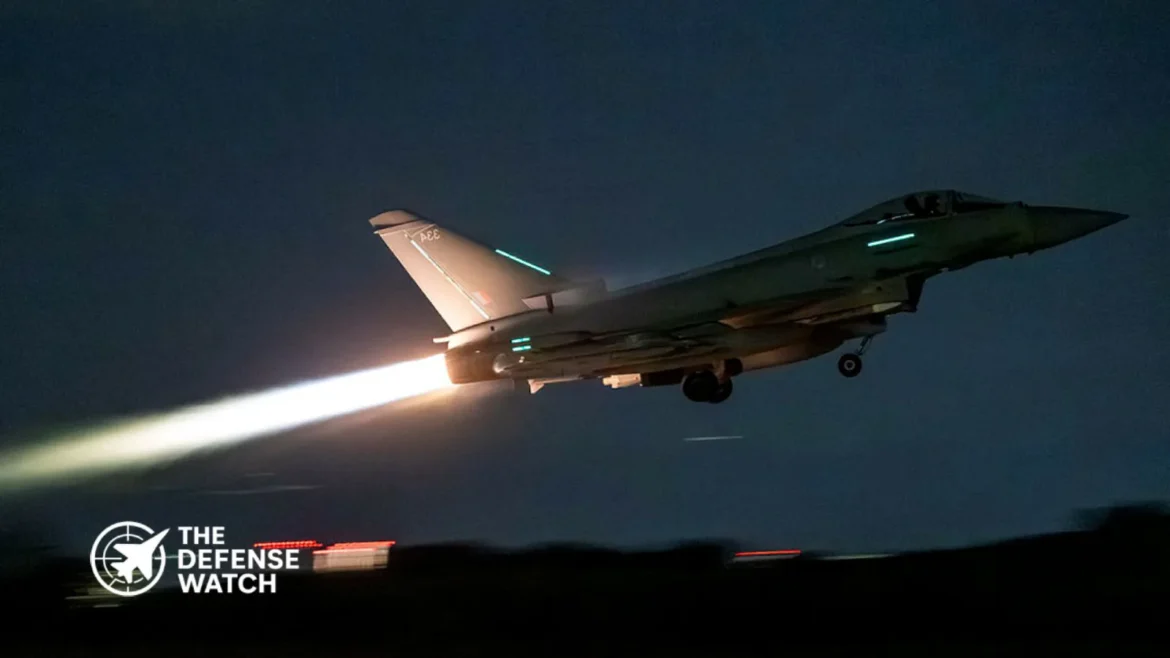
- UK deploys its largest number of combat aircraft to the Middle East in 15 years.
- Deployment includes advanced RAF fighter jets and support aircraft for sustained operations.
- Move aims to strengthen deterrence and support allied operations in a volatile region.
- Deployment reflects ongoing UK military commitments and rapid response capability.
- Marks a significant expansion of British air power projection beyond Europe.
UK Deploys Most Jets To Middle East In 15 Years
The UK deploys most jets to Middle East in 15 years, significantly expanding Royal Air Force operations in the region as part of a broader effort to reinforce allied presence and maintain regional stability.
The Big Picture
Britain’s latest air deployment reflects a wider shift in NATO and allied force posture toward persistent presence in strategically critical regions. The Middle East remains central to global energy flows, maritime security, and counterterrorism operations.
The United Kingdom has steadily reoriented its military strategy toward expeditionary operations since the release of its Integrated Review. Forward basing, rapid deployment, and coalition interoperability now define British defense planning.
This surge in aircraft deployment also aligns with broader Western efforts to maintain operational flexibility across multiple theaters, including Eastern Europe and the Indo-Pacific, without overcommitting ground forces.
What’s Happening
The Royal Air Force has deployed its largest contingent of jets to the Middle East in over 15 years, according to official reporting. The deployment includes frontline combat aircraft supported by tanker and surveillance platforms, enabling sustained air operations across extended distances.
The aircraft are operating from established UK and allied bases in the region. These locations provide strategic reach across key operational zones, including the Persian Gulf and surrounding airspace.
The deployment comes amid heightened regional tensions and ongoing military operations involving coalition forces. British aircraft are expected to support a mix of missions, including air policing, deterrence patrols, and potential strike operations if required.
Why It Matters
The decision to deploy the largest RAF air package in 15 years signals a clear intent to reinforce deterrence without escalating to large-scale ground deployments.
Air power offers flexibility. Fighter jets can conduct surveillance, intercept hostile aircraft, and deliver precision strikes with minimal footprint. This makes them a preferred tool in politically sensitive environments where escalation risks must remain controlled.
The presence of advanced aircraft also enhances interoperability with US and allied forces already operating in the region. Joint operations rely heavily on shared air assets, data links, and coordinated command structures.
Strategic Implications
The expanded RAF presence strengthens coalition air dominance in the Middle East. It ensures rapid response capability against emerging threats, including missile attacks, drone incursions, and maritime security challenges.
The deployment also reinforces the UK’s role as a key security partner in the region. By committing high-end air assets, London signals reliability to allies while maintaining influence in regional security discussions.
From a deterrence standpoint, the visible presence of combat aircraft complicates adversary planning. It reduces the likelihood of opportunistic actions by signaling readiness and capability.
Competitor View
Regional actors such as Iran are likely to interpret the increased air presence as part of a broader Western effort to contain and monitor its military activities. Increased air patrols and surveillance flights can directly impact operational freedom in contested airspace.
Russia, which maintains a military footprint in parts of the Middle East, may view the deployment through the lens of NATO expansion of influence. However, the RAF’s presence remains aligned with coalition operations rather than unilateral action.
China, while not a direct military actor in the region, continues to monitor Western force deployments closely as part of its global strategic assessment.
What To Watch Next
Operational tempo will provide the clearest indicator of the deployment’s intent. Increased sortie rates, joint exercises, or expanded mission sets could signal a longer-term commitment.
Future rotations of aircraft and personnel will also reveal whether this surge represents a temporary response or a sustained posture shift.
Defense planners will watch for integration with US-led command structures, particularly in areas such as air defense coordination and intelligence sharing.
Capability Gap
The deployment addresses a key gap in rapid-response air power availability in the Middle East. While the UK maintains a global presence, sustained high-tempo operations require forward-deployed assets.
However, limitations remain. Air power alone cannot secure territory or address underlying political instability. It must operate as part of a broader strategy that includes diplomacy and regional partnerships.
Logistical constraints also shape the deployment. Sustaining large numbers of aircraft overseas requires significant tanker support, maintenance capacity, and secure basing arrangements.
The Bottom Line
The UK’s largest jet deployment to the Middle East in 15 years underscores a renewed focus on air power as a flexible and credible tool for deterrence and regional stability.
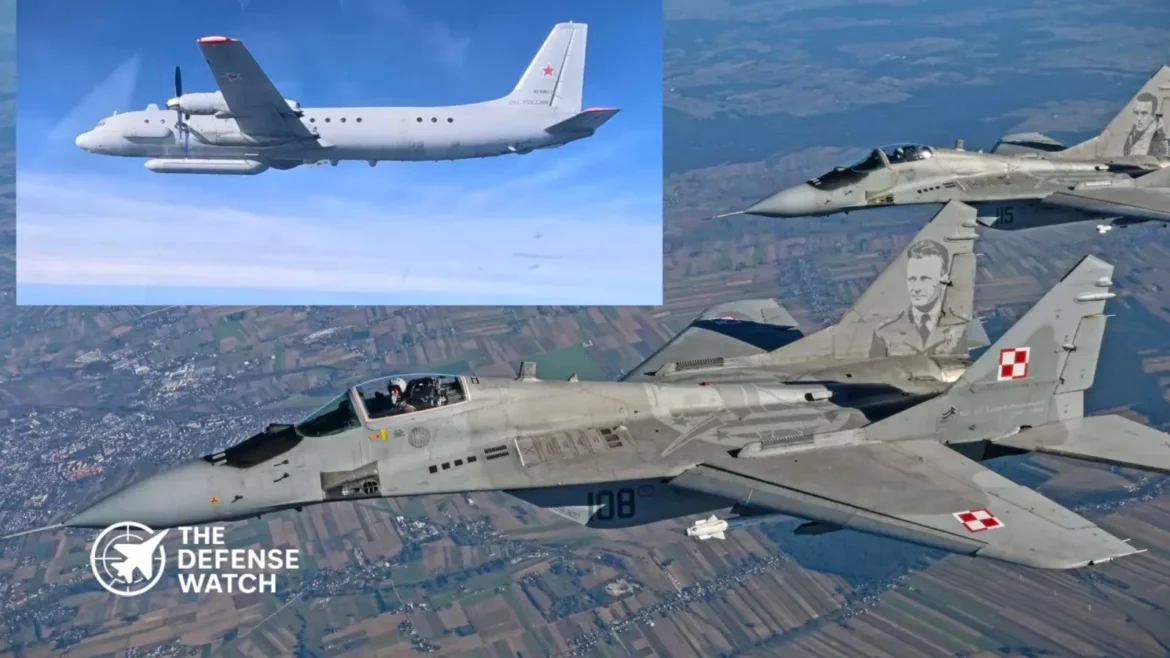
- Polish Air Force MiG-29 fighters intercepted a Russian Il-20 reconnaissance aircraft over the Baltic region.
- The Il-20 is a signals intelligence platform designed for electronic surveillance and battlefield awareness.
- The intercept reflects increasing NATO-Russia intelligence competition near allied airspace.
- Incident occurred amid ongoing NATO air policing missions and heightened regional alert levels in 2026.
- The encounter underscores persistent ISR activity shaping the Baltic security environment.
Polish MiG-29 Intercept Russian Il-20 Highlights Rising Baltic Tensions
The Polish MiG-29 intercept Russian Il-20 incident underscores growing intelligence competition over the Baltic Sea, as NATO air policing forces respond to increased Russian surveillance activity near allied airspace.
The Big Picture
NATO’s eastern flank has become a focal point for persistent air and electronic surveillance operations since the escalation of tensions with Russia following the Ukraine war.
Baltic airspace now serves as a contested intelligence environment. NATO allies routinely scramble fighters to monitor Russian aircraft operating near or along alliance boundaries. These missions are part of a broader deterrence posture designed to maintain situational awareness and signal readiness.
Poland plays a central role in this effort. Its air force supports NATO’s Baltic Air Policing mission while also defending national airspace. The continued use of legacy Soviet-era platforms such as the MiG-29 alongside newer Western systems reflects a transitional force structure adapting to evolving threats.
What’s Happening
Polish Air Force MiG-29 fighters intercepted a Russian Il-20 reconnaissance aircraft during a recent mission over the Baltic region.
The Russian Il-20, a modified electronic intelligence aircraft, conducted a flight pattern consistent with signals collection near NATO airspace. Polish authorities scrambled their aircraft in response, in line with standard NATO quick reaction alert procedures.
The intercept occurred in international airspace but close enough to NATO territory to trigger monitoring and escort actions. Such encounters remain routine but carry operational significance due to the sensitive nature of ISR activity.
The Il-20 platform is equipped with radar and electronic surveillance systems designed to collect communications and emissions data. These capabilities allow Russia to map NATO radar coverage, track aircraft movements, and assess response times.
Why It Matters
The Polish MiG-29 intercept Russian Il-20 event highlights the central role of intelligence gathering in modern military competition.
ISR missions like those conducted by the Il-20 provide critical data that can shape future operations. By probing NATO air defenses, Russia can identify vulnerabilities and refine electronic warfare tactics.
For NATO, intercepting these aircraft ensures transparency and control. It prevents unmonitored surveillance near sensitive areas and reinforces the credibility of allied air defense systems.
The encounter also reflects the normalization of close military interactions in contested airspace. While professional and controlled, these operations increase the risk of miscalculation if procedures are not strictly followed.
Strategic Implications
Persistent ISR activity over the Baltic region strengthens Russia’s situational awareness while testing NATO readiness.
NATO’s response, including rapid interception by Polish MiG-29 fighters, demonstrates operational discipline and alliance cohesion. It sends a clear signal that allied airspace remains actively defended.
The interaction also contributes to a broader pattern of strategic signaling. Russia uses reconnaissance flights to assert presence and gather intelligence. NATO uses intercepts to reinforce deterrence without escalation.
This dynamic creates a continuous cycle of observation and response, shaping the regional balance of power.
Competitor View
Russia likely views these missions as essential for maintaining visibility into NATO force posture and movements.
From Moscow’s perspective, the Il-20 provides a relatively low-risk method of collecting valuable intelligence without crossing into NATO airspace. The presence of intercepting fighters is expected and factored into mission planning.
At the same time, Russia may interpret frequent NATO intercepts as confirmation of heightened alert levels and defensive sensitivity along the alliance’s eastern flank.
Other actors, including China, observe these interactions as part of broader lessons on ISR competition and airspace management between major military blocs.
What To Watch Next
NATO will likely continue to increase the tempo of air policing missions across the Baltic region.
Poland is also advancing modernization efforts, including transitioning from MiG-29 fighters to more advanced platforms such as the F-35. This shift will enhance detection, tracking, and response capabilities against ISR aircraft.
Future encounters may involve more advanced aircraft and electronic warfare measures, reflecting the evolving nature of aerial surveillance competition.
Monitoring changes in flight frequency, routes, and escort behavior will provide insight into shifting operational patterns.
Capability Gap
The continued reliance on MiG-29 aircraft highlights a capability gap in legacy platform survivability and sensor integration.
While effective for interception, the MiG-29 lacks the advanced sensor fusion and networked warfare capabilities of fifth-generation fighters. This limits its ability to fully exploit or counter sophisticated ISR platforms like the Il-20.
Poland’s ongoing modernization aims to close this gap by integrating stealth aircraft and advanced command and control systems.
However, until the transition is complete, NATO operations will depend on a mix of legacy and modern assets.
The Bottom Line
The Polish MiG-29 intercept Russian Il-20 incident reflects a sustained and intensifying intelligence contest over the Baltic that is shaping NATO’s deterrence posture.

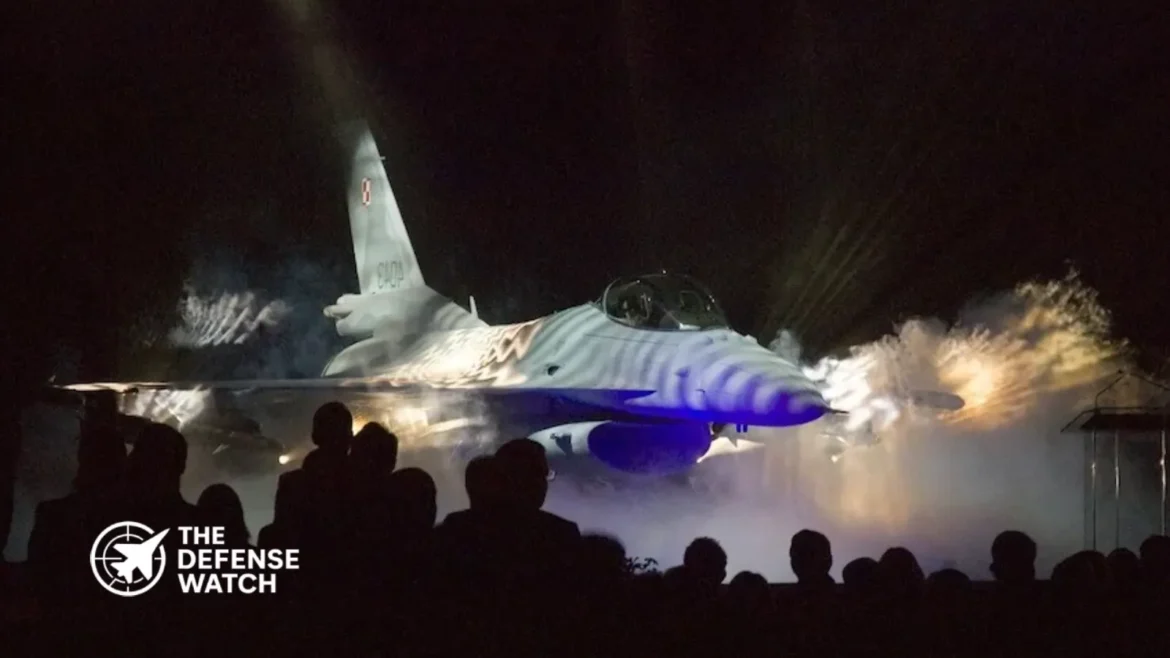
- Poland has operated F-16 fighter jets for 20 years, forming the backbone of its modern air force.
- The fleet supports NATO missions, including air policing and joint exercises in Eastern Europe.
- Lockheed Martin highlights interoperability and modernization as key advantages of the platform.
- Polish F-16s have been upgraded to maintain compatibility with evolving NATO standards.
- The milestone reflects Poland’s growing role in NATO’s eastern flank defense strategy.
Polish F-16 Service Strengthens NATO Airpower
The Polish F-16 service NATO milestone has reached a significant point as Poland marks 20 years of operating its F-16 fighter fleet, with Lockheed Martin emphasizing the aircraft’s role in strengthening NATO airpower and regional security. Since entering service in the mid-2000s, Poland’s F-16s have become a central pillar of its air defense and a key contributor to alliance operations across Eastern Europe.
According to the original report, Lockheed Martin highlighted how Poland’s investment in the F-16 platform has enhanced interoperability within NATO while ensuring a credible deterrent posture along the alliance’s eastern flank.
Two Decades of Polish F-16 Operations
Poland introduced the F-16 Fighting Falcon as part of a broader modernization effort to transition from Soviet-era platforms to NATO-compatible systems. The aircraft quickly became a cornerstone of the Polish Air Force, enabling the country to participate fully in allied missions and joint operations.
Over the past two decades, Polish F-16s have taken part in air policing missions, multinational exercises, and deterrence operations. Their presence has been particularly important in reinforcing NATO’s eastern defenses, especially amid heightened tensions in Eastern Europe.
The aircraft’s multirole capability allows Poland to conduct air superiority, ground attack, and reconnaissance missions using a single platform. This flexibility has proven critical as NATO adapts to a more complex threat environment that includes both conventional and hybrid warfare.
Interoperability and NATO Integration
One of the most important aspects of the Polish F-16 service NATO framework is interoperability. From the outset, Poland’s F-16 fleet was designed to integrate seamlessly with NATO command structures, communication systems, and operational procedures.
This compatibility allows Polish pilots to operate alongside other NATO air forces without technical or procedural barriers. Joint exercises, such as large-scale air drills across Europe, have further strengthened coordination and readiness.
Lockheed Martin noted that the F-16 platform continues to evolve through upgrades in avionics, weapons integration, and data-sharing capabilities. These enhancements ensure that the aircraft remains relevant in modern network-centric warfare environments.
Modernization and Capability Enhancements
To maintain operational effectiveness, Poland has pursued continuous upgrades to its F-16 fleet. These improvements include advanced radar systems, precision-guided munitions, and enhanced electronic warfare capabilities.
Modernization efforts also focus on improving survivability and mission effectiveness in contested environments. As threats evolve, particularly in the form of advanced air defense systems and electronic warfare, maintaining a technological edge remains essential.
The ongoing upgrades align with NATO’s broader push to modernize its air forces and ensure collective defense capabilities remain credible. Poland’s commitment to upgrading its F-16s reflects a long-term strategy to sustain high readiness levels.
Strategic Importance for Eastern Europe
Poland’s geographic position places it at the center of NATO’s eastern flank, making its airpower capabilities especially critical. The Polish F-16 service NATO framework contributes directly to regional stability by providing rapid response and deterrence capabilities.
The presence of a capable and modern air force helps deter potential adversaries and reassures neighboring NATO members. In recent years, the importance of airpower in Eastern Europe has grown significantly due to shifting geopolitical dynamics.
Poland’s F-16 fleet also supports rotational deployments and allied exercises, reinforcing NATO’s collective defense posture. This role has become increasingly important as the alliance seeks to maintain readiness in a rapidly changing security environment.
Analysis: Why the F-16 Still Matters in NATO
Even as fifth-generation aircraft like the F-35 Lightning II enter service, the F-16 remains a critical asset for NATO. Its proven reliability, lower operating costs, and upgrade potential make it a practical choice for many member states.
For Poland, the F-16 provides a balance between capability and affordability. While newer platforms offer advanced stealth features, the F-16 continues to deliver strong performance in most operational scenarios, especially when supported by modern upgrades.
This layered approach, combining legacy platforms with next-generation systems, reflects NATO’s broader strategy. It allows the alliance to maintain a large, capable force while gradually integrating more advanced technologies.
Analysis: Long-Term Implications for NATO Airpower
Looking ahead, Poland’s experience with the F-16 highlights the importance of sustained investment in airpower. Rather than relying solely on new acquisitions, continuous modernization of existing fleets can deliver significant strategic value.
The Polish F-16 service NATO model demonstrates how mid-life upgrades can extend the operational life of aircraft while maintaining high levels of readiness. This approach is particularly relevant for countries balancing budget constraints with growing security demands.
At the same time, Poland’s ongoing defense investments, including future integration of advanced platforms, suggest a dual-track strategy. Maintaining a strong F-16 fleet while preparing for next-generation capabilities ensures long-term resilience within NATO.
FAQs
How long has Poland operated F-16 fighter jets?Poland has operated F-16 aircraft for approximately 20 years since their introduction in the mid-2000s.
Why are Polish F-16s important for NATO?They enhance interoperability, support joint missions, and strengthen NATO’s eastern flank defense.
Are Poland’s F-16s still modern?Yes, they have undergone continuous upgrades to remain compatible with modern NATO standards.
Will Poland replace its F-16 fleet?Poland is adding newer platforms but is expected to keep upgraded F-16s in service for years.
What role do F-16s play in modern warfare?They provide multirole capabilities including air defense, strike missions, and reconnaissance.
 ¦ KEY FACTS AT A GLANCE
- NASA is preparing the X-59 aircraft for upcoming low-boom flight tests.
- The aircraft is designed to reduce sonic boom noise to a quiet thump.
- Data from test flights will inform future global supersonic flight regulations.
- Community overflight tests will gather public response to low-boom noise levels.
- The program could enable commercial supersonic travel over land for the first time in decades.
NASA X-59 Test Flights Mark Critical Step Toward Quiet Supersonic Travel
The NASA X-59 test flights represent a major milestone in the effort to enable quiet supersonic flight, with NASA preparing to demonstrate its low-boom aircraft to media and stakeholders ahead of operational testing.
NASA confirmed that the X-59, developed under the Quesst mission, will soon enter a new phase of flight testing designed to validate its ability to significantly reduce the disruptive sonic boom associated with supersonic travel.
The Big Picture
Supersonic flight over land has remained largely restricted since the late 20th century due to noise concerns. Traditional aircraft like the Concorde generated loud sonic booms that led regulators to prohibit routine overland supersonic operations.
The X-59 program directly addresses this long-standing limitation. It forms part of a broader U.S. push to modernize aerospace capabilities and reestablish leadership in high-speed aviation.
Low-boom technology has implications beyond commercial travel. It supports military research into survivability, rapid response, and reduced acoustic signatures for high-speed platforms.
What’s Happening
NASA is inviting media to observe the upcoming X-59 test flight campaign, which will take place at its flight research facilities. The aircraft has already completed ground testing and is transitioning toward initial flight operations.
The X-59 features a highly elongated nose and advanced aerodynamic shaping designed to disperse shockwaves. Instead of a sharp sonic boom, the aircraft is expected to produce a quieter “sonic thump.”
Following initial flights, NASA plans to conduct community overflight tests across multiple U.S. locations. These tests will measure how people perceive the reduced noise signature.
The collected data will be shared with regulators, including the Federal Aviation Administration and international aviation bodies, to inform future policy decisions.
Why It Matters
The NASA X-59 test flights could redefine the future of civil aviation. If the aircraft meets its performance goals, regulators may reconsider bans on supersonic flight over land.
This would open new commercial routes and significantly reduce travel times. For example, transcontinental flights could be shortened by several hours.
From a defense perspective, the ability to manage acoustic signatures at high speeds offers clear operational benefits. Reduced noise improves mission discretion and could expand operational flexibility in contested environments.
Strategic Implications
The X-59 program strengthens U.S. technological leadership in advanced aerodynamics and flight testing. It reinforces the role of government-led research in shaping global aviation standards.
Quiet supersonic capability also supports future military aviation concepts. Aircraft that can travel faster than sound without revealing their position through loud booms offer a tactical advantage.
The program may also influence allied nations. NATO partners and close U.S. allies could adopt similar technologies or align their regulatory frameworks with U.S. standards.
Competitor View
China and Russia continue to invest in high-speed aviation, including hypersonic systems and next-generation fighters.
Both countries are likely to monitor the NASA X-59 test flights closely. While their focus remains heavily military, the ability to reduce acoustic signatures has dual-use implications.
China, in particular, has shown interest in commercial supersonic concepts. A successful U.S. demonstration could accelerate competing programs or drive parallel regulatory efforts.
Russia, with its legacy in supersonic aviation, may view the X-59 as a validation of renewed interest in high-speed civilian flight.
What To Watch Next
The next phase involves first flight operations, followed by envelope expansion testing. Engineers will validate handling, stability, and acoustic performance.
Community overflight campaigns will mark a critical milestone. These tests will provide real-world data on public perception, a key factor in regulatory approval.
Regulatory engagement will follow. Authorities will review the data to determine whether current restrictions on supersonic overland flight should be updated.
Capability Gap
The X-59 addresses a clear gap in aviation. Current supersonic aircraft cannot operate over land without violating noise regulations.
By reducing sonic boom intensity, the aircraft aims to make supersonic travel socially acceptable and operationally viable.
However, limitations remain. The X-59 is a demonstrator, not a commercial platform. Scaling the technology for widespread airline use will require further investment, certification, and economic validation.
The Bottom Line
NASA X-59 test flights could unlock quiet supersonic travel and reshape both civilian aviation and future high-speed military operations.
¦ KEY FACTS AT A GLANCE- Baykar has unveiled the AI powered K2 kamikaze drone designed for long range precision strike missions.
- The drone reportedly features autonomous navigation, AI based targeting, and swarm operation capability.
- The system is designed to strike targets more than 2,000 kilometers away while carrying a heavy warhead.
- K2 can operate from short or unprepared runways, expanding launch flexibility for dispersed operations.
- The platform reflects Turkey’s continued push into AI enabled unmanned strike warfare.
Baykar K2 Kamikaze Drone Expands Turkey’s AI Enabled Strike Arsenal
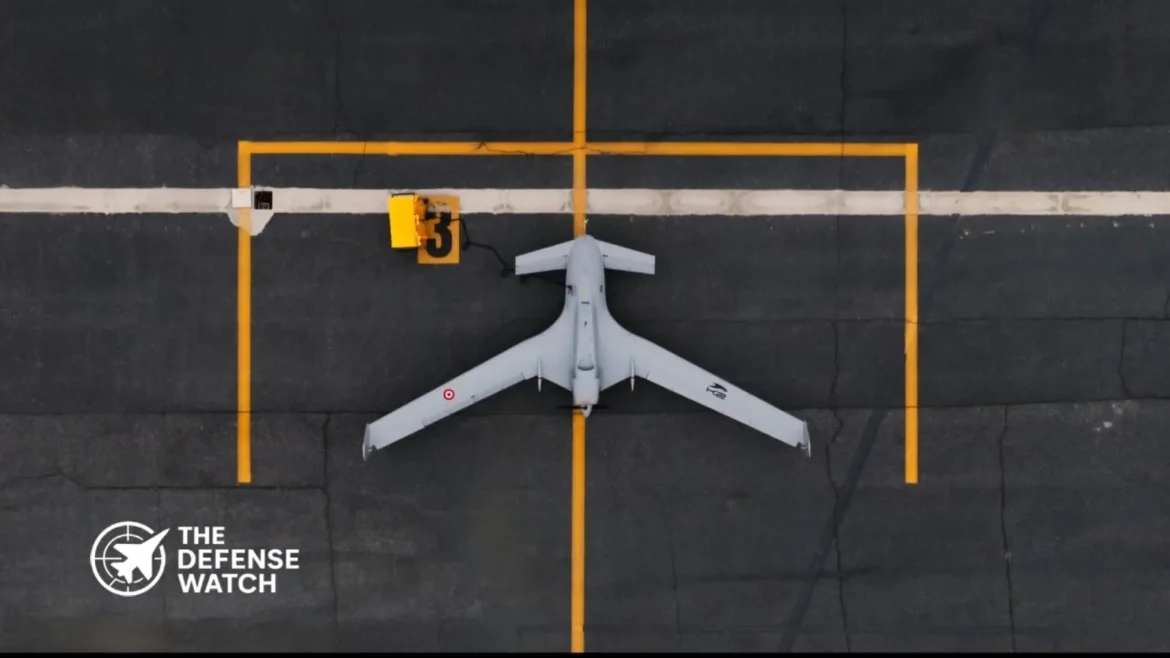
The AI powered K2 kamikaze drone has been introduced by Turkish defense company Baykar as part of the country’s growing portfolio of autonomous strike systems. The new platform is designed to conduct long range precision attacks using artificial intelligence assisted navigation, target recognition, and autonomous mission capabilities.
Baykar revealed the system as part of its expanding unmanned warfare ecosystem, which already includes combat drones such as the Bayraktar TB2 and the heavier AKINCI unmanned combat aerial vehicle.
The K2 represents a shift toward larger, longer range loitering munitions capable of conducting deep strike missions against high value targets.
The Big Picture
Autonomous loitering munitions have become a defining feature of modern warfare. Conflicts in Ukraine, the Middle East, and the Caucasus have demonstrated the growing role of expendable strike drones capable of penetrating defenses and striking critical infrastructure.
Nations are now developing larger and more sophisticated systems that combine the persistence of UAVs with the destructive effect of cruise missiles.
Turkey has emerged as one of the leading exporters and developers of unmanned systems in the past decade. Baykar alone generated roughly $1.8 billion in exports in recent years and has delivered UAV systems to dozens of countries, strengthening Turkey’s position in the global drone market.
The introduction of the AI powered K2 kamikaze drone reflects Ankara’s continued investment in autonomous strike technologies designed for both domestic defense and international export markets.
What’s Happening
Baykar has unveiled the K2 kamikaze drone, a large loitering munition designed to conduct autonomous long range strike missions.
According to reported specifications, the drone is capable of striking targets at distances exceeding 2,000 kilometers while carrying a warhead of roughly 200 kilograms. The platform has a maximum takeoff weight around 800 kilograms and can operate for extended periods before engaging its target.
The drone incorporates artificial intelligence based systems that allow it to:
• Navigate using visual terrain recognition
• Identify and track targets autonomously
• Coordinate with other drones during swarm missionsThe system is designed to take off from short or unprepared runways, allowing forces to launch missions from dispersed locations rather than fixed air bases.
Baykar says the AI architecture allows the drone to maintain mission capability even in contested electronic warfare environments where GPS signals may be degraded.
Why It Matters
The AI powered K2 kamikaze drone represents a notable step in the evolution of loitering munition technology.
Early loitering munitions typically carried small warheads and operated within relatively short ranges. Systems like the K2 combine extended range, heavier payloads, and AI assisted targeting, moving the concept closer to a reusable autonomous strike aircraft.
This capability offers several operational advantages:
First, the long range allows forces to strike strategic targets deep behind enemy lines without deploying manned aircraft.
Second, autonomous navigation and AI target recognition reduce reliance on constant operator control.
Third, swarm coordination allows multiple drones to overwhelm air defense systems through saturation tactics.
These features align with broader trends in military modernization, where autonomous systems increasingly support precision strike missions.
Strategic Implications
Turkey’s continued expansion into AI enabled drone warfare has clear implications for regional and global security dynamics.
The country has already demonstrated the battlefield impact of UAV systems through deployments in Syria, Libya, and Nagorno Karabakh.
Adding longer range autonomous strike drones could expand Turkey’s ability to conduct deep precision strikes while limiting risk to pilots and high value aircraft.
For NATO, Turkey’s drone industry provides an additional source of advanced unmanned systems within the alliance. At the same time, Ankara’s export policy means these technologies may appear in multiple regional security environments.
The K2 also signals a broader shift toward autonomous strike networks where UAVs, loitering munitions, and AI enabled sensors operate together.
Competitor View
Other major powers are pursuing similar capabilities.
Iran has fielded long range loitering munitions such as the Shahed 136, which have been widely used in the Ukraine conflict.
Israel pioneered the concept with systems such as the Harop loitering munition, designed to attack radar systems and air defense networks.
China and Russia are also investing heavily in autonomous swarm drones and AI assisted strike platforms.
The emergence of systems like the AI powered K2 kamikaze drone suggests that long range loitering munitions will remain a key focus area in the evolving unmanned warfare landscape.
What To Watch Next
Several developments will determine the operational impact of the K2 system.
First, flight testing and operational trials will reveal the platform’s true performance in contested electronic warfare environments.
Second, integration with existing Turkish UAV platforms and command networks could enable coordinated drone operations.
Third, export interest will likely emerge quickly given Baykar’s established international customer base.
Countries already operating Baykar drones may view the K2 as a complementary deep strike capability.
Capability Gap
The K2 system appears designed to address a key operational challenge faced by many militaries: conducting long range precision strikes without relying on expensive cruise missiles or risking manned aircraft.
Loitering munitions fill the gap between traditional UAV surveillance platforms and high cost missile systems.
However, systems like the K2 also face limitations. Large drones remain vulnerable to layered air defense networks that combine radar, missiles, and electronic warfare systems.
Operational effectiveness will therefore depend on tactics such as swarm deployment, electronic warfare integration, and coordinated strikes.
The Bottom Line
The AI powered K2 kamikaze drone highlights Turkey’s growing ambition to lead the next generation of autonomous long range strike systems.
¦ KEY FACTS AT A GLANCE- U.S. Central Command released imagery showing armed A-10 Warthog aircraft supporting Operation Epic Fury.
- The aircraft were observed carrying air-to-ground weapons including AGM-65 Maverick missiles and guided rockets.
- The deployment highlights the role of persistent close air support platforms in the campaign against Iranian military targets.
- Operation Epic Fury began February 28, 2026 and involves extensive U.S. and allied air and naval assets.
- The operation targets Iran’s missile infrastructure, command centers, and naval forces.
A-10 Warthog Supports Operation Epic Fury Against Iran
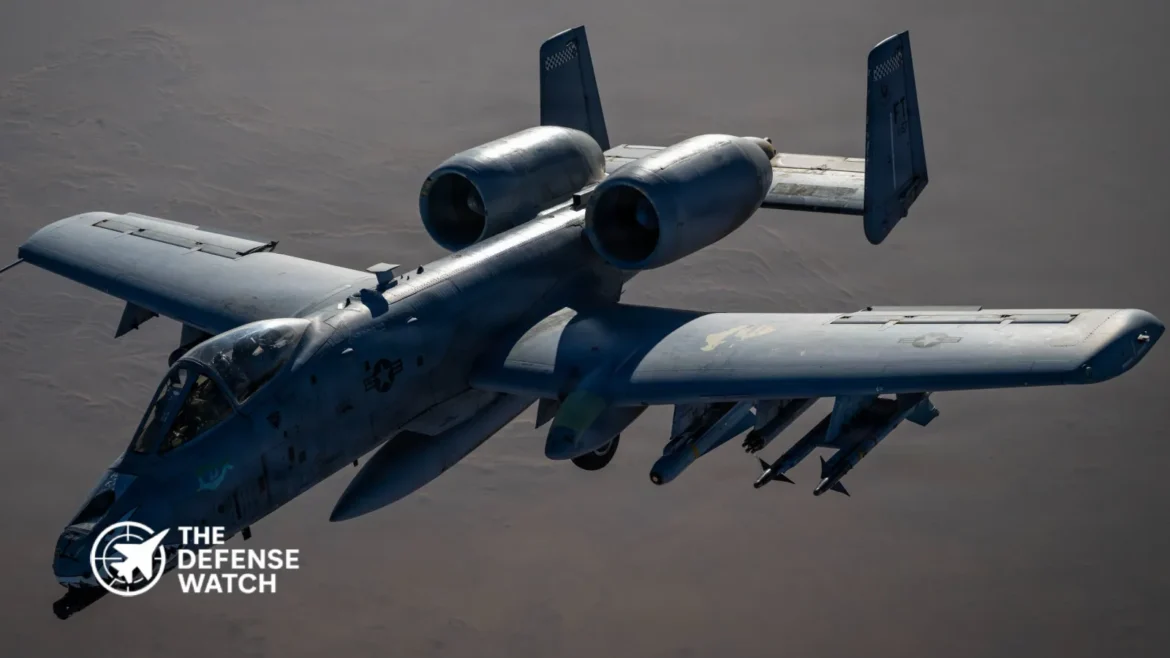
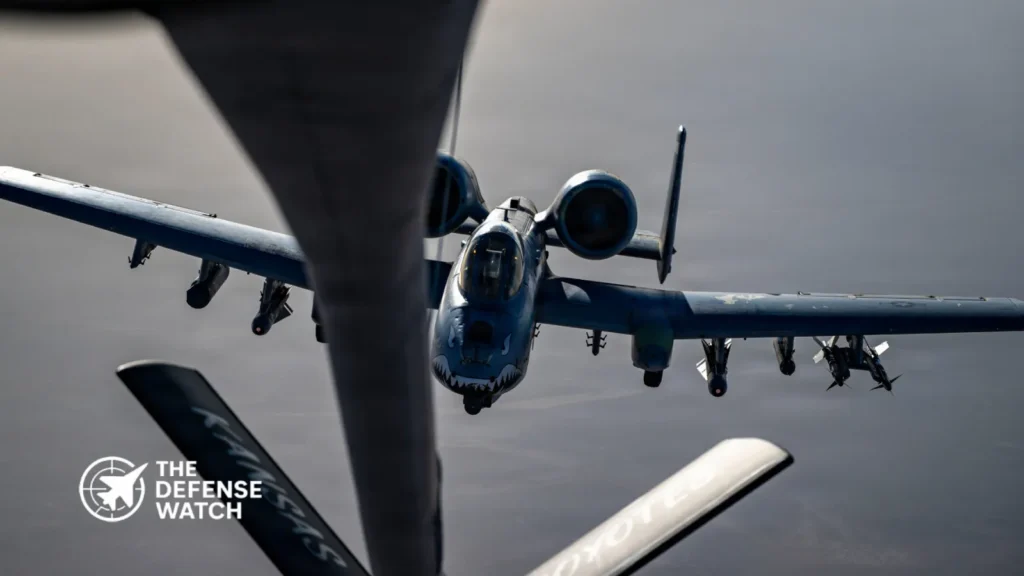
The A-10 Warthog Operation Epic Fury mission has entered public view after U.S. Central Command released imagery showing armed A-10 Thunderbolt II attack aircraft operating in support of the ongoing campaign against Iran. The aircraft were photographed refueling in flight while carrying combat loadouts, underscoring their role in sustained air operations over the region.
CENTCOM published the imagery on its official social media channels, highlighting the aircraft’s ability to remain on station for extended periods while providing rapid-response strike capability. The disclosure confirms that the U.S. Air Force’s iconic close air support platform continues to play a role in the expanding military operation launched in late February.
Operation Epic Fury began on February 28, 2026, as a large-scale U.S. led campaign targeting Iranian military infrastructure considered to pose an imminent threat to regional security. The operation combines air strikes, maritime operations, electronic warfare, and missile defense activities across the broader Middle East theater.
The Big Picture
Operation Epic Fury represents one of the most complex U.S. military campaigns in the Middle East in recent years. The operation integrates stealth bombers, advanced fighter aircraft, electronic warfare platforms, drones, and naval strike assets in a coordinated effort to degrade Iran’s military capabilities.

Image Source: U.S. CENTCOM U.S. Central Command has confirmed the use of a broad range of systems including B-2 and B-1 bombers, F-22 and F-35 stealth fighters, F-15 and F-16 tactical aircraft, A-10 attack jets, and MQ-9 Reaper drones. Naval forces and missile defense systems such as Patriot and THAAD are also involved in the broader operational architecture.
This combination reflects a layered approach to modern air warfare. Stealth aircraft and electronic attack platforms suppress air defenses, while conventional fighters and attack aircraft sustain pressure on targets once the most dangerous defenses are neutralized.
Within that structure, the A-10 Warthog fills a specialized but still important operational niche.
What’s Happening
CENTCOM imagery released in March 2026 shows an armed A-10 Thunderbolt II operating in support of Operation Epic Fury. The aircraft was photographed during an aerial refueling sequence, a routine procedure that extends its endurance during combat operations.
The visible loadout suggests a multi role configuration. Weapons reportedly include AGM-65 Maverick air to ground missiles and precision guided rockets, along with short range air to air missiles for self defense. This configuration allows the aircraft to engage a range of targets including vehicles, mobile missile launchers, and lightly defended infrastructure.
The A-10’s presence in the campaign highlights its ability to remain over a battlefield for extended periods. Unlike high performance fighters designed primarily for short strike missions, the Warthog can loiter for hours while providing armed overwatch for ground forces or strike opportunities.
The broader campaign has already targeted Iranian command centers, ballistic missile facilities, air defense systems, and naval assets. Early phases of the operation reportedly struck multiple vessels and key elements of Iran’s military command structure.
Why It Matters
The use of the A-10 Warthog in Operation Epic Fury illustrates the continued relevance of specialized close air support aircraft in modern conflicts.
Despite decades of technological evolution in stealth aviation and precision strike capabilities, many combat scenarios still require persistent air presence rather than high speed strike missions. The A-10 was designed precisely for that mission profile.
Its ability to fly slowly at low altitude, identify targets visually, and deliver precise firepower makes it particularly effective against dispersed or mobile targets. These include vehicle convoys, missile launchers, or irregular ground units that may not be easily engaged by long range precision weapons.
In the context of the Iran campaign, such capabilities are especially valuable for targeting mobile missile systems or logistics movements after the initial wave of strategic strikes has degraded major infrastructure.
The aircraft also carries the GAU-8 Avenger 30 mm cannon, one of the most powerful aircraft mounted guns ever fielded, designed to destroy armored vehicles and hardened targets.
Strategic Implications
The A-10 Warthog Operation Epic Fury deployment demonstrates how the United States continues to combine legacy platforms with advanced systems in modern combat operations.
Stealth bombers and fifth generation fighters open access to heavily defended airspace. Once those defenses are suppressed, aircraft such as the A-10 provide sustained pressure against remaining targets.
This layered strategy maximizes operational efficiency. High end stealth aircraft focus on the most heavily defended or strategically important targets, while lower cost platforms conduct follow on missions and battlefield persistence.
For the United States, this approach also reduces operational costs. Using an A-10 for certain strike missions can be significantly cheaper than deploying a stealth fighter for the same target set.
Competitor View
Iran and other potential adversaries closely watch the composition of U.S. air operations in campaigns such as Operation Epic Fury.
From a strategic perspective, the presence of A-10 aircraft signals that the United States believes it has achieved at least partial air superiority in portions of the battlespace. The A-10 is most effective when advanced surface to air threats are limited or suppressed.
For Iran’s military planners, this development likely indicates that key elements of their integrated air defense network have been degraded by earlier strikes from stealth aircraft, cruise missiles, and electronic warfare systems.
Other strategic competitors, including Russia and China, analyze such operations for lessons in how the United States integrates different aircraft types in large scale air campaigns.
What To Watch Next
The next phase of Operation Epic Fury will likely focus on sustained strike operations against remaining Iranian military capabilities.
Key indicators to monitor include:
• Expanded use of unmanned systems for persistent surveillance and strike
• Follow on strikes targeting mobile missile launchers
• Additional carrier air wing operations in the region
• Continued aerial refueling operations supporting long duration missionsAs the campaign evolves, the U.S. military may adjust the mix of aircraft involved depending on threat levels and mission requirements.
Capability Gap
The deployment of A-10 aircraft also highlights a persistent capability gap in many modern air forces: affordable, long endurance close air support platforms.
While fifth generation fighters offer unmatched stealth and sensor capabilities, they are expensive to operate and not optimized for extended loiter missions over ground battlefields.
The A-10 was specifically designed to fill that role. Its survivability features, including armor around the cockpit and redundant systems, allow it to operate in contested environments where other aircraft might face greater risk.
However, the platform also has limitations. It lacks stealth characteristics and remains vulnerable to advanced air defense systems if those systems are fully operational.
For this reason, the aircraft typically operates only after the most dangerous threats have been suppressed.
The Bottom Line
The A-10 Warthog Operation Epic Fury deployment highlights how the United States continues to rely on a layered mix of advanced and legacy aircraft to sustain air dominance and precision strike capability in modern conflicts.
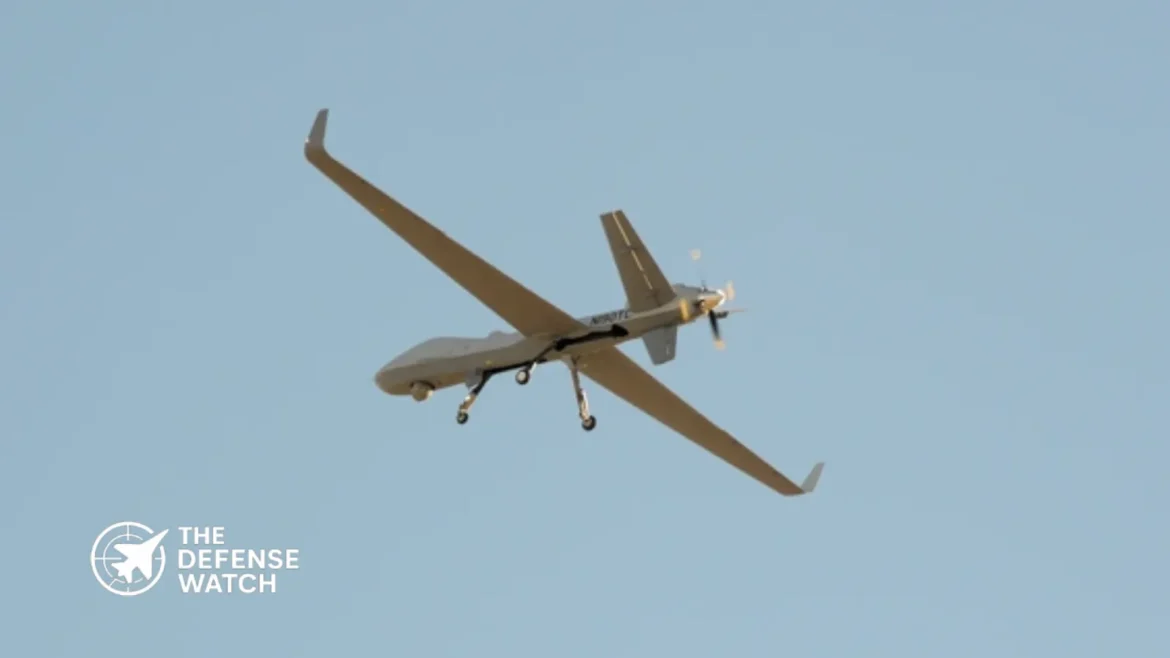
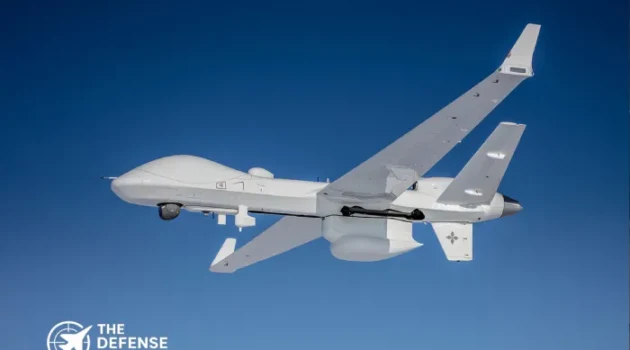
¦ KEY FACTS AT A GLANCE- General Atomics is studying integration of long-range cruise missiles on the MQ-9B SkyGuardian and SeaGuardian drones.
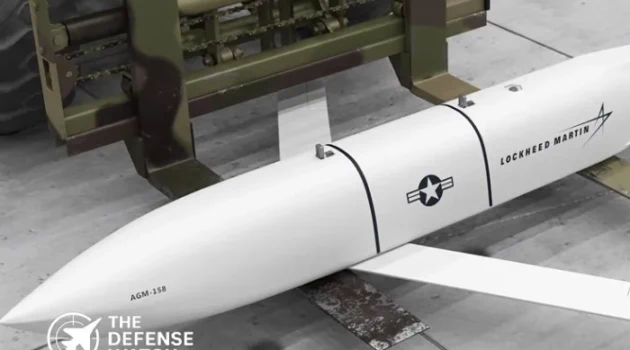
- Candidate weapons include the AGM-158 JASSM, AGM-158C LRASM, and the Joint Strike Missile (JSM).
- The capability aims to expand MQ-9B missions from ISR to long-range maritime and land strike.
- General Atomics plans to test flight integration of at least one of these weapons as early as 2026.
- The concept supports distributed operations across vast theaters such as the Western Pacific.
MQ-9B Long Range Missile Integration Expands Drone Strike Potential
MQ-9B long range missile integration is being explored by General Atomics Aeronautical Systems Inc. as the company examines ways to equip its flagship unmanned aircraft with advanced cruise missiles such as the AGM-158 Joint Air-to-Surface Standoff Missile (JASSM), AGM-158C Long-Range Anti-Ship Missile (LRASM), and the Joint Strike Missile (JSM).
The initiative aims to expand the MQ-9B SkyGuardian and SeaGuardian platforms beyond their traditional intelligence, surveillance, and reconnaissance roles and into long-range precision strike missions.
If successful, the integration would mark a major shift in how medium-altitude long-endurance (MALE) drones contribute to high-end combat operations.
The Big Picture
U.S. and allied militaries increasingly seek distributed strike capabilities that can operate across large geographic areas without relying solely on manned aircraft.
Platforms capable of launching long-range precision weapons from outside hostile air defense zones are becoming central to modern operational concepts. The Indo-Pacific theater in particular presents vast distances that complicate traditional force projection.
Unmanned aircraft like the MQ-9B offer several advantages in this environment. They can remain airborne for extended periods, operate at relatively low cost compared with manned strike aircraft, and maintain persistent surveillance over potential targets.
Adding cruise missiles to such platforms effectively transforms them into long-range strike nodes within a distributed network of sensors and shooters.
What’s Happening
General Atomics announced in February 2026 that it is developing the ability for the MQ-9B to carry extended-range precision weapons.
Engineers are evaluating how the aircraft’s payload capacity, aerodynamic stability, range, and mission systems can support heavier weapons such as:
- AGM-158 JASSM long-range land-attack missile
- AGM-158C LRASM anti-ship missile
- Joint Strike Missile developed by Kongsberg and Raytheon
These weapons would allow the MQ-9B to engage heavily defended land targets or high-value naval assets from significant stand-off distances.
General Atomics said it intends to conduct flight testing with at least one of the missile types as early as 2026.
The company is examining how the additional weight and aerodynamic loads of these weapons affect the aircraft’s performance envelope.
Why It Matters
Equipping MQ-9B drones with long-range cruise missiles would significantly expand the operational role of unmanned aircraft in high-intensity conflict.
Traditionally, MQ-9 family drones have focused on ISR missions and limited precision strikes using smaller weapons such as Hellfire missiles or guided bombs. Integrating cruise missiles capable of traveling hundreds of kilometers changes that model.
Instead of operating near the battlefield, MQ-9B drones could remain well outside contested airspace while still delivering precision strikes.
This approach offers several advantages:
Persistent targeting capability
Lower operational cost compared with manned aircraft
Reduced risk to pilots
Greater flexibility for distributed operationsThe concept also aligns with emerging U.S. military doctrines emphasizing networked kill chains and multi-domain operations.
Strategic Implications
The addition of long-range cruise missiles could transform the MQ-9B into a distributed strike platform capable of supporting joint and coalition operations.
In maritime scenarios, an MQ-9B equipped with LRASM or JSM could help locate and engage hostile naval forces while coordinating with surface ships, submarines, and aircraft.
In land warfare, JASSM integration would allow the drone to target high-value infrastructure, command nodes, or air defense systems from extended distances.
Because the MQ-9B can remain airborne for many hours, it could loiter in designated areas waiting for targeting data before launching weapons.
This persistence provides commanders with additional flexibility compared with traditional strike aircraft that must return to base more frequently.
Competitor View
China and Russia closely monitor developments in unmanned strike capabilities, particularly those that enable long-range precision attacks.
Both countries have invested heavily in integrated air defense systems designed to deny access to contested regions. Weapons launched from outside these defensive envelopes complicate those strategies.
From Beijing’s perspective, MQ-9B platforms equipped with anti-ship missiles could enhance allied maritime strike capabilities in the Western Pacific. Such systems could contribute to distributed maritime operations targeting naval assets at extended ranges.
Moscow is also expanding its own unmanned strike programs, including long-range drones and cruise missile carriers.
The global competition in unmanned combat capabilities continues to accelerate as states seek cost-effective alternatives to traditional airpower.
What To Watch Next
Several milestones will determine whether the MQ-9B long range missile concept becomes operational.
First, engineers must validate the aircraft’s ability to safely carry and release heavier cruise missiles without compromising flight stability.
Second, integration with targeting networks and command systems will be critical. Long-range weapons require accurate targeting data that often comes from multiple sensors across the battlefield.
Third, export customers may influence the program’s trajectory. Many MQ-9B operators, including the United Kingdom, Japan, and India, could benefit from expanded strike capabilities.
Future demonstrations in 2026 will provide the first real indication of how viable the concept is in operational terms.
Capability Gap
Modern military planners face a growing challenge in maintaining persistent strike options across large theaters while minimizing risk to manned aircraft.
Traditional fighter aircraft provide speed and survivability but have limited endurance compared with unmanned platforms.
Meanwhile, surveillance drones provide persistence but historically lacked heavy strike capability.
Arming the MQ-9B with cruise missiles attempts to bridge that gap.
However, limitations remain. The drone’s speed and survivability are lower than those of stealth fighters, making it unsuitable for penetrating heavily defended airspace. Its role would likely focus on stand-off launch positions outside contested zones.
The Bottom Line
Integrating long-range cruise missiles on the MQ-9B could transform the drone from a surveillance platform into a persistent standoff strike asset for modern distributed warfare.
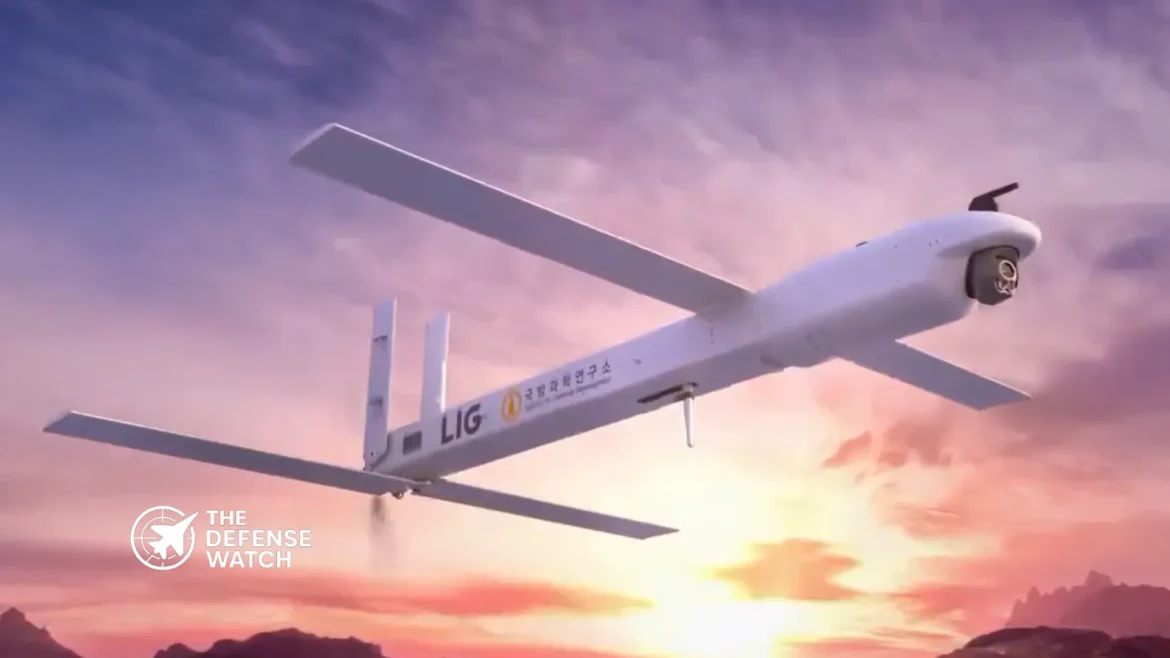
KEY FACTS AT A GLANCE- South Korea’s Agency for Defense Development plans to complete the S-9 swarm drone development in October.
- The S-9 system uses dozens of coordinated drones equipped with AI-based automatic target recognition capabilities.
- The drone swarm can conduct reconnaissance, strike, re-attack, and recovery missions in coordinated formations.
- South Korean defense contractor LIG Nex1 is developing the system alongside ADD as part of the S-series drone program.
- The system can also operate in a rocket artillery style mass launch configuration for saturation attacks.
South Korea’s S-9 Swarm Drone Program Approaches Development Milestone
South Korea’s S-9 swarm drone program is approaching a key development milestone as the country’s Agency for Defense Development (ADD) plans to complete the system’s development in October this year. The project, developed in cooperation with South Korean defense contractor LIG Nex1, represents a significant step toward operational autonomous drone swarm capabilities within the Republic of Korea’s military modernization strategy.
The S-9 is part of ADD’s broader S-series unmanned systems initiative, which focuses on deploying coordinated drone formations capable of reconnaissance, strike operations, and autonomous targeting using artificial intelligence.
If successfully deployed, the S-9 swarm drone could provide South Korea with a new class of low-cost, scalable strike capability designed to overwhelm adversary defenses through mass and coordination.
The Big Picture
Drone swarm technology is emerging as one of the most significant transformations in modern warfare. Militaries worldwide are investing in autonomous or semi-autonomous unmanned systems capable of operating in coordinated groups rather than as individual platforms.
Swarm systems allow commanders to deploy dozens, or potentially hundreds, of small drones simultaneously. These systems can perform reconnaissance, electronic warfare, and precision strike missions while complicating enemy air defense responses.
South Korea’s S-9 swarm drone program reflects this global trend. Countries including the United States, China, Israel, and Türkiye are pursuing similar technologies designed to combine artificial intelligence with distributed unmanned systems.
For South Korea, the operational logic is particularly clear. The Korean Peninsula features dense air defenses, hardened military infrastructure, and a large concentration of artillery and missile assets. Swarm drones offer a potential method to penetrate or saturate these defensive networks.
What’s Happening
The S-9 swarm drone is currently under development by the Agency for Defense Development in cooperation with LIG Nex1, one of South Korea’s leading defense electronics and missile system manufacturers.
According to available information, the system is designed to deploy several dozen drones that can operate in coordinated formations. The drones rely on artificial intelligence based automatic target recognition technology, allowing them to identify, track, and engage targets with limited operator intervention.
Key capabilities reported for the S-9 system include:
Reconnaissance and surveillance missions
Precision strike operations
Re-attack capability after an initial strike attempt
Drone recovery operations
Mass launch deployment similar to rocket artilleryDemonstration footage suggests the drones can be launched in large groups, enabling a rapid saturation attack profile that mirrors the operational concept of multiple launch rocket systems.
The program remains under development, with ADD targeting completion in October. Additional testing phases are expected before operational deployment with South Korean armed forces.
Why It Matters
The S-9 swarm drone highlights a shift in how militaries approach precision strike and reconnaissance missions.
Traditional strike platforms such as fighter aircraft or cruise missiles are expensive and often limited in number. Drone swarms offer a more scalable alternative. A large number of smaller unmanned systems can achieve similar operational effects at lower cost while creating greater complexity for enemy defenses.
Autonomous target recognition also reduces the workload for human operators. Instead of controlling each drone individually, commanders can assign mission parameters while the swarm coordinates internally.
In high intensity conflicts, this capability could enable rapid suppression of enemy air defenses, radar systems, artillery units, or command nodes.
South Korea’s interest in swarm technology reflects the growing importance of distributed and autonomous warfare systems across the Indo-Pacific region.
Strategic Implications
The development of the S-9 swarm drone could strengthen South Korea’s deterrence posture on the Korean Peninsula.
North Korea maintains a large arsenal of artillery, ballistic missiles, and hardened military facilities positioned near the Demilitarized Zone. Swarm drones could provide a flexible capability for reconnaissance and rapid strike missions against these targets.
A coordinated swarm could also complicate North Korean air defense systems, which are primarily designed to counter conventional aircraft and ballistic missile threats.
Beyond the Korean Peninsula, the S-9 program demonstrates South Korea’s growing role as a developer of advanced unmanned and AI-enabled military technologies. The country has increasingly positioned its defense industry as a major exporter of advanced systems ranging from artillery to fighter aircraft.
Swarm drone technologies could eventually follow the same path, particularly as global demand for autonomous systems continues to grow.
Competitor View
China has already invested heavily in swarm drone research and has demonstrated large-scale drone swarm launches in military exercises and defense exhibitions.
Beijing’s military planners view drone swarms as a key component of future networked warfare concepts. The People’s Liberation Army has explored swarm deployments for reconnaissance, maritime strike missions, and electronic warfare operations.
Russia has also expanded its use of loitering munitions and unmanned strike systems following battlefield experiences in Ukraine.
In this context, South Korea’s S-9 program reflects a broader technological competition surrounding autonomous weapons systems and AI-enabled targeting.
Capability Gap
The S-9 swarm drone appears designed to address several operational challenges faced by modern militaries.
Air defense systems are becoming increasingly capable, particularly against traditional aircraft and large missiles. Smaller, distributed drones present a much harder target set for defensive systems designed to intercept limited numbers of high value threats.
Swarm drones can also provide persistent surveillance over contested areas where crewed aircraft may face significant risk.
However, swarm systems face several limitations. Autonomous coordination requires resilient communications networks and strong electronic warfare protection. Enemy jamming, cyber attacks, or signal disruption could degrade swarm performance.
Command and control frameworks will also determine how effectively human operators can supervise large autonomous formations during complex missions.
What To Watch Next
Several key milestones will determine the future trajectory of the S-9 swarm drone program.
First, the completion of development in October will likely be followed by operational testing with South Korean military units.
Second, integration with broader command and control networks will be critical. Swarm drones become significantly more effective when linked to real-time intelligence and targeting data from other military systems.
Finally, South Korea may explore export opportunities if the technology matures successfully. The country has increasingly marketed advanced defense systems to global partners seeking modern but cost-effective capabilities.
The Bottom Line
South Korea’s S-9 swarm drone program signals the country’s growing investment in AI-enabled autonomous warfare systems designed to deliver scalable, coordinated strike capability in future conflicts.