• Home
  • About
  • Defense Systems
  • Manufacturer
  • Comparisons
  • Compare 
  • Tools
TheDefenseWatch.com
  • Aerospace & Aviation
  • Military & Ordnance
  • Naval & Maritime
  • Cyber & Space Defense
  • Policy & Strategy
  • Global News
  • Tools Library
    • Smart Calculator
    • Drone Flight Time Calculator
    • Drone Range Calculator
    • Counter-Drone Jammer Effective Range Calculator
    • Counter-Battery Radar Detection Calculator
    • Artillery Fire Correction Calculator
    • Thermal Camera Detection Range Calculator
    • Missile Range & Time-of-Flight Calculator
    • Radar Detection Range Calculator
    • FPV Strike Drone Payload vs Range Calculator
    • Loitering Munition Endurance Calculator
    • Sniper Ballistic Drop & Windage Calculator
    • Bullet Drop Calculator
    • U.S. Army Combat Fitness Test (ACFT) Calculator
    • Military Pension Calculator
    • Military Retirement Calculator
    • Military Pension Calculator
    • Large Number Calculator
Font ResizerAa

TheDefenseWatch.com

The Defense Watch | U.S. & Global Defense News, Analysis & Military Updates

Search
  • Home
  • About
  • Defense Systems
  • Manufacturer
  • Comparisons
  • Compare 
  • Tools

Stay Updated

Get the latest update

Subscribe

Explore

  • Drone
  • Fighter Jets & Military Aircraft
  • Hypersonic Weapons
  • Aircraft Carriers
  • Strategic History & Missions
  • Tools Library
Home » Pentagon’s 2025 China Military Report: PLA Advance, U.S. Vulnerabilities and Strategic Shifts
Policy & Strategy

Pentagon’s 2025 China Military Report: PLA Advance, U.S. Vulnerabilities and Strategic Shifts

TeamDefenseWatch
Last updated: September 8, 2026 12:30 am
TeamDefenseWatch
Share
2 Min Read
2025 China military report
SHARE
Follow The Defense Watch on Google:

The U.S. Department of Defense released the Annual Report to Congress on Military and Security Developments Involving the People’s Republic of China 2025 on December 23, providing an in-depth assessment of China’s growing military strength across nuclear, maritime, space and cyber domains, and outlining implications for U.S. defense strategy.

Contents
Overview and Strategic ContextKey FindingsChina’s Strategic Focus and Military GoalsNuclear Forces ExpansionMaritime and Conventional ForcesSpace, Cyberspace and Emerging TechnologiesTaiwan and Regional ContingenciesU.S. Security ImplicationsChinese Government ResponseWhat Is Next

Overview and Strategic Context

This annual assessment, mandated by Congress for more than two decades, tracks developments in the People’s Liberation Army (PLA) and China’s broader security strategy. The 2025 report notes China’s rapid force modernization and Beijing’s aim to build a “world-class” military capable of challenging the United States and regional adversaries.

In its preface, the report says that while U.S.–China relations have improved politically, the U.S. will maintain military advantage and deterrence across the Indo-Pacific. U.S. defense strategy aims to prevent any one power from dominating the region, with a focus on strategic strength rather than confrontation.

Key Findings

China’s Strategic Focus and Military Goals

The report reiterates that Beijing considers the First Island Chain — from Japan through Taiwan to the Malay Peninsula — its strategic center of gravity in regional competition. It states China’s national strategy centers on achieving global power status by 2049, a milestone aligned with the centennial of the People’s Republic of China.

- Advertisement -

China’s leadership publicly frames military development as defensive, but the report underscores capabilities that could directly challenge U.S. interests and allies, particularly in the Western Pacific.

Nuclear Forces Expansion

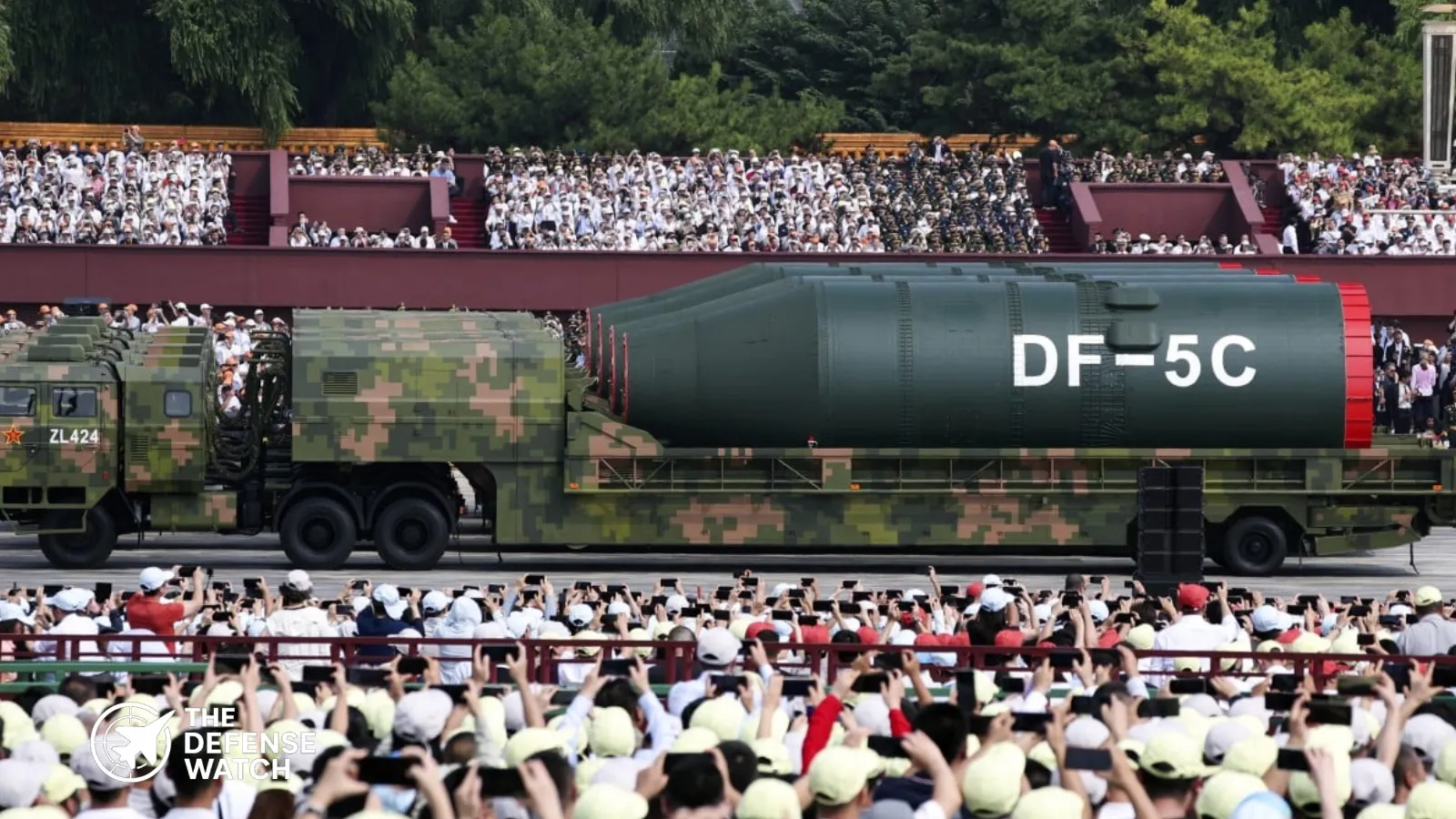
The report highlights sustained expansion of China’s nuclear arsenal. While exact numbers remain classified, U.S. intelligence assessments publicly suggest that China could possess several hundred nuclear warheads with projections that stockpiles may exceed 1,000 by 2030. China’s strategic nuclear modernization emphasizes survivable launch platforms, counterstrike capability, and flexible targeting.

China’s growing long-range strike forces, particularly solid-fuel intercontinental ballistic missiles (ICBMs), contribute to a more credible nuclear deterrent and complicate U.S. homeland defense planning.

Maritime and Conventional Forces

China’s People’s Liberation Army Navy (PLAN) remains among the world’s largest naval forces. The report documents expansion in aircraft carriers, advanced destroyers, submarines and long-range precision strike systems capable of shaping regional maritime contests.

Beyond numbers, the PLA has integrated its forces to operate jointly across domains with advanced sensors, long-range fires and improving logistics. These capabilities enhance Beijing’s ability to project power beyond its borders, according to the report.

Space, Cyberspace and Emerging Technologies

The 2025 assessment gives substantial weight to space and cyber domains. China’s space architecture supports intelligence, surveillance and reconnaissance missions that can enhance targeting and situational awareness, with potential to degrade U.S. advantages in orbit. Cyber operations by state-linked actors have targeted U.S. infrastructure, highlighting Beijing’s emphasis on information-age competition.

Emerging technologies including artificial intelligence, autonomous systems and hypersonic weapons are identified as key enablers of the PLA’s future combat concepts, though specific capabilities are often classified.

Taiwan and Regional Contingencies

A significant theme in the report is China’s preparations regarding Taiwan. The PLA continues to refine integrated joint operational plans aimed at deterring or defeating Taiwan’s defenses, with capabilities that can range from amphibious assault options to sustained blockades. U.S. analysts see this as illustrating Beijing’s intent to shape the military balance across the Taiwan Strait.

- Advertisement -

The report suggests that by 2027 the PLA will possess necessary components to conduct decisive operations in the region, reinforcing earlier assessments about China’s evolving timelines for coercive military options.

U.S. Security Implications

The Department of Defense emphasizes that China’s comprehensive buildup makes the U.S. homeland and allied interests increasingly vulnerable. Growth in China’s long-range strike, cyber and space capabilities — alongside the nuclear and maritime expansions — shape the strategic competition into the next decade.

The report states that the United States does not seek conflict but will retain a posture that deters aggression, strengthens alliances and preserves stable conditions in the Indo-Pacific. It highlights that U.S. defense planning, investment priorities and force posture reviews factor heavily on current assessments of Chinese capabilities.

Chinese Government Response

Chinese officials have criticized the report, dismissing it as exaggerated and politically motivated. Beijing insists its military development remains defensive and compliant with international norms, even as it accelerates modernization across multiple domains. Chinese commentary also accuses the U.S. of using such assessments to justify its own force expansions.

What Is Next

Looking forward, the findings will shape debate in Congress over defense budgets and Indo-Pacific strategy. The report’s emphasis on multi-domain competition and strategic vulnerabilities is expected to influence U.S. investments in missile defense, space resiliency, cyber operations and allied interoperability.

Analysts say continued monitoring of China’s modernization, force posture and strategic intent will remain critical throughout 2026. U.S. defense planners are likely to balance deterrence priorities with efforts at de-escalation and crisis communication channels with Beijing.

Enjoying our coverage?

Make The Defense Watch a preferred source on Google to see more of our geopolitical and defense insights when relevant to you.

TAGGED:2025 China military reportChina defense capabilitiesIndo-Pacific Securitynuclear forcesPentagonPLA ModernizationU.S. Department of Defense
Share This Article
Facebook Copy Link Print
ByTeamDefenseWatch
TeamDefenseWatch is the official editorial byline of TheDefenseWatch.com. Working under one umbrella, TheDefenseWatch.com, the team delivers verified, factual reporting on global defense, military technology, aerospace systems, and security developments. Articles are sourced from official statements, defense industry releases, and trusted media, with editorial review to ensure accuracy and clarity.Contact: info@TheDefenseWtach.com
Leave a Comment

Leave a Reply Cancel reply

Your email address will not be published. Required fields are marked *

Search Defense Systems

Latest Defense Systems

  • KN-23 Ballistic Missile KN-23 Ballistic Missile
  • Su-75 Checkmate Fighter Jet Su-75 Checkmate Fighter Jet
  • Ilyushin Il-20 Coot Aircraft Ilyushin Il-20 Coot Aircraft
  • FGM-148 Javelin Anti-Tank Missile FGM-148 Javelin Anti-Tank Missile
  • F-104 Starfighter F-104 Starfighter
  • F-15J Eagle Fighter Jet F-15J Eagle Fighter Jet
  • China’s GJ-21 Stealth Drone China’s GJ-21 Stealth Drone
  • China’s GJ-11 Stealth Drone China’s GJ-11 Stealth Drone
  • F-15EX Eagle Fighter Jet F-15EX Eagle Fighter Jet

Recent Compares

  • J-10C vs JF-17 Thunder: Which Fighter Is More Capable? J-10C vs JF-17 Thunder: Which Fighter Is More Capable? View Comparison →
  • Tejas vs Gripen: Key Differences and Capabilities Tejas vs Gripen: Key Differences and Capabilities View Comparison →
  • Tejas vs MiG-21 Bison: How India Replaced Its Iconic Supersonic Fighter Tejas vs MiG-21 Bison: How India Replaced Its Iconic Supersonic Fighter View Comparison →
  • F-35 vs F-16: Stealth, Sensors and Combat Roles F-35 vs F-16: Stealth, Sensors and Combat Roles View Comparison →
  • Tejas Fighter Jet vs F-16 Fighting Falcon: Capability Compared Tejas Fighter Jet vs F-16 Fighting Falcon: Capability Compared View Comparison →
  • Rafale Fighter Jet vs F-16 Fighting Falcon : Which Fighter Has the Edge? Rafale Fighter Jet vs F-16 Fighting Falcon : Which Fighter Has the Edge? View Comparison →
  • Su-57 Fighter Jet vs J-20 Fighter Jet: Stealth and Air Combat Compared Su-57 Fighter Jet vs J-20 Fighter Jet: Stealth and Air Combat Compared View Comparison →
  • Mirage 2000 vs Tejas Mk1A: Legacy Combat Power vs Indigenous Modernization Mirage 2000 vs Tejas Mk1A: Legacy Combat Power vs Indigenous Modernization View Comparison →
  • Rafale Fighter Jet vs F-22 Raptor: Which Air Dominance Fighter Has the Edge? Rafale Fighter Jet vs F-22 Raptor: Which Air Dominance Fighter Has the Edge? View Comparison →
  • Tejas Fighter Jet vs. Rafale Fighter Jet: India’s Indigenous Fighter Meets France’s Proven Multirole Combat Aircraft Tejas Fighter Jet vs. Rafale Fighter Jet: India’s Indigenous Fighter Meets France’s Proven Multirole Combat Aircraft View Comparison →

Recent Posts

  • Is the US Planning a 7th-Generation Fighter Jet?
  • NATO Jets Scrambled After Drone Breaches Latvian Airspace
  • North Korea Reportedly Suspends Missile and Artillery Deliveries to Russia
  • U.S. Navy Conducts Hovercraft Operations With USS Boxer in Middle East
  • Russia Shows Possible Su-75 Checkmate Prototype Progress at KnAAZ Aircraft Plant

You Might Also Like

B-21 Raider production line expansion
Aerospace & AviationFighter Jets & Military Aircraft

Pentagon Considers Second B-21 Raider Production Line To Accelerate U.S. Stealth Bomber Expansion

September 17, 2026
US Tomahawk strike options Iran
Defense Budgets & PolicyPolicy & Strategy

US Government Moves To Expand Tomahawk And Patriot Missile Production With Ford And GM

September 7, 2026
Army Foundation College expansion plans
Policy & Strategy

UK Army Weighs Second Army Foundation College As Under-18 Recruitment Expands

September 7, 2026
Israeli Prime Minister Benjamin Netanyahu speaking about ending U.S. military aid dependence during a policy discussion
Defense Budgets & PolicyPolicy & Strategy

Netanyahu Moves To End U.S. Military Aid As Israel Pushes For Defense Independence

May 11, 2026

Logo

Copyright © 2026 TheDefenseWatch.com

Helpful Links

  • Home
  • About Us
  • Privacy Policy
  • Terms of Use / Disclaimer
  • U.S. Privacy Notice – CCPA Compliance

Defense Systems

  • Defense Systems
  • Comparisons 
  • Manufacturer
  • Tactical Calculators

Popuplar

Which 5 Air Forces Possess the Costliest Fighter Jet Fleets in the World
Evolving Strategic Value: Carrier Strike Groups in the Indo-Pacific’s Future Security Architecture
Autonomous Weapon Systems Spark U.S. Ethics Debate Amid Rapid Military AI Integration

We report on developments involving military forces, governments, defense companies, research organizations, and security institutions around the world. 

Welcome Back!

Sign in to your account

Username or Email Address
Password

Lost your password?

Enjoying our coverage?

Make The Defense Watch a preferred source on Google to see more insights.