• Home
  • About
  • Defense Systems
  • Manufacturer
  • Comparisons
  • Compare 
  • Tools
TheDefenseWatch.com
  • Aerospace & Aviation
  • Military & Ordnance
  • Naval & Maritime
  • Cyber & Space Defense
  • Policy & Strategy
  • Global News
  • Tools Library
    • Smart Calculator
    • Drone Flight Time Calculator
    • Drone Range Calculator
    • Counter-Drone Jammer Effective Range Calculator
    • Counter-Battery Radar Detection Calculator
    • Artillery Fire Correction Calculator
    • Thermal Camera Detection Range Calculator
    • Missile Range & Time-of-Flight Calculator
    • Radar Detection Range Calculator
    • FPV Strike Drone Payload vs Range Calculator
    • Loitering Munition Endurance Calculator
    • Sniper Ballistic Drop & Windage Calculator
    • Bullet Drop Calculator
    • U.S. Army Combat Fitness Test (ACFT) Calculator
    • Military Pension Calculator
    • Military Retirement Calculator
    • Military Pension Calculator
    • Large Number Calculator
Font ResizerAa

TheDefenseWatch.com

The Defense Watch | U.S. & Global Defense News, Analysis & Military Updates

Search
  • Home
  • About
  • Defense Systems
  • Manufacturer
  • Comparisons
  • Compare 
  • Tools

Stay Updated

Get the latest update

Subscribe

Explore

  • Drone
  • Fighter Jets & Military Aircraft
  • Hypersonic Weapons
  • Aircraft Carriers
  • Strategic History & Missions
  • Tools Library
Home » US–China Lunar Nuclear Power Race Heats Up as NASA Eyes 100 kW Reactor by 2030
Cyber & Space DefenseSpace Assets & Satellites

US–China Lunar Nuclear Power Race Heats Up as NASA Eyes 100 kW Reactor by 2030

TeamDefenseWatch
Last updated: November 14, 2025 12:13 pm
TeamDefenseWatch
Share
2 Min Read
lunar nuclear power race
SHARE
Follow The Defense Watch on Google:

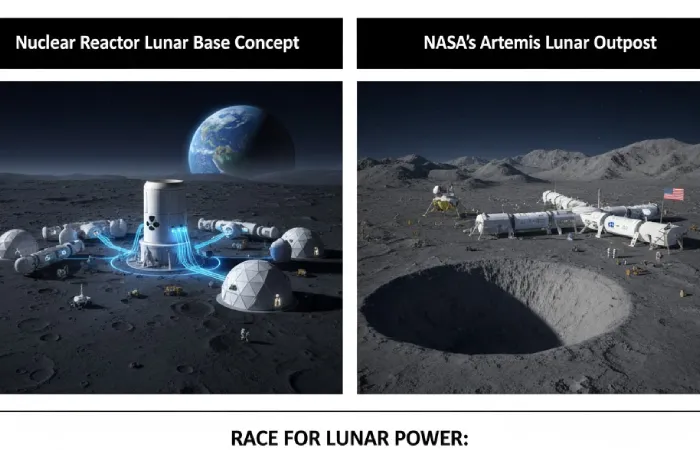
The National Aeronautics and Space Administration (NASA) has accelerated its plans to deploy a nuclear-fission reactor on the surface of the Moon by 2030, setting a target power output of around 100 kilowatts and signaling a strategic move in the expanding lunar infrastructure race. Recent reports indicate that this timeline positions Washington ahead of the China National Space Administration (CNSA) and its Russian partners’ goal of building a lunar reactor by 2035.

Contents
BackgroundDetails of the PlanExpert and Policy PerspectivesWhat’s Next

Background

The push for nuclear power on the Moon comes amid renewed competition in space beyond traditional exploration. Solar and battery systems struggle with the lunar day-night cycle—approximately two weeks of sunlight followed by two weeks of darkness—making sustained operations difficult. A compact fission reactor could enable permanent bases, power-intensive activities and deep-space precursor missions, including those envisioned under the Artemis program.

Prior NASA initiatives such as the Kilopower experimental reactor project advanced designs for small reactors (1–10 kW) for space applications. These are now being scaled by NASA and industry toward 100 kW class systems for lunar surface deployment.

Meanwhile, China has indicated via a presentation that its broader lunar base initiative—the International Lunar Research Station (ILRS)—will include a nuclear power component, with a baseline manned base expected by 2035.

- Advertisement -

Details of the Plan

According to policy documents obtained by media outlets, NASA has instructed industry to submit proposals for a lunar surface reactor capable of producing about 100 kW of electrical power by 2030. The directive also notes that the first nation to deploy such a reactor might declare exclusive zones (“keep-out zones”) around its lunar installations, influencing future access.

In a related briefing, interim NASA administrator Sean Duffy emphasized: “To have a base on the Moon, we need energy.” He described the drive as part of a broader “second space race”.

Technical challenges remain significant. In the Moon’s vacuum environment, conventional cooling methods are inadequate. Engineers must design systems that manage heat rejection via radiators and possibly use conduction to the lunar regolith. NASA’s Fission Surface Power project addresses these vacuum-cooling and shielding issues.

China’s lunar reactor plan reportedly targets the same class of power but seeks to deploy by 2035. A Chinese space official, Pei Zhaoyu, presented slides showing a reactor component for the ILRS at a forum in Shanghai earlier in the year.

Expert and Policy Perspectives

From a defense-and-space policy standpoint, the lunar nuclear reactor initiative carries dual-use implications. Reliable power on the Moon could support infrastructure that, while civilian in nature, can bolster strategic presence. The possibility of “keep-out zones” raises questions about how lunar sovereignty and access rights will be managed under the Outer Space Treaty (1967).

Dr. Laura Kirkpatrick, a space-policy analyst, commented: “Deploying nuclear power enables not only habitats but also continuous operations—telemetry, robotics, mining—so whoever does it first gains a significant infrastructure head-start.”

On the technical side, the critical path lies in coupling compact fission units with reliable heat-rejection systems suitable for the lunar vacuum and dust environment. The burn-time, shielding mass, launch mass and automated deployment are all major hurdles. Previous terrestrial micro-reactors such as the Project Pele design for the U.S. Army reflect some of these challenges, though not in lunar conditions.

What’s Next

If NASA meets its 2030 target, the deployment of a 100 kW lunar reactor would mark a major milestone in the Artemis programme’s goal of establishing a sustainable lunar presence. It could also force competing actors, including China–Russia, to accelerate their own timelines or adjust base designs accordingly.

- Advertisement -

For industry, the next steps will include issuing requests for proposals, selecting commercial partners and commencing ground tests of reactor modules. NASA’s timeline calls for industry consultation within 60 days of the directive.

On the geopolitical front, lunar infrastructure power systems could become a new domain of strategic competition, with infrastructure-led influence extending beyond Earth orbit. The implementation of such systems may influence future agreements on lunar operations, commercial mining rights, and international collaboration.

Enjoying our coverage?

Make The Defense Watch a preferred source on Google to see more of our geopolitical and defense insights when relevant to you.


TAGGED:Artemis programmeChina space programlunar-reactorNASAspace nuclear power
Share This Article
Facebook Copy Link Print
ByTeamDefenseWatch
TeamDefenseWatch is the official editorial byline of TheDefenseWatch.com. Working under one umbrella, TheDefenseWatch.com, the team delivers verified, factual reporting on global defense, military technology, aerospace systems, and security developments. Articles are sourced from official statements, defense industry releases, and trusted media, with editorial review to ensure accuracy and clarity.Contact: info@TheDefenseWtach.com
5 Comments
  • Pingback: Top 10 Most Powerful Navies in the World 2025: Gauging Maritime Dominance Through Aggregate Displacement
  • Pingback: China Aircraft Carrier vs US: Who Leads in Naval Air Power in 2025
  • Pingback: Royal Navy Tests Wildcat Helicopter Drone Teaming for Martlet Missile Strikes | TheDefenseWatch.com
  • Pingback: US Iran Talks Focus on Nuclear Issue as Disputes Over Scope Remain | TheDefenseWatch.com
  • Pingback: U.S. Accuses China of Secret Nuclear Weapons Testing, Covering Tracks with Decoupling Methods | TheDefenseWatch.com

Leave a Reply Cancel reply

Your email address will not be published. Required fields are marked *

Search Defense Systems

Latest Defense Systems

  • Ilyushin Il-20 Coot Aircraft Ilyushin Il-20 Coot Aircraft
  • FGM-148 Javelin Anti-Tank Missile FGM-148 Javelin Anti-Tank Missile
  • F-104 Starfighter F-104 Starfighter
  • F-15J Eagle Fighter Jet F-15J Eagle Fighter Jet
  • China’s GJ-21 Stealth Drone China’s GJ-21 Stealth Drone
  • China’s GJ-11 Stealth Drone China’s GJ-11 Stealth Drone
  • F-15EX Eagle Fighter Jet F-15EX Eagle Fighter Jet
  • TRML-4D Radar TRML-4D Radar
  • F-47A Fighter Jet F-47A Fighter Jet

Recent Compares

  • J-10C vs JF-17 Thunder: Which Fighter Is More Capable? J-10C vs JF-17 Thunder: Which Fighter Is More Capable? View Comparison →
  • Tejas vs Gripen: Key Differences and Capabilities Tejas vs Gripen: Key Differences and Capabilities View Comparison →
  • Tejas vs MiG-21 Bison: How India Replaced Its Iconic Supersonic Fighter Tejas vs MiG-21 Bison: How India Replaced Its Iconic Supersonic Fighter View Comparison →
  • F-35 vs F-16: Stealth, Sensors and Combat Roles F-35 vs F-16: Stealth, Sensors and Combat Roles View Comparison →
  • Tejas Fighter Jet vs F-16 Fighting Falcon: Capability Compared Tejas Fighter Jet vs F-16 Fighting Falcon: Capability Compared View Comparison →
  • Rafale Fighter Jet vs F-16 Fighting Falcon : Which Fighter Has the Edge? Rafale Fighter Jet vs F-16 Fighting Falcon : Which Fighter Has the Edge? View Comparison →
  • Su-57 Fighter Jet vs J-20 Fighter Jet: Stealth and Air Combat Compared Su-57 Fighter Jet vs J-20 Fighter Jet: Stealth and Air Combat Compared View Comparison →
  • Mirage 2000 vs Tejas Mk1A: Legacy Combat Power vs Indigenous Modernization Mirage 2000 vs Tejas Mk1A: Legacy Combat Power vs Indigenous Modernization View Comparison →
  • Rafale Fighter Jet vs F-22 Raptor: Which Air Dominance Fighter Has the Edge? Rafale Fighter Jet vs F-22 Raptor: Which Air Dominance Fighter Has the Edge? View Comparison →
  • Tejas Fighter Jet vs. Rafale Fighter Jet: India’s Indigenous Fighter Meets France’s Proven Multirole Combat Aircraft Tejas Fighter Jet vs. Rafale Fighter Jet: India’s Indigenous Fighter Meets France’s Proven Multirole Combat Aircraft View Comparison →

Recent Posts

  • Modern Warfare Puts Command and Control at the Center of Military Operations
  • Lockheed Martin Completes Third JR3 Rocket Test for U.S. Army Training
  • Lockheed Martin Advances Robotic Welding Technology for In-Space Construction
  • Europe Seeks U.S. National Guard F-16s for Ukraine’s Drone Defense
  • U.S. Marines to Join Finland and Estonia in Baltic Sea Defense Exercise

You Might Also Like

Autonomous weapon systems
AI & Electronic WarfareCyber & Space Defense

Autonomous Weapon Systems Spark U.S. Ethics Debate Amid Rapid Military AI Integration

November 5, 2026
Pulsar Fusion Sunbird
Aerospace & AviationSpace Assets & Satellites

UK Startup Pulsar Fusion Achieves First Plasma in Sunbird Fusion Rocket Engine

March 30, 2026
U.S. Space Force Andromeda program
Cyber & Space DefenseSpace Assets & Satellites

U.S. Space Force Awards Contracts To Expand Orbital Surveillance Under Andromeda Program

April 12, 2026
Belgian IDDEA offline AI battlefield identification system analyzing military vehicles in a combat operations environment
AI & Electronic WarfareCyber & Space Defense

Belgium Unveils Offline AI System To Counter Battlefield Identification Threats

September 7, 2026

Logo

Copyright © 2026 TheDefenseWatch.com

Helpful Links

  • Home
  • About Us
  • Privacy Policy
  • Terms of Use / Disclaimer
  • U.S. Privacy Notice – CCPA Compliance

Defense Systems

  • Defense Systems
  • Comparisons 
  • Manufacturer
  • Tactical Calculators

Popuplar

Which 5 Air Forces Possess the Costliest Fighter Jet Fleets in the World
Evolving Strategic Value: Carrier Strike Groups in the Indo-Pacific’s Future Security Architecture
Autonomous Weapon Systems Spark U.S. Ethics Debate Amid Rapid Military AI Integration

We report on developments involving military forces, governments, defense companies, research organizations, and security institutions around the world. 

Welcome Back!

Sign in to your account

Username or Email Address
Password

Lost your password?

Enjoying our coverage?

Make The Defense Watch a preferred source on Google to see more insights.