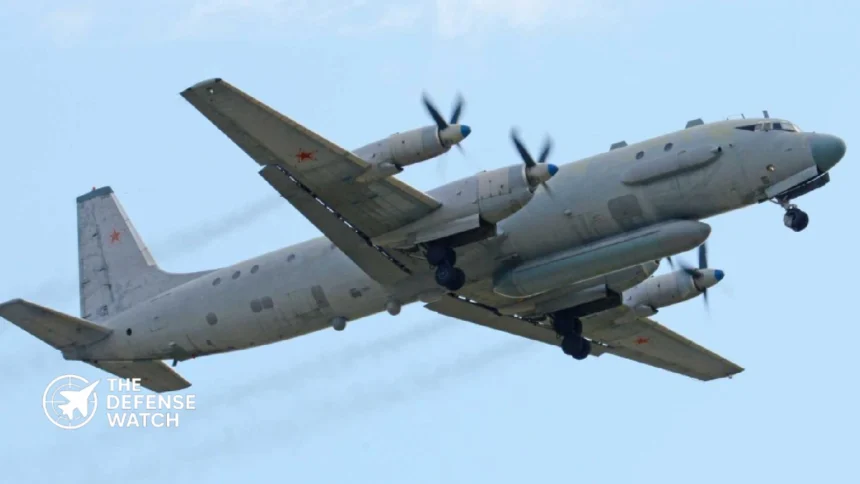
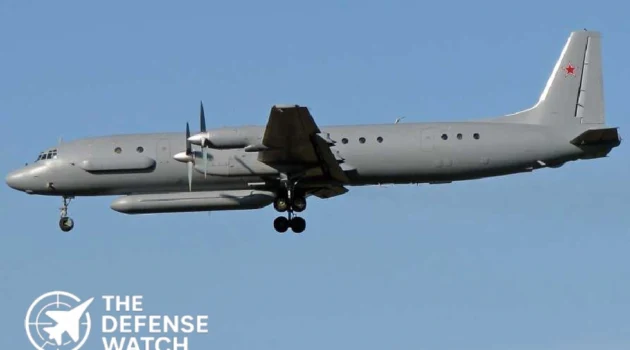
Russia reportedly used a Soviet-era Ilyushin Il-20 electronic intelligence aircraft to conduct surveillance near Ukraine’s western border after the aircraft was observed flying over Belarus on May 27, 2025. The reported mission focused on detecting Ukrainian air defense radar activity, according to Ukrainian defense publication Defense Express.
The reported deployment illustrates how Russia continues to use older intelligence aircraft to collect information about Ukrainian military infrastructure, including radar systems potentially supplied by Western partners.
The aircraft, known by NATO’s reporting name Coot, was developed during the Cold War and remains part of Russia’s airborne intelligence capabilities.
However, the precise mission objectives and the information collected during the reported flight have not been independently established.
Il-20 sighting raises questions about Russian surveillance activity
Defense Express published its report on May 28, 2025, citing information from several Telegram monitoring channels, including Belarus of the Brain and eRadar.
According to those sources, the Russian Aerospace Forces aircraft was operating in Belarusian airspace on May 27. Its radar signature was reportedly visible on publicly accessible flight-tracking platforms.
The monitoring groups assessed that the aircraft was collecting information about Ukrainian air defense installations in western regions of the country.
One potential objective was identifying radar emissions from Ukrainian surface-to-air missile systems and other air defense equipment. Such information could help Russian military planners understand the location and operating characteristics of Ukrainian radar networks.
Defense Express also suggested that airborne surveillance could provide information unavailable to ground-based intelligence assets because of the radar horizon.
That assessment is operationally plausible, but the available reporting does not establish which Ukrainian radar systems were detected, whether their positions were identified, or whether the collected information was subsequently used in Russian strike planning.
An aircraft designed for intelligence collection
The Il-20 was developed from the Ilyushin Il-18 passenger aircraft during the 1960s. Its conversion into an electronic intelligence platform gave the Soviet Union an aircraft capable of collecting information from military installations and communications networks without entering hostile territory.
Unlike conventional airborne early warning aircraft, which primarily monitor airspace and coordinate air operations, the Il-20 is designed for intelligence collection.
Its reported equipment includes:
- Side-looking surveillance radar.
- Signals intelligence (SIGINT) equipment.
- Electronic intelligence (ELINT) systems.
- Aerial photographic reconnaissance equipment.
- Electronic signal interception systems.
These capabilities allow the aircraft to perform several intelligence tasks, including monitoring electronic emissions, observing ground activity and collecting information about military infrastructure.
SIGINT is the broader discipline of collecting intelligence from electronic signals. ELINT focuses specifically on non-communications electronic emissions, including radar transmissions.
For Russia, the ability to identify and study radar emissions is particularly relevant to operations against an opponent operating a distributed air defense network.
Why Ukrainian air defense radars matter
Ukraine’s air defense network remains an important obstacle to Russian air operations.
Its structure includes Soviet-designed systems and Western-provided platforms, with radar installations supporting surveillance, target tracking and missile engagement.
Identifying the location and characteristics of these systems can help an adversary develop suppression of enemy air defenses (SEAD) operations.
This involves locating, disrupting or attacking enemy air defense capabilities to reduce the risks faced by aircraft and missile operations.
A 2022 study by the Royal United Services Institute (RUSI), titled The Russian Air War and Ukrainian Requirements for Air Defence, documented Russia’s use of reconnaissance aircraft, electronic warfare and anti-radiation missiles during the invasion.
The study also described how Russian Su-30SM and Su-35S fighters employed Kh-31P and Kh-58 anti-radiation missiles against Ukrainian surface-to-air missile radars.
The significance of an Il-20 surveillance mission is therefore not simply that Russia can observe Ukrainian military installations. It is that electronic intelligence can contribute to a wider process of identifying, classifying and potentially targeting air defense assets.
However, collecting radar emissions does not automatically provide a precise, continuously updated target location. Radar operators can change operating patterns, relocate mobile equipment or limit transmissions to reduce their electronic exposure.
Why Russia may be relying on an older aircraft
The Il-20’s reported appearance also raises questions about the availability and employment of Russia’s more modern airborne surveillance platforms.
Russia operates the Beriev A-50 airborne early warning and control aircraft, which provides a different set of capabilities, including airspace surveillance and command support.
The A-50 and Il-20 are not interchangeable. The former is primarily an airborne early warning and control platform, while the latter specializes in electronic and photographic reconnaissance.
Defense Express suggested that Russia’s use of the Il-20 could reflect a preference for employing an older platform rather than exposing more valuable aircraft to operational risks.
The publication also referred to the damage sustained by a Russian A-50 at the Machulishchy airfield in Belarus in February 2023. That aircraft was reportedly damaged in a drone attack, rather than being confirmed destroyed at the time.
Russia subsequently lost another A-50 over the Sea of Azov in January 2024, according to reporting at the time. These incidents illustrate the vulnerability and operational importance of Russia’s limited high-value airborne surveillance fleet.
Nevertheless, there is insufficient evidence to conclude that the Il-20 deployment was a direct replacement for A-50 operations.
Belarus provides a useful operating position
Belarus occupies an important geographic position for Russian military operations against Ukraine.
Its territory borders Ukraine’s northern regions and provides Russian aircraft with opportunities to conduct surveillance near Ukrainian airspace without necessarily crossing the international border.
Operating from or over Belarus can also allow Russian intelligence aircraft to observe areas that are difficult to monitor from positions farther east.
The reported Il-20 flight is consistent with Russia’s broader use of Belarusian territory as part of its military posture against Ukraine. However, the available reporting does not establish the aircraft’s exact operating base or whether the flight formed part of a sustained reconnaissance deployment.
For Ukraine, the possibility of airborne electronic surveillance adds another consideration to the protection of air defense infrastructure. Radar emissions can reveal useful information even when the associated missile systems are not actively engaging targets.
What the reported flight does not establish
Several important details remain unavailable.
Neither the Russian Ministry of Defense nor Belarusian authorities were identified in the reporting as publicly confirming the mission.
There is also no independently verified information establishing:
- The exact radar systems monitored by the aircraft.
- Whether the Il-20 identified specific Ukrainian air defense positions.
- Whether it collected intelligence on Western-supplied systems.
- Whether the collected information supported a subsequent missile attack.
- Whether additional Il-20 surveillance flights followed the May 2025 sighting.
These distinctions matter because detecting electronic emissions, identifying a radar installation and generating actionable targeting information are separate intelligence tasks.
The reported flight demonstrates the continued relevance of conventional airborne intelligence collection in a conflict increasingly shaped by drones, electronic warfare and long-range precision weapons.
Despite its age, the Il-20 retains a specialized role in Russia’s military reconnaissance inventory. Its reported activity over Belarus shows why older aircraft can remain operationally useful when equipped for intelligence missions.
For Ukraine, the challenge is not only protecting air defense systems against missiles and drones, but also limiting the information an adversary can collect about their locations and electronic signatures.
Enjoying our coverage?
Make The Defense Watch a preferred source on Google to see more of our geopolitical and defense insights when relevant to you.