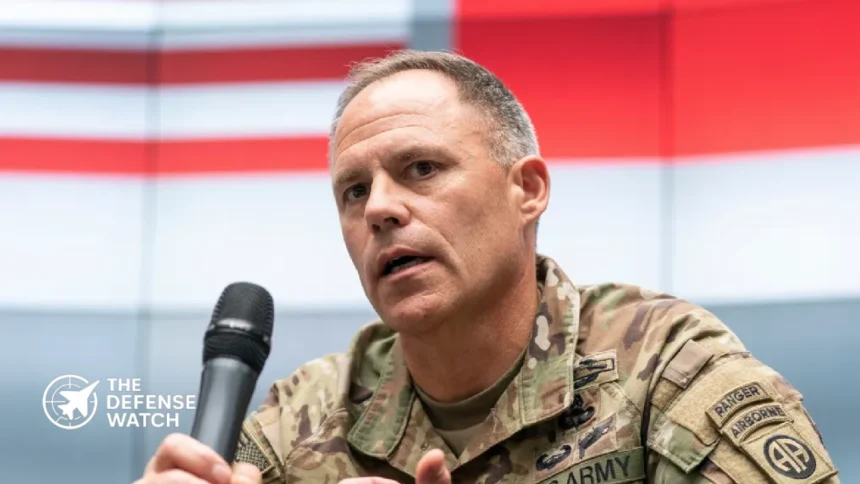
WASHINGTON, November 18, 2026: President Donald Trump has formally nominated Gen. Christopher C. LaNeve to become the next chief of staff of the U.S. Army, beginning the process of replacing the service’s acting leadership with a Senate-confirmed four-star general.
The nomination was received by the Senate on November 16 and referred to the Senate Armed Services Committee. LaNeve has served as acting Army chief of staff since April, following the removal of Gen. Randy George by Defense Secretary Pete Hegseth.
The administration has also nominated Lt. Gen. Marcus S. Evans, currently director of the Army Staff, to succeed LaNeve as vice chief of staff. Both appointments require Senate confirmation.
The nominations are important for an Army undergoing changes in force structure, autonomous systems, operational doctrine and modernization priorities. However, the confirmation process could become a test of congressional support for the Pentagon’s recent senior leadership decisions.
Senate confirmation puts LaNeve’s appointment to the test
The Senate has registered LaNeve’s nomination as PN1509 under the 119th Congress. The official Senate nominations list identifies him for appointment as chief of staff of the Army at the rank of general.
His nomination was referred to the Senate Armed Services Committee on November 16. It remains pending, meaning the White House announcement does not yet make him the permanently appointed Army chief.
LaNeve’s confirmation prospects have attracted attention because of previously reported opposition among lawmakers, including members of the Republican Party.
Sen. Roger Wicker, chairman of the Senate Armed Services Committee, acknowledged in August that some committee members from both parties had concerns about the nomination. Sen. Joni Ernst, a Republican from Iowa and retired Army lieutenant colonel, was also identified in reporting as an opponent.
The political timing adds another complication. The incoming Congress is scheduled to begin on January 3, 2027, with Democrats expected to take control of the Senate following the 2026 midterm elections.
If the current Senate does not complete the confirmation process before the transition, LaNeve’s nomination could face a different political environment. However, the precise timing of committee consideration and a potential floor vote has not been announced.
From Pentagon adviser to the Army’s top uniformed position
LaNeve’s rise through senior Army leadership has been relatively rapid.
According to his official U.S. Army biography, he graduated from the University of Arizona and received his infantry commission in May 1990. His military career includes operational assignments, combat deployments and command positions across several major Army formations.
His senior assignments include:
- Commanding General of the 7th Army Training Command in Germany.
- Commanding General of the 82nd Airborne Division.
- Commanding General of Eighth Army in South Korea.
- Senior Military Assistant to the Secretary of Defense.
- Vice Chief of Staff of the Army.
He was appointed the Army’s 40th vice chief of staff on February 6, 2026, after serving as Hegseth’s senior military assistant.
He received his fourth star in February 2026. Following George’s departure in April, LaNeve assumed the acting chief of staff responsibilities while retaining his vice chief position.
His experience in the 82nd Airborne Division and Eighth Army gives him operational experience in both expeditionary forces and the U.S. military’s forward presence in the Indo-Pacific.
That background is relevant as the Army continues preparing for potential high-intensity conflicts involving technologically advanced opponents, particularly in the Indo-Pacific and European theaters.
Modernization priorities already taking shape
The nomination comes after LaNeve has overseen several important organizational and doctrinal initiatives during his acting tenure.
One of the most notable developments is the Army’s increased emphasis on autonomous systems and robotics.
In October, the service announced the establishment of the U.S. Army Futures and Autonomous Systems Command, known as FASCOM. The organization is intended to accelerate the integration of autonomous capabilities into Army formations, acquisition programs and training.
LaNeve subsequently confirmed that the Army’s Futures and Concepts Command had been redesignated as FASCOM.
The initiative reflects a wider Pentagon effort to increase the military use of uncrewed platforms, autonomous technologies and robotic systems.
For the Army, these capabilities could support reconnaissance, logistics, combat engineering and other battlefield functions. Their integration, however, will require changes to force structure, training, maintenance and command arrangements.
New operational guidance for future warfare
LaNeve also played a central role in developing the Army’s October 7 operational guidance, titled How the Army Fights.
The document provides a framework for organizing, training, equipping and sustaining Army formations during high-intensity conflict.
It identifies four interconnected elements of land warfare:
- Convergence: Coordinating effects across multiple military domains to create operational advantages.
- Strike: Using lethal and nonlethal fires against enemy systems at range.
- Close Battle: Defeating opposing forces and securing important terrain.
- Endurance: Maintaining and projecting combat power across extended distances and periods of conflict.
The framework also addresses uncrewed systems, artificial intelligence-enabled tools, resilient communications networks and precision fires.
These priorities are particularly relevant to potential conflicts against technologically capable adversaries, where electronic warfare, long-range weapons, drones and contested logistics could place significant pressure on traditional Army formations.
The guidance does not itself establish that these capabilities have been fully fielded. Instead, it provides an operational framework for shaping future Army organization and readiness. The United States Army
LaNeve’s confirmation would therefore place a permanent chief of staff in charge of continuing these initiatives, subject to decisions by civilian Pentagon leadership and congressional oversight.
Marcus Evans nominated to become vice chief
The administration’s second nomination addresses the leadership position LaNeve currently holds.
Lt. Gen. Marcus S. Evans has been nominated to become the Army’s next vice chief of staff. His nomination is registered as PN1510 in the Senate.
Evans currently serves as director of the Army Staff and has previously commanded the 25th Infantry Division in Hawaii.
His career also includes senior positions within U.S. Special Operations Command and service in the 75th Ranger Regiment. He has combat experience in Afghanistan and Iraq.
Like LaNeve, Evans is an infantry officer. His appointment would provide continuity in senior Army leadership while introducing a new officer into the service’s second-highest uniformed position.
Both nominations remain subject to Senate confirmation.
Army leadership transition extends beyond uniformed command
The chief of staff nomination addresses only part of the Army’s senior leadership situation.
Former Army Secretary Dan Driscoll resigned on September 2, 2026, leaving Acting Secretary Adam Telle responsible for the service’s top civilian leadership position.
The White House has not announced a permanent replacement for Driscoll.
Consequently, the Army is operating without permanently confirmed leadership in either its top civilian or top uniformed position.
This matters because the Army’s modernization agenda requires coordination between military leadership, civilian policymakers, Congress and defense acquisition organizations.
The chief of staff is responsible for leading the Army Staff and overseeing the service’s military organization, readiness and development within the broader Department of Defense structure. The Army secretary, meanwhile, provides civilian leadership over the service.
Their responsibilities intersect across major decisions involving personnel, equipment, force structure, procurement and long-term modernization.
A permanent chief could provide greater continuity for the Army’s military planning, but confirmation alone would not resolve the wider leadership gap or settle disagreements over the service’s direction.
What the nomination means for Army modernization
LaNeve’s nomination is more than a routine personnel announcement because it comes during a period of organizational change and uncertainty over the Army’s senior leadership.
His previous initiatives indicate an emphasis on autonomous warfare, operational readiness, long-range strike capabilities and the integration of emerging technologies into conventional formations.
However, implementing these priorities will depend on more than the chief of staff’s appointment.
The Army must translate operational concepts into funded acquisition programs, trained personnel, deployable equipment and sustainable logistics arrangements. It must also balance investments in emerging technologies with established requirements involving artillery, armored vehicles, aviation, air defense and ammunition.
Congressional support will remain important, particularly where modernization initiatives involve significant changes to Army force structure and established programs.
LaNeve’s nomination now places those questions before the Senate Armed Services Committee. Until confirmation is completed, he will continue serving in an acting capacity rather than holding the Army’s chief of staff position permanently.
Enjoying our coverage?
Make The Defense Watch a preferred source on Google to see more of our geopolitical and defense insights when relevant to you.