• Home
  • About
  • Defense Systems
  • Manufacturer
  • Comparisons
  • Compare 
  • Tools
TheDefenseWatch.com
  • Aerospace & Aviation
  • Military & Ordnance
  • Naval & Maritime
  • Cyber & Space Defense
  • Policy & Strategy
  • Global News
  • Tools Library
    • Smart Calculator
    • Drone Flight Time Calculator
    • Drone Range Calculator
    • Counter-Drone Jammer Effective Range Calculator
    • Counter-Battery Radar Detection Calculator
    • Artillery Fire Correction Calculator
    • Thermal Camera Detection Range Calculator
    • Missile Range & Time-of-Flight Calculator
    • Radar Detection Range Calculator
    • FPV Strike Drone Payload vs Range Calculator
    • Loitering Munition Endurance Calculator
    • Sniper Ballistic Drop & Windage Calculator
    • Bullet Drop Calculator
    • U.S. Army Combat Fitness Test (ACFT) Calculator
    • Military Pension Calculator
    • Military Retirement Calculator
    • Military Pension Calculator
    • Large Number Calculator
Font ResizerAa

TheDefenseWatch.com

The Defense Watch | U.S. & Global Defense News, Analysis & Military Updates

Search
  • Home
  • About
  • Defense Systems
  • Manufacturer
  • Comparisons
  • Compare 
  • Tools

Stay Updated

Get the latest update

Subscribe

Explore

  • Drone
  • Fighter Jets & Military Aircraft
  • Hypersonic Weapons
  • Aircraft Carriers
  • Strategic History & Missions
  • Tools Library
Home » Raytheon Wins $12.3 Million Contract Modification to Sustain U.S. Navy Rolling Airframe Missile System
Defense ContractsNaval & Maritime

Raytheon Wins $12.3 Million Contract Modification to Sustain U.S. Navy Rolling Airframe Missile System

Samuel Drake | Defense Analyst
Last updated: November 18, 2026 2:11 am
Samuel Drake | Defense Analyst
Share
2 Min Read
Raytheon Rolling Airframe Missile contract
SHARE
Follow The Defense Watch on Google:

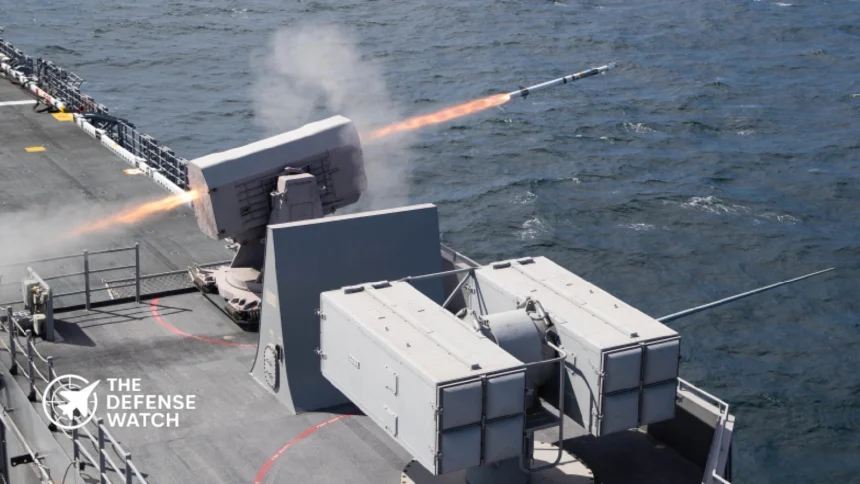
Raytheon has received a $12.34 million U.S. Navy contract modification to provide engineering and technical support for the Rolling Airframe Missile (RAM), a shipboard weapon designed to protect naval vessels against incoming anti-ship missiles and other airborne threats.

Contents
Engineering Support, Not a New Missile PurchaseWhy the Rolling Airframe Missile Matters to Naval DefenseGermany’s Role in the RAM ProgramContinued Support for an Established Naval Weapon

The cost-plus-fixed-fee modification, identified as P00036 under contract N0002423C5401, exercises previously established options for design agent and engineering services. The work is scheduled to continue through September 2028.

According to the contract announcement, the entire $12,337,200 award will be funded by the Federal Republic of Germany. The work will take place in Tucson, Arizona, where Raytheon’s missile engineering operations are based.

The award is being administered by Portfolio Acquisition Executive Munitions in Washington, D.C. The underlying contract was not competitively procured.

- Advertisement -

Engineering Support, Not a New Missile Purchase

The modification focuses on maintaining the technical condition and operational capabilities of the existing RAM weapon system rather than purchasing a new batch of missiles.

Raytheon’s responsibilities cover several areas of long-term system support:

  • Design and systems engineering: Addressing technical issues and maintaining the weapon system’s design integrity.
  • Software maintenance: Supporting software updates and resolving technical problems affecting system operation.
  • Reliability and maintainability: Monitoring system performance and supporting efforts to maintain dependable operation.
  • Quality assurance: Providing engineering oversight to help maintain required technical standards.
  • Logistics engineering: Supporting the technical and logistical requirements associated with continued system availability.

These activities are important for a naval weapon system that must remain compatible with different shipboard installations and operational requirements.

The contract does not disclose specific software changes, engineering modifications, missile quantities, or newly introduced capabilities. It also does not identify individual technical problems that prompted the support work.

Why the Rolling Airframe Missile Matters to Naval Defense

The RIM-116 Rolling Airframe Missile is a short-range naval air-defense weapon developed through cooperation between the United States and Germany.

Its primary mission is to provide close-in protection against anti-ship cruise missiles. It can also engage other airborne and surface threats, including aircraft and helicopters.

Unlike weapons that depend on continuous shipboard guidance after launch, RAM uses a fire-and-forget engagement concept. Its guidance architecture combines passive radio-frequency and infrared technologies, allowing the missile to continue its engagement without continuous illumination from the launching vessel.

The U.S. Navy identifies three historical RAM configurations: Block 0, Block 1A and Block 2. Block 2 introduced improvements to propulsion, control and radio-frequency reception to address more demanding target characteristics.

- Advertisement -

RAM is deployed through two principal shipboard arrangements:

  • MK 49 Guided Missile Launching System: A dedicated launcher with capacity for 21 missiles.
  • SeaRAM: A close-in defense configuration that combines RAM missiles with a Phalanx-derived sensor and engagement arrangement.

According to the U.S. Navy’s published fact sheet, the weapon has been integrated across multiple ship categories, including aircraft carriers, amphibious assault ships and littoral combat ships.

Maintaining these installations requires more than keeping missiles available. Software, launcher interfaces, technical documentation, component reliability and engineering support all contribute to the weapon system’s continued operational readiness.

Germany’s Role in the RAM Program

Germany’s financial contribution reflects the weapon system’s long-standing international development and production arrangement.

The U.S. Navy’s procurement documentation identifies RAM as a cooperative program between Washington and Berlin. Both governments have participated in the production and support of the system, with Raytheon working alongside German industry.

The partnership also involves RAM-System GmbH (RAMSYS). German defense companies Diehl and MBDA Deutschland participate in the industrial arrangement.

Germany funding the entire $12.34 million modification demonstrates its continued financial participation in sustaining the jointly developed weapon system.

This arrangement also means that engineering support benefits a program used by both countries, rather than representing a solely U.S. national requirement.

Continued Support for an Established Naval Weapon

The contract modification comes against a broader requirement to maintain shipboard defenses as anti-ship missile threats continue to evolve.

The Pentagon’s FY2027 weapons procurement documentation identifies RAM as a point-defense system intended to engage threats that penetrate other layers of naval air defense. It also describes ongoing work to improve the system’s relevance against advanced weapons.

The same budget documentation lists Raytheon and German company RAMSYS as the program’s industrial partners.

However, the $12.34 million engineering award should not be confused with missile procurement or a new development program. Its stated purpose is to sustain existing capabilities through design, software, reliability, quality and logistics engineering.

For Raytheon, the modification extends its engineering responsibilities under the existing Navy contract. For Germany, it maintains participation in the technical support of a jointly developed naval defense capability.

Work is expected to conclude in September 2028. The Navy has not disclosed additional delivery milestones or specific capability upgrades associated with this modification.

Enjoying our coverage?

Make The Defense Watch a preferred source on Google to see more of our geopolitical and defense insights when relevant to you.


TAGGED:naval air defenseRaytheonRolling Airframe MissileU.S. Navy
Share This Article
Facebook Copy Link Print
BySamuel Drake | Defense Analyst
Follow:
Samuel Drake is a defense analyst at TheDefenseWatch.com covering naval warfare, military ordnance, maritime technology, fleet modernization, and defense procurement. His reporting focuses on documented capabilities, procurement programs, and military technology.

Search Defense Systems

Latest Defense Systems

  • F-15J Eagle Fighter Jet F-15J Eagle Fighter Jet
  • China’s GJ-21 Stealth Drone China’s GJ-21 Stealth Drone
  • China’s GJ-11 Stealth Drone China’s GJ-11 Stealth Drone
  • F-15EX Eagle Fighter Jet F-15EX Eagle Fighter Jet
  • TRML-4D Radar TRML-4D Radar
  • F-47A Fighter Jet F-47A Fighter Jet
  • China DF-61 Missile China DF-61 Missile
  • B61 Nuclear Bomb B61 Nuclear Bomb
  • Japan E-767 Airborne Japan E-767 Airborne

Recent Compares

  • J-10C vs JF-17 Thunder: Which Fighter Is More Capable? J-10C vs JF-17 Thunder: Which Fighter Is More Capable? View Comparison →
  • Tejas vs Gripen: Key Differences and Capabilities Tejas vs Gripen: Key Differences and Capabilities View Comparison →
  • Tejas vs MiG-21 Bison: How India Replaced Its Iconic Supersonic Fighter Tejas vs MiG-21 Bison: How India Replaced Its Iconic Supersonic Fighter View Comparison →
  • F-35 vs F-16: Stealth, Sensors and Combat Roles F-35 vs F-16: Stealth, Sensors and Combat Roles View Comparison →
  • Tejas Fighter Jet vs F-16 Fighting Falcon: Capability Compared Tejas Fighter Jet vs F-16 Fighting Falcon: Capability Compared View Comparison →
  • Rafale Fighter Jet vs F-16 Fighting Falcon : Which Fighter Has the Edge? Rafale Fighter Jet vs F-16 Fighting Falcon : Which Fighter Has the Edge? View Comparison →
  • Su-57 Fighter Jet vs J-20 Fighter Jet: Stealth and Air Combat Compared Su-57 Fighter Jet vs J-20 Fighter Jet: Stealth and Air Combat Compared View Comparison →
  • Mirage 2000 vs Tejas Mk1A: Legacy Combat Power vs Indigenous Modernization Mirage 2000 vs Tejas Mk1A: Legacy Combat Power vs Indigenous Modernization View Comparison →
  • Rafale Fighter Jet vs F-22 Raptor: Which Air Dominance Fighter Has the Edge? Rafale Fighter Jet vs F-22 Raptor: Which Air Dominance Fighter Has the Edge? View Comparison →
  • Tejas Fighter Jet vs. Rafale Fighter Jet: India’s Indigenous Fighter Meets France’s Proven Multirole Combat Aircraft Tejas Fighter Jet vs. Rafale Fighter Jet: India’s Indigenous Fighter Meets France’s Proven Multirole Combat Aircraft View Comparison →

Recent Posts

  • Lockheed Martin Scales GMLRS Production as U.S. Army Expands Rocket Demand
  • Lockheed Martin Links F-35 Simulators With Six Airborne F/A-18s in Training First
  • NATO Launches Space Data Marketplace to Expand Allied Intelligence Access
  • Raytheon Wins $12.3 Million Contract Modification to Sustain U.S. Navy Rolling Airframe Missile System
  • General Dynamics Wins $20.5 Million Navy Contract for AN/BYG-1 Submarine Combat System Software

You Might Also Like

U.S. Navy Arleigh Burke-class destroyer operating at sea equipped with Integrated Bridge Navigation System technology supplied by Northrop Grumman.
Defense Contracts

Northrop Grumman Secures $23M U.S. Navy Contract for Destroyer Navigation Systems

September 7, 2026
Harmattan AI drones
Defense Contracts

France Orders 5,000 Harmattan AI Drones in Major Expansion of Military Drone Capability

September 7, 2026
UAE THAAD launcher contract
Defense ContractsMissile Defense Systems

Lockheed Martin Secures $211M Contract To Build New UAE THAAD Launchers

August 12, 2026
Raytheon SDB II contract
Defense Contracts

Raytheon Secures $708.9M Deal For SDB II Production Expansion

September 7, 2026

Logo

Copyright © 2026 TheDefenseWatch.com

Helpful Links

  • Home
  • About Us
  • Privacy Policy
  • Terms of Use / Disclaimer
  • U.S. Privacy Notice – CCPA Compliance

Defense Systems

  • Defense Systems
  • Comparisons 
  • Manufacturer
  • Tactical Calculators

Popuplar

Which 5 Air Forces Possess the Costliest Fighter Jet Fleets in the World
Evolving Strategic Value: Carrier Strike Groups in the Indo-Pacific’s Future Security Architecture
Autonomous Weapon Systems Spark U.S. Ethics Debate Amid Rapid Military AI Integration

We report on developments involving military forces, governments, defense companies, research organizations, and security institutions around the world. 

Welcome Back!

Sign in to your account

Username or Email Address
Password

Lost your password?

Enjoying our coverage?

Make The Defense Watch a preferred source on Google to see more insights.