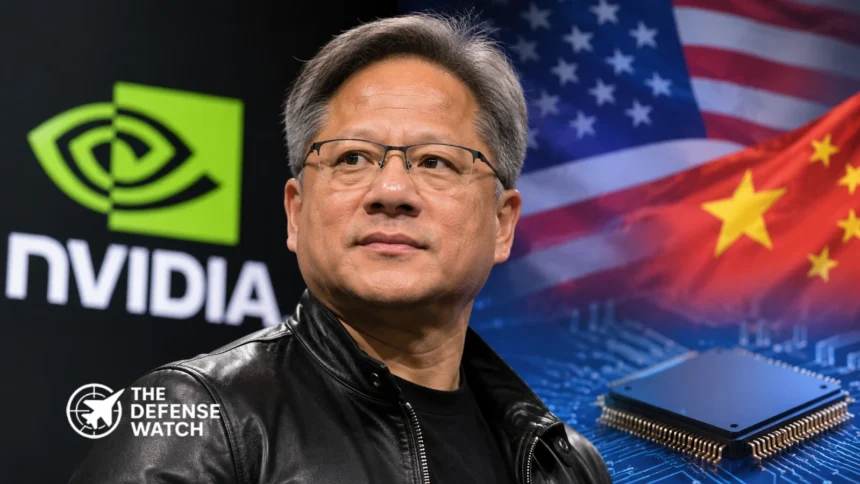
Jensen Huang’s departure from Nvidia removes one of the most influential executives in the global artificial intelligence industry at a time when access to advanced semiconductors has become a central issue in U.S.-China strategic competition.
Nvidia announced on November 12, 2026, that Huang had resigned as president, chief executive officer and member of the board, effective immediately. The company appointed Chief Financial Officer Colette Kress as interim CEO while beginning a search for a permanent replacement. Harvey C. Jones, a longtime Nvidia director, was appointed the company’s first chairman of the board.
The immediate circumstances surrounding Huang’s departure involve a corporate governance crisis and reports of alleged personal relationships that prompted scrutiny of possible Chinese intelligence connections. However, the broader technology implications extend beyond the circumstances of his resignation.
For more than three decades, Huang helped build Nvidia from a graphics processor manufacturer into a central supplier of the computing infrastructure used to train and operate advanced AI systems. He also became one of the most prominent advocates for maintaining access to the Chinese market despite increasingly restrictive U.S. semiconductor policies.
His departure raises a consequential question for Washington and Beijing: will Nvidia continue to argue for carefully controlled access to Chinese customers, or will its next leadership team adopt a more restrictive approach?
A leadership change at a strategically important company
Nvidia’s importance to U.S. technological competitiveness extends beyond its commercial success.
Its graphics processing units, networking equipment and software ecosystem support large-scale AI training, data-center computing, scientific research and applications with potential military relevance.
Advanced AI computing can support intelligence analysis, autonomous systems development, simulation, logistics planning, image recognition and other military-related activities. Access to powerful processors therefore has implications for both commercial innovation and national security.
Huang’s influence came partly from his ability to connect these technical capabilities with global business strategy. He consistently argued that U.S. technology companies should remain competitive in international markets rather than surrendering customers to domestic Chinese suppliers.
That position became increasingly difficult to maintain as Washington tightened restrictions on advanced semiconductor exports.
Nvidia’s board has now placed Kress in temporary control of the company. Her appointment provides executive continuity, but the board has not announced a permanent successor.
The immediate question is not whether Nvidia can continue developing advanced processors. It is whether the company can preserve its existing commercial strategy while facing greater political and regulatory scrutiny.
Why China remains central to Nvidia’s future
China represents a significant technology market, but Nvidia’s access to it has become increasingly complicated.
U.S. export controls have restricted Chinese access to advanced American processors, particularly products designed for large-scale AI training and data-center operations.
The policy has evolved over time. In January 2026, the U.S. Department of Commerce’s Bureau of Industry and Security announced that applications to export Nvidia H200 and AMD MI325X processors to China would be reviewed on a case-by-case basis, subject to security and compliance requirements.
Those conditions included customer screening, independent testing and assurances that exports would not reduce semiconductor production capacity available to U.S. customers.
The policy illustrates the competing objectives facing Washington.
Allowing controlled exports could preserve revenue for American semiconductor companies, maintain relationships with international customers and reinforce the position of U.S. technology platforms.
Restricting exports more aggressively could limit China’s access to advanced computing resources, but it could also encourage Chinese companies to develop domestic alternatives.
Nvidia has previously warned investors that restrictions are creating commercial disadvantages.
In its fiscal 2027 second-quarter regulatory filing, the company said it was effectively unable to compete in China’s data-center computing market under the prevailing U.S. and Chinese regulatory conditions. It also warned that competitors could use the opportunity to develop larger customer and software ecosystems.
This is an important distinction. Nvidia’s commercial exclusion from much of China’s advanced data-center market does not mean Chinese demand for AI computing has disappeared.
Instead, that demand creates opportunities for domestic chip manufacturers and alternative computing providers.
The export-control debate could become more difficult
Huang’s departure comes amid renewed scrutiny of Nvidia’s China-related business relationships.
Reuters reported on November 13 that U.S. scrutiny had intensified following allegations involving a former executive and a cloud-computing partner. The report also identified Chinese AI infrastructure projects worth more than 23 billion yuan, approximately $3.2 billion, that were built around restricted Nvidia processors.
The figure covers planned and signed projects, infrastructure and equipment, rather than simply purchases of Nvidia chips. Reuters also noted that some projects were operating or under construction, while the status of chip deliveries to others remained uncertain.
These findings illustrate the difficulty of enforcing semiconductor restrictions across international supply chains.
Advanced processors can be incorporated into servers, integrated into data centers and accessed through remote computing services. Consequently, controlling direct chip exports does not necessarily eliminate every route through which overseas customers might access advanced computing capacity.
This creates a broader policy challenge for the United States.
Washington must consider not only which companies receive processors directly, but also how computing capacity is deployed, who controls the infrastructure and which customers ultimately use the technology.
Huang’s departure could make Nvidia’s position in this debate less predictable. His successor will have to balance commercial opportunities against regulatory exposure, national security concerns and relationships with U.S. policymakers.
However, there is no established evidence that Huang’s resignation itself resulted from a proven violation of U.S. export-control laws. Nor does the available reporting establish that the Chinese AI projects identified by Reuters were connected to the allegations surrounding his departure.
Those distinctions matter when evaluating the national security implications.
China’s domestic semiconductor industry could gain ground
The longer-term consequence may be an acceleration of China’s efforts to reduce dependence on American AI processors.
Chinese technology companies have strong incentives to develop domestic alternatives when access to Nvidia hardware is uncertain. Domestic semiconductor development is therefore not simply an industrial policy objective. It is also part of China’s wider effort to maintain technological independence in areas considered important to economic and national security.
The shift could benefit Chinese processor designers, domestic data-center operators and companies developing AI software optimized for non-Nvidia hardware.
However, replacing Nvidia involves more than manufacturing a comparable processor.
The company’s competitive position rests on several interconnected elements:
- GPU architecture: Processors designed for parallel computing and demanding AI workloads.
- CUDA software ecosystem: A widely used development platform that supports AI researchers, developers and commercial applications.
- High-speed interconnects: Technologies that allow processors to communicate efficiently inside large computing systems.
- Networking and systems integration: Hardware and software designed to operate together across large data centers.
- Developer relationships: A global ecosystem of companies, research institutions and software developers.
Chinese competitors must address these interconnected capabilities, not just processor performance.
A transition away from Nvidia could therefore involve significant engineering costs, software adaptation and changes to data-center infrastructure.
For Beijing, the strategic objective is to build a domestic computing ecosystem capable of supporting advanced AI development even when access to foreign technology becomes restricted.
For Washington, the challenge is ensuring that export restrictions do not accelerate the emergence of competitors that eventually challenge American technology companies in international markets.
What Huang’s departure means for U.S. national security
The competition over AI processors has a direct connection to military modernization.
Advanced computing supports research and development in autonomous systems, intelligence processing, cyber operations, military simulation and decision-support technologies.
AI capabilities can also support the analysis of satellite imagery, processing of large intelligence datasets and development of autonomous platforms.
The availability of advanced computing infrastructure does not automatically translate into superior military capability. Operational effectiveness also depends on data quality, software, communications networks, trained personnel, integration and the ability to deploy systems reliably.
Nevertheless, access to advanced processors is becoming an important element of the defense industrial base.
The United States has an interest in maintaining its lead in semiconductor design, manufacturing technology and AI software while limiting the transfer of sensitive computing capabilities to potential strategic competitors.
Nvidia occupies an unusual position in this policy debate because it is simultaneously a commercial technology supplier, a major participant in the American AI industry and an important source of computing infrastructure used by government and private-sector organizations.
Huang frequently argued that American companies should remain engaged in China rather than allowing domestic Chinese suppliers to occupy the market.
Without him, Nvidia’s position in Washington could change. A new CEO may place greater emphasis on regulatory certainty, compliance and the risks associated with Chinese business relationships.
That does not mean the company will automatically abandon China or support every proposed export restriction. Its commercial interests remain significant, and the board has not announced a new China strategy.
The leadership transition also creates uncertainty for Nvidia
Nvidia’s next CEO will inherit a company whose influence extends well beyond graphics processors.
The challenge will involve maintaining product development, relationships with major cloud providers, software ecosystem growth and manufacturing partnerships while navigating a more complicated political environment.
Kress has served as Nvidia’s CFO since 2013 and has substantial experience with the company’s financial and commercial operations. Her interim appointment provides continuity, but the board’s search for a permanent CEO leaves longer-term strategic questions unresolved.
One particularly important issue is how Nvidia approaches international sales.
The company has previously warned that restrictions on its China business could help competitors establish larger customer and developer ecosystems. That concern is not limited to lost revenue. It involves the possibility that Chinese alternatives could become more competitive through domestic adoption and continued software development.
The company must also manage the distinction between U.S. regulatory requirements and Chinese customer expectations.
A product approved for export by Washington may still face commercial or regulatory barriers in China. Conversely, a processor designed specifically for Chinese customers may not qualify for U.S. export approval.
This creates a difficult environment for a company whose business model depends on global technology development and large-scale manufacturing partnerships.
The bigger question is who shapes the next phase of the AI race
Huang’s departure should not be interpreted as an immediate shift in the technological balance between the United States and China.
Nvidia retains its engineering capabilities, intellectual property, established customer relationships and software ecosystem. Its product development and manufacturing partnerships do not disappear with a change in executive leadership.
China, meanwhile, continues to pursue domestic alternatives and develop computing infrastructure despite restrictions on advanced American processors.
The more immediate concern for Washington is whether Nvidia’s new leadership will maintain the same level of engagement in discussions over semiconductor exports and international market access.
The issue is especially important as U.S. policymakers consider how to regulate not only direct chip shipments but also access to computing resources through overseas data centers and cloud providers.
The next phase of U.S.-China technology competition will depend on more than individual corporate leaders. It will be shaped by government policy, semiconductor manufacturing capacity, software ecosystems, international supply chains and the ability of each country to turn computing resources into practical capabilities.
Huang’s departure removes a prominent voice from that debate. Whether Nvidia’s next leadership team changes the company’s approach to China remains an open question.