Chinese and US military officials have agreed to pursue practical communication measures aimed at reducing the risk of miscalculation, following a two-day bilateral defense meeting in Washington, D.C., on November 2-3, 2026.
The meeting brought together representatives of the People’s Liberation Army (PLA) and the US Department of War for the annual Crisis Communications and Prevention Working Group. Discussions focused on improving military communication, strengthening crisis management and exploring additional channels for contact between the two countries.
The meeting is part of broader efforts by Washington and Beijing to maintain military-to-military engagement despite continuing disagreements over regional security, Taiwan and military activities in the Indo-Pacific.
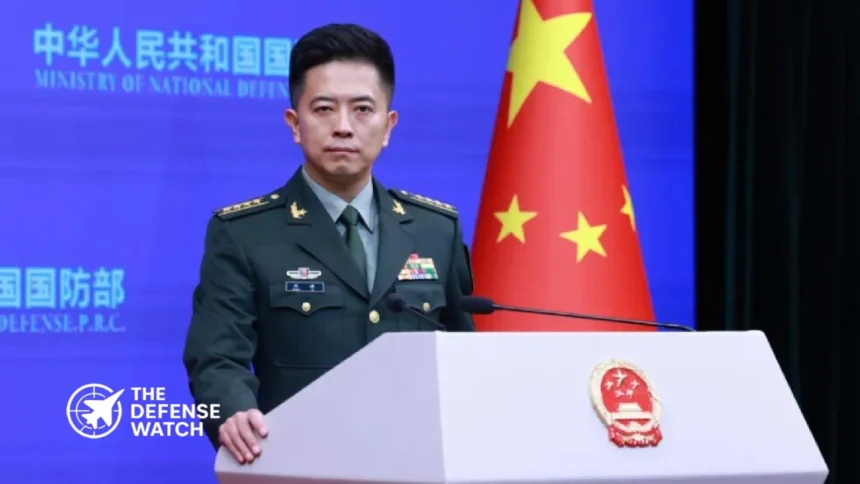
China’s Ministry of National Defense spokesperson Chen Xi confirmed the meeting on November 13, describing communication between the two defense establishments as an ongoing process involving dialogue at different levels.
What the November military meeting established
According to the US Department of War’s November 3 readout, Cynthia Xanthi Carras, Principal Director for China, Taiwan and Mongolia in the Office of the Under Secretary of War for Policy, met Senior Colonel Wang Wei in Washington.
Wang serves as deputy director of the PLA Office of International Military Cooperation’s Americas and Oceania Affairs Bureau.
Both representatives agreed on the importance of advancing practical communication measures to reduce risks between the United States and China.
The discussions also covered additional channels for effective crisis management and ways to communicate more quickly and effectively during potential emergencies.
The Pentagon said it would continue discussions with the PLA on key defense issues in the coming months.
However, the public readout did not announce a new military hotline, establish specific response procedures or disclose a binding agreement on how either military would handle an operational incident.
That distinction matters. Agreeing on the need for better communication is an important diplomatic step, but it does not establish that both sides have resolved the practical problems involved in managing a military crisis.
Why Washington and Beijing need military communication channels
The United States and China operate increasingly capable military forces in the Indo-Pacific, where their activities frequently take place within the same strategic and geographic environment.
US naval and air forces operate across the Western Pacific, including areas surrounding the Taiwan Strait and South China Sea. The PLA, meanwhile, continues to expand its regional military capabilities through naval modernization, advanced combat aircraft, missile forces and increasingly sophisticated surveillance systems.
These activities create opportunities for encounters between military aircraft and ships belonging to both countries.
An unsafe interception, misinterpreted maneuver or communication failure could create a crisis that develops faster than diplomatic authorities can respond.
Military communication mechanisms are intended to reduce that risk by providing officials with ways to clarify intentions, exchange information and prevent an isolated incident from escalating into a wider confrontation.
They cannot eliminate strategic competition or guarantee that either side will change its operational behavior. Their value lies primarily in improving the ability to manage unexpected events.
September agreement provides the diplomatic framework
The Washington meeting followed discussions between US President Donald Trump and Chinese President Xi Jinping in September 2026.
According to the Associated Press, the two governments agreed to conclude a memorandum of understanding on strengthening military crisis communications and preventing incidents between their armed forces.
The agreement was part of a wider effort to establish working-level mechanisms covering areas of bilateral cooperation. However, the Chinese government’s public statement provided limited operational detail about the proposed military arrangements.
The November working group therefore provides an opportunity to move the broader political commitment into practical discussions between military officials.
The distinction between establishing a framework and implementing it remains important. A functioning crisis communication arrangement requires agreed procedures, designated points of contact, reliable communication channels and confidence that messages will reach the appropriate decision-makers during an emergency.
Neither the US readout nor the Chinese statement published on November 13 provides enough information to determine how far these arrangements have progressed.
Potential senior-level military engagement
Further military engagement could follow the working-level discussions.
On November 7, the South China Morning Post reported that Stephen Orlins, president of the National Committee on United States-China Relations, had indicated that US Secretary of War Pete Hegseth and Admiral Samuel Paparo, commander of US Indo-Pacific Command, might visit China.
The possibility has not been confirmed through an official travel announcement by either government. No confirmed dates, itinerary or meeting schedule have been disclosed.
If such visits take place, they could provide an additional channel for senior-level military engagement.
Paparo’s potential participation would be particularly relevant because US Indo-Pacific Command is responsible for American military operations across a region where US and Chinese forces operate in close proximity.
However, a possible visit should not be interpreted as evidence of an agreement on regional military activities or a reduction in underlying strategic competition.
Communication does not resolve the underlying military tensions
Washington and Beijing continue to hold fundamentally different positions on several security issues.
Taiwan remains a major source of tension, particularly over US military support for Taipei and China’s opposition to foreign military involvement in the issue.
The South China Sea also presents risks involving competing territorial claims, naval deployments and military activities near disputed maritime areas.
These disagreements create a difficult environment for military communication. Even when senior officials maintain diplomatic contact, operational encounters can produce competing interpretations of intentions and actions.
For both countries, maintaining communication mechanisms can help reduce the possibility that an incident develops into a larger confrontation.
The November discussions are therefore best understood as an effort to maintain crisis-management channels rather than evidence of a broader improvement in US-China military relations.
The next meaningful indicator will be whether the two governments translate their stated commitment into clearly defined procedures, regular military contacts and communication arrangements that can function during an actual crisis.