Three men accused of supporting Iran-aligned militant organizations have been indicted in the United States over an alleged September 2026 plot targeting RAF Fairford, a British military airbase that hosted US military aircraft and personnel.
The eight-count superseding indictment, unsealed on November 10 by federal prosecutors in the Southern District of New York, identifies Mohammad Baqer Saad Dawood al-Saadi, Mohsen Mohajeri and Mohammad Ali al-Hassani as alleged participants in a wider network responsible for planning attacks across Europe and the United States.
Prosecutors allege that the three men supported Kata’ib Hezbollah and Iran’s Islamic Revolutionary Guard Corps (IRGC), both designated as Foreign Terrorist Organizations by the United States. The indictment also links them to nearly 20 attacks and attempted attacks, including incidents targeting Jewish communities and institutions in Europe and the United States.
The RAF Fairford case is particularly significant because prosecutors allege that coordination continued even after one of the suspected organizers had been arrested and transferred to US custody.
The allegations have not been tested at trial. All three defendants are presumed innocent unless proven guilty.
How the RAF Fairford operation was allegedly organized
According to the Justice Department, Mohammed Ali al-Hassani directed the preparations for the attempted operation from outside the United Kingdom.
The indictment places the initial preparations in August 2026. On August 22, al-Hassani allegedly paid an individual in Britain to conduct surveillance around RAF Fairford’s perimeter. The individual subsequently sent him videos showing the surrounding area.
Prosecutors say the preparations expanded during September, when al-Hassani allegedly recruited and paid several associates to arrange vehicles and other materials.
The indictment identifies three white vans as central to the alleged operation. Some reportedly contained barrels of fuel, while the vehicles carried custom markings designed to make them appear to belong to commercial fuel delivery and swimming pool supply businesses.
The alleged preparations also included researching chemical accelerants and obtaining metallic objects that prosecutors said could have been used as explosive shrapnel.
On September 26, al-Hassani allegedly instructed associates to drive the three vans toward RAF Fairford. He remained in frequent communication with the drivers, directing their movements.
At least two vehicles encountered a security roadblock and were prevented from following their intended routes.
British law enforcement recovered three white vans during the early hours of September 27 and arrested their occupants, according to the US indictment.
The available court documents do not establish that an explosive device was successfully deployed at the base. The case concerns an alleged attempted operation that was disrupted before the vehicles reached their intended destination.
An alleged command network operating across three countries
One of the more unusual elements of the investigation concerns the alleged role of al-Saadi, who was already being held in federal custody in New York.
US prosecutors say al-Saadi was arrested abroad on May 1, 2026, and subsequently transferred to the United States to face terrorism-related charges. Despite his detention, investigators allege that he continued communicating with associates through family members in Iraq.
According to the indictment, al-Saadi used telephone conversations with his mother and sister to pass coded messages to Mohajeri and al-Hassani.
Prosecutors say the communications included references to operational work, financial assistance and the status of previous plans.
In a September 24 conversation, al-Saadi allegedly asked his family about al-Hassani and instructed them to provide him with money so that they could proceed with their plans.
The indictment places that conversation three days before the alleged operation involving the vans at RAF Fairford.
The allegations suggest that investigators are examining a network in which suspected organizers based outside Britain relied on local associates to conduct surveillance, obtain vehicles and arrange access to a military installation.
That distinction matters for security investigations. The people accused of directing an operation do not necessarily need to be physically present at its intended target.
Who are the three defendants?
The superseding indictment identifies three individuals with different alleged roles in the wider network.
– Mohammad Baqer Saad Dawood al-Saadi: A dual Iranian-Iraqi national, aged 32, whom prosecutors describe as a Kata’ib Hezbollah commander and an alleged coordinator of terrorist activities. He was already in US federal custody when the RAF Fairford plot was allegedly organized.
– Mohsen Mohajeri: A 48-year-old Iranian national whom prosecutors describe as an IRGC operative. He allegedly coordinated with al-Saadi and al-Hassani and was in Iran during the RAF Fairford preparations.
– Mohammad Ali al-Hassani: A 35-year-old Iraqi national whom prosecutors identify as the alleged organizer of the RAF Fairford operation. He reportedly used contacts and associates in the United Kingdom to arrange the preparations.
The indictment alleges that the three men were involved in a broader campaign of attacks and attempted attacks across Europe, with activities attributed to a purported organization called Harakat Ashab al-Yamin al-Islamiya (HAYI).
US prosecutors describe HAYI as a front for Kata’ib Hezbollah and other designated organizations. They allege that the network claimed responsibility for approximately 18 attacks in Europe during the spring of 2026, including seven in the United Kingdom.
These are prosecution allegations contained in the indictment, rather than findings established through a criminal trial.
Why RAF Fairford matters to US military operations
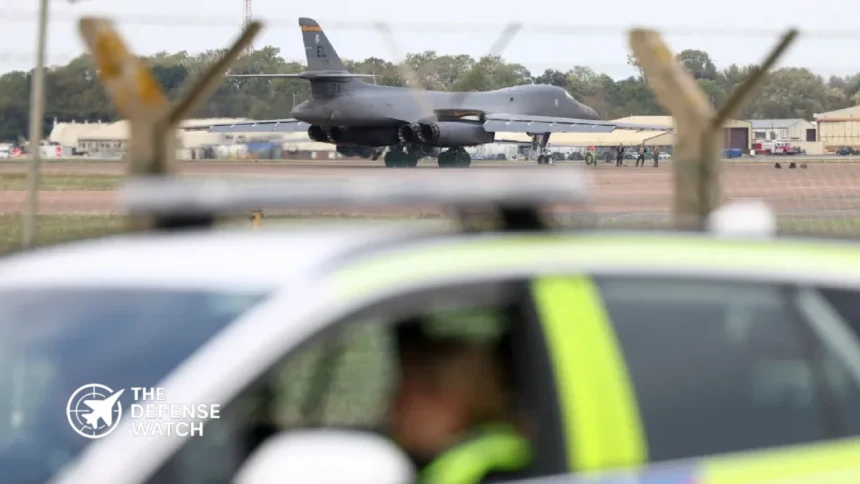
RAF Fairford is an important operating location for US military aviation in Europe. Its use by American bomber aircraft makes the installation relevant to US force posture and the protection of military infrastructure outside the continental United States.
The base had been used by US bombers to conduct strikes against Iran. Reuters reported that the aircraft were subsequently withdrawn on security grounds shortly after five British men were arrested outside the installation in September.
The alleged plot therefore involved more than an attempted attack on a British military installation. It concerned a facility supporting American military operations during a period of direct military confrontation between Washington and Tehran.
For the United States and United Kingdom, the incident raises questions about protecting overseas airfields against threats that combine surveillance, local recruitment, disguised vehicles and remote coordination.
Traditional airbase security focuses on perimeter protection, access control, surveillance and rapid response. The allegations in this case also point to the importance of monitoring suspicious activity outside installation boundaries and identifying potential logistical preparations before vehicles reach security checkpoints.
However, the indictment does not establish that RAF Fairford’s aircraft, personnel or operational capabilities were compromised.
British investigation adds another dimension
The US indictment follows a separate investigation by British authorities into the September incident.
On October 27, two men appeared in a London court facing charges under Britain’s National Security Act and other national security legislation.
Reuters identified them as Mohmed Abdulkarim, a British national accused of assisting a foreign intelligence service, and Nouman Essghir, a dual British-Iranian national charged with entering a prohibited place for a purpose prejudicial to the United Kingdom.
British prosecutors alleged that Abdulkarim arranged for five men to transport three vans toward RAF Fairford at the direction of an individual known as Ali. Essghir was accused of conducting reconnaissance around the base in August and subsequently travelling in one of the vans.
Police said six other people arrested in connection with the September incident remained on bail at the time of the October report.
The British proceedings and US indictment provide separate accounts of the investigation. Although both describe an individual called Ali and preparations involving three vans, the available reporting does not independently establish the full identities of every person involved across the two cases.
That distinction is important as investigators continue examining the suspected links between the local British network and individuals allegedly directing the operation from abroad.
A wider counterterrorism investigation
The RAF Fairford allegations form part of a much larger US investigation into attacks and attempted attacks attributed to the alleged network.
The Justice Department says the three defendants were connected to incidents targeting Jewish communities, synagogues, businesses and other locations in Europe. The indictment also describes an alleged attempt to target a synagogue in Manhattan.
The US government alleges that al-Saadi helped coordinate these activities while working with individuals associated with the IRGC and Kata’ib Hezbollah.
The case has therefore expanded beyond the security of one British airbase. It involves alleged international coordination, financial support, recruitment of local associates and the use of communications to organize attacks across national borders.
For military planners, the RAF Fairford incident illustrates a security challenge that extends beyond conventional military threats. Overseas installations can face risks from locally recruited individuals operating on behalf of networks located outside the host country.
The effectiveness of future protection measures will depend not only on physical security around military bases but also on intelligence sharing, counterintelligence operations and cooperation between allied law enforcement agencies.
The US indictment provides prosecutors’ account of how the alleged operation was organized. Whether the defendants can be linked to the full range of activities described in the filing will ultimately be determined through the judicial process.