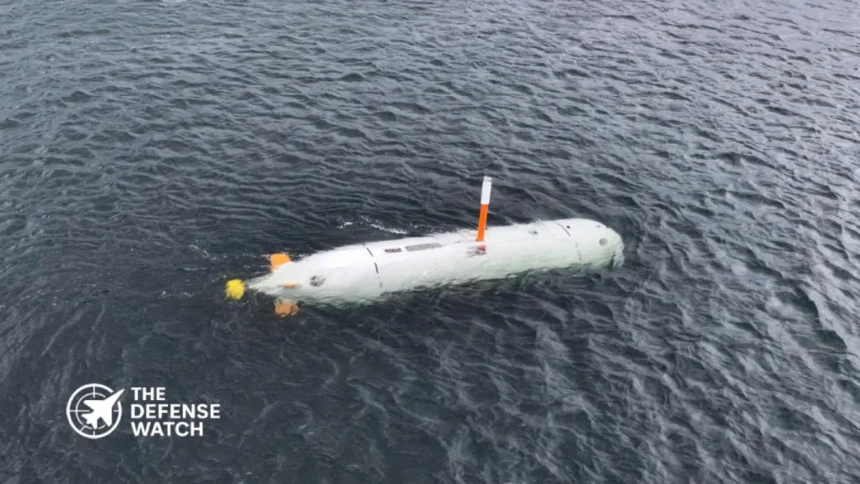
Swedish defense company Saab has completed the initial development and sea trials of a large uncrewed underwater vehicle demonstrator in cooperation with the Swedish Defence Materiel Administration (FMV) and the Swedish Armed Forces. The project reached the milestone less than a year after the development contract was awarded, providing Sweden with a test platform for evaluating future autonomous underwater capabilities.
Announced on October 16, 2026, the milestone completes the project’s first phase. Further work is expected to focus on more advanced capabilities, including software, sensors and autonomous functions. The Swedish authorities have not announced a decision to procure the demonstrator as an operational fleet system.
From a development contract to sea trials
The program began in August 2025, when FMV awarded Saab a contract valued at 60 million Swedish kronor to develop and demonstrate a Large Uncrewed Undersea Vehicle (LUUV). Saab was appointed prime contractor, with responsibility for designing, building and testing the vehicle. The original plan called for initial sea trials in summer 2026.
The successful completion of the first phase indicates that the team has met the central objective of moving from a concept to a functioning demonstrator and testing it at sea. However, completing trials does not establish that the vehicle has met all requirements for operational deployment.
The distinction matters for procurement. A demonstrator allows the customer to evaluate technical choices, identify shortcomings and refine requirements before committing to a production system. The results can help determine which capabilities merit further investment and what additional testing is needed.
FMV leads the project in cooperation with the Swedish Armed Forces and Saab. The arrangement brings the customer, military end user and industrial developer into the same development process, allowing technical feedback to inform subsequent work.
Autonomous control is central to the design
Saab’s software-centric development approach and its Autonomous Ocean Core control system have supported the LUUV program. According to the company, Autonomous Ocean Core provides autonomous capabilities for surface and subsurface vehicles. The system is intended to provide a common control foundation that can support different maritime platforms.
For an uncrewed underwater vehicle, autonomy is important because communication with operators can be constrained beneath the surface. A vehicle must be able to carry out its assigned tasks and manage aspects of its operation without relying on continuous direct control. The level of autonomy required will depend on the mission, onboard sensors, navigation arrangements and safeguards built into the system.
Saab has not disclosed the demonstrator’s dimensions, displacement, propulsion system, maximum operating depth, endurance, speed or communications architecture in its October 16 announcement. Details of its sensor suite and demonstrated autonomous functions also remain limited.
The next phase is expected to develop more advanced capabilities. Its results should help clarify how far the vehicle can progress from a technology demonstrator toward a system suitable for defined naval missions.
Why Sweden is investing in uncrewed underwater systems
Sweden’s interest in autonomous underwater platforms is closely connected to the security of the Baltic Sea and the protection of maritime infrastructure. Subsea communications cables, energy connections and shipping routes are important to the country’s economic and security interests.
In an August 2025 announcement, the Swedish Armed Forces said the LUUV project was intended to strengthen the military’s ability to detect, monitor and respond to underwater threats. The service also identified the protection of critical infrastructure as an important part of Sweden’s wider underwater security requirements.
A large uncrewed underwater vehicle could potentially support surveillance over extended periods, collect information in areas of interest and operate alongside crewed naval platforms. Such systems may help navies expand underwater monitoring without assigning every mission to a crewed submarine.
These are potential applications rather than confirmed capabilities of the Swedish demonstrator. The available announcement does not establish which missions have been tested successfully or how the vehicle would perform in operational conditions.
The Baltic Sea’s geography also places a premium on understanding activity around important maritime routes and infrastructure. Uncrewed platforms could supplement existing surveillance assets, but their practical value would depend on sensor performance, navigation accuracy, endurance, data processing and the ability to transmit useful information to operators.
Integration with submarines and future naval operations
Saab says the demonstrator is intended to support future underwater capabilities and operate alongside existing naval platforms, including submarines. That points toward a complementary role rather than an immediate replacement for conventional submarines.
Crewed submarines can perform complex missions and accommodate personnel and equipment that an uncrewed platform may not support. A LUUV, by contrast, could eventually undertake selected tasks without placing a crew aboard, depending on its design and the capabilities demonstrated during testing.
Integration will require more than a functioning underwater vehicle. The Swedish Armed Forces will need to evaluate how uncrewed systems fit into mission planning, information sharing, command arrangements, maintenance and recovery procedures. Compatibility with existing naval platforms will also matter if the system is to operate as part of a wider force.
The current project provides a basis for examining those requirements. It does not yet confirm a production schedule, fleet size or operational service date.
What the next phase needs to establish
The immediate priority is to turn the initial sea-trial results into a clearer set of technical and operational requirements. Further development of software, sensors and autonomous functions could help authorities assess the system’s usefulness across different underwater missions.
Several important questions remain unanswered. Saab and FMV have not publicly detailed the demonstrator’s endurance, payload capacity, operating depth, navigation performance or ability to work in challenging underwater conditions. These factors will influence the range of missions the platform can perform and the resources required to support it.
The August 2025 contract was valued at 60 million Swedish kronor, but that figure relates to the initial development project. It should not be interpreted as the cost of a production-ready vehicle or a future operational fleet.
For Sweden, the completed first phase is a development milestone, not the end of the procurement process. Further trials and capability assessments will help determine whether the demonstrator can meet the Navy’s requirements and whether additional investment in autonomous underwater systems is justified.