• Home
  • About
  • Defense Systems
  • Manufacturer
  • Comparisons
  • Compare 
  • Tools
TheDefenseWatch.com
  • Aerospace & Aviation
  • Military & Ordnance
  • Naval & Maritime
  • Cyber & Space Defense
  • Policy & Strategy
  • Global News
  • Tools Library
    • Smart Calculator
    • Drone Flight Time Calculator
    • Drone Range Calculator
    • Counter-Drone Jammer Effective Range Calculator
    • Counter-Battery Radar Detection Calculator
    • Artillery Fire Correction Calculator
    • Thermal Camera Detection Range Calculator
    • Missile Range & Time-of-Flight Calculator
    • Radar Detection Range Calculator
    • FPV Strike Drone Payload vs Range Calculator
    • Loitering Munition Endurance Calculator
    • Sniper Ballistic Drop & Windage Calculator
    • Bullet Drop Calculator
    • U.S. Army Combat Fitness Test (ACFT) Calculator
    • Military Pension Calculator
    • Military Retirement Calculator
    • Military Pension Calculator
    • Large Number Calculator
Font ResizerAa

TheDefenseWatch.com

The Defense Watch | U.S. & Global Defense News, Analysis & Military Updates

Search
  • Home
  • About
  • Defense Systems
  • Manufacturer
  • Comparisons
  • Compare 
  • Tools

Stay Updated

Get the latest update

Subscribe

Explore

  • Drone
  • Fighter Jets & Military Aircraft
  • Hypersonic Weapons
  • Aircraft Carriers
  • Strategic History & Missions
  • Tools Library
Home » Pakistan Tests Extended-Range Fatah-4 Cruise Missile
Global News

Pakistan Tests Extended-Range Fatah-4 Cruise Missile

Kaleem Sheikh | Regional Defense Correspondent
Last updated: October 7, 2026 1:27 am
Kaleem Sheikh | Regional Defense Correspondent
Share
3 Min Read
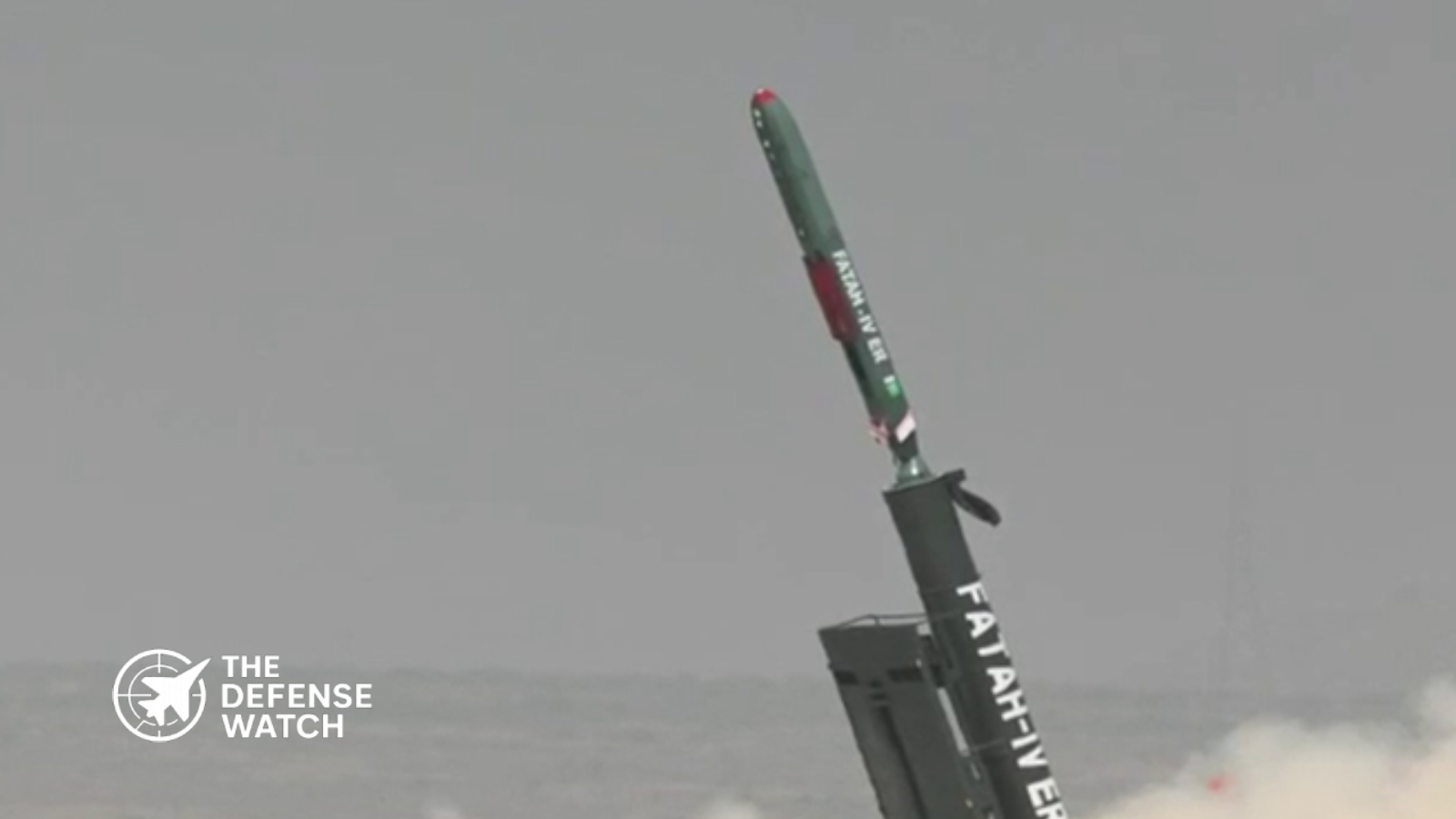
Fatah-4 extended-range missile
Screen Grab
SHARE
Follow The Defense Watch on Google:

Pakistan has conducted a successful test launch of an extended-range version of its Fatah-4 ground-launched cruise missile, adding another test milestone to the country’s developing conventional long-range precision-strike capability.

Contents
What the Latest Test ConfirmsFrom the 750 km Fatah-4 to the Extended VersionA Development Path Rather Than a Single TestWhy the Range Question MattersImplications for Pakistan’s Conventional Strike ForceWhat Remains Undisclosed

The October 6, 2026 launch was conducted by the Pakistan Army and involved the extended version of the indigenously developed Fatah-4. Pakistan’s official government reporting, citing the Inter-Services Public Relations (ISPR), said the weapon incorporates advanced avionics and navigational aids and that the latest test validated additional technical parameters intended to improve accuracy and survivability.

The official announcement did not disclose the missile’s maximum range.

Reports circulating around the test have suggested that the extended-range Fatah-4 may have a range exceeding 1,000 kilometers. That figure has not been confirmed by Pakistan’s military or government in the official material reviewed for this report and should therefore be treated as unverified.

- Advertisement -
  • Fatah-4 Cruise Missile

    Fatah-4 Cruise Missile

    • Guidance System: Advanced avionics and navigational aids; detailed guidance architecture not officially disclosedAdvanced avionics and navigational aids; detailed guidance architecture not officially disclosed
    • Maximum Speed: Approximately Mach 0.7 for the originally disclosed Fatah-4; extended version not disclosed
    • Launch Compatibility: Ground-launched
    • Warhead Technology: Conventional warhead; detailed technology not officially disclosed
    • View Details →
    8.0

    What the Latest Test Confirms

    The October launch is important because Pakistan described the weapon specifically as an extended version of the Fatah-4 rather than simply repeating the earlier description of the baseline missile.

    According to the official account, the test assessed additional technical parameters of various subsystems. The stated objectives included improvements in accuracy and survivability.

    Pakistan did not publicly identify which individual subsystems were modified, nor did it disclose detailed guidance architecture, propulsion changes, warhead characteristics, flight profile, or the distance covered during the October test.

    That distinction matters. A test of an extended-range configuration demonstrates continued development, but it does not by itself establish the final operational range or configuration of the weapon.

    The launch was witnessed by senior Pakistan Army officers, scientists and engineers from the development organization, according to the official statement.

    From the 750 km Fatah-4 to the Extended Version

    Pakistan first publicly disclosed the Fatah-4 as a ground-launched cruise missile in September 2025. During a training launch on September 30 that year, the Pakistan Army stated that the missile had a range of 750 kilometers.

    The military also said the system used advanced avionics and navigational aids and was designed with terrain-hugging characteristics intended to make it more difficult for missile-defense systems to detect and engage.

    The Fatah-4 was associated with the newly established Army Rocket Force Command, which Pakistan announced in August 2025 as a formation intended to strengthen the country’s conventional warfare capabilities.

    The Army Rocket Force Command represents an important organizational change. Rather than treating long-range conventional rocket and missile systems only as individual weapons programs, Pakistan has created a dedicated command structure around conventional precision strike.

    The Fatah-4 therefore fits into a broader effort to give the Pakistan Army a longer-range conventional strike option that is distinct from its nuclear deterrence architecture.

    • Fatah-4 Cruise Missile

      Fatah-4 Cruise Missile

      • Guidance System: Advanced avionics and navigational aids; detailed guidance architecture not officially disclosedAdvanced avionics and navigational aids; detailed guidance architecture not officially disclosed
      • Maximum Speed: Approximately Mach 0.7 for the originally disclosed Fatah-4; extended version not disclosed
      • Launch Compatibility: Ground-launched
      • Warhead Technology: Conventional warhead; detailed technology not officially disclosed
      • View Details →
      8.0

      A Development Path Rather Than a Single Test

      The Fatah-4 program has now accumulated several publicly reported test milestones.

      In September 2025, Pakistan conducted the initial training launch at the publicly stated 750 km range. In May 2026, the Army Rocket Force Command conducted another Fatah-4 training fire, saying the event was intended to improve troop operational efficiency and validate technical parameters related to accuracy and survivability.

      The October test went further by explicitly identifying the missile as an extended version.

      That progression suggests that Pakistan is continuing to refine the system rather than treating the original 750 km configuration as the final form of the weapon.

      However, the available official information does not establish whether the extended version has entered operational service, whether it has completed a full qualification program, or whether the reported range above 1,000 km represents an actual demonstrated capability.

      Why the Range Question Matters

      A range increase from the previously disclosed 750 km figure to more than 1,000 km would materially expand the geographic area that could be reached from Pakistani territory.

      For a conventional land-attack cruise missile, range is only one part of the military equation. Guidance accuracy, target intelligence, mission planning, launch survivability, communications, terrain-following performance and the ability to penetrate air defenses all affect operational value.

      Pakistan’s official statements have emphasized accuracy and survivability, but have provided few technical details that would allow an independent assessment of those characteristics.

      The absence of a disclosed range for the October test also prevents a firm comparison between the original Fatah-4 and the extended version.

      For now, the defensible conclusion is that Pakistan is developing a longer-range version of an already established ground-launched cruise missile capability. The scale of that increase remains unclear.

      Implications for Pakistan’s Conventional Strike Force

      The development is consistent with Pakistan’s broader effort to strengthen conventional stand-off strike capabilities.

      The Army Rocket Force Command was announced in August 2025, with Prime Minister Shehbaz Sharif describing the new formation as a means of strengthening Pakistan’s conventional warfare capability. The Fatah-4 became one of the first long-range systems publicly associated with the command.

      The significance of the extended-range missile is therefore not limited to the weapon itself. It also concerns the force structure being developed around conventional precision strike.

      A longer-range cruise missile could provide commanders with additional options for engaging targets beyond the immediate battlefield while potentially reducing reliance on aircraft for certain strike missions. Its practical value, however, would depend on the number of missiles available, launch-platform survivability, intelligence support and the ability to operate against modern integrated air-defense networks.

      Those factors are not publicly detailed for the extended Fatah-4.

      What Remains Undisclosed

      Pakistan has not publicly released a comprehensive specification sheet for the extended-range Fatah-4.

      Among the most important unanswered questions are:

      • The demonstrated range of the extended version
      • Whether the system has actually exceeded 1,000 km in a test
      • Changes to propulsion or fuel capacity
      • Warhead configuration
      • Guidance and terminal navigation systems
      • Cruise speed
      • Operational altitude
      • Production quantities
      • Deployment status
      • Full operational qualification timeline

      Consequently, claims that the missile has a range exceeding 1,000 km should not yet be presented as an established specification.

      The October test does establish that Pakistan is continuing development of an extended-range Fatah-4 configuration and that the military is testing additional subsystems related to accuracy and survivability.

      For the moment, the most significant development is the continued expansion of Pakistan’s conventional long-range precision-strike architecture, rather than a confirmed numerical increase in missile range.
Enjoying our coverage?

Make The Defense Watch a preferred source on Google to see more of our geopolitical and defense insights when relevant to you.


TAGGED:Army Rocket Force Commandcruise missilesFatah-4Pakistan Army
Share This Article
Facebook Copy Link Print
ByKaleem Sheikh | Regional Defense Correspondent
Follow:
Kaleem Sheikh is a regional defense correspondent at TheDefenseWatch.com covering defense and security developments across Asia and the Middle East, including military operations, procurement, and regional security issues.
Leave a Comment

Leave a Reply Cancel reply

Your email address will not be published. Required fields are marked *

Search Defense Systems

Latest Defense Systems

  • F-104 Starfighter F-104 Starfighter
  • F-15J Eagle Fighter Jet F-15J Eagle Fighter Jet
  • China’s GJ-21 Stealth Drone China’s GJ-21 Stealth Drone
  • China’s GJ-11 Stealth Drone China’s GJ-11 Stealth Drone
  • F-15EX Eagle Fighter Jet F-15EX Eagle Fighter Jet
  • TRML-4D Radar TRML-4D Radar
  • F-47A Fighter Jet F-47A Fighter Jet
  • China DF-61 Missile China DF-61 Missile
  • B61 Nuclear Bomb B61 Nuclear Bomb

Recent Compares

  • J-10C vs JF-17 Thunder: Which Fighter Is More Capable? J-10C vs JF-17 Thunder: Which Fighter Is More Capable? View Comparison →
  • Tejas vs Gripen: Key Differences and Capabilities Tejas vs Gripen: Key Differences and Capabilities View Comparison →
  • Tejas vs MiG-21 Bison: How India Replaced Its Iconic Supersonic Fighter Tejas vs MiG-21 Bison: How India Replaced Its Iconic Supersonic Fighter View Comparison →
  • F-35 vs F-16: Stealth, Sensors and Combat Roles F-35 vs F-16: Stealth, Sensors and Combat Roles View Comparison →
  • Tejas Fighter Jet vs F-16 Fighting Falcon: Capability Compared Tejas Fighter Jet vs F-16 Fighting Falcon: Capability Compared View Comparison →
  • Rafale Fighter Jet vs F-16 Fighting Falcon : Which Fighter Has the Edge? Rafale Fighter Jet vs F-16 Fighting Falcon : Which Fighter Has the Edge? View Comparison →
  • Su-57 Fighter Jet vs J-20 Fighter Jet: Stealth and Air Combat Compared Su-57 Fighter Jet vs J-20 Fighter Jet: Stealth and Air Combat Compared View Comparison →
  • Mirage 2000 vs Tejas Mk1A: Legacy Combat Power vs Indigenous Modernization Mirage 2000 vs Tejas Mk1A: Legacy Combat Power vs Indigenous Modernization View Comparison →
  • Rafale Fighter Jet vs F-22 Raptor: Which Air Dominance Fighter Has the Edge? Rafale Fighter Jet vs F-22 Raptor: Which Air Dominance Fighter Has the Edge? View Comparison →
  • Tejas Fighter Jet vs. Rafale Fighter Jet: India’s Indigenous Fighter Meets France’s Proven Multirole Combat Aircraft Tejas Fighter Jet vs. Rafale Fighter Jet: India’s Indigenous Fighter Meets France’s Proven Multirole Combat Aircraft View Comparison →

Recent Posts

  • NASA’s Voyager 1 Reaches One Light-Day From Earth After 49 Years in Space
  • Russian Missiles Enter Polish Airspace During European Military Exercises
  • L3Harris Wins $28 Million Australian Defence Contract for Advanced Capability System
  • F-35C Completes First Launch and Recovery Trials Aboard Ford-Class Carrier
  • Northrop Grumman Declares $2.47 Per-Share Dividend for Fourth Quarter 2026

You Might Also Like

Shahed-136 air-to-air missile upgrade
Global News

Russia Deploys Shahed-136 Drones Now Armed With Air-to-Air Missiles — New Threat to Ukrainian Aviation

September 14, 2026
U.S. airpower
Global News

U.S. Airpower Edge Eroding as China Accelerates Air Force Modernization

November 3, 2025
UK Nightfall missile plan
Global News

Russia Rejects UK Nightfall Missile Plan for Ukraine, Warns Western Troops Are Targets

January 16, 2026
Iran protest death toll
Global News

Iran Acknowledges 2,000 Protest Deaths as Trump Weighs Military Strikes

January 13, 2026

Logo

Copyright © 2026 TheDefenseWatch.com

Helpful Links

  • Home
  • About Us
  • Privacy Policy
  • Terms of Use / Disclaimer
  • U.S. Privacy Notice – CCPA Compliance

Defense Systems

  • Defense Systems
  • Comparisons 
  • Manufacturer
  • Tactical Calculators

Popuplar

Which 5 Air Forces Possess the Costliest Fighter Jet Fleets in the World
Evolving Strategic Value: Carrier Strike Groups in the Indo-Pacific’s Future Security Architecture
Autonomous Weapon Systems Spark U.S. Ethics Debate Amid Rapid Military AI Integration

We report on developments involving military forces, governments, defense companies, research organizations, and security institutions around the world. 

Welcome Back!

Sign in to your account

Username or Email Address
Password

Lost your password?

Enjoying our coverage?

Make The Defense Watch a preferred source on Google to see more insights.