

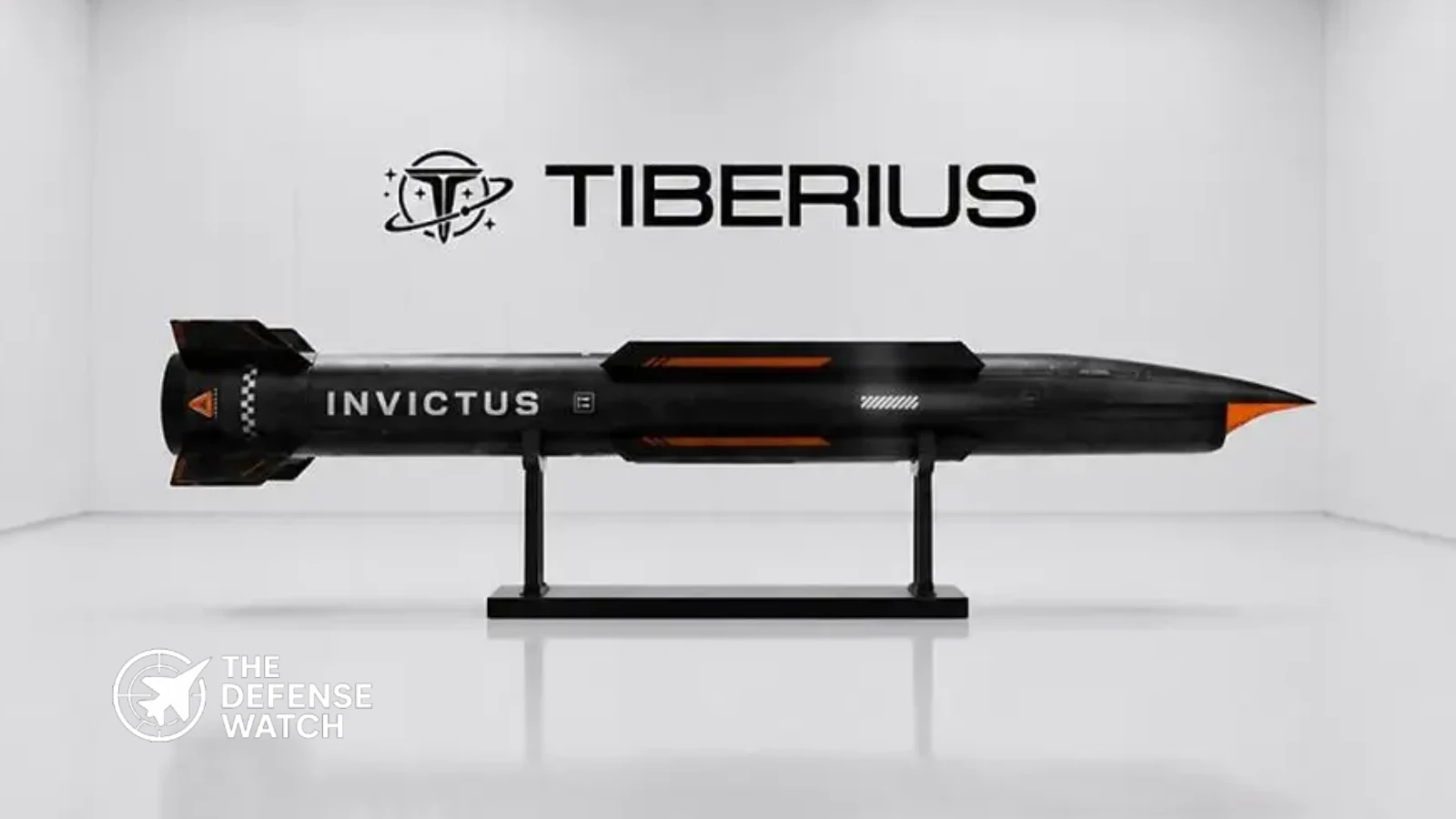
Tiberius Aerospace Advances Invictus Missile Into Formal Testing
The Invictus missile has entered formal engineering Test and Evaluation as Tiberius Aerospace moves the long-range precision strike system beyond early laboratory work and toward structured validation. The company says the program is intended to combine long-range precision, multi-domain deployment and scalable production in a single missile architecture.
Takeaways
Tiberius Aerospace is advancing the Invictus missile from laboratory development into formal engineering testing.
1. Formal Engineering Testing Begins
Tiberius Aerospace has moved the Invictus program into formal engineering Test and Evaluation, focusing on propulsion, flight performance, guidance, platform integration and manufacturability.
2. Mach 3 and 200-Kilometer Design Target
The Invictus-200 is designed to reach speeds of up to Mach 3 and engage targets at ranges of up to 200 kilometers.
3. Ramjet Propulsion
The system combines a ramjet engine with an integral booster, with direct-connect engine testing already underway at Purdue University’s Zucrow Laboratories.
4. Modular Multi-Mission Architecture
Tiberius says the missile will have a 10 to 15 kilogram payload and an open architecture intended to support different missions and future upgrades.
5. Production Capacity Is Part of the Design
The company is positioning Invictus not only as a precision strike system but also as a weapon designed for scalable production and adaptation through its service life.
The development marks an important change in the status of Invictus. Rather than remaining primarily a concept or laboratory project, the program is now focused on testing the engineering elements required to mature the weapon. According to Tiberius, those activities include propulsion, flight performance, guidance, platform integration and manufacturability.
The company has not announced an operational deployment date. The move into formal Test and Evaluation therefore should be viewed as a development milestone rather than evidence that Invictus has entered military service.
Invictus-200 Targets Mach 3 and 200-Kilometer Range
The central configuration is the Invictus-200, which Tiberius says is designed to reach speeds of up to Mach 3 and strike targets at ranges of up to 200 kilometers.
The missile is designed around a ramjet propulsion system combined with an integral booster. Tiberius says the system is intended to achieve targeting precision of approximately 5.5 meters circular error probable, or CEP, depending on the guidance configuration. The planned payload is between 10 and 15 kilograms.
These figures remain design and development targets rather than independently verified operational performance. That distinction is important as the program enters formal testing.
The Invictus architecture is also intended to support a range of launch platforms. Tiberius describes it as a tube-launched, multi-mission system that could be integrated with vertical launch systems and autonomous vehicles operating from land and sea.
This approach gives the program a broader role than a missile designed around one launcher or platform. The company is developing the weapon around a modular architecture intended to allow different configurations as mission requirements change.
Ramjet Development Builds On Sceptre
Invictus follows Tiberius Aerospace’s Sceptre program, a 155 mm precision-guided artillery munition that uses ramjet propulsion.
In April 2026, Tiberius reported that Sceptre had successfully demonstrated liquid-fuelled ramjet ignition after launch from a NATO-standard 155 mm howitzer during testing in New Mexico. The company said the test demonstrated the ability to launch the munition, ignite the ramjet and maintain intended flight performance.
Tiberius has presented Sceptre as a system capable of extending the reach of existing artillery infrastructure. Its reported development target includes speeds above Mach 3 and ranges of up to 150 kilometers. The company’s current website lists Sceptre with a range exceeding 255 kilometers, a speed above Mach 3 and a 4.5-meter CEP, indicating that the program’s published performance figures have evolved during development.
The experience gained from Sceptre is now being applied to Invictus. Tiberius says the earlier program helped accelerate Invictus from exploratory laboratory work into a formal engineering effort.
Purdue Zucrow Laboratories Supports Engine Testing
A key part of the current Invictus effort is propulsion testing at Purdue University’s Maurice J. Zucrow Laboratories.
Tiberius says direct-connect testing of the Invictus ramjet engine is underway at the facility and that the engine has demonstrated operability using Jet-A across the conditions tested so far.
Purdue describes Zucrow Laboratories as a major propulsion research complex with capabilities covering propulsion systems, combustion, hypersonics, aerodynamics and energetic materials. Its test infrastructure includes multiple propulsion test cells, dedicated control and diagnostics facilities, and systems capable of testing propulsion hardware under representative conditions.
The facility’s role is significant because propulsion testing provides a controlled environment for evaluating engine behavior before more complex flight testing. For a ramjet-powered system, validating combustion and engine performance across relevant operating conditions is a central part of the development process.
Production Capacity Is Central To The Design
Tiberius is positioning Invictus around two related requirements: precision strike capability and the ability to produce weapons at scale.
The company says its modular, open architecture is intended to allow the missile to evolve without replacing the entire system. This could enable changes to guidance, payload or other components as requirements develop, although specific future configurations have not been publicly detailed.
Tiberius also says it is using its GRAIL software platform to support development, supplier integration and production planning. The company describes GRAIL as an AI-powered platform intended to assess weapon effectiveness and connect program requirements with domestic and allied suppliers.
The production objective reflects a broader issue facing Western militaries. Recent conflicts have highlighted the difficulty of maintaining inventories of precision weapons when expenditure rates are high and production capacity is limited.
Tiberius argues that a weapon designed from the beginning for high-volume production can address part of that problem. However, whether Invictus can achieve the proposed production scale and cost targets will depend on the results of engineering tests, manufacturing qualification, supplier capacity and eventual government procurement decisions.
Multi-Domain Launch Options
The planned launch architecture is another defining feature of the Invictus missile.
Tiberius describes Invictus as a tube-launched system that could be integrated with vertical launch systems and autonomous platforms operating on land and at sea. The approach is intended to reduce dependence on a single launch platform and provide flexibility in how precision effects are delivered.
Earlier reporting on the program identified the Vault launch system as a planned containerized launcher for Invictus. EDR Magazine reported in 2025 that the proposed system could use a booster to accelerate the missile to the speed needed for ramjet operation before the ramjet takes over propulsion. At that stage, however, many Invictus details were still preliminary.
The transition into formal Test and Evaluation should provide additional information about how the propulsion, launcher, guidance and missile airframe perform as an integrated system.
What Formal Testing Means For Invictus
The move into formal engineering testing is an important development stage, but it does not by itself establish that Invictus is ready for operational deployment.
The program must demonstrate that its propulsion system can perform reliably, that the missile can achieve its intended flight characteristics, and that guidance and control systems can deliver the required accuracy. Platform integration and manufacturing processes will also need to mature.
The company has stated that these areas are now part of the formal testing program.
For TheDefenseWatch.com readers, the most important point is that Invictus has moved from a primarily developmental concept into a structured engineering validation phase. The advertised Mach 3 speed, 200-kilometer range and 5.5-meter CEP remain targets that must be demonstrated through testing.
If those targets are achieved, the system could give U.S. and allied forces another potential option for mobile, long-range precision strike. At present, however, the program remains in development and no operational fielding decision has been announced.
Analysis: Why The Invictus Missile Program Matters
The significance of the Invictus missile is not limited to its stated range or speed. Its development reflects a broader shift in Western defense planning toward weapons that combine precision, mobility and production capacity.
Traditional missile programs often prioritize performance requirements first, with manufacturing capacity addressed later in the acquisition cycle. Tiberius is explicitly making production scalability part of the weapon’s design philosophy.
That approach is relevant to a defense environment in which precision-guided weapons can be consumed faster than traditional industrial systems can replace them.
Invictus is also being developed alongside Sceptre, allowing Tiberius to build experience with ramjet propulsion, testing and production processes across more than one weapon category. The successful Sceptre ramjet ignition demonstration provides a company-reported technical milestone, but it does not independently validate the full Invictus system.
The next phase will therefore be closely tied to measurable test results. Flight demonstrations, guidance accuracy, propulsion reliability, launcher integration and manufacturing performance will provide a clearer assessment of whether the Invictus design can move from development into a deployable military capability.
For now, the formal engineering Test and Evaluation phase represents the clearest indication yet that Tiberius Aerospace is attempting to turn Invictus from a proposed long-range strike concept into a testable weapon system.
