

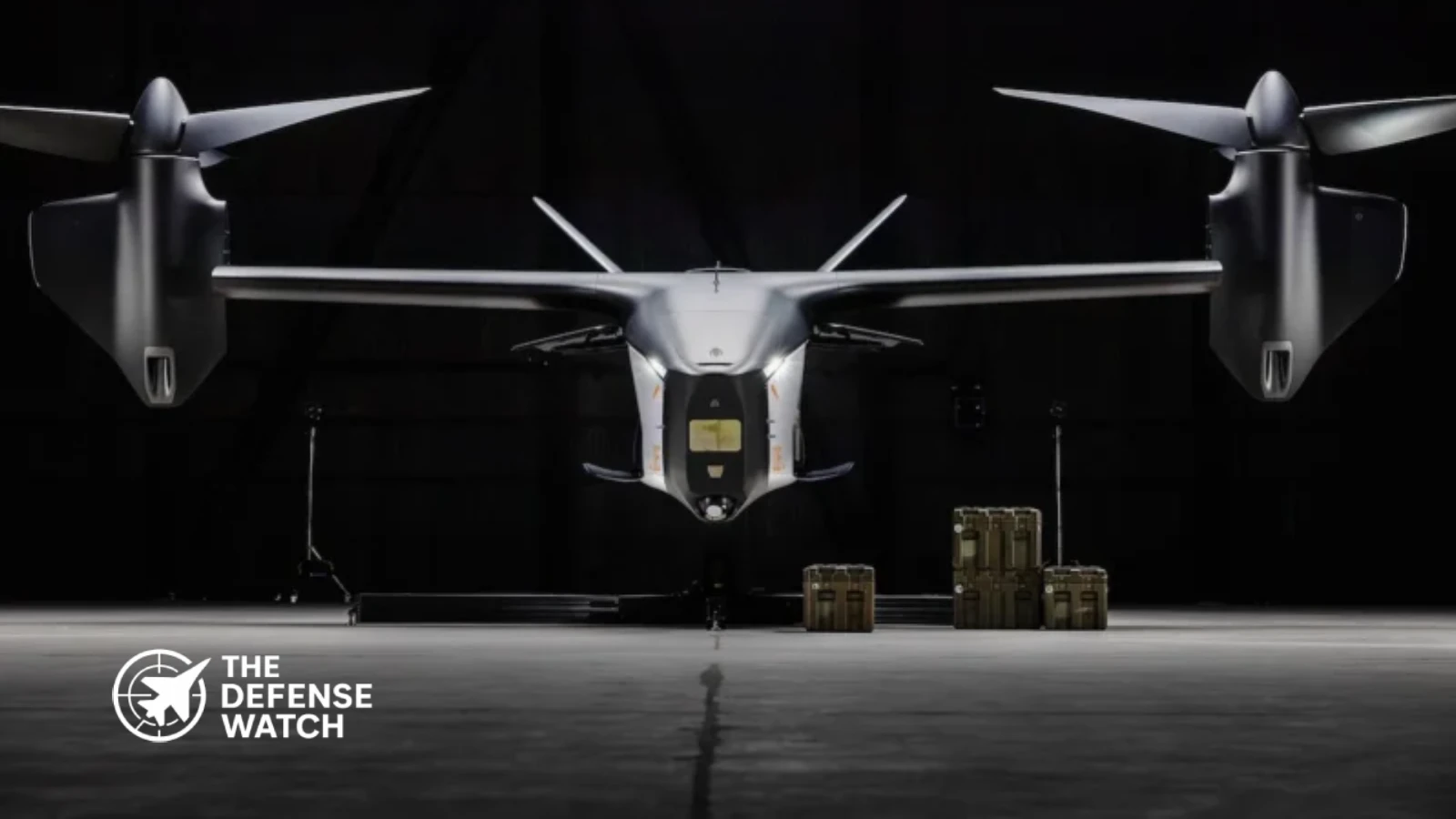
Elroy Air Inc. has received a $46.06 million firm-fixed-price Phase III Small Business Innovation Research contract from the U.S. Army to develop an autonomous Group IV hybrid vertical takeoff and landing unmanned aircraft system for modular multi-mission payload delivery. Army Contracting Command, Aberdeen Proving Ground, Maryland, is the contracting activity under contract W911QX-26-C-A016.
Takeaways
Elroy Air receives a major Army development award for autonomous heavy cargo operations
1. $46 Million Phase III Award
Elroy Air has received a $46.06 million firm-fixed-price Phase III SBIR contract from the U.S. Army for autonomous Group IV UAS development.
2. Autonomous Hybrid VTOL Aircraft
The program targets a hybrid-electric vertical takeoff and landing aircraft capable of delivering modular payloads with limited operator intervention.
3. $5.14 Million Initially Obligated
The Army obligated $5.135 million in FY2026 research, development, test and evaluation funding at award, about 11.2% of the contract’s total value.
4. Work Runs Through February 2029
All identified contract work will be performed in South San Francisco, California, with completion scheduled for Feb. 18, 2029.
5. Designed For Distributed Logistics
The aircraft’s VTOL architecture and modular payload concept are suited to logistics missions where conventional runways, crewed aircraft and exposed ground routes can create operational constraints.
The award runs through Feb. 18, 2029, with work to be performed in South San Francisco, California. The Army obligated $5.135 million in fiscal 2026 research, development, test and evaluation funding when the contract was awarded. The procurement notice states that the Army solicited bids through the internet and received one proposal.
The award represents a significant step for Elroy Air because Phase III SBIR work is intended to advance technology developed through earlier SBIR efforts toward government use and broader acquisition. Under Defense Federal Acquisition Regulation Supplement guidance, Phase III work derives from, extends or completes earlier SBIR or STTR efforts and is funded outside the traditional SBIR program structure.
Hybrid VTOL Design Targets Distributed Military Logistics
The Army’s interest centers on a class of unmanned aircraft substantially larger than the small tactical drones commonly used for reconnaissance and short-range missions. Under the Department of Defense UAS classification system, Group IV aircraft weigh more than 1,320 pounds and normally operate below 18,000 feet, although the classification is based on multiple operating characteristics rather than payload alone.
That distinction is important. A Group IV autonomous cargo aircraft is intended to move meaningful quantities of equipment rather than simply provide sensing or targeting data. The combination of vertical takeoff and landing, autonomous flight and modular payload handling can allow military units to establish aerial logistics links without building or relying on conventional runways at every destination.
Elroy Air’s Chaparral is the company’s principal autonomous cargo platform and closely matches the capabilities described in the Army award. The company describes Chaparral as a hybrid-electric VTOL aircraft designed for military resupply, with eight vertical-lift propellers and four forward-flight propellers. Current company specifications list a 500-plus-pound payload, 450-mile maximum range and 132 mph cruise speed.
The platform uses separate vertical and forward-flight propulsion arrangements. During takeoff and landing, the vertical rotors provide lift, while the aircraft transitions to wingborne flight for more efficient cruise operations. Elroy Air demonstrated autonomous transition from vertical flight to forward flight in 2025, reaching a reported 70 mph during those tests.
The modular payload concept is equally important for military use. Earlier Army SBIR work identified cargo pods that could carry supplies, sensors and fuel, with the aircraft autonomously locating and handling assigned pods using LiDAR-based perception and ultra-wideband identification technology.
That architecture gives the Army a potential logistics aircraft that can be configured around the mission rather than requiring a separate airframe for every payload category.
Contract Breakdown & Financial Allocation
$46.06 Million Total Contract Value
- Contract value: $46,058,871
- Contract type: Firm-fixed-price
- Acquisition pathway: Phase III Small Business Innovation Research
- Solicitation: Internet-based solicitation
- Proposals received: One
- Contract number: W911QX-26-C-A016
A firm-fixed-price contract places substantial cost and performance risk on the contractor. The government generally agrees to pay the established price for the defined work, while the contractor must manage its labor, materials and execution costs within that price.
$5.14 Million Initial Obligation
- FY2026 RDT&E obligation: $5,135,354
- Initial obligation as share of total contract value: approximately 11.2%
- Remaining contract value not initially obligated: approximately $40.92 million
The relatively small initial obligation compared with the contract ceiling indicates that the Army is not committing the full $46.06 million as an immediate cash outlay. Instead, funding is being obligated as authorized work progresses.
The funding is classified as research, development, test and evaluation, reinforcing that this award is centered on development and maturation rather than a straightforward production purchase.
South San Francisco Work Location
- Primary work location: South San Francisco, California
- Geographic allocation: 100% of identified contract work
- Estimated completion: Feb. 18, 2029
No foreign military sales funding, overseas work locations or separate international funding streams are identified in the award information.
From Earlier Army SBIR Work To Phase III
The new award follows a series of Army-supported development efforts involving Elroy Air’s Chaparral architecture.
In 2024, an Army Phase I SBIR award examined improvements to the aircraft’s lift capacity and utility, including skid landing gear for austere landing areas. That effort described a hybrid-electric autonomous VTOL aircraft capable of carrying approximately 300 to 400 pounds over more than 300 miles and using modular cargo pods.
A subsequent $1.9 million Army Phase II SBIR award, announced for Chaparral airdrop capability development, focused on integrating an airworthy cargo pod capable of delivering mission-relevant payloads. The effort included planned design and fabrication work followed by testing and validation of airdrop functions.
The timing of the new Phase III award is therefore significant. It comes after several years of technology maturation, including autonomous flight testing, cargo-pod integration and flight demonstrations. Elroy Air reported its first point-to-point cargo delivery with Chaparral in December 2025.
Industry Impact & Acquisition Insight
The Army’s award strengthens Elroy Air’s position in the emerging market for autonomous heavy-cargo aircraft. The company has also been pursuing commercial and dual-use applications, while expanding its manufacturing strategy with Kratos Defense & Security Solutions. In 2026, Elroy Air announced a proposed transaction that would provide capital for scaled Chaparral production, subject to closing conditions.
For the Army, the more important issue is whether the technology can transition from a technically successful aircraft into a repeatable logistics capability. Autonomous cargo aircraft have to solve more than flight autonomy. They must demonstrate reliable navigation, communications, cargo handling, maintenance, airspace integration, cyber resilience and safe operations around deployed forces.
The modular architecture could also prove important in contested logistics environments. A single aircraft capable of carrying different payload modules could support resupply, specialized equipment delivery, sensor carriage or other missions without requiring an entirely new air vehicle for each role. Earlier Army SBIR work specifically examined the use of modular pods for supplies, sensors and fuel.
The award also reflects a broader shift in military aviation toward autonomous logistics. The Army does not necessarily need unmanned cargo aircraft to replace every crewed transport or helicopter. Their value may instead come from performing repetitive or hazardous resupply missions while reducing exposure of pilots and ground convoys.
For Elroy Air, the next challenge is translating an established prototype into a system that can meet military reliability, maintainability and operational test requirements. The Phase III award gives the company a multi-year pathway to do that, with the program now scheduled to run into 2029.
