• Home
  • About
  • Defense Systems
  • Manufacturer
  • Comparisons
  • Compare 
  • Tools
TheDefenseWatch.com
  • Aerospace & Aviation
  • Military & Ordnance
  • Naval & Maritime
  • Cyber & Space Defense
  • Policy & Strategy
  • Global News
  • Tools Library
    • Smart Calculator
    • Drone Flight Time Calculator
    • Drone Range Calculator
    • Counter-Drone Jammer Effective Range Calculator
    • Counter-Battery Radar Detection Calculator
    • Artillery Fire Correction Calculator
    • Thermal Camera Detection Range Calculator
    • Missile Range & Time-of-Flight Calculator
    • Radar Detection Range Calculator
    • FPV Strike Drone Payload vs Range Calculator
    • Loitering Munition Endurance Calculator
    • Sniper Ballistic Drop & Windage Calculator
    • Bullet Drop Calculator
    • U.S. Army Combat Fitness Test (ACFT) Calculator
    • Military Pension Calculator
    • Military Retirement Calculator
    • Military Pension Calculator
    • Large Number Calculator
Font ResizerAa

TheDefenseWatch.com

The Defense Watch | U.S. & Global Defense News, Analysis & Military Updates

Search
  • Home
  • About
  • Defense Systems
  • Manufacturer
  • Comparisons
  • Compare 
  • Tools

Stay Updated

Get the latest update

Subscribe

Explore

  • Drone
  • Fighter Jets & Military Aircraft
  • Hypersonic Weapons
  • Aircraft Carriers
  • Strategic History & Missions
  • Tools Library
Home » U.S. Military Doubles Down on Directed Energy Weapons: Testing, Budgets & Challenges in 2025
Conventional Weapons & ModernizationMilitary & Ordnance

U.S. Military Doubles Down on Directed Energy Weapons: Testing, Budgets & Challenges in 2025

TeamDefenseWatch
Last updated: September 8, 2026 5:20 am
TeamDefenseWatch
Share
3 Min Read
Directed energy weapons
SHARE

The U.S. Military’s Directed Energy Weapons Push Intensifies in 2025

The U.S. Department of Defense is pressing forward with research, prototyping, and limited field tests of directed energy weapons (DEWs) such as high-energy lasers and high-power microwaves, seeking to transition them from laboratory curiosities to operational tools. With evolving threats—particularly cheap drone swarms and saturation missile attacks—DEWs offer a potentially game-changing layer in multi-tiered defense architectures, enabling lower-cost engagements and rapid response at the speed of light.

Contents
The U.S. Military’s Directed Energy Weapons Push Intensifies in 2025Where the Tests Are Happening: Live Fire, Prototypes, and DemosArmy Live-Fire Tests at Fort SillArmy & Microwave: The THOR and HPM FrontierNaval & Sea-Level DEW ProjectsBudget Trajectories and Program GapsStrategic Context & Challenges AheadEconomics vs. Attrition WarfareTechnical Hurdles: Power, Cooling, Optics, and WeatherManufacturing, Engineering Base & DoctrineGlobal Momentum & CompetitionOutlook: From Prototypes to Fielded ArsenalFAQs

In FY 2025, the DOD requested $789.7 million for directed energy programs, a moderate reduction from FY 2024 levels but still signaling strategic commitment. While funding is under pressure, momentum is visible in recent field tests and prototype efforts across the Army, Air Force, and Navy.

Where the Tests Are Happening: Live Fire, Prototypes, and Demos

Army Live-Fire Tests at Fort Sill

In mid-2025, U.S. Army units at Fort Sill, Oklahoma, conducted live-fire drills combining directed energy prototypes and conventional kinetic interceptors. The tests, executed by the 4th Battalion, 60th Air Defense Artillery with support from the Rapid Capabilities and Critical Technologies Office (RCCTO), targeted swarms of small unmanned aerial systems (UAS) using prototype DE M-SHORAD systems. The aim was not to displace kinetic systems but to validate how lasers and microwaves could augment existing air defense assets.

The Army is now eyeing the Enduring High Energy Laser initiative, with plans to begin acquisitions assuming funding in FY 2026. Officials highlight that laser technologies are nearing maturity—they “just need to be pulled across the finish line,” as one senior Army research head put it.

- Advertisement -

Army & Microwave: The THOR and HPM Frontier

The Air Force Research Laboratory’s THOR (Tactical High-Power Operational Responder) high-power microwave demonstrator remains a central piece of the DEW push for counter-UAS missions. Designed to disable the electronics of multiple UAVs in a sweep, THOR can be containerized and rapidly deployed.

Concurrently, the Phaser HPM system, developed by Raytheon, is under testing for short-range counter-UAS roles.
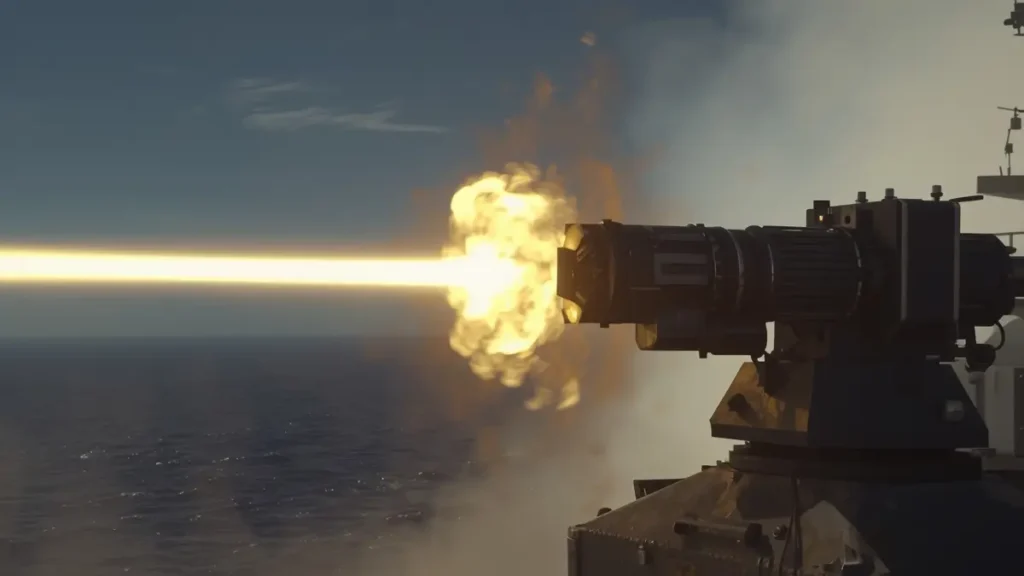
Directed energy weapons

Naval & Sea-Level DEW Projects

The U.S. Navy and Office of Naval Research continue work on High-Energy Laser (HEL) and High-Power Microwave (HPM) systems for ship-based defense. Legacy efforts like the LaWS (Laser Weapon System) on USS Ponce have informed newer designs such as the Maritime Laser Demonstrator (MLD) and HEL for Expeditionary (HELEX). The Counter Directed Energy Weapons (CDEW) program is focusing on detection, mitigation, and platform survivability against adversary DEW attacks.

Budget Trajectories and Program Gaps

While the 2025 funding request is lower than in prior years, the DOD is still targeting key areas:

  • $48.6 million sought for High Energy Laser Development
  • $110.4 million earmarked for High Energy Laser Advanced Development (scaling outputs)
  • $16.5 million for High Energy Laser Research Initiatives (basic research)
  • Additional funds directed to assessments, effects, and limitations studies
  • DARPA’s WARDEN program (Waveform Agile Radio-frequency Directed Energy) continues with smaller scale funds aimed at pushing HPM range and lethality

The funding dip underscores constraints and competing priorities but does not suggest a retreat. Rather, it reflects that many DEW programs are still in risk reduction, prototyping, and transition phases—not yet full-scale acquisition.

Strategic Context & Challenges Ahead

Economics vs. Attrition Warfare

A driving rationale for DEWs is cost per shot. While kinetic interceptors—Patriots, SM-series missiles, etc.—can cost millions apiece, DE engagements often scale to dollars or even cents per shot, limited largely by power and thermal constraints. Especially in high-intensity saturation attacks, DEWs can force adversaries into unfavorable cost imposition dynamics.

Still, DEWs will not replace kin­etic systems entirely. They are best viewed as part of a layered defense package: lasers and microwaves thinning incoming salvos, reserving interceptors for the hardest threats.

Technical Hurdles: Power, Cooling, Optics, and Weather

Major challenges remain in power generation and storage, thermal dissipation (cooling), beam director size/weight, and atmospheric effects (dust, fog, turbulence) that degrade performance.High-power microwave weapons also face constraints in how to focus energy, avoid collateral electronic damage, and maintain precision control.

- Advertisement -

Manufacturing, Engineering Base & Doctrine

Officials warn of an insufficient industrial base and shortage of engineers specialized in DEW systems. Further, operational doctrine, tactics, training, and rules of engagement must catch up. Users must learn the subtleties of beam control, optics alignment, energy budgeting, and integration into existing sensor-to-shooter architectures.

Global Momentum & Competition

U.S. adversaries and partners alike are racing to mature DEW capabilities. Israel’s “Iron Beam” system is slated for 2025 operational deployment. The United Kingdom’s DragonFire program recently achieved aerial target engagements. The defense market for directed energy is projected to nearly double (2022–2027) to over $12 billion.

In the private sector, companies like Epirus (which develops the Leonidas high-power microwave system) have recently raised $250 million to scale for U.S. and export markets.

Outlook: From Prototypes to Fielded Arsenal

The current phase is transitional—rigorous testing, gradual integration, and doctrinal development are essential. Over the next 3–5 years, the U.S. military aims to evolve DEWs from experimental testbeds into reliable elements of layered defenses on bases, ships, and potentially mobile platforms. The value lies not in replacing kinetic weapons, but in preserving them, lowering attrition, and shifting the tactical balance in future conflicts.

If these efforts succeed, they will represent one of the most significant evolutions in air and missile defense since the advent of surface-to-air missiles.

FAQs

What kinds of directed energy weapons is the U.S. developing?

The U.S. is working mainly on high-energy lasers (HEL) and high-power microwave (HPM) systems, as well as radio-frequency directed energy systems for counter-UAS and base defense missions.

Are these systems combat-ready now?

Not yet. Most systems are in prototype or test phases. Live-fire exercises are happening at bases like Fort Sill, but full operational deployment remains a few years away.

Why invest in DEWs instead of more missiles?

DEWs offer much lower cost per engagement, rapid re-fire, and the ability to counter massed cheap threats, which can overwhelm traditional missile defenses economically.

What are the biggest engineering challenges?

Generating and storing sufficient power, managing heat, beam control and optics alignment, and dealing with atmospheric effects like dust, scattering, and turbulence.

Who else is advancing this technology globally?

Countries like Israel (Iron Beam), the UK (DragonFire), and others are actively developing and fielding DEW systems. Private defense firms like Epirus are also scaling high-power microwave systems for export and domestic use.

Note: The images are AI-generated.

TAGGED:Counter-UASDirected energyHigh-Energy LaserHigh-Power MicrowaveU.S. Military Research
Share This Article
Facebook Copy Link Print
ByTeamDefenseWatch
TeamDefenseWatch is the official editorial byline of TheDefenseWatch.com. Working under one umbrella, TheDefenseWatch.com, the team delivers verified, factual reporting on global defense, military technology, aerospace systems, and security developments. Articles are sourced from official statements, defense industry releases, and trusted media, with editorial review to ensure accuracy and clarity.Contact: info@TheDefenseWtach.com
17 Comments
  • Pingback: Glock 19: The Compact 9mm Pistol Favored by Special Operations Forces for Close-Quarters Battle
  • Pingback: Militarization of Space: What It Means for the Future of Global Security
  • Pingback: Hypersonic Missiles Explained: Why These Next-Generation Weapons Are So Dangerous
  • Pingback: Army Achieves Breakthrough in Cruise Missile Intercepts with IBCS System
  • Pingback: AeroVironment Deploys Counter-Drone Technology at Grand Forks Air Force Base to Support “Golden Dome” Defense Initiative
  • Pingback: US vs China Military Spending & Capabilities: Who Holds the Edge?
  • Pingback: U.S. to Launch LGM-30G Minuteman III Ballistic Missile in Scheduled Strategic Readiness Test
  • Pingback: U.S. Army Accelerates Drone Procurement and Laser Weapons to Counter Growing UAV Threats
  • Pingback: China Claims Breakthrough in Hypersonic Engine with Mach 16 Potential
  • Pingback: Japan Deploys Laser Weapons on Warships, Joining U.S. and U.K. Navies | TheDefenseWatch.com
  • Pingback: QinetiQ Secures £67M Contract for Royal Navy DragonFire Laser System | TheDefenseWatch.com
  • Pingback: Italy Invests €9 Billion in GCAP Fighter Jet to Replace Eurofighter Typhoon by 2035 | TheDefenseWatch.com
  • Pingback: Canada Builds Land-Based Test Facility for River-class Destroyers | TheDefenseWatch.com
  • Pingback: Australian Laser Maker EOS Expands to Europe Amid Rising Defence Demand | TheDefenseWatch.com
  • Pingback: U.S. military achieves standoff weapon milestone 16 months after contract award | TheDefenseWatch.com
  • Pingback: Hanwha Showcases K9A1 Howitzer, Laser Weapons, and Advanced Air Defense at WDS 2026 Riyadh | TheDefenseWatch.com
  • Pingback: China Shows LW-30 Truck-Mounted Laser Weapon at World Defense Show 2026 for Gulf Counter-Drone Defense | TheDefenseWatch.com

Leave a Reply Cancel reply

Your email address will not be published. Required fields are marked *

Search Defense Systems

Latest Defense Systems

  • TRML-4D Radar TRML-4D Radar
  • F-47A Fighter Jet F-47A Fighter Jet
  • China DF-61 Missile China DF-61 Missile
  • B61 Nuclear Bomb B61 Nuclear Bomb
  • Japan E-767 Airborne Japan E-767 Airborne
  • Remington 870 Shotgun Remington 870 Shotgun
  • RUTA B1 Cruise Missile RUTA B1 Cruise Missile
  • XQ-67A Drone XQ-67A Drone
  • B-25 Mitchell Bomber B-25 Mitchell Bomber

Recent Compares

  • J-10C vs JF-17 Thunder: Which Fighter Is More Capable? J-10C vs JF-17 Thunder: Which Fighter Is More Capable? View Comparison →
  • Tejas vs Gripen: Key Differences and Capabilities Tejas vs Gripen: Key Differences and Capabilities View Comparison →
  • Tejas vs MiG-21 Bison: How India Replaced Its Iconic Supersonic Fighter Tejas vs MiG-21 Bison: How India Replaced Its Iconic Supersonic Fighter View Comparison →
  • F-35 vs F-16: Stealth, Sensors and Combat Roles F-35 vs F-16: Stealth, Sensors and Combat Roles View Comparison →
  • Tejas Fighter Jet vs F-16 Fighting Falcon: Capability Compared Tejas Fighter Jet vs F-16 Fighting Falcon: Capability Compared View Comparison →
  • Rafale Fighter Jet vs F-16 Fighting Falcon : Which Fighter Has the Edge? Rafale Fighter Jet vs F-16 Fighting Falcon : Which Fighter Has the Edge? View Comparison →
  • Su-57 Fighter Jet vs J-20 Fighter Jet: Stealth and Air Combat Compared Su-57 Fighter Jet vs J-20 Fighter Jet: Stealth and Air Combat Compared View Comparison →
  • Mirage 2000 vs Tejas Mk1A: Legacy Combat Power vs Indigenous Modernization Mirage 2000 vs Tejas Mk1A: Legacy Combat Power vs Indigenous Modernization View Comparison →
  • Rafale Fighter Jet vs F-22 Raptor: Which Air Dominance Fighter Has the Edge? Rafale Fighter Jet vs F-22 Raptor: Which Air Dominance Fighter Has the Edge? View Comparison →
  • Tejas Fighter Jet vs. Rafale Fighter Jet: India’s Indigenous Fighter Meets France’s Proven Multirole Combat Aircraft Tejas Fighter Jet vs. Rafale Fighter Jet: India’s Indigenous Fighter Meets France’s Proven Multirole Combat Aircraft View Comparison →

Recent Posts

  • Saab Secures SEK 350 Million Danish Order for Combat Training Systems
  • Thales Accelerates Delivery of Two Radar Systems to Romania
  • Pakistan Marks Dome Placement Milestone at Chashma-5 Nuclear Plant
  • SpaceX Wins $12.7 Million SDA Contract for Plaser Laser Study
  • Hegseth and Polish Defense Chief Seek Closer Military Cooperation

You Might Also Like

air-breathing hypersonic missiles
Hypersonic WeaponsMilitary & Ordnance

U.S. Moves to Close Air-Breathing Hypersonic Missile Gap With China

September 11, 2026
UK military missing firearms
Military & OrdnanceSmall Arms & Infantry Weapons

UK Military Races To Tighten Weapons Security As Machine Guns Among Missing Firearms

June 18, 2026
Covenant Anthem cruise missile
Artillery & Missile SystemsMilitary & Ordnance

Covenant Unveils Anthem Low-Cost Cruise Missile As U.S. Pushes For Affordable Mass Strike Weapons

September 10, 2026
Saudi Arabia M1 Abrams
Military & OrdnanceTanks & Armored Vehicles

Saudi Arabia Confirms Purchase of 300 M1 Abrams Tanks in Landmark U.S. Strategic Defense Agreement

September 8, 2026

Logo

Copyright © 2026 TheDefenseWatch.com

Helpful Links

  • Home
  • About Us
  • Privacy Policy
  • Terms of Use / Disclaimer
  • U.S. Privacy Notice – CCPA Compliance

Defense Systems

  • Defense Systems
  • Comparisons 
  • Manufacturer
  • Tactical Calculators

Popuplar

Which 5 Air Forces Possess the Costliest Fighter Jet Fleets in the World
Evolving Strategic Value: Carrier Strike Groups in the Indo-Pacific’s Future Security Architecture
Autonomous Weapon Systems Spark U.S. Ethics Debate Amid Rapid Military AI Integration

We report on developments involving military forces, governments, defense companies, research organizations, and security institutions around the world. 

Welcome Back!

Sign in to your account

Username or Email Address
Password

Lost your password?