• Home
  • About
  • Defense Systems
  • Manufacturer
  • Comparisons
  • Compare 
  • Tools
TheDefenseWatch.com
  • Aerospace & Aviation
  • Military & Ordnance
  • Naval & Maritime
  • Cyber & Space Defense
  • Policy & Strategy
  • Global News
  • Tools Library
    • Smart Calculator
    • Drone Flight Time Calculator
    • Drone Range Calculator
    • Counter-Drone Jammer Effective Range Calculator
    • Counter-Battery Radar Detection Calculator
    • Artillery Fire Correction Calculator
    • Thermal Camera Detection Range Calculator
    • Missile Range & Time-of-Flight Calculator
    • Radar Detection Range Calculator
    • FPV Strike Drone Payload vs Range Calculator
    • Loitering Munition Endurance Calculator
    • Sniper Ballistic Drop & Windage Calculator
    • Bullet Drop Calculator
    • U.S. Army Combat Fitness Test (ACFT) Calculator
    • Military Pension Calculator
    • Military Retirement Calculator
    • Military Pension Calculator
    • Large Number Calculator
Font ResizerAa

TheDefenseWatch.com

The Defense Watch | U.S. & Global Defense News, Analysis & Military Updates

Search
  • Home
  • About
  • Defense Systems
  • Manufacturer
  • Comparisons
  • Compare 
  • Tools

Stay Updated

Get the latest update

Subscribe

Explore

  • Drone
  • Fighter Jets & Military Aircraft
  • Hypersonic Weapons
  • Aircraft Carriers
  • Strategic History & Missions
  • Tools Library
Home » NATO Moves To Strengthen Baltic Defense As German-Dutch Corps Takes Command Role In Estonia, Latvia
Alliances & DoctrinesPolicy & Strategy

NATO Moves To Strengthen Baltic Defense As German-Dutch Corps Takes Command Role In Estonia, Latvia

Samuel Drake | Defense Analyst
Last updated: May 28, 2026 11:12 am
Samuel Drake | Defense Analyst
Share
7 Min Read
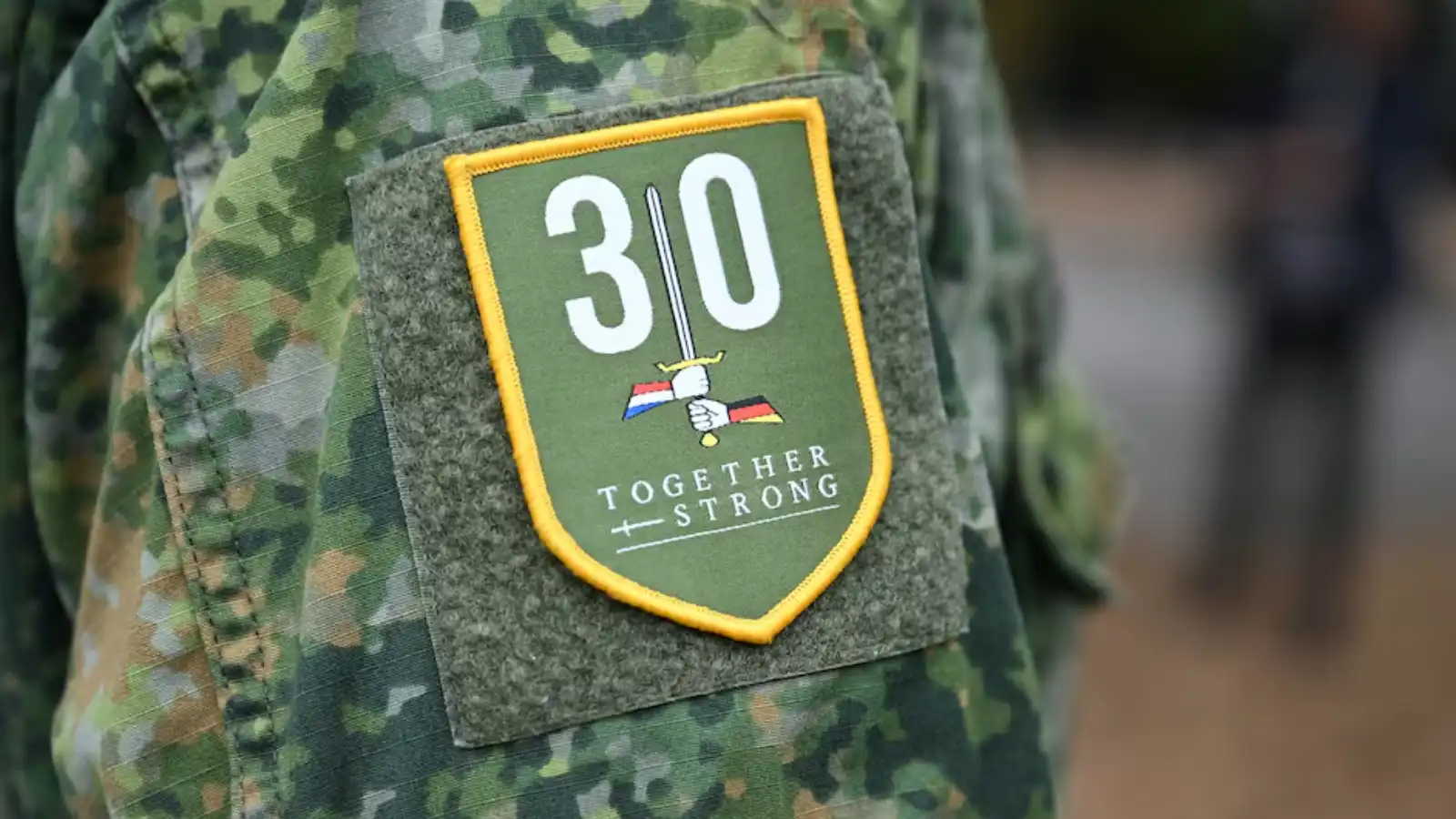
German and Dutch NATO troops participating in a multinational military exercise in the Baltic region.
SHARE

NATO expands Baltic defense as the German-Netherlands Corps takes a command role in Estonia and Latvia amid regional security tensions.

Contents
    • Executive Summary:
  • NATO Baltic Defense Expands With New Command Role
  • Why The Baltic Region Matters To NATO
  • Germany Expands Its Leadership Role In NATO
  • NATO Shifts Toward Forward Defense
  • Operational Impact On NATO’s Eastern Flank
  • Strategic Message To Moscow

Executive Summary:

NATO has assigned the German-Netherlands Corps a command role overseeing alliance land forces in Estonia and Latvia. The move strengthens NATO’s eastern flank posture as European allies continue adapting military structures in response to Russia’s long-term security challenge in the Baltic region.

NATO Baltic Defense Expands With New Command Role

NATO Baltic defense efforts entered a new phase after Germany confirmed that the German-Netherlands Corps has formally assumed a command role for alliance forces operating in Estonia and Latvia.

According to Germany’s defense ministry, the multinational corps will coordinate NATO land component operations in the two Baltic states, reinforcing alliance readiness and command integration along NATO’s northeastern frontier.

The development comes as NATO continues restructuring its regional defense plans following Russia’s invasion of Ukraine and the alliance’s broader shift from deterrence by presence to deterrence by forward defense.

- Advertisement -

Germany stated that the headquarters role is designed to improve operational coordination, force deployment speed, and multinational interoperability in the Baltic theater.

Reuters first reported the announcement on May 28, citing statements from German officials regarding the command transition.

Why The Baltic Region Matters To NATO

Estonia and Latvia occupy a strategically sensitive position on NATO’s eastern flank, bordering Russia and located near the heavily militarized Kaliningrad region.

Since 2022, NATO has significantly expanded troop deployments, air policing missions, logistics infrastructure, and command structures across Eastern Europe. The Baltic states have repeatedly urged allies to increase permanent force presence and improve rapid reinforcement capabilities.

The German-Netherlands Corps, headquartered in Münster, Germany, is one of NATO’s High Readiness Forces headquarters. The corps has experience leading multinational operations and coordinating large-scale land formations under alliance command structures.

By assigning the corps operational responsibilities in Estonia and Latvia, NATO aims to streamline battlefield coordination during both peacetime exercises and potential crisis scenarios.

Defense analysts view the move as part of NATO’s broader effort to establish region-specific command frameworks capable of responding faster to high-intensity conflict.

Germany Expands Its Leadership Role In NATO

Germany has steadily increased its military leadership responsibilities within NATO over the past several years.

- Advertisement -

Berlin currently leads NATO’s multinational battlegroup in Lithuania and has pledged additional investments in regional defense infrastructure, armored formations, and logistics support capabilities.

The expanded Baltic command role reflects Germany’s effort to position itself as a central military coordinator within Europe’s collective defense structure.

The Netherlands also remains deeply integrated into NATO multinational operations, particularly through combined land force structures with Germany.

The German-Netherlands Corps itself represents one of Europe’s longest-standing multinational military headquarters, integrating personnel, planning, and operational functions from both countries.

The new assignment demonstrates NATO’s preference for multinational command structures that reduce duplication while improving interoperability between allied forces.

NATO Shifts Toward Forward Defense

Before 2022, NATO’s eastern deployments largely focused on tripwire deterrence, using relatively small battlegroups to signal alliance commitment.

That approach has evolved significantly.

NATO now emphasizes forward defense concepts designed to hold territory immediately in the event of conflict rather than relying solely on reinforcement after an attack begins.

This requires larger command networks, prepositioned equipment, integrated logistics systems, and more robust regional planning.

The Baltic region has become one of the alliance’s most heavily monitored operational theaters due to its proximity to Russian military assets and strategic maritime routes in the Baltic Sea.

Recent NATO exercises in Northern and Eastern Europe have increasingly focused on rapid mobilization, air defense coordination, and cross-border reinforcement operations.

The addition of the German-Netherlands Corps to Baltic command responsibilities supports these evolving operational requirements.

Operational Impact On NATO’s Eastern Flank

The operational significance of the move lies less in troop numbers and more in command integration.

Modern military operations depend heavily on synchronized communications, intelligence sharing, logistics coordination, and rapid decision-making across multinational formations.

Assigning a dedicated corps headquarters to oversee Baltic land operations helps NATO reduce fragmentation between national contingents stationed across the region.

Military planners have increasingly emphasized that command readiness can be as important as force size during the early stages of a conflict.

The corps headquarters structure also allows NATO to scale operations more efficiently during exercises or emergencies.

This approach aligns with alliance efforts to create more flexible regional defense architectures capable of responding to multiple simultaneous threats.

Strategic Message To Moscow

Although NATO officials consistently describe alliance deployments as defensive, the expanded command role sends a broader strategic signal regarding allied unity and preparedness.

Russia has repeatedly criticized NATO force expansion near its borders, while alliance members argue the deployments are necessary to deter aggression and reassure eastern allies.

The Baltic states remain among NATO’s strongest advocates for enhanced regional defense planning due to geographic exposure and historical concerns over Russian military activity.

By placing a multinational corps in a formal command position, NATO demonstrates long-term commitment to maintaining operational readiness in the region.

The decision also highlights the growing importance of European-led defense coordination inside the alliance framework.


TAGGED:Baltic SecurityNATO
Share This Article
Facebook Copy Link Print
BySamuel Drake | Defense Analyst
Follow:
Samuel Drake is a defense analyst at TheDefenseWatch.com covering naval warfare, military ordnance, maritime technology, fleet modernization, and defense procurement. His reporting focuses on documented capabilities, procurement programs, and military technology.
Leave a Comment

Leave a Reply Cancel reply

Your email address will not be published. Required fields are marked *

New Arrivals

  • Boeing VC-25B Presidential Aircraft Boeing VC-25B Presidential Aircraft
  • SM-3 Block IB Missile SM-3 Block IB Missile
  • USS Abraham Lincoln Aircraft Carrier USS Abraham Lincoln Aircraft Carrier
  • M142 HIMARS M142 HIMARS
  • Terrex S5 Infantry Vehicle Terrex S5 Infantry Vehicle
  • A-29 Super Tucano Aircraft A-29 Super Tucano Aircraft
  • DSAR 15 Rifle DSAR 15 Rifle

Recent Compares

  • Tejas vs Gripen: Key Differences and Capabilities Tejas vs Gripen: Key Differences and Capabilities View Comparison →
  • Tejas vs MiG-21 Bison: How India Replaced Its Iconic Supersonic Fighter Tejas vs MiG-21 Bison: How India Replaced Its Iconic Supersonic Fighter View Comparison →
  • F-35 vs F-16: Stealth, Sensors and Combat Roles F-35 vs F-16: Stealth, Sensors and Combat Roles View Comparison →
  • Tejas Fighter Jet vs F-16 Fighting Falcon: Capability Compared Tejas Fighter Jet vs F-16 Fighting Falcon: Capability Compared View Comparison →
  • Rafale Fighter Jet vs F-16 Fighting Falcon : Which Fighter Has the Edge? Rafale Fighter Jet vs F-16 Fighting Falcon : Which Fighter Has the Edge? View Comparison →
  • Su-57 Fighter Jet vs J-20 Fighter Jet: Stealth and Air Combat Compared Su-57 Fighter Jet vs J-20 Fighter Jet: Stealth and Air Combat Compared View Comparison →
  • Mirage 2000 vs Tejas Mk1A: Legacy Combat Power vs Indigenous Modernization Mirage 2000 vs Tejas Mk1A: Legacy Combat Power vs Indigenous Modernization View Comparison →
  • Rafale Fighter Jet vs F-22 Raptor: Which Air Dominance Fighter Has the Edge? Rafale Fighter Jet vs F-22 Raptor: Which Air Dominance Fighter Has the Edge? View Comparison →
  • Tejas Fighter Jet vs. Rafale Fighter Jet: India’s Indigenous Fighter Meets France’s Proven Multirole Combat Aircraft Tejas Fighter Jet vs. Rafale Fighter Jet: India’s Indigenous Fighter Meets France’s Proven Multirole Combat Aircraft View Comparison →
  • F-22 Raptor vs. F-35 Joint Strike Fighter: Which Fifth Generation Fighter Has the Edge? F-22 Raptor vs. F-35 Joint Strike Fighter: Which Fifth Generation Fighter Has the Edge? View Comparison →

Recent Posts

  • USS Oregon Visits Norway as U.S. Navy Maintains High North Presence
  • Lockheed Martin Unveils PAC-3 Edge Interceptor for U.S. Army
  • Northrop Grumman Completes B-2 Spirit of Kitty Hawk Overhaul
  • Army Report Finds Systemic Failures Behind Fatal 2025 Midair Collision
  • Lockheed Martin to Supply Black Hawk Training Systems to Philippine Air Force

You Might Also Like

counter drone systems
Global News

U.S. Army Tests Next-Gen Counter-Drone Systems During Baltic Coast Exercise

December 1, 2025
UK NATO ballistic missile defence
Alliances & DoctrinesPolicy & Strategy

UK Joins NATO Ballistic Missile Defence Effort To Counter Rising Missile Threats

September 7, 2026
Finland AIM-120D-3 missile
Global News

Finland Chooses AIM-120D-3 Missiles for F-35A Fleet

September 12, 2026
most powerful army in the world
Geopolitical & Strategic DoctrinesPolicy & Strategy

Top 10 Most Powerful Army in the World 2025, Global Military Rankings Explained

September 8, 2026

Logo

Copyright © 2026 TheDefenseWatch.com

Helpful Links

  • Home
  • About Us
  • Privacy Policy
  • Terms of Use / Disclaimer
  • U.S. Privacy Notice – CCPA Compliance

Defense Systems

  • Defense Systems
  • Comparisons 
  • Manufacturer
  • Tactical Calculators

Popuplar

Which 5 Air Forces Possess the Costliest Fighter Jet Fleets in the World
Evolving Strategic Value: Carrier Strike Groups in the Indo-Pacific’s Future Security Architecture
Autonomous Weapon Systems Spark U.S. Ethics Debate Amid Rapid Military AI Integration

We report on developments involving military forces, governments, defense companies, research organizations, and security institutions around the world. 

Welcome Back!

Sign in to your account

Username or Email Address
Password

Lost your password?