• Home
  • About
  • Defense Systems
  • Manufacturer
  • Comparisons
  • Compare 
  • Tools
TheDefenseWatch.com
  • Aerospace & Aviation
  • Military & Ordnance
  • Naval & Maritime
  • Cyber & Space Defense
  • Policy & Strategy
  • Global News
  • Tools Library
    • Smart Calculator
    • Drone Flight Time Calculator
    • Drone Range Calculator
    • Counter-Drone Jammer Effective Range Calculator
    • Counter-Battery Radar Detection Calculator
    • Artillery Fire Correction Calculator
    • Thermal Camera Detection Range Calculator
    • Missile Range & Time-of-Flight Calculator
    • Radar Detection Range Calculator
    • FPV Strike Drone Payload vs Range Calculator
    • Loitering Munition Endurance Calculator
    • Sniper Ballistic Drop & Windage Calculator
    • Bullet Drop Calculator
    • U.S. Army Combat Fitness Test (ACFT) Calculator
    • Military Pension Calculator
    • Military Retirement Calculator
    • Military Pension Calculator
    • Large Number Calculator
Font ResizerAa

TheDefenseWatch.com

The Defense Watch | U.S. & Global Defense News, Analysis & Military Updates

Search
  • Home
  • About
  • Defense Systems
  • Manufacturer
  • Comparisons
  • Compare 
  • Tools

Stay Updated

Get the latest update

Subscribe

Explore

  • Drone
  • Fighter Jets & Military Aircraft
  • Hypersonic Weapons
  • Aircraft Carriers
  • Strategic History & Missions
  • Tools Library
Home » Green-Water Navy vs. Blue-Water Navy: Understanding the U.S. Navy’s Strategic Depth
Head-to-Head

Green-Water Navy vs. Blue-Water Navy: Understanding the U.S. Navy’s Strategic Depth

TeamDefenseWatch
Last updated: November 16, 2025 9:17 am
TeamDefenseWatch
Share
2 Min Read
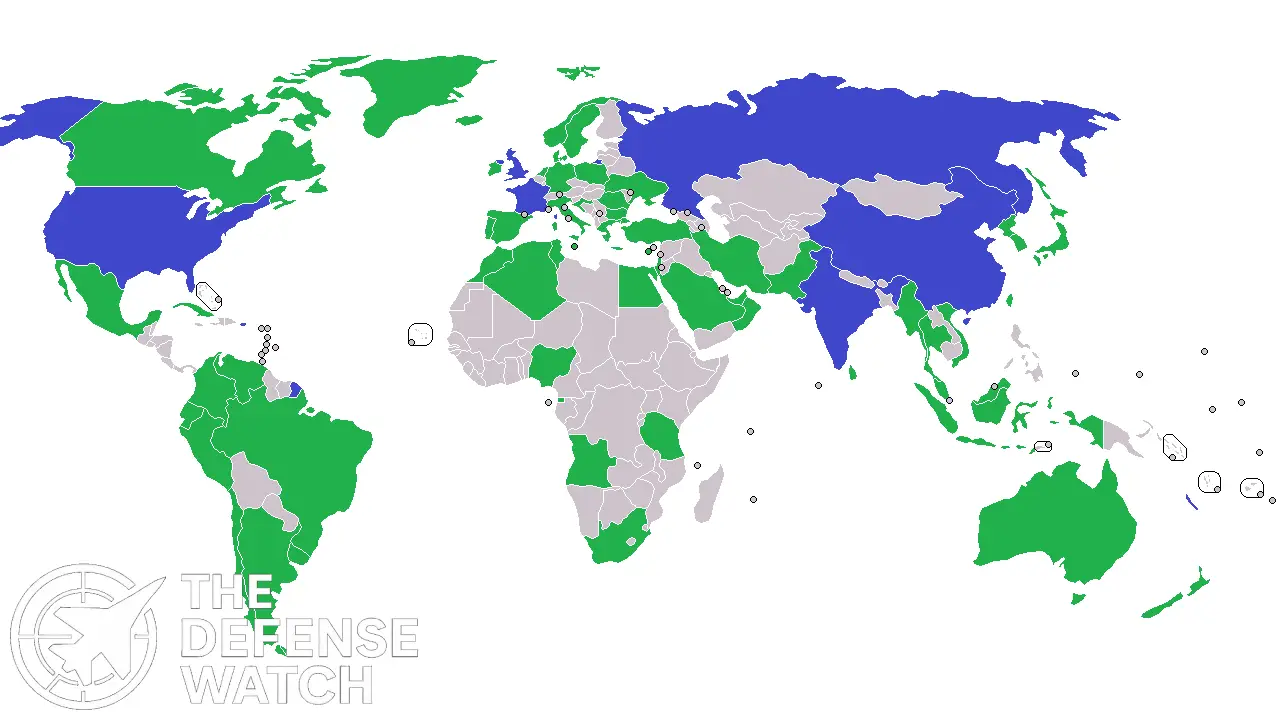
Green-Water Navy vs Blue-Water Navy
SHARE

In maritime strategic discourse, “green-water navy” and “blue-water navy” are pivotal terms defining the scale, reach, and operational capabilities of naval forces. In the U.S. Navy’s lexicon and broader defense analysis, these classifications shape how naval power is projected and sustained. This article explores the nuances between these two concepts, placing them in context alongside U.S. naval strategy today.

Contents
What Defines a Green-Water Navy?What Constitutes a Blue-Water Navy?U.S. Navy: The Benchmark of Blue-Water PowerAnalysis: Strategic ImplicationsFAQs

What Defines a Green-Water Navy?

A green-water navy operates primarily within littoral zones and marginal seas, capable of limited open-ocean missions but reliant on support for extended operations. Originally conceptualized by the U.S. Navy to denote coastal-focused offensive units, the term has since expanded. It now commonly refers to navies that project power near home shores — often equipped with amphibious ships, helicopters, and modest replenishment assets, but lacking full logistical autonomy.

Regional examples include Japan and Brazil. Japan’s Maritime Self-Defense Force (JMSDF) fields helicopter destroyers and replenishment vessels but remains limited relative to global reach. Brazil similarly maintains a greener-water profile.

The Green-Water Zone

Typically spans beyond brown-water (inland and littoral) areas into nearby archipelagos and the outer continental shelf – often within a few hundred nautical miles from coast.

- Advertisement -

What Constitutes a Blue-Water Navy?

A blue-water navy boasts global operational capacity, with sustained reach into deep oceans and power projection capabilities, enabled by logistics, air assets, and naval support infrastructure. According to U.S. definitions:

  • Ability to operate across open oceans
  • Robust logistics with replenishment and carrier support
  • Multi-theater maritime presence with sustained endurance

Rankings of Naval Reach

Using the Todd & Lindberg scale:

  • Rank 1 (Global-reach): U.S. Navy – the only navy in this category
  • Ranks 2–4: France, China, India, Brazil, Australia – varying levels of growing capability
  • Ranks 5–6: Green-water navies like Canada, Thailand, Indonesia
  • Ranks 7–10: Brown-water and limited constabulary forces

U.S. Navy: The Benchmark of Blue-Water Power

The U.S. Navy exemplifies the blue-water standard. It maintains:

  • Eleven aircraft carrier strike groups (six deployment-ready within 30 days)
  • Nine amphibious expeditionary strike groups embarking Marine units
  • The world’s largest Military Sealift Command for rew supply, transport, and sustainment

These capabilities enable global response—from littoral deployments to extended deep-sea presence.

Analysis: Strategic Implications

Why it matters:
A blue-water navy underpins strategic flexibility, deterrence, alliance support, and global trade route security. In contrast, green-water navies focus on regional deterring but lack global endurance.

Emerging trends:
Competition is rising—particularly between the U.S. and China. China’s People’s Liberation Army Navy (PLAN) is expanding into first- and second-island chain coverage—signals of an evolving green-to-blue transition. Yet, many analysts warn tonnage and proximity do not yet equal fully sustained global operations.

Meanwhile, the U.S. continues investing in replenishment ships, unmanned systems, and distributed logistics to preserve its global edge.

FAQs

What is the primary difference between green-water and blue-water navies?

Green-water navies operate regionally within littoral and marginal seas; blue-water navies sustain operations across deep oceans and long distances.

Does a navy need aircraft carriers to be blue-water?

Not strictly, but carriers dramatically enhance power projection. Essential elements include strong logistics, long-range surface and sub-surface assets, and sustained deployment capacity.

Why is logistics critical for blue-water operations?

Without robust replenishment (fuel, munitions, maintenance), global and prolonged deployments collapse. Logistics is the backbone of sustained naval presence.

Is China now a blue-water navy?

China is expanding into early blue-water capabilities, particularly around the first island chain, but still lacks fully sustained global scale operations without additional logistical infrastructure support

Can green-water navies evolve into blue-water forces?

Yes. Countries like Japan, South Korea, India, and Brazil are investing in platforms like helicopter destroyers, replenishment ships, and carrier groups in an evolutionary path toward longer-range capabilities.


TAGGED:BlueWaterNavyDefenseAnalysisGreenWaterNavyMaritimePowerNavalStrategy
Share This Article
Facebook Copy Link Print
ByTeamDefenseWatch
TeamDefenseWatch is the official editorial byline of TheDefenseWatch.com. Working under one umbrella, TheDefenseWatch.com, the team delivers verified, factual reporting on global defense, military technology, aerospace systems, and security developments. Articles are sourced from official statements, defense industry releases, and trusted media, with editorial review to ensure accuracy and clarity.Contact: info@TheDefenseWtach.com
2 Comments
  • Pingback: What Is NATO and Why It Matters for U.S. Defense Strategy | TheDefenseWatch.com
  • Pingback: Angkatan Laut Perairan Biru Indonesia: Infrastruktur, Komitmen Finansial, dan SDM - DIP Institute

Leave a Reply Cancel reply

Your email address will not be published. Required fields are marked *

Search Defense Systems

Latest Defense Systems

  • B61 Nuclear Bomb B61 Nuclear Bomb
  • Japan E-767 Airborne Japan E-767 Airborne
  • Remington 870 Shotgun Remington 870 Shotgun
  • RUTA B1 Cruise Missile RUTA B1 Cruise Missile
  • XQ-67A Drone XQ-67A Drone
  • B-25 Mitchell Bomber B-25 Mitchell Bomber
  • F-100 Super Sabre F-100 Super Sabre
  • North American F-86 Sabre North American F-86 Sabre
  • North American XB-70 Valkyrie North American XB-70 Valkyrie

Recent Compares

  • J-10C vs JF-17 Thunder: Which Fighter Is More Capable? J-10C vs JF-17 Thunder: Which Fighter Is More Capable? View Comparison →
  • Tejas vs Gripen: Key Differences and Capabilities Tejas vs Gripen: Key Differences and Capabilities View Comparison →
  • Tejas vs MiG-21 Bison: How India Replaced Its Iconic Supersonic Fighter Tejas vs MiG-21 Bison: How India Replaced Its Iconic Supersonic Fighter View Comparison →
  • F-35 vs F-16: Stealth, Sensors and Combat Roles F-35 vs F-16: Stealth, Sensors and Combat Roles View Comparison →
  • Tejas Fighter Jet vs F-16 Fighting Falcon: Capability Compared Tejas Fighter Jet vs F-16 Fighting Falcon: Capability Compared View Comparison →
  • Rafale Fighter Jet vs F-16 Fighting Falcon : Which Fighter Has the Edge? Rafale Fighter Jet vs F-16 Fighting Falcon : Which Fighter Has the Edge? View Comparison →
  • Su-57 Fighter Jet vs J-20 Fighter Jet: Stealth and Air Combat Compared Su-57 Fighter Jet vs J-20 Fighter Jet: Stealth and Air Combat Compared View Comparison →
  • Mirage 2000 vs Tejas Mk1A: Legacy Combat Power vs Indigenous Modernization Mirage 2000 vs Tejas Mk1A: Legacy Combat Power vs Indigenous Modernization View Comparison →
  • Rafale Fighter Jet vs F-22 Raptor: Which Air Dominance Fighter Has the Edge? Rafale Fighter Jet vs F-22 Raptor: Which Air Dominance Fighter Has the Edge? View Comparison →
  • Tejas Fighter Jet vs. Rafale Fighter Jet: India’s Indigenous Fighter Meets France’s Proven Multirole Combat Aircraft Tejas Fighter Jet vs. Rafale Fighter Jet: India’s Indigenous Fighter Meets France’s Proven Multirole Combat Aircraft View Comparison →

Recent Posts

  • General Atomics to Supply Components for U.S. Army and Navy Hypersonic Weapons
  • Lockheed Martin Tests Mk21A Reentry Vehicle for Sentinel ICBM
  • Lockheed Martin Wins $122.4 Million Trident II Navigation Contract
  • Pentagon Prepares Review of Military Legal System and JAG Corps
  • U.S. and Colombia Launch Southern Vanguard 2027 Exercise

You Might Also Like

J-20 vs F-22
Head-to-Head

J-20 vs F-22: Stealth Battle of the Century

September 12, 2026
Rafale vs Eurofighter Typhoon
Head-to-Head

Rafale vs Eurofighter Typhoon: A Comprehensive Fighter Jet Comparison

September 8, 2026
hypersonic vs supersonic
Head-to-Head

Hypersonic vs Supersonic: Key Differences in Speed, Technology, and Military Impact

September 8, 2026
Ford Class vs Nimitz Class
Head-to-Head

Ford Class vs Nimitz Class: Key Differences Between U.S. Navy Carriers

September 12, 2026

Logo

Copyright © 2026 TheDefenseWatch.com

Helpful Links

  • Home
  • About Us
  • Privacy Policy
  • Terms of Use / Disclaimer
  • U.S. Privacy Notice – CCPA Compliance

Defense Systems

  • Defense Systems
  • Comparisons 
  • Manufacturer
  • Tactical Calculators

Popuplar

Which 5 Air Forces Possess the Costliest Fighter Jet Fleets in the World
Evolving Strategic Value: Carrier Strike Groups in the Indo-Pacific’s Future Security Architecture
Autonomous Weapon Systems Spark U.S. Ethics Debate Amid Rapid Military AI Integration

We report on developments involving military forces, governments, defense companies, research organizations, and security institutions around the world. 

Welcome Back!

Sign in to your account

Username or Email Address
Password

Lost your password?