• Home
  • About
  • Defense Systems
  • Manufacturer
  • Comparisons
  • Compare 
  • Tools
TheDefenseWatch.com
  • Aerospace & Aviation
  • Military & Ordnance
  • Naval & Maritime
  • Cyber & Space Defense
  • Policy & Strategy
  • Global News
  • Tools Library
    • Smart Calculator
    • Drone Flight Time Calculator
    • Drone Range Calculator
    • Counter-Drone Jammer Effective Range Calculator
    • Counter-Battery Radar Detection Calculator
    • Artillery Fire Correction Calculator
    • Thermal Camera Detection Range Calculator
    • Missile Range & Time-of-Flight Calculator
    • Radar Detection Range Calculator
    • FPV Strike Drone Payload vs Range Calculator
    • Loitering Munition Endurance Calculator
    • Sniper Ballistic Drop & Windage Calculator
    • Bullet Drop Calculator
    • U.S. Army Combat Fitness Test (ACFT) Calculator
    • Military Pension Calculator
    • Military Retirement Calculator
    • Military Pension Calculator
    • Large Number Calculator
Font ResizerAa

TheDefenseWatch.com

The Defense Watch | U.S. & Global Defense News, Analysis & Military Updates

Search
  • Home
  • About
  • Defense Systems
  • Manufacturer
  • Comparisons
  • Compare 
  • Tools

Stay Updated

Get the latest update

Subscribe

Explore

  • Drone
  • Fighter Jets & Military Aircraft
  • Hypersonic Weapons
  • Aircraft Carriers
  • Strategic History & Missions
  • Tools Library
Home » Germany Moves To Clarify Rules As Fighting-Age Men Leave Country
Defense Budgets & PolicyPolicy & Strategy

Germany Moves To Clarify Rules As Fighting-Age Men Leave Country

Samuel Drake | Defense Analyst
Last updated: April 6, 2026 2:06 am
Samuel Drake | Defense Analyst
Share
2 Min Read
Germany exit rules fighting-age men
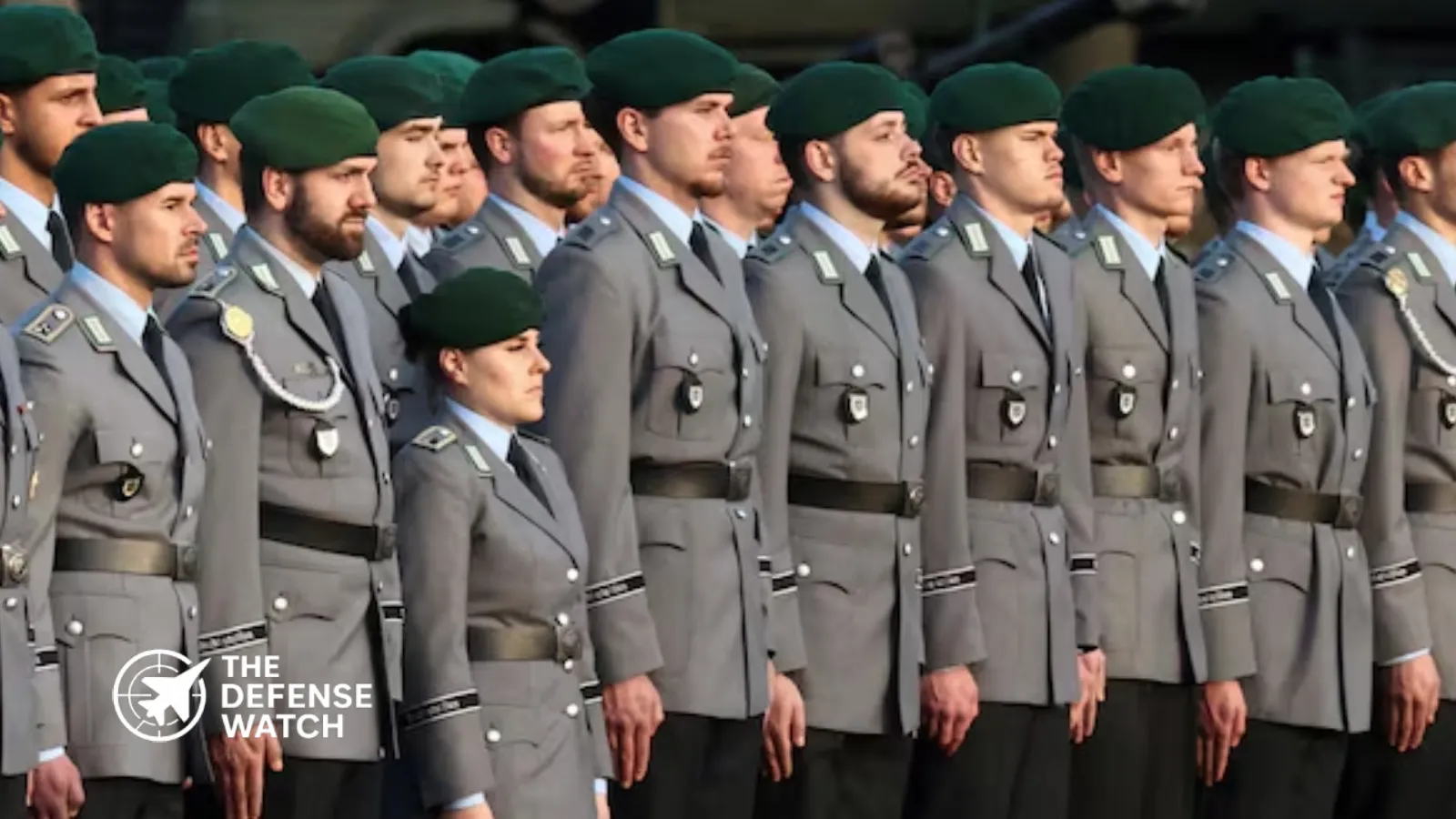
Soldiers of the Guard Battalion of the German army
SHARE
Follow The Defense Watch on Google:

Germany Exit Rules Fighting-Age Men Under Review Amid Security Concerns

Germany exit rules fighting-age men are under renewed scrutiny as Germany moves to clarify how existing laws apply to individuals of military age leaving the country, according to reporting by Reuters.

Contents
Germany Exit Rules Fighting-Age Men Under Review Amid Security ConcernsPolicy Context: Migration Meets SecurityLegal Clarity, Not Immediate RestrictionStrategic Implications for EuropeEU Coordination Becomes CriticalOutlook: Incremental Change Likely

Berlin’s effort does not introduce immediate sweeping restrictions. Instead, it focuses on legal clarity and enforcement consistency, particularly as European governments face growing pressure linked to the ongoing war in Ukraine.

German officials are reportedly reviewing how national and EU frameworks intersect when it comes to the movement of fighting-age men, especially those who may be subject to mobilization requirements in their home countries.

¦ KEY FACTS AT A GLANCE
  • Germany is working to clarify legal rules regarding fighting-age men leaving the country.
  • The issue is linked to broader European concerns over military mobilization and migration flows tied to the Ukraine conflict.
  • Authorities aim to ensure consistent enforcement of existing laws rather than introducing immediate blanket restrictions.
  • The move reflects rising pressure on European governments to balance humanitarian policies with national security priorities.
  • Officials stress coordination with EU partners as policy alignment becomes increasingly critical.

Policy Context: Migration Meets Security

The issue sits at the intersection of migration policy and defense readiness. Since the start of the Ukraine conflict, millions have moved across European borders, creating legal gray zones around eligibility, asylum, and potential military obligations.

- Advertisement -

While Germany has maintained a broadly open humanitarian stance, the question of whether fighting-age men should be allowed to freely leave conflict zones or transit through EU states has become more politically sensitive.

This is particularly relevant for Ukrainian nationals. Kyiv has previously restricted the departure of most men aged 18 to 60 to preserve its mobilization pool. However, enforcement varies, and individuals continue to reach EU countries through legal and irregular channels.

Germany’s current effort appears aimed at avoiding contradictions between domestic law, EU free movement principles, and partner country expectations.

Legal Clarity, Not Immediate Restriction

Officials emphasize that the initiative is not about imposing blanket exit bans or new border controls. Instead, it is about ensuring that authorities have clear legal guidance when dealing with cases involving military-age individuals.

This includes questions such as:

  • Whether Germany can or should return individuals to their home country if they are subject to mobilization
  • How asylum protections apply in such cases
  • What role EU-wide coordination should play

Legal experts note that Germany must carefully balance international law obligations, including refugee protections, with political pressure to support allied nations facing manpower shortages.

Strategic Implications for Europe

Germany exit rules fighting-age men highlight a broader shift in European security thinking. The war in Ukraine has forced governments to reconsider assumptions about long-term stability and the role of civilian populations in national defense.

From a strategic perspective, the issue touches on force generation. Countries under threat rely heavily on maintaining a sufficient pool of trained or trainable personnel. Large-scale outward migration of fighting-age men can complicate this.

- Advertisement -

At the same time, European nations like Germany face domestic considerations, including labor market needs, demographic challenges, and integration policies.

This creates a tension between:

  • Supporting allies’ military readiness
  • Upholding humanitarian commitments
  • Managing domestic economic priorities

EU Coordination Becomes Critical

Germany is unlikely to act in isolation. Any meaningful policy shift will require coordination with the broader European Union to avoid creating loopholes or inconsistencies across borders.

If one country tightens rules while others remain permissive, migration flows could simply reroute. This makes harmonized policy approaches essential.

Analysts point out that this situation could lead to:

  • Greater data sharing between EU states
  • Standardized guidelines on handling military-age migrants
  • Increased dialogue with countries like Ukraine on legal expectations

Outlook: Incremental Change Likely

Germany exit rules fighting-age men are expected to evolve gradually rather than through abrupt policy shifts. The current focus on clarification suggests Berlin is testing legal boundaries and political reactions before considering stronger measures.

Given the sensitivity of the issue, any future changes will likely be framed within existing legal structures rather than as emergency powers.

For now, the move signals a broader European trend. Migration policy is no longer viewed solely through a humanitarian lens. It is increasingly tied to national and collective security considerations.

Enjoying our coverage?

Make The Defense Watch a preferred source on Google to see more of our geopolitical and defense insights when relevant to you.


TAGGED:Europe securityGermany policymigration rulesmilitary age menUkraine conflict
Share This Article
Facebook Copy Link Print
BySamuel Drake | Defense Analyst
Follow:
Samuel Drake is a defense analyst at TheDefenseWatch.com covering naval warfare, military ordnance, maritime technology, fleet modernization, and defense procurement. His reporting focuses on documented capabilities, procurement programs, and military technology.
Leave a Comment

Leave a Reply Cancel reply

Your email address will not be published. Required fields are marked *

Search Defense Systems

Latest Defense Systems

  • F-104 Starfighter F-104 Starfighter
  • F-15J Eagle Fighter Jet F-15J Eagle Fighter Jet
  • China’s GJ-21 Stealth Drone China’s GJ-21 Stealth Drone
  • China’s GJ-11 Stealth Drone China’s GJ-11 Stealth Drone
  • F-15EX Eagle Fighter Jet F-15EX Eagle Fighter Jet
  • TRML-4D Radar TRML-4D Radar
  • F-47A Fighter Jet F-47A Fighter Jet
  • China DF-61 Missile China DF-61 Missile
  • B61 Nuclear Bomb B61 Nuclear Bomb

Recent Compares

  • J-10C vs JF-17 Thunder: Which Fighter Is More Capable? J-10C vs JF-17 Thunder: Which Fighter Is More Capable? View Comparison →
  • Tejas vs Gripen: Key Differences and Capabilities Tejas vs Gripen: Key Differences and Capabilities View Comparison →
  • Tejas vs MiG-21 Bison: How India Replaced Its Iconic Supersonic Fighter Tejas vs MiG-21 Bison: How India Replaced Its Iconic Supersonic Fighter View Comparison →
  • F-35 vs F-16: Stealth, Sensors and Combat Roles F-35 vs F-16: Stealth, Sensors and Combat Roles View Comparison →
  • Tejas Fighter Jet vs F-16 Fighting Falcon: Capability Compared Tejas Fighter Jet vs F-16 Fighting Falcon: Capability Compared View Comparison →
  • Rafale Fighter Jet vs F-16 Fighting Falcon : Which Fighter Has the Edge? Rafale Fighter Jet vs F-16 Fighting Falcon : Which Fighter Has the Edge? View Comparison →
  • Su-57 Fighter Jet vs J-20 Fighter Jet: Stealth and Air Combat Compared Su-57 Fighter Jet vs J-20 Fighter Jet: Stealth and Air Combat Compared View Comparison →
  • Mirage 2000 vs Tejas Mk1A: Legacy Combat Power vs Indigenous Modernization Mirage 2000 vs Tejas Mk1A: Legacy Combat Power vs Indigenous Modernization View Comparison →
  • Rafale Fighter Jet vs F-22 Raptor: Which Air Dominance Fighter Has the Edge? Rafale Fighter Jet vs F-22 Raptor: Which Air Dominance Fighter Has the Edge? View Comparison →
  • Tejas Fighter Jet vs. Rafale Fighter Jet: India’s Indigenous Fighter Meets France’s Proven Multirole Combat Aircraft Tejas Fighter Jet vs. Rafale Fighter Jet: India’s Indigenous Fighter Meets France’s Proven Multirole Combat Aircraft View Comparison →

Recent Posts

  • NASA’s Voyager 1 Reaches One Light-Day From Earth After 49 Years in Space
  • Russian Missiles Enter Polish Airspace During European Military Exercises
  • L3Harris Wins $28 Million Australian Defence Contract for Advanced Capability System
  • F-35C Completes First Launch and Recovery Trials Aboard Ford-Class Carrier
  • Northrop Grumman Declares $2.47 Per-Share Dividend for Fourth Quarter 2026

You Might Also Like

EDGE European defense enterprise
Geopolitical & Strategic DoctrinesPolicy & Strategy

EDGE Group Moves To Expand European Defense Presence As Sovereignty Push Accelerates Across Europe

June 11, 2026
Italy hybrid warfare defense investment
Defense Budgets & PolicyPolicy & Strategy

Italy Plans More Than €6 Billion for Hybrid Threat Defense

November 19, 2026
F-35A fighter jet 2027 budget
Aerospace & AviationDefense Budgets & PolicyFighter Jets & Military Aircraft

Pentagon Moves To Fund 38 F-35A Fighters As Air Force Battles Its Worst Fighter Shortfall In History

September 7, 2026
Pakistani and Iranian officials meeting during regional mediation talks over Iran US ceasefire negotiations
Geopolitical & Strategic DoctrinesPolicy & Strategy

Pakistan Moves To Revive Iran US Talks As Middle East Conflict Pressure Mounts

September 7, 2026

Logo

Copyright © 2026 TheDefenseWatch.com

Helpful Links

  • Home
  • About Us
  • Privacy Policy
  • Terms of Use / Disclaimer
  • U.S. Privacy Notice – CCPA Compliance

Defense Systems

  • Defense Systems
  • Comparisons 
  • Manufacturer
  • Tactical Calculators

Popuplar

Which 5 Air Forces Possess the Costliest Fighter Jet Fleets in the World
Evolving Strategic Value: Carrier Strike Groups in the Indo-Pacific’s Future Security Architecture
Autonomous Weapon Systems Spark U.S. Ethics Debate Amid Rapid Military AI Integration

We report on developments involving military forces, governments, defense companies, research organizations, and security institutions around the world. 

Welcome Back!

Sign in to your account

Username or Email Address
Password

Lost your password?

Enjoying our coverage?

Make The Defense Watch a preferred source on Google to see more insights.