

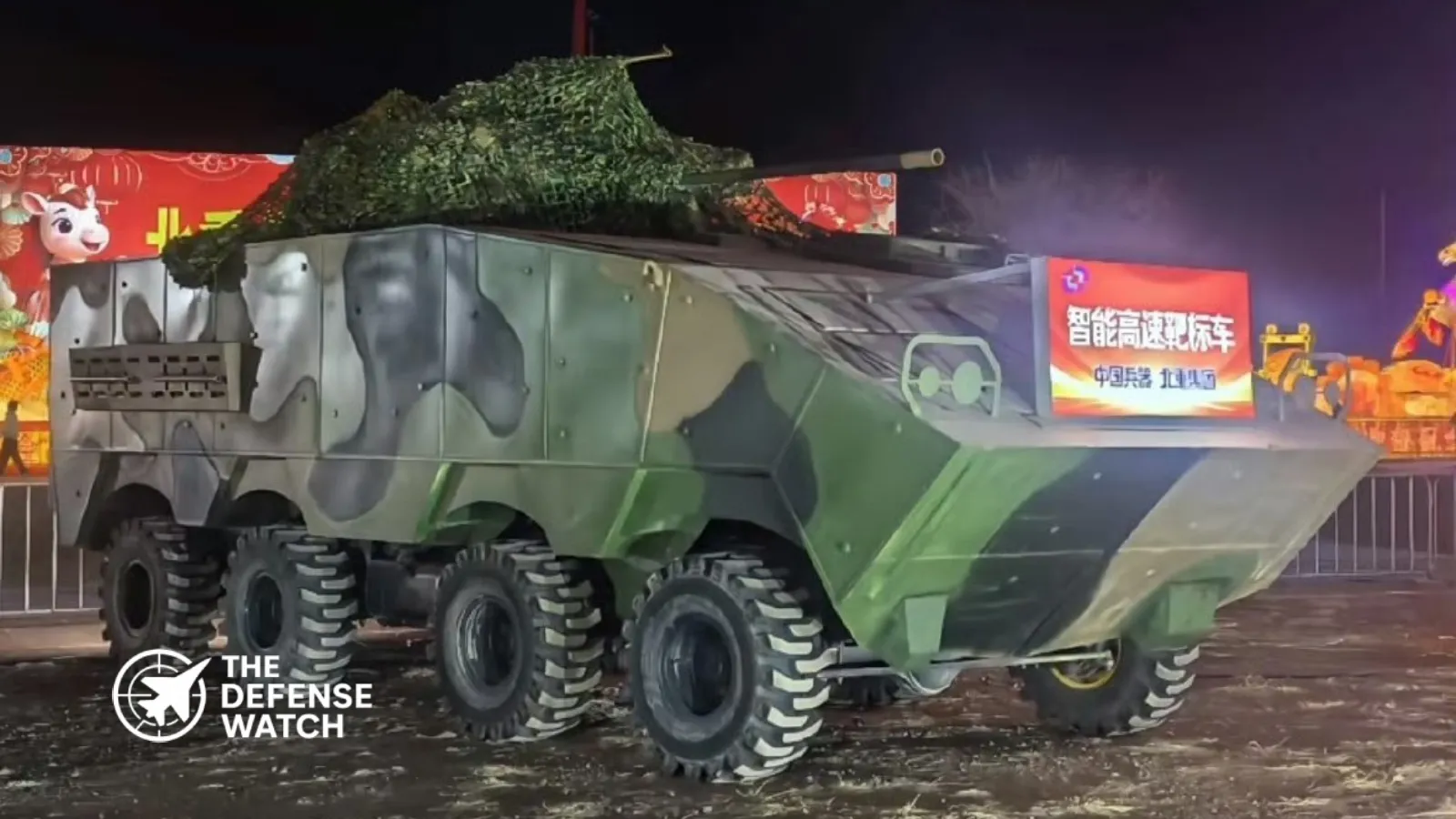
- China’s Norinco revealed two intelligent high-speed target vehicles designed to simulate advanced combat systems.
- The vehicles visually replicate Taiwan’s HIMARS rocket system and Clouded Leopard armored vehicle.
- Both platforms feature long-range remote control modules and infrared signal simulation capabilities.
- Integrated AI-based decision-making systems allow adaptive behavior during training scenarios.
- The systems are intended to enhance realism in Chinese military training and targeting exercises.
China Intelligent High-Speed Target Vehicles Simulate Modern Battlefield Threats
China intelligent high-speed target vehicles have been unveiled by state-owned defense giant Norinco, marking a notable step in the evolution of military training and simulation systems. According to information released through Chinese defense channels, the newly revealed platforms are designed to replicate advanced battlefield assets, specifically systems resembling Taiwan’s HIMARS rocket artillery and Clouded Leopard armored vehicle.
The introduction of these systems reflects a broader trend in modern militaries toward more realistic and adaptive training environments. By integrating artificial intelligence and advanced signal simulation, China appears to be enhancing its ability to prepare forces for high-intensity, technology-driven conflict scenarios.
Designed To Replicate Real-World Combat Systems
From a design perspective, the two China intelligent high-speed target vehicles closely mimic the visual and operational signatures of their intended counterparts. One vehicle resembles the High Mobility Artillery Rocket System (HIMARS), a precision-strike platform widely used by the United States and exported to allies, including Taiwan. The second mirrors the Clouded Leopard, an eight-wheeled armored vehicle fielded by Taiwan’s military.
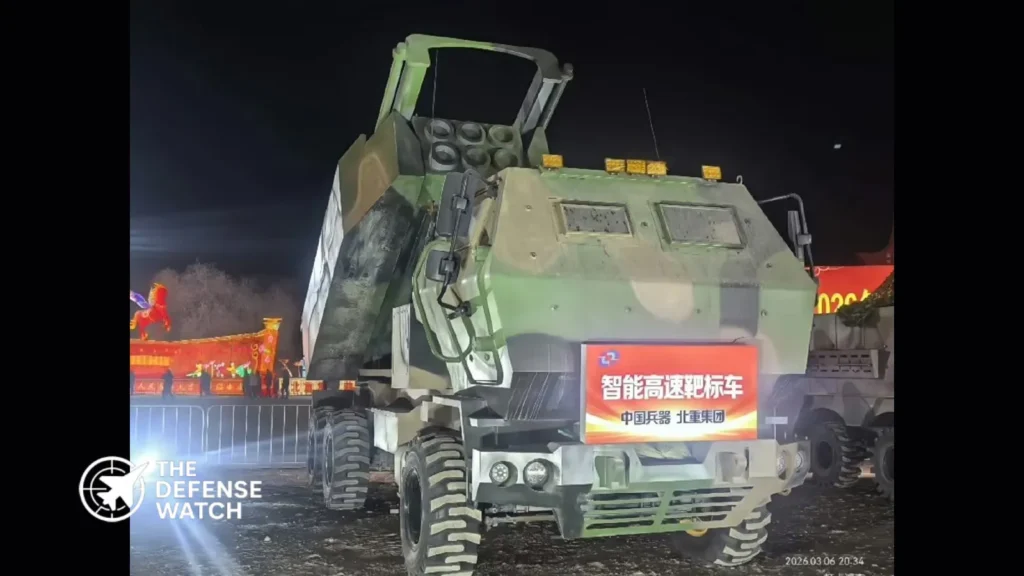
This visual fidelity is not incidental. Modern targeting and reconnaissance systems rely heavily on identifying shapes, heat signatures, and movement patterns. By replicating these characteristics, the vehicles provide a more accurate training target for sensors, drones, and precision-guided munitions.
Integration Of AI And Infrared Simulation
A key feature of the China intelligent high-speed target vehicles is the integration of AI-based decision-making systems. These systems allow the targets to adapt dynamically during exercises, altering speed, route, and behavior in response to simulated battlefield conditions.
In addition, the vehicles are equipped with infrared signal simulation devices. This enables them to mimic the thermal signatures of real combat platforms, a critical factor given the increasing reliance on infrared targeting systems in modern warfare.
The inclusion of long-range remote control modules further enhances operational flexibility. Training operators can control or monitor the vehicles from a distance, enabling complex, multi-domain exercises without exposing personnel to risk.
Advancing Military Training Realism
The development of these platforms underscores a shift toward high-fidelity training environments. Traditional target systems, often static or predictable, are increasingly insufficient against modern weapons systems that rely on real-time data processing and adaptive targeting.
By contrast, AI-enabled targets introduce unpredictability. They can simulate evasive maneuvers, coordinated movements, and even basic tactical responses. This forces training units to operate under conditions that more closely resemble actual combat.
For China, this capability is particularly relevant in the context of cross-strait military planning. The ability to simulate systems associated with Taiwan’s defense inventory allows for more tailored training scenarios, especially in areas such as counter-artillery operations and armored warfare.
Strategic And Operational Implications
While the unveiling of China intelligent high-speed target vehicles is primarily framed as a training development, it carries broader strategic implications. The focus on replicating specific foreign systems suggests an emphasis on preparing for contingencies involving those platforms.
At the same time, the use of AI in target systems highlights the growing role of autonomy in military applications. Although these vehicles are not combat systems themselves, the technologies underpinning them, such as decision-making algorithms and sensor simulation, have potential crossover into operational platforms.
This aligns with global trends, where militaries are investing in AI to enhance both offensive and defensive capabilities. The United States, for example, has pursued similar concepts in autonomous target drones and training systems, though with varying degrees of sophistication.
Context Within Global Defense Trends
The unveiling fits within a wider international push toward realistic training and simulation. NATO and allied forces have increasingly emphasized synthetic training environments, combining live exercises with virtual and constructive simulations.
China’s approach, as demonstrated by these target vehicles, appears to focus on physical realism enhanced by digital intelligence. This hybrid model allows forces to train with tangible platforms while benefiting from AI-driven adaptability.
Such developments are particularly relevant as precision-guided munitions and sensor networks continue to evolve. Training systems must keep pace, ensuring that personnel can effectively detect, track, and engage increasingly complex targets.
Outlook
The introduction of China intelligent high-speed target vehicles represents a measured but meaningful advancement in military training capability. By combining visual replication, infrared simulation, and AI-driven behavior, Norinco has developed systems that could significantly enhance training realism.
While the full operational deployment and scale of these systems remain unclear, their unveiling signals a continued focus on preparing for technologically advanced conflict scenarios. As militaries worldwide adapt to the demands of modern warfare, the role of intelligent training systems is likely to expand further.
