ER GMLRS: Lockheed Martin Advances Extended-Range Rocket
Lockheed Martin says its Extended-Range Guided Multiple Launch Rocket System (ER GMLRS) has advanced toward operational fielding after two soldier-led operational tests, moving the program closer to wider production and deployment with U.S. Army rocket artillery units.
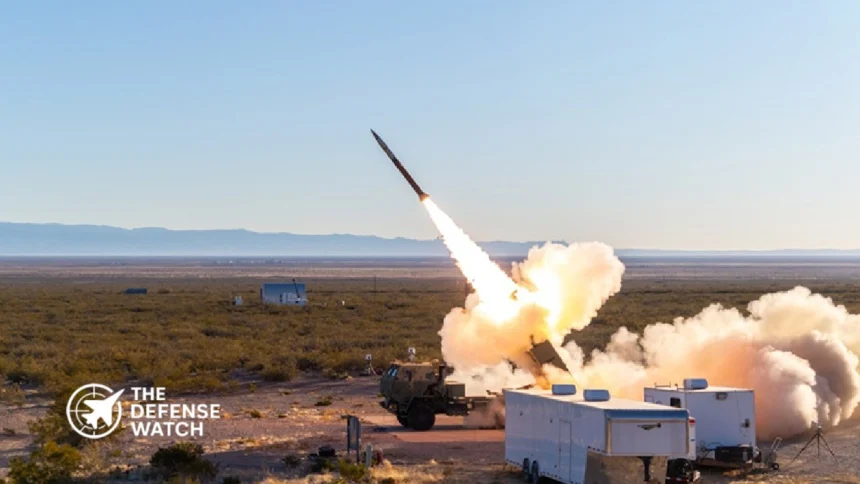
In an Oct. 19 announcement, the company said both the Alternative Warhead and Unitary Warhead variants had completed operational testing following launches in September and October at White Sands Missile Range, New Mexico. The tests involved multiple rockets fired in succession from an M270A2 Multiple Launch Rocket System launcher.
Lockheed Martin also confirmed that the Army had approved Milestone C, the acquisition decision that permits a program to proceed into production. The announcement did not specify an initial fielding date, the number of rockets to be delivered in the first production lot, or a revised production schedule.
The milestone shifts attention from technical qualification toward manufacturing, delivery and the Army’s ability to introduce the extended-range ammunition into its existing artillery force.
Two warhead options, one extended-range rocket
ER GMLRS is an evolution of the U.S. Army’s existing Guided Multiple Launch Rocket System. It is designed to increase engagement distance while retaining compatibility with the M142 High Mobility Artillery Rocket System (HIMARS) and the M270 family of tracked launchers.
Lockheed Martin advertises a maximum range of approximately 150 kilometers, compared with roughly 70 kilometers for standard GMLRS. Actual engagement distance depends on the munition configuration and firing conditions.
The system is intended to provide greater reach without requiring the Army to introduce an entirely new launcher fleet.
The two warhead variants serve different target sets:
- Unitary warhead: Designed to concentrate explosive effects against a specific target.
- Alternative Warhead: Designed for area targets, using a payload configuration intended to distribute effects across a wider area.
Maintaining both options allows commanders to select a munition according to the target and desired effects. The availability of two warhead configurations does not, by itself, establish that both have identical operational performance or that every target can be engaged under the same conditions.
The extended-range design uses a larger rocket motor and an aft-mounted control actuation system, according to Lockheed Martin’s published technical material. The changes support the increased range while retaining the broader launcher architecture used by existing GMLRS ammunition.
What the latest tests establish
The October announcement follows a series of development and qualification milestones.
In December 2025, the Army reported that an ER GMLRS Alternative Warhead rocket traveled 112 kilometers during a flight test at White Sands Missile Range. The test demonstrated engagement of an area target from a HIMARS launcher.
In January 2026, the Army conducted another flight test, with its Feb. 9 report stating that the rocket engaged area targets beyond 100 kilometers. The Army said the measured performance met or exceeded expectations.
Lockheed Martin subsequently reported that the Alternative Warhead variant had completed system qualification testing and that an M270A2 had conducted its first launch of the variant.
The October milestone differs from those earlier demonstrations because the company now reports completion of soldier-led operational tests and Army approval to proceed into production.
That distinction matters. A successful flight test establishes that a weapon has demonstrated specified performance under test conditions. Operational testing assesses the system in a more representative military setting, while a production decision allows the program to move into the next acquisition phase. Neither milestone alone confirms that large numbers of weapons have reached operational units.
The latest company announcement does not disclose the full operational-test results, the number of rockets expended, detailed accuracy measurements or the schedule for initial unit deliveries.
Why the additional range matters to Army artillery
ER GMLRS is intended to give artillery units more options for striking targets at distances beyond the normal reach of standard GMLRS ammunition.
The extra range can allow a launcher to engage targets from farther away while reducing the need to move closer to the target area. This may improve the flexibility of artillery formations operating against an opponent equipped with counter-battery radar, long-range fires and surveillance systems.
However, increased range does not automatically guarantee launcher survivability. Units must still manage their positions, firing signatures, communications and movement, while relying on accurate targeting information and effective command networks.
The weapon also fits between other systems in the Army’s precision-fires inventory. Standard GMLRS provides shorter-range precision fires, while the Army Tactical Missile System (ATACMS) and Precision Strike Missile (PrSM) address longer-range missions.
ER GMLRS offers an intermediate option that uses the established HIMARS and M270 launcher ecosystem. The Army can therefore expand its available engagement distances without relying exclusively on larger or longer-range missiles for every target.
The practical benefit will depend on the number of rockets available, target intelligence, battlefield conditions and the ability of units to sustain firing operations over time.
Production capacity is the next challenge
Moving ER GMLRS toward operational use comes as the U.S. defense industrial base faces continuing pressure to supply precision munitions for American forces and international partners.
The Army awarded Lockheed Martin a contract valued at up to $4.1 billion in October 2024 for GMLRS production, including ER GMLRS missiles and associated hardware. The award covered multiple types of ammunition, rather than ER GMLRS alone.
That broader production effort provides important context for the latest milestone. Introducing a new munition into the inventory requires more than completing development. The manufacturer must produce the rockets, secure components from suppliers, maintain quality standards and deliver ammunition at a rate that meets military requirements.
Lockheed Martin says it is expanding production capacity across its precision-fires portfolio, but its Oct. 19 announcement did not provide an ER GMLRS-specific annual production target or quantify the additional manufacturing capacity attributable to this milestone.
The Army’s budget documents also show that ER GMLRS development has involved work beyond extending the rocket’s range. The fiscal 2026 research and development budget identified redesign and qualification work on a side-mounted proximity sensor following performance anomalies encountered during system qualification testing. It also included development of an Enhanced Alternative Warhead.
Those activities illustrate why a production decision should not be confused with the end of all technical work across the wider GMLRS family. Different variants and improvements can have separate qualification and integration requirements.
The public information available for the October announcement does not establish whether the sensor redesign or Enhanced Alternative Warhead work affects the initial production configuration of the two variants that completed operational testing.
What remains unconfirmed
The October announcement establishes that ER GMLRS has advanced through operational testing and received the Army’s Milestone C approval, according to Lockheed Martin.
Several details remain outstanding, including the first operational unit scheduled to receive the ammunition, the quantity planned for initial fielding, the timing of deliveries and the expected annual production rate.
Those details will determine how quickly the extended-range capability becomes available across Army formations. The number of rockets produced and delivered will also shape how much the system can contribute to sustained operations, rather than simply demonstrating a longer engagement distance in testing.
For now, ER GMLRS is moving from a development effort toward production and fielding. Its operational value will depend not only on the additional range, but also on whether the Army can procure sufficient ammunition and integrate it into its existing precision-fires force.