Executive Summary:
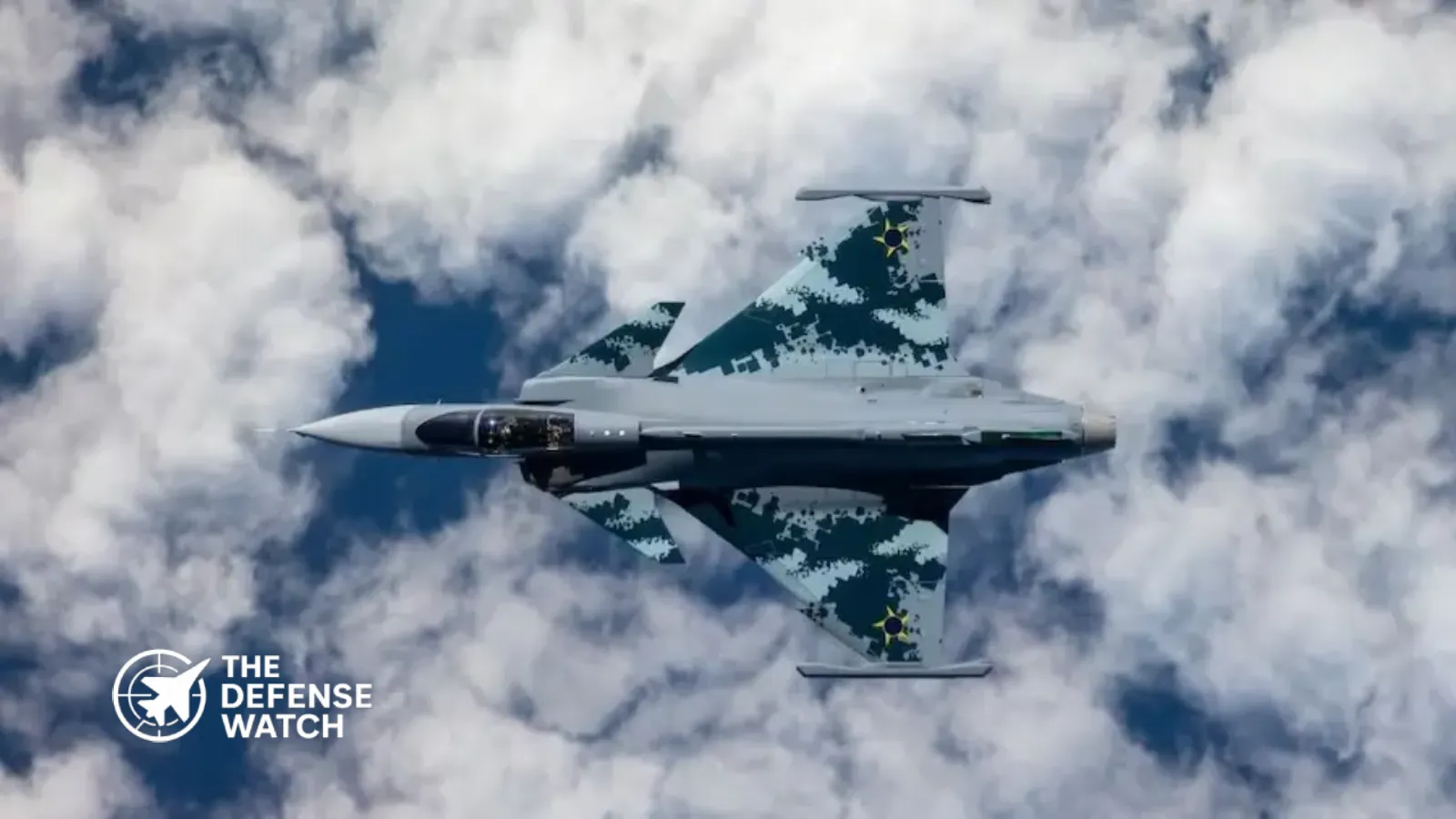
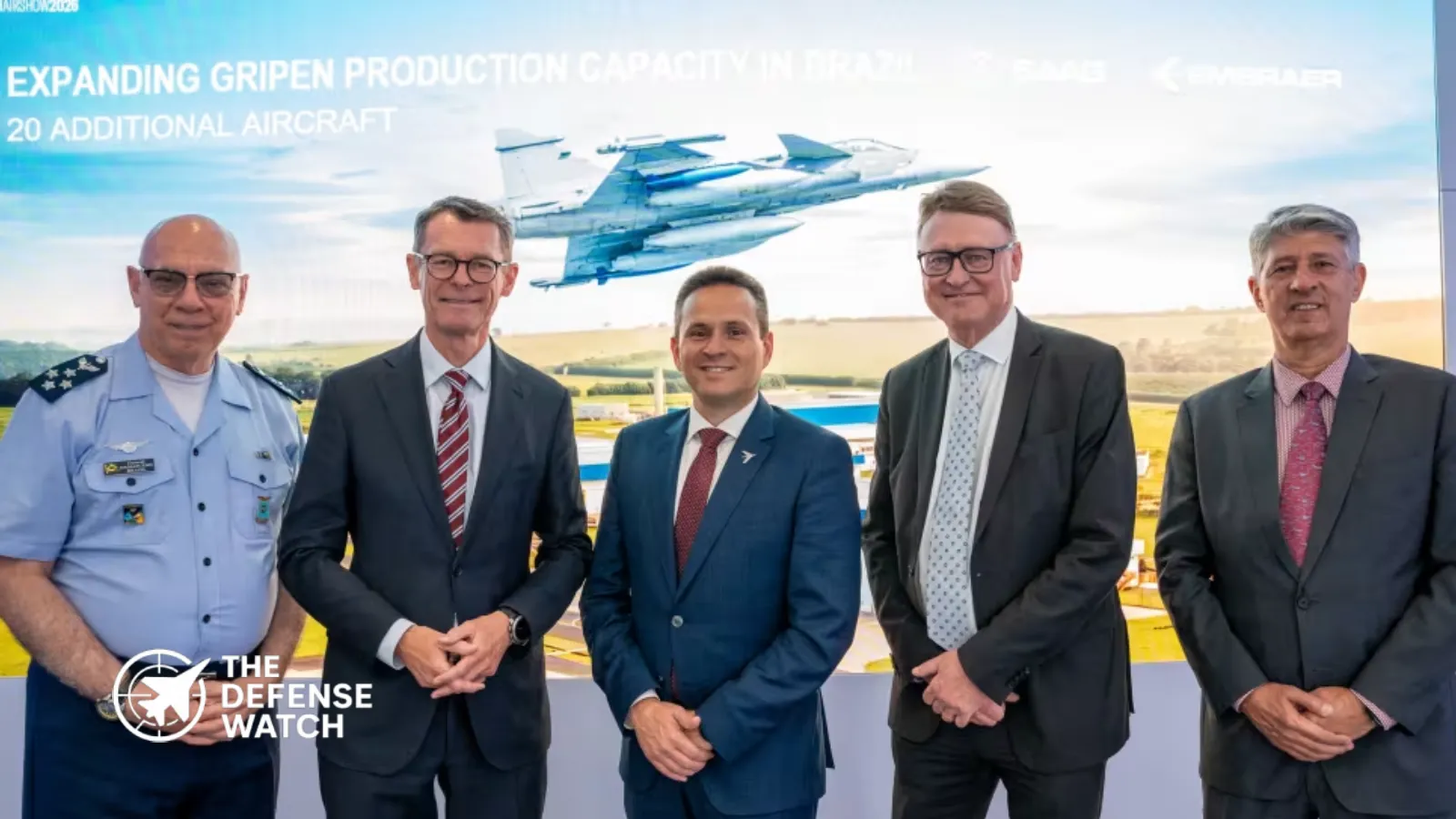
Saab has officially rolled out the first Gripen F twin-seat fighter aircraft for the Brazilian Air Force during a ceremony at the company’s facility in Linköping, Sweden, on June 2, 2026. Developed jointly by Saab and Brazilian industry, the aircraft combines advanced pilot training capabilities with full operational combat functionality, representing a significant milestone in Brazil’s Gripen modernization program.
Saab Rolls Out First Gripen F Fighter For Brazilian Air Force
Saab has unveiled the first Gripen F fighter aircraft, the two-seat variant of its Gripen E multirole fighter family, during a ceremony held at the company’s production facilities in Linköping, Sweden.
The rollout marks a major milestone in the long-running defense partnership between Sweden and Brazil, which has seen extensive industrial cooperation, technology transfer, and joint development activities since the signing of the original Gripen acquisition agreement in 2014.
According to Saab, the Gripen F has been specifically designed to meet modern air force requirements by combining advanced pilot conversion training with full combat capability on a single platform.
The aircraft will now enter a dedicated flight test campaign at Saab’s Flight Test Centre before eventual delivery to the Brazilian Air Force.
Brazil’s Role In Developing The Gripen F
Unlike many export fighter programs where customers simply acquire finished aircraft, Brazil played a direct role in the development of the Gripen F.
Under the broader Gripen partnership agreement, Brazilian aerospace engineers and technicians participated in aircraft development activities through Saab’s technology transfer initiative. Hundreds of Brazilian specialists have received advanced training in fighter aircraft design, systems integration, software development, and aerospace engineering.
Saab’s Aeronautics business area head, Lars Tossman, described the aircraft as a product of long-term industrial collaboration between Saab, Brazilian industry, and the Brazilian Air Force.
The program has become one of the most significant aerospace technology transfer efforts undertaken by Brazil in recent decades, helping strengthen domestic expertise in advanced combat aircraft development.
What Makes The Gripen F Different?
The Gripen F shares the same core architecture, avionics suite, sensors, electronic warfare systems, and mission capabilities found on the single-seat Gripen E.
However, its most notable feature is the addition of a fully operational second cockpit.
Rather than serving solely as a training seat, the rear cockpit allows an instructor, mission commander, or weapons systems operator to actively participate in missions.
Key Operational Benefits
- Accelerated pilot conversion training
- Real-world mission rehearsal in operational aircraft
- Enhanced mission command and coordination
- Reduced pilot workload during complex operations
- Improved effectiveness in contested environments
- Greater flexibility for advanced tactical instruction
This approach allows pilots transitioning to the Gripen fleet to gain combat-relevant experience more rapidly than traditional training methods that rely heavily on dedicated trainer aircraft.
Gripen F Technical Overview
Specification Gripen F Aircraft Type Twin-seat multirole fighter Manufacturer Saab Primary Operator Brazilian Air Force Configuration Two-seat Combat Capability Full operational capability Radar AESA radar Electronic Warfare Integrated EW suite Data Links Advanced network-centric communications Mission Roles Air superiority, strike, ISR, training Development Partner Brazil Like the Gripen E, the Gripen F benefits from an open-architecture design that allows future software and sensor upgrades throughout its operational life cycle.
The aircraft was developed for modern network-centric warfare environments where data fusion, electronic warfare resilience, and rapid information sharing are increasingly critical.
Progress Of Brazil’s Gripen Acquisition Program
The rollout comes as Brazil continues to receive aircraft under its 2014 agreement with Saab.
The original contract covers:
Program Element Quantity Gripen E Fighters 28 Gripen F Fighters 8 Total Aircraft 36 Deliveries began in 2020.
According to Saab, 11 aircraft have already been delivered to Brazil, where they are gradually replacing older combat aircraft and expanding the Brazilian Air Force’s operational capabilities.
The Gripen program represents one of the most important modernization initiatives undertaken by the Brazilian military and forms a central component of the country’s long-term airpower strategy.
Why The Gripen F Matters Beyond Brazil
The rollout of the Gripen F carries significance beyond the Brazilian Air Force.
Many modern fighter fleets face challenges associated with pilot shortages, increasingly complex mission systems, and growing demands for advanced tactical training.
The Gripen F addresses these issues by combining operational and instructional functions within a single aircraft platform.
From a strategic perspective, the aircraft offers several advantages:
Enhanced Force Generation
Air forces can shorten pilot qualification timelines while maintaining operational readiness.
Improved Mission Effectiveness
A second crew member can assist with mission management, sensor operation, electronic warfare coordination, and tactical decision-making.
Lower Training Costs
Operators may reduce dependence on separate advanced jet trainer fleets by conducting portions of pilot conversion training in frontline aircraft.
Export Potential
The aircraft’s dual-role design broadens its appeal among nations seeking a cost-effective solution for both training and combat operations.
This export potential is already evident. Saab has confirmed additional Gripen F orders from Thailand and Colombia, indicating growing international interest in the two-seat variant.
Strategic Implications For The Global Fighter Market
The rollout highlights Saab’s broader strategy of positioning the Gripen family as a flexible and affordable alternative within the global fighter market.
While larger competitors continue to focus heavily on fifth-generation platforms, Saab has emphasized adaptability, lower operating costs, advanced electronic warfare capabilities, and rapid upgrade potential.
For emerging and mid-sized air forces, the Gripen F may offer a particularly attractive balance between operational capability and training efficiency.
The aircraft also demonstrates how defense industrial partnerships can extend beyond procurement into collaborative development and technology transfer, a model increasingly sought by nations seeking to strengthen domestic defense industries alongside military modernization.
As the aircraft enters flight testing, the Gripen F moves one step closer to operational service, adding a new capability to Brazil’s growing Gripen fleet while reinforcing Saab’s position in the competitive global fighter aircraft market.
Executive Summary:
Northrop Grumman announced on June 1, 2026, the successful completion of a key flight test for its Jackal next-generation precision strike missile. The test validated critical flight systems, including propulsion, autopilot performance, and autonomous capabilities. This milestone supports U.S. Army efforts to field affordable, multi-domain strike options capable of operating in GPS-denied and contested electromagnetic environments.
Jackal Precision Strike Missile Advances in Flight Testing
Northrop Grumman completed a key flight test for the Jackal precision strike missile, demonstrating the platform’s flight system readiness, the company announced June 1, 2026.
The test involved multiple flights that showcased rapid turbojet engine start, precise autopilot-controlled flight profiles, and overall system maturity. Jackal is engineered as a compact, affordable weapon for air, land, and sea platforms, with particular emphasis on integration with U.S. Army light tactical vehicles and aerial assets.
Technical Specifications and Capabilities
Jackal is a turbojet-powered missile designed for high subsonic speeds and extended range:
- Speed: Sustains over 300 mph (some references note capability exceeding 400 mph in sprint modes).
- Range: Up to 100 km from surface launch; 125 km from air launch.
- Navigation: Autonomous waypoint navigation with GPS-denied operation.
- Targeting: AI-driven algorithms for target discrimination, automatic recognition, and engagement without continuous line-of-sight from the operator.
- Payload: Modular options supporting lethal warheads as well as non-lethal payloads for ISR or electronic warfare missions.
- Launch Flexibility: Compatible with ground vehicles, aircraft, and maritime platforms.
The missile’s low-altitude flight profile (under 50 meters in some modes) and onboard power generation (up to 1 kW) support advanced electronic warfare packages and modular payloads.
Strategic Context and Operational Relevance
The Jackal program aligns with U.S. military priorities for affordable mass in contested environments. Peer adversaries have invested heavily in integrated air defense systems and electronic warfare capabilities that challenge traditional precision-guided munitions reliant on GPS and datalinks.
By emphasizing autonomy and resilience, Jackal aims to provide maneuver forces with organic, beyond-line-of-sight strike options that reduce dependence on contested satellite navigation and high-value aerial platforms. Its design supports rapid retasking mid-flight and potential future swarm operations.
Analysis: In an era where U.S. forces face sophisticated anti-access/area-denial (A2/AD) networks, systems like Jackal represent a shift toward distributed lethality. Rather than relying solely on expensive, exquisite platforms, the U.S. Army can deploy larger numbers of attritable, intelligent munitions from forward positions. This approach complicates enemy targeting calculus and enables sustained pressure even when communications are degraded. Technical hurdles remain in AI robustness against advanced jamming and decoys, as well as ensuring safe integration with existing Army fire control architectures.
Development Path and Testing
Northrop Grumman conducted multiple flight tests to advance Jackal’s development. The recent milestone focused on propulsion, autonomy, and precision strike operations. Data collected will inform subsequent development phases, including integration testing and expanded mission profiles.
The program builds on Northrop Grumman’s extensive experience in munitions, propulsion, autonomy, and digital engineering. Jackal was publicly unveiled in 2024-2025 and has progressed rapidly through early testing phases.
Implications for U.S. Defense Strategy
Jackal enhances the U.S. military’s ability to maintain overmatch in multi-domain operations. For the Army, it offers a complementary capability to existing systems like GMLRS and ATACMS, filling a niche for lighter, more mobile, and attritable precision effects at the tactical edge.
Its multi-platform compatibility also supports joint operations, potentially integrating with Marine Corps and Navy assets for littoral and maritime strike missions. As defense budgets face scrutiny, the emphasis on affordability and modularity positions Jackal as a scalable solution for high-volume production if required by evolving threats.
- U.S. Army Modernization Alignment: Supports transformation toward lighter, more lethal formations capable of dispersed operations.
- Contested Environment Focus: Directly addresses lessons from ongoing conflicts involving heavy electronic warfare and layered air defenses.
- Industrial Base Benefit: Reinforces Northrop Grumman’s role in advanced weapons development while leveraging modern manufacturing techniques for cost control.
Executive Summary:
Canada is evaluating a significant shift in its fighter aircraft procurement, potentially acquiring around 30 Lockheed Martin F-35A jets and approximately 60 Saab JAS 39 Gripen fighters instead of its original plan for 88 F-35s. The move, driven by the government of Prime Minister Mark Carney, aims to balance advanced stealth capabilities with enhanced industrial sovereignty and reduced reliance on a single supplier. This potential mixed fleet comes as Ottawa seeks to modernize the Royal Canadian Air Force’s aging CF-18 fleet while addressing geopolitical and economic priorities.
Canada Fighter Procurement Review Gains Momentum
Canada is actively considering a mixed fighter fleet for the Royal Canadian Air Force (RCAF), according to recent reports from Canadian media. The proposal involves scaling back the planned purchase of 88 F-35A Lightning II stealth fighters to approximately 30 aircraft while acquiring about 60 Saab Gripen E fighters from Sweden.
This development follows Canada’s earlier commitment to the F-35 program under the previous administration. In 2023, Ottawa finalized an agreement for 88 F-35s valued at around C$27.7 billion. However, the current government under Prime Minister Mark Carney has placed the larger portion of the order under review amid evolving strategic and economic considerations.
Canada remains contractually obligated to accept the first 16 F-35s, with deliveries expected to begin in 2026. Payments have also been initiated for an additional 14 aircraft. The flexibility lies in the remaining aircraft, allowing Ottawa to adjust its long-term fleet composition.
Strategic and Economic Drivers Behind the Potential Shift
The review reflects broader efforts to diversify defense supply chains and bolster domestic industry. Saab has proposed local assembly of Gripen fighters in Canada, potentially in partnership with Bombardier, which could generate or sustain up to 12,600 high-skilled aerospace jobs. This package has been linked to additional acquisitions, such as Saab GlobalEye airborne early warning aircraft.
Proponents argue that a mixed fleet would enhance operational flexibility. The F-35 offers unmatched stealth, sensor fusion, and interoperability within NORAD and NATO frameworks. The Gripen E, a 4.5-generation multirole fighter, emphasizes cost-effectiveness, rapid turnaround, and high availability, with features like dispersed operations suited to Canada’s vast geography.
Analysis: A mixed fleet could allow Canada to allocate its high-end stealth assets for the most demanding missions—such as penetrating advanced air defenses or leading coalition operations—while using Gripens for routine patrol, sovereignty missions over the Arctic, and high-volume training sorties. This approach mirrors strategies employed by other nations operating mixed fleets, though it introduces logistical complexities in maintenance, training, and spares management. From a geopolitical standpoint, diversifying away from exclusive U.S. dependence addresses concerns over potential supply disruptions or policy shifts, particularly amid recent trade tensions. However, it risks interoperability challenges and higher overall lifecycle costs compared to a single-type fleet.
Background on Canada’s Fighter Replacement Program
Canada’s Future Fighter Capability Project long sought to replace its CF-18 Hornets. After a competitive evaluation, the F-35 was selected in 2022-2023 for its superior capabilities in network-centric warfare. The Gripen was a competitor but scored lower in operational assessments.
Tensions with the United States, including tariff disputes and statements from former President Trump, accelerated the review. The Carney government has emphasized “elbows up” sovereignty in defense procurement. Saab’s willingness to offer technology transfer and local production has made the Gripen option more attractive.
Challenges and Considerations for a Mixed Fleet
Operating two fighter types presents notable hurdles. The RCAF would need dual training pipelines, separate maintenance infrastructures, and distinct supply chains. Critics, including some within the RCAF leadership, have expressed reservations about diluting focus from the F-35’s proven advantages.
There are also diplomatic and contractual implications. Reducing the F-35 order could strain relations with the U.S. and Lockheed Martin, potentially affecting industrial offsets or NORAD cooperation. Legal and penalty considerations for any contract adjustments remain under scrutiny.
On capability, the F-35’s low-observable profile and data-sharing prowess provide a qualitative edge in high-threat environments. The Gripen excels in affordability and agility, with modern avionics, Meteor missile integration, and a design optimized for austere operations.
Further original analysis: In the Arctic context, where Canada faces increasing Russian and Chinese activity, a larger number of affordable, maintainable platforms like the Gripen could increase sortie rates for presence patrols. Meanwhile, a smaller F-35 core would serve as a strategic deterrent and enabler for allied operations. Success would depend on robust integration of both platforms into a common command-and-control network, leveraging Link 16 and other datalinks. Long-term, this could position Canada as a more self-reliant aerospace player in North America.
Path Forward and Timeline
Sources indicate the decision on the fighter mix is largely formed, with an announcement possibly timed around the U.S. midterm elections in the fall of 2026 to minimize immediate bilateral friction.
The RCAF’s current fighter fleet stands at around 76 CF-18s, many of which are approaching the end of their service life. A timely decision is critical to avoid capability gaps.
Executive Summary:
Tycho.AI, an MIT spin-off based in Cambridge, Massachusetts, is pitching the Pentagon on the Halley, a compact tail-sitting VTOL drone interceptor designed to replicate the low-cost, high-effectiveness model of Ukrainian counter-UAS systems. The electrically powered platform reaches speeds of 174 knots and uses AI-enabled Voyager autonomy for GPS-denied operations. This development addresses growing US military demand for economical solutions to counter proliferating one-way attack drones like the Iranian Shahed.
Tycho.AI is positioning its Halley interceptor to bring battle-proven, Ukraine-style drone defense capabilities to the US market. As drone warfare dominates modern conflicts, the startup aims to deliver a more affordable alternative to existing high-cost counter-UAS platforms.
The system targets a key vulnerability exposed in both Ukraine and recent Middle East operations: the unsustainable expense of using advanced missiles against cheap loitering munitions and one-way attack drones.
Ukraine’s Counter-Drone Innovation Drives Global Interest
Ukraine’s four-year conflict with Russia has reshaped air defense priorities. According to the Ukrainian Ministry of Defense, drones account for as many as 80% of military strikes and a similar share of battlefield casualties.
To conserve expensive Western-supplied missiles, Ukrainian forces and industry developed low-cost interceptors such as the Wild Hornets Sting and SkyFall P1-Sun. These systems, often costing under $5,000, achieve speeds in the hundreds of kilometers per hour and effectively engage threats like the Shahed-136/Geran-2, which cost around $35,000.
This approach contrasts sharply with traditional US systems like Raytheon’s Coyote or Anduril’s Roadrunner, which, while effective, carry price tags in the hundreds of thousands of dollars due to larger platforms and more complex propulsion.
Halley: Design and Performance Specifications
Tycho.AI’s Halley is a tail-sitting, electrically powered VTOL interceptor featuring a fixed-wing delta configuration with two large winglets and four rotors. The design combines vertical takeoff and landing convenience with efficient forward flight.
Key performance parameters include:
- Maximum speed: 174 knots (322 km/h)
- Range: Approximately 50 km (27 nm) in current configuration
- Endurance: 20 minutes on battery, with improvements targeting extended performance
- Service ceiling: 10,000 feet
Phillip Pitsky, senior vice-president of growth at Tycho.AI, described the system as “an FPV drone that can go extremely fast and be extremely agile, but also with a very stable flight system.”
The company is currently in low-rate initial production and accepting orders, with options for customization in cameras, motors, and payloads. Neither the Halley platform nor its Voyager guidance software is export-restricted.
Voyager AI: Enabling Autonomous Operations
Central to Halley’s effectiveness is Tycho.AI’s Voyager system — an AI-enabled visual navigation solution that supports operations without GPS. The tablet-based interface integrates threat data from existing counter-UAS sensors to autonomously guide the interceptor.
Early testing employed remote FPV-style control, but future trials will demonstrate fully autonomous target engagement. Operators will simply designate threats for interception, with Halley handling launch and terminal guidance independently.
This autonomy addresses contested electromagnetic environments where jamming and spoofing degrade traditional navigation.
Strategic Context and Pentagon Demand
US interest in low-cost interceptors has intensified amid threats from Iranian Shahed-style drones targeting bases and assets in the Middle East. High-cost missile engagements against low-value targets strain budgets and inventories, mirroring challenges faced by Ukrainian forces.
Tycho.AI reports the “main demand signal” from the Pentagon centers on ground-launched counter-UAS applications against such threats. Discussions also explore air-launched variants, potentially deployable from aircraft dispensers for forward positioning against incoming drone waves.
US Special Operations Command is anticipated as the launch customer, with Tycho expecting its first full-scale contract award in the coming months.
Analysis: Closing the Cost-Effectiveness Gap
The emergence of platforms like Halley represents a necessary evolution in US counter-UAS strategy. Traditional kinetic interceptors excel in high-end threats but prove economically inefficient against massed, low-cost drone swarms. Ukraine’s experience demonstrates that sustainable defense requires matching the attacker’s production economics.
Tycho.AI’s approach leverages commercial-off-the-shelf elements and academic roots at MIT to accelerate development while maintaining military-grade performance. The fixed-wing VTOL design offers operational flexibility over pure multi-rotor FPV systems, potentially improving range and speed without sacrificing agility.
However, challenges remain. Battery technology limits endurance, though the company is addressing this. Integration with broader US air defense networks, including command-and-control systems, will determine real-world effectiveness. Scalability to high-rate production will be critical if the system is to counter potential peer-level drone campaigns.
Compared to competitors, Halley’s emphasis on affordability and autonomy positions it well for both domestic adoption and allied export markets facing similar asymmetric threats. Success could influence broader DoD procurement toward attritable, mass-producible systems.
This aligns with ongoing US military modernization efforts emphasizing resilience in contested environments and cost-per-kill metrics.
Broader Implications for US Defense Modernization
The Tycho.AI initiative fits into a larger pattern of incorporating lessons from Ukraine into American capabilities. From electronic warfare to attritable munitions, the conflict serves as a real-world laboratory for next-generation systems.
For the US, adopting lower-cost interceptors could preserve high-value missile stocks for strategic threats while providing layered defense options against tactical drone incursions.
Executive Summary: Boeing has received a $21.6 million contract modification from the U.S. Navy to support advanced cybersecurity certification efforts for the MQ-25A Stingray unmanned tanker program. The work focuses on validating secure cross-domain communications and mission management systems that will enable the aircraft to operate within increasingly complex and classified military networks.
The U.S. Naval Air Systems Command (NAVAIR), headquartered in Patuxent River, Maryland, has awarded Boeing a $21.62 million contract modification to support cybersecurity and mission systems certification activities for the MQ-25A Stingray program. According to the Department of Defense announcement, the modification adds engineering work, hardware procurement, and laboratory testing capabilities necessary to validate critical security components of the aircraft’s mission management architecture.
The effort specifically supports certification of the mission management system computer’s Multi-Level Security (MLS) Switch and MLS Guard technologies against standards established by the National Cross Domain Strategy and Management Office (NCDSMO). The testing is intended to support National Security Agency (NSA) assessment requirements under Raise-the-Bar (RTB) Version 5.1 Increment 2 and Increment 3 security standards.
Deep Technical & Strategic Context Analysis
While the MQ-25A is widely recognized as the U.S. Navy’s first carrier-based unmanned aerial refueling aircraft, its strategic significance extends well beyond tanker operations. The platform is expected to become a critical node within future naval battle networks, sharing data between carrier strike groups, airborne assets, intelligence platforms, and command centers operating across multiple classification levels.
The latest contract highlights a growing Pentagon focus on secure cross-domain solutions. In military network architecture, a cross-domain solution allows information to move between networks operating at different security classifications while preventing unauthorized disclosure or compromise. As modern combat increasingly relies on distributed sensors, artificial intelligence, and collaborative targeting networks, the ability to securely transfer information between classified and less-classified environments has become a mission-critical capability.
The Multi-Level Security Switch and Guard being tested under this contract serve as digital gatekeepers within the MQ-25’s mission architecture. These systems inspect, filter, and validate data before it crosses security boundaries. Achieving NSA certification under Raise-the-Bar standards represents one of the most demanding cybersecurity benchmarks within the U.S. national security community.
From a procurement perspective, the modification was added to an existing contract that combines fixed-price-incentive-fee, cost-plus-incentive-fee, and cost-plus-fixed-fee elements. Such hybrid structures are commonly used for advanced defense development efforts where technical risk remains significant. Fixed-price portions encourage cost control, while cost-reimbursable elements provide flexibility for complex engineering tasks where requirements may evolve during testing and certification.
The cybersecurity effort also reflects the Navy’s broader vision for integrating unmanned systems into future carrier air wings. Beyond aerial refueling, MQ-25 technologies are expected to inform future unmanned strike, intelligence, surveillance, reconnaissance, and collaborative combat aircraft concepts operating in contested Indo-Pacific environments.
Contract Breakdown & Details
Contract Value
- Contract Modification: P00091
- Award Value: $21,619,263
- Prime Contractor: Boeing, St. Louis, Missouri
- Original Contract Number: N00019-18-C-1012
- Contract Type: Fixed-price-incentive-fee, cost-plus-incentive-fee, and cost-plus-fixed-fee modification
- Competition Status: Not competed
Scope of Work
The modification funds:
- Non-recurring engineering activities
- Cybersecurity certification support
- Hardware procurement
- Laboratory testing infrastructure
- Mission Management System security validation
- MLS Switch and MLS Guard certification testing
- NSA assessment support for cross-domain solutions
Program Objective
The effort supports:
- MQ-25A Stingray mission systems
- National Cross Domain Strategy and Management Office testing standards
- Raise-the-Bar Version 5.1 Increment 2 requirements
- Raise-the-Bar Version 5.1 Increment 3 requirements
- National Security Agency certification activities
Geographic Distribution of Work
Work will be performed across multiple U.S. defense and technology centers:
Location Share St. Louis, Missouri 53.5% Melbourne, Florida 25.0% El Segundo, California 18.0% Alameda, California 1.5% Pleasanton, California 1.0% Heath, Ohio 1.0% Funding Details
- Funding Source: Fiscal Year 2026 Research, Development, Test & Evaluation (RDT&E), Navy
- Amount Obligated at Award: $15,633,634
- Expiration Status: Funds will not expire at the end of the current fiscal year
Schedule
- Contracting Authority: Naval Air Systems Command (NAVAIR)
- Contract Completion: December 2028
Why This Contract Matters
Although relatively modest in dollar value compared with major aircraft production awards, this modification addresses one of the most challenging aspects of next-generation military aviation: trusted data movement across classified networks. As the Department of Defense accelerates Joint All-Domain Command and Control (JADC2) initiatives and network-centric warfare concepts, cybersecurity certification has become as strategically important as traditional aircraft performance metrics.
For the MQ-25A program, successful completion of these certification efforts will help ensure the aircraft can securely participate in future naval combat networks while supporting the Navy’s long-term transition toward a more connected and increasingly autonomous carrier air wing.
Executive Summary: The world’s first sixth-generation fighter jets have moved from classified skunkworks to funded, contracted, test-flying reality — and three distinct programs are now vying to define the future of air combat. The U.S. F-47 leads on funding at nearly $8.5 billion cumulative, China’s J-36 and J-50 are flight-testing simultaneously, and the UK-Italy-Japan GCAP has just awarded a £686 million development contract. Whoever fields a combat-ready platform first will set the technological and strategic baseline for the next 50 years of aerial warfare.
Three sovereign powers are simultaneously constructing the most lethal, autonomous, and stealthy combat aircraft in history. None of them plan to wait for the others to finish.
As of mid-2026, the United States’ Boeing-built F-47 has accumulated nearly $8.5 billion in cumulative programmatic funding and is targeting first flight in 2028. China’s two competing prototypes — the J-36 and J-50 — completed their first flight tests in late 2024 and have accelerated through multiple prototype iterations since. The UK-Italy-Japan Global Combat Air Programme (GCAP) just contracted Edgewing, a newly formed tri-national industrial consortium, for £686 million (~$908 million) to formally begin detailed design work. Europe’s Franco-German FCAS, by contrast, is sinking under workshare disputes and may not produce a demonstrator before the mid-2030s.
The gap between the front-runners and the stragglers isn’t just programmatic. It’s strategic.
Technical Analysis: What Makes a “Sixth-Generation” Fighter Different From the F-35
The term “sixth generation” isn’t a marketing tier. It describes a genuinely new doctrine of air combat — one where the crewed fighter is not the primary weapon, but the command node of a broader, AI-managed kill web.
Every major program converges on five defining characteristics:
1. Manned-Unmanned Teaming (MUM-T) The F-47 is explicitly designed to operate alongside Collaborative Combat Aircraft (CCAs) — autonomous drones controlled from the cockpit capable of electronic warfare, ISR, SEAD (Suppression of Enemy Air Defenses), and kinetic strikes. The Pentagon’s logic: one F-47 paired with two CCAs may provide more combat-relevant capability than two or three F-35s at comparable lifecycle cost.
2. Adaptive Cycle Engines Next-generation propulsion isn’t just about thrust. Adaptive cycle engines (like GE Aerospace’s XA100) can switch operating modes mid-flight — high-bypass for fuel economy at cruise, low-bypass for supercruise and afterburner for combat. The F-47 is targeting Mach 1.8+ supercruise without afterburner, extending combat radius dramatically over the F-22.
3. Embedded, All-Spectrum Stealth Fifth-generation stealth (F-22, F-35) was primarily radar-cross-section (RCS) management. Sixth-generation platforms extend this to infrared signature reduction, acoustic masking, electronic emission control (EMCON), and low-probability-of-intercept radar systems. The J-36’s tailless flying-wing configuration — no vertical stabilizers — reduces RCS in the rear hemisphere where legacy fighters are most vulnerable.
4. On-Board AI for Sensor Fusion The GCAP program describes its aircraft not as a fighter in the traditional sense but as a “super-connected, supercomputing command node.” Processing data from distributed sensors, networked CCAs, space-based ISR, and legacy platforms in real time requires on-board AI that no current production fighter possesses.
5. Directed-Energy Weapons Integration Laser and high-power microwave (HPM) weapons are structural design requirements, not retrofits. The airframes are being engineered from the outset to accommodate power generation and thermal management for directed-energy payloads that defeat both missiles and drone swarms.
Program Breakdown: The F-47, GCAP, and China’s Twin Track
United States: F-47 (NGAD)
Boeing won the Next Generation Air Dominance contract on March 21, 2025, defeating Lockheed Martin and Northrop Grumman after a classified fly-off that reportedly began with initial demonstrator flights in 2020. The designation “F-47” is a deliberate historical callback to the P-47 Thunderbolt — a rugged, high-output multi-role fighter that dominated every theater of World War II.
The Air Force’s FY2026 budget request allocated $5 billion in new baseline discretionary funding for the F-47, with an additional $900 million in reconciliation funding. Combined with prior allocations, the program has received approximately $8.5 billion by end of FY2026. The first prototype article is currently in production, with Air Force Chief of Staff Gen. David Allvin confirming in September 2025 that Boeing had already begun manufacturing the first physical article months after contract award. Target: first flight 2028, initial operational capability 2029, initial fielding in the early 2030s.
One program complexity that is now openly discussed: the F-47 may be an “Increment 1” design — the first in a family of iteratively improved variants, rather than a single fixed-design production run. This “spiral development” approach mirrors how the F-16 evolved through Blocks 15, 40, 52, and beyond, but at a far higher baseline capability level.
The U.S. Navy’s parallel F/A-XX carrier-based program was effectively put on ice in FY2026 to concentrate funding on the F-47. Congress moved to restore F/A-XX funding in January 2026, but the program’s timeline remains uncertain.
United Kingdom, Italy, Japan: GCAP (Global Combat Air Programme)
Formally launched in December 2022, GCAP is the most geopolitically significant multinational defense program in a generation. In June 2025, BAE Systems (UK), Leonardo (Italy), and Japan Aircraft Industrial Enhancement formed Edgewing — a purpose-built joint venture — to lead design and development. The £686 million Edgewing contract, awarded in early 2026, marks the program’s transition from concept to funded development.
The target service entry date is 2035. The airframe is described as a tailless delta-wing with Rolls-Royce/IHI co-developed engines. Each nation will integrate its own sensors, radar, and weapons — Japan’s active electronically scanned array (AESA) radar technology is considered one of the program’s key technical differentiators, while BAE’s Digital Design and Manufacturing capabilities are providing the industrial backbone. GCAP explicitly builds on work done under the UK’s Tempest program, including new-generation integrated avionics, digital twin manufacturing, and AI-assisted cockpit design.
Italy’s Defense Minister Guido Crosetto has publicly pushed back at proposals to slow or dilute the Italian industrial workshare, calling any such move “madness” — a signal that the political cohesion that has doomed the Franco-German FCAS is, so far, holding for GCAP.
China: J-36 and J-50 (Parallel Track Development)
China is the only nation simultaneously flight-testing two distinct sixth-generation prototype programs. The U.S. Department of War confirmed in December 2025 that both aircraft completed initial flight tests in late 2024.
The J-36, attributed to Chengdu Aircraft Corporation (CAC), features a large tailless diamond-wing flying configuration with an estimated MTOW of 50–55+ tons, three engines, and deep stealth shaping. Its physical dimensions suggest an emphasis on range, payload, and long-duration maritime patrol — making it a credible anti-access/area-denial asset against U.S. carrier strike groups operating in the South China Sea and Western Pacific.
The J-50, attributed to Shenyang Aircraft Corporation (SAC), is more compact, twin-engine, and still tailless. Based on images circulated in 2025 and early 2026, its delta-wing layout with seamless fuselage blending and large internal weapons bays suggest a multi-mission, carrier-capable design. The J-50 was publicly acknowledged during China’s September 3, 2025 military parade as among Beijing’s “sixth-generation” platforms.
By October 2025, a second J-36 prototype appeared with substantial design revisions — redesigned serrated exhausts resembling 2D thrust-vectoring nozzles, revised DSI side intakes, and a new main landing gear layout. The pace of prototype iteration demonstrates an industrial design-to-flight velocity that caught Western analysts off guard. China’s declared goal is to field operational sixth-generation fighters before 2030 — a timeline most Western defense establishments consider aggressive but no longer implausible.
Europe: FCAS (Futura Combat Air System) — The Stalled Program
The Franco-German-Spanish FCAS represents what happens when defense industrial politics override operational urgency. Despite enormous projected contract value, the program has been mired in workshare disputes between Dassault (France), Airbus (Germany/Spain), and Indra (Spain). As of 2026, no demonstrator has flown. Timeline projections have slipped to 2045 and beyond in some assessments. The ongoing Franco-German rift threatens to collapse the program in its current form entirely.
The operational consequences of FCAS slipping are not abstract. If Germany — the program’s second-largest contributor — pivots toward GCAP or purchases an F-47 variant, the European sovereign air combat industrial base fragments in ways that would take decades to repair.
Data Block: Sixth-Generation Fighter Program Comparison (2026)
Program Nation(s) Lead Contractor Cumulative Funding First Flight Target IOC Target Key Differentiator F-47 (NGAD) United States Boeing ~$8.5B (FY2026) 2028 2029–early 2030s CCA drone teaming; highest funding velocity GCAP (Tempest) UK, Italy, Japan Edgewing (BAE/Leonardo/JAIE) £686M contracted (2026) 2027 (demonstrator) 2035 Tri-nation sensor fusion; Japan AESA technology J-36 China Chengdu Aircraft Corp. Classified Flew 2024 (prototype) Pre-2030 (target) Tailless flying wing; long-range maritime strike J-50 China Shenyang Aircraft Corp. Classified Flew 2024 (prototype) Pre-2030 (target) Compact, likely carrier-capable; twin-engine FCAS France, Germany, Spain Dassault / Airbus ~€3B+ (contested) Not started 2045+ (slipped) European sovereignty; currently stalled F/A-XX United States (Navy) TBD (Boeing/Northrop) FY2026 funding frozen 2030s (uncertain) Late 2030s Carrier-based; Congress working to restore funding The Strategic Insight: Why “First Look, First Shot” Is No Longer Enough
For 30 years, the defining mantra of U.S. air superiority was first look, first shot — the ability to detect, track, and engage any adversary before they could detect you. The F-22 and F-35 were engineered to own that advantage decisively.
Sixth-generation doctrine abandons the linear logic of individual aircraft superiority. What replaces it is network kill web management — the ability for a single crewed platform to orchestrate a distributed swarm of autonomous systems across multiple domains simultaneously.
This is where the gaming and esports analogy holds genuine analytical weight. The shift from fifth- to sixth-generation air combat architecture closely mirrors the shift in competitive strategy gaming from individual mechanical skill (the F-22 model) to real-time resource management across multiple agents (the F-47 model). The best competitive StarCraft II players are not the ones with the fastest reflexes in a single engagement — they’re the ones who can maintain optimal decision-making across 12 simultaneous production queues, scout movements, and combat theaters. The F-47 pilot operating three CCAs in a denied-access environment faces an analogous cognitive architecture challenge.
The U.S. Air Force’s answer to the cognitive load problem is AI-enabled automation — shifting sensor fusion, threat classification, and CCA tasking to on-board systems so the human pilot focuses exclusively on decision authorization. Not execution. Authorization.
China’s dual-track development strategy reflects a different doctrinal answer to the same question. By pursuing two distinct platforms simultaneously — one optimized for range and maritime strike (J-36), one for carrier operations and multi-mission flexibility (J-50) — Beijing is hedging against single-point design failures while accelerating its overall development velocity. This mirrors China’s broader industrial strategy: parallel competition between Chengdu and Shenyang, the same way Silicon Valley runs competing internal teams on the same product.
“Standing still is not an option. The ‘first look, first shot’ advantage must be maintained through continuous advancement — and that now means continuous advancement not of individual aircraft, but of the entire networked kill system those aircraft command.” — U.S. Air Force strategic framing on NGAD/F-47, as summarized across USAF budget and doctrine documents, 2025–2026
Conclusion: The Decade That Decides Air Dominance for 50 Years
The 2026–2035 window is the decisive decade. Every program on this list that produces a combat-ready aircraft by the mid-2030s will set the baseline that every air force on earth must answer for the next half century. Every program that misses will face a generation of technological and strategic subordination to those that didn’t.
The F-47 has the funding advantage and the most mature industrial execution. GCAP has the geopolitical coherence and some of the most technically capable industrial partners in the world. China’s J-36 and J-50 have demonstrated a prototype velocity and design iteration speed that no Western program has matched since the Cold War.
FCAS has a budget request and a political dispute.
When the first F-47 lifts off from Edwards Air Force Base in 2028, it will not just be the most advanced fighter jet ever flown. It will be a timer. Every nation watching that flight will have to calculate how far behind they are — and whether the gap is still closeable.
For some, the answer will already be no.
Executive Summary: The Indian Air Force sits 12 squadrons below its sanctioned strength of 42, with the last MiG-21 retired in 2025 and Russian-origin jets aging fast. India is responding with a $40+ billion Rafale order for 114 jets, a $14.1 billion commitment for 180 Tejas Mk1A aircraft, and a “Super Sukhoi” upgrade covering up to 200 Su-30MKIs—the most expensive single-generation fighter recapitalization in South Asian history. The outcome will determine India’s air power posture against China and Pakistan for the next 40 years.
Twelve squadrons. That’s the gap between what the Indian Air Force is authorized to field and what it actually operates right now. With approximately 30 active combat squadrons against a sanctioned strength of 42, the IAF is running thin—and has been for over a decade, as successive MiG-21 retirements outpaced any new inductions.
The math is brutal. The MiG-21 Bison—India’s workhorse since the Cold War—flew its final sortie in 2025. The Jaguar, Mirage 2000, and MiG-29 fleets are all inside their retirement windows. What replaces them is a three-platform bet that will shape Indian airspace through the 2060s.
The Deep Dive: India’s Fighter Platforms, Specs, and Hard Numbers
Dassault Rafale — The Crown Jewel With a Price Tag to Match
The IAF’s Rafale story begins in 2016 with a controversial ₹59,000 crore deal for 36 aircraft. The final “C” variant was delivered in December 2024. What exists now is two full squadrons—No. 17 “Golden Arrows” and No. 101 “Falcons”—based at Ambala and Hasimara respectively.

In February 2026, India’s Defence Acquisition Council cleared the single largest fighter jet deal in the country’s history: 114 additional Rafales at approximately ₹3.25 lakh crore (~$36–40 billion, with cost estimates varying between sources by accounting methodology). Unlike the 2016 flyaway purchase, this order mandates substantial local manufacturing—18 jets delivered from France, with the remaining 96 produced in India. Final assembly at the Dassault Reliance Aerospace facility in Nagpur. Indigenous content could hit 60%, with Tata Advanced Systems already manufacturing Rafale fuselage sections in Hyderabad.
At full build-out, India becomes one of the largest non-French Rafale operators on the planet.
Rafale (IAF Configuration) — Key Specs:
- Role: Twin-engine 4.5-gen multirole fighter
- Max Speed: Mach 1.8
- Combat Radius: ~1,850 km (with external tanks)
- Payload: Up to 9,500 kg
- Key Weapons: MBDA METEOR BVR, SCALP cruise missile, HAMMER precision munitions
- Unit Cost (approx.): ~$243 million per airframe (2026 batch, including support)
HAL Tejas Mk1A — The Indigenous Backbone
The Tejas program is now 43 years old, launched as the Light Combat Aircraft project in 1983. That history invites ridicule in some quarters. What’s less discussed is how far the final product has traveled from its clunky origins.
The Mk1A is a genuine fourth-generation-plus platform. It carries an indigenous AESA radar, an advanced electronic warfare suite, an in-flight refueling probe, and the GE F404-IN20 engine rated at 84 kN in afterburner. Beyond-visual-range missile capability (Astra Mk1 with 80+ km range) puts it in contention with regional peers.
-
India has now committed to 180 Mk1A aircraft: 83 jets under a 2021 contract worth ₹48,000 crore (~$5.5B), and a second batch of 97 jets signed in September 2025 for ₹62,370 crore (~$7.1B). Deliveries from the second batch commence in 2027–28, with production ramping to 24 aircraft annually.

HAL Tejas Mk1A The program’s Achilles’ heel remains engines. GE delivered its first F404-IN20 to HAL only in March 2025, after supply chain disruptions tied to the Russia-Ukraine conflict caused years of slippage. Air Chief Marshal AP Singh publicly flagged the delays—a rare admission of how close the IAF was to a genuine capability crisis.
Tejas Mk1A — Key Specs:
- Role: Single-engine light combat aircraft
- Max Speed: Mach 1.6
- Combat Radius: ~500 km
- Payload: ~3,500 kg
- Key Weapons: Astra Mk1/Mk2 BVR, Derby, Python-5
- Unit Cost (approx.): ~$37.8 million (fighter variant, Mk1A contract pricing)
Sukhoi Su-30MKI — Aging Workhorse, Being Reborn
Approximately 260 Su-30MKIs form the absolute core of IAF combat power—the heavy hitter in every air superiority and deep-strike scenario. Built by HAL under a Sukhoi license, these twin-engine behemoths carry up to 8,130 kg of ordnance and boast a combat radius of roughly 1,500 km clean.
The problem: the original mission computer dates to 1998 and runs on a 32-bit architecture. In a network-centric combat environment—particularly against China’s J-20 and J-35 fleets—that’s a structural disadvantage.
The “Super-30” program addresses this directly. Phase One, approved in 2023 for ₹19,000 crore, upgrades 84 Su-30MKIs with a new DRDO-developed 64-bit mission computer, Tejas Mk1A-derived avionics, and an indigenous AESA radar. Phase Two—around 2030—targets another 84 jets with AMCA-derived technologies. An even more ambitious proposal would extend modernization to 200 of the 260-strong fleet, potentially integrating the AL-31F 177S engine (a serious thrust upgrade) and the Virupaksha AESA radar.

Sukhoi Su-30MKI The IAF’s intent is unambiguous: keep these jets operationally relevant deep into the 2070s.
Comparative Data Block
Platform Generation Max Speed Combat Radius Max Payload Unit Cost (approx.) Fleet Size (2026) Dassault Rafale C 4.5 Mach 1.8 ~1,850 km 9,500 kg ~$243M 36 (150 on order) HAL Tejas Mk1A 4+ Mach 1.6 ~500 km 3,500 kg ~$38M Deliveries ongoing (180 contracted) Sukhoi Su-30MKI 4 (upgrading) Mach 2.0 ~1,500 km 8,130 kg ~$50M (unit cost at time of production) ~260 Mirage 2000 (legacy) 4 Mach 2.2 ~1,480 km 6,300 kg N/A (retiring) <50 (phasing out) MiG-29 (legacy) 4 Mach 2.25 ~1,430 km 4,000 kg N/A (retiring) <50 (phasing out) HAL AMCA (in dev.) 5 Mach 1.8+ TBD TBD TBD 0 (prototype ~2035) The Strategic Calculus: Why This Fleet Mix Makes Geopolitical Sense
India doesn’t face one air force threat—it faces two simultaneously, and they’re coordinating.
China fields approximately 300 J-20 fifth-generation fighters and over 50 J-35 stealth aircraft. Pakistan operates F-16 Block 52s, J-10Cs, and JF-17 Block IIIs—a substantially modernized force compared to 2019. The IAF’s planners aren’t designing a fleet for today’s order of battle. They’re designing for 2035, when these numbers will have grown further.
The Rafale handles the high-end fight. Its METEOR missile—with a no-escape zone exceeding 60 km—outranges anything currently in Pakistan Air Force inventory and most of what China deploys. Its SCALP cruise missile gives the IAF a deep-strike capability it didn’t have before. Two Rafale squadrons at Ambala, located 220 km from Pakistan and 500 km from the Chinese border, are positioned deliberately.
The Tejas fills volume. 180 Mk1A jets won’t match Rafale in raw capability, but at roughly one-sixth the unit cost, they allow the IAF to rebuild squadron numbers without bankrupting a procurement budget already stretched to its limits. They also drive HAL’s production capacity upward, setting the industrial foundation for the Tejas Mk2—a heavier, GE F414-powered follow-on designed to replace the Mirage 2000 and fill the “medium fighter” role.
The Su-30MKI upgrade ensures continuity. Withdrawing 260 jets for replacement simultaneously is logistically impossible. “Super Sukhoi” buys time, capability, and industrial employment—while the AMCA program aims for a genuine fifth-generation capability by the mid-2030s.
“The IAF is not fighting the last war. It is building a force for the next 40 years—and the decisions made between 2024 and 2028 will determine whether India achieves air parity with China or spends the 2030s playing catch-up.”
— Synthesis of IAF strategic planning documents and public statements by Air Chief Marshal AP Singh, 2025–2026
The History Angle: From MiG-21 to Multi-Vendor Mastery
The MiG-21’s final retirement in 2025 closed a chapter that defined Indian air power since the 1960s. The jet that helped India win the 1971 war—and later earned the grim nickname “Flying Coffin” due to crash rates—is gone. What’s replacing it is a fleet built on three continents: France, Russia, and India itself.
That multi-vendor architecture is deliberate. Over-reliance on Soviet/Russian platforms exposed the IAF structurally—when GE’s supply chain stumbled on F404 engines for Tejas, the entire domestic production program stalled. When geopolitical pressure constrains Russian spares pipelines, Su-30MKI serviceability suffers. India’s answer is diversification, codified in the “Make in India” defense policy: buy Rafale now, manufacture it locally, build Tejas in parallel, and develop AMCA entirely in-house.
The cultural resonance here cuts deep. India’s aerospace industry—for decades considered a cautionary tale of bureaucratic delays and missed timelines—is now producing fighters, helicopters, and warships at scale. Tejas is no longer a punchline. It’s a platform with 180 active orders, a pipeline of private-sector suppliers (over 105 Indian companies in the Mk1A supply chain), and an export pitch being made to Malaysia and Argentina.
The “Flying Coffin” era is over. The question now is whether the “Make in India” era can close a 12-squadron gap before the strategic window narrows.
Conclusion: A Force in the Making, Racing a Clock
The IAF’s transformation is real, well-funded, and strategically coherent. Over ₹4.5 lakh crore (~$52 billion) in active or approved fighter procurement—Rafale, Tejas Mk1A, Su-30MKI upgrades—represents the most significant recapitalization of any Asian air force outside China in this decade.
But timelines remain the enemy. AMCA won’t fly operationally until the late 2030s at earliest. Tejas Mk1A deliveries are behind schedule. The Rafale’s 114-jet order will take years to execute at scale. In the interim, India will fly under its sanctioned strength, facing two nuclear-armed neighbors whose air forces are modernizing on parallel tracks.
The $47 billion bet is not a guarantee of air dominance. It is a wager that indigenous production, multi-source procurement, and generational platform overlap can close a 12-squadron gap before China’s fifth-generation fleet achieves the kind of qualitative overmatch that makes the numbers irrelevant.
The IAF knows the clock is running. The question is whether the production lines can keep pace with it.
Executive Summary: The question of which fighter jet rules the sky in 2026 is no longer purely about raw speed or payload — it is about stealth depth, sensor fusion, and the ability to command unmanned wingmen. The F-22 Raptor holds the technical crown with a radar cross-section the size of a marble and supercruise above Mach 1.8, but its 178-aircraft fleet and $85,325-per-flight-hour operating cost expose a strategic liability that its replacement — Boeing’s F-47 — is being built to correct. Meanwhile, China is producing J-20s at roughly 120 per year, a production velocity that forces a rethinking of what “best” actually means in a large-scale peer conflict.
The $334 Million Question Nobody Answers Straight
The F-22 Raptor costs $334 million per aircraft — once you account for the $67.3 billion total program spend spread across just 195 airframes. Its hourly flight cost sits at $85,325. The Air Force currently requires up to 30 maintenance hours for every single hour it flies. And yet, across every serious defense ranking published in 2025 and 2026, the F-22 still holds the number one slot.

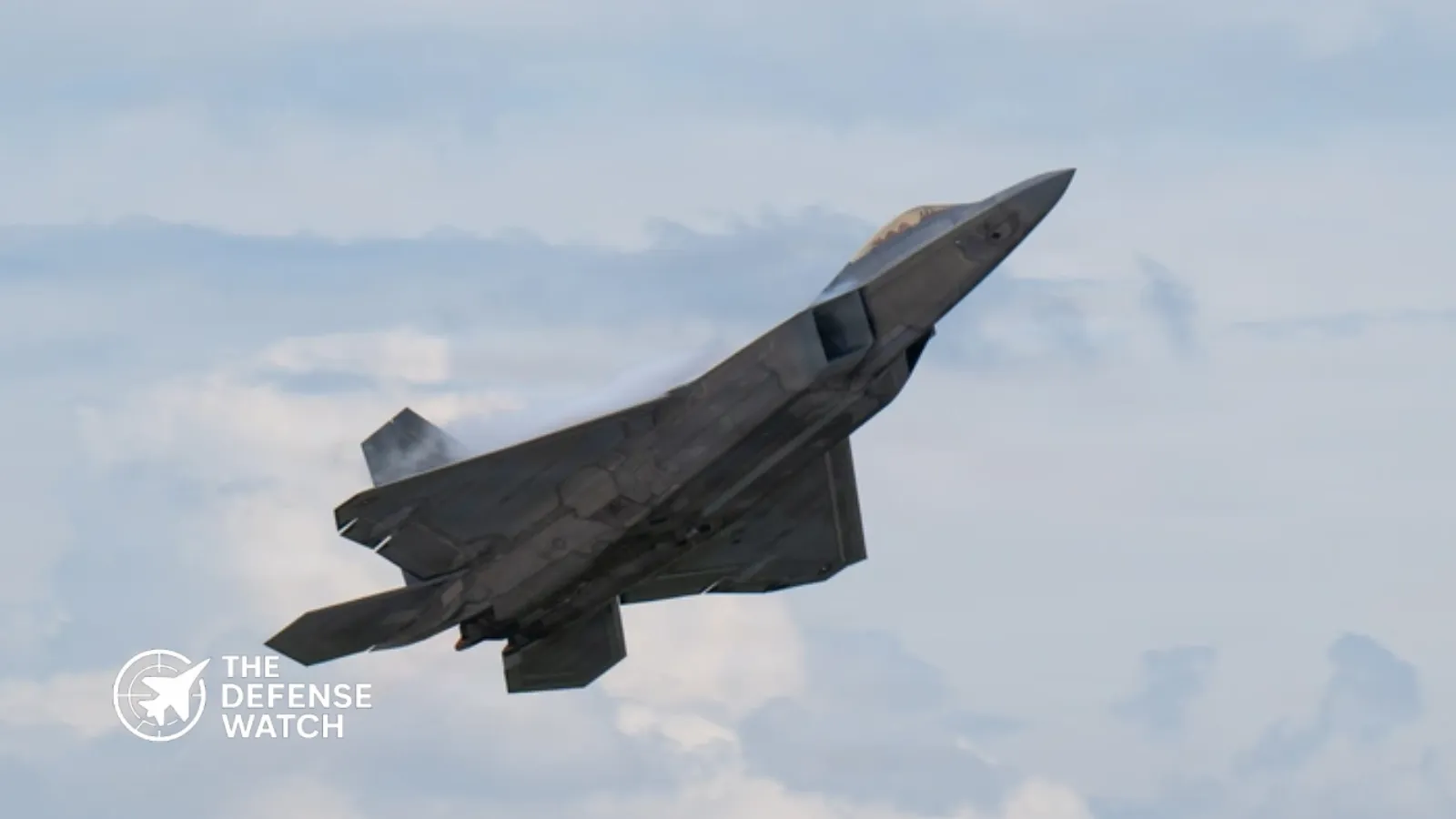
F-22 Demonstration Team performs at Air Dot Show Tour Fort Lauderdale 2026 That tension — between singular technical dominance and catastrophic operational economics — defines the modern air superiority debate. The best fighter jet in the world is not the one with the highest speed or the longest missile range. It is the one that can enter denied airspace, kill without being seen, and survive to fly again. By that standard, the answer changes depending on whether you are asking about today, 2030, or the decade after that.
Here is the 2026 definitive breakdown.
Technical Analysis: The Five Contenders That Matter
1. Lockheed Martin F-22 Raptor — The Untouchable Benchmark
The F-22 is the only operational fighter with a radar cross-section estimated at 0.0001 square meters — comparable to a metal marble. It supercruises at Mach 1.8 without afterburners, outrunning adversary missile envelopes before a targeting solution is even possible. Its AN/APG-77 AESA radar can track 28 air targets and engage six simultaneously.
Production ended in 2012 at 195 aircraft. Today, approximately 178 remain in inventory, with only 150 combat-coded. An ongoing “Raptor 2.0” upgrade program worth $11 billion addresses the platform’s two biggest weaknesses: range and sensor modernization. New stealth-compatible conformal fuel tanks add 850 nautical miles of range without degrading the aircraft’s low-observable signature — critical for Pacific scenarios involving distances that previously made the Raptor tactically marginal.
The F-22 is also conducting live testing of Collaborative Combat Aircraft (CCA) integration. An F-22 pilot has already commanded a General Atomics MQ-20 Avenger drone from the cockpit in flight testing, making it the first manned fighter to achieve this. Boeing’s F-47 NGAD — selected in March 2025 — will replace it, with first flight targeted for 2028 and initial operational capability in the early 2030s.
Verdict: Technically unmatched, strategically constrained by fleet size and cost.
2. Lockheed Martin F-35 Lightning II — The Network Warfare Machine
The F-35 is not the F-22’s equal in pure air-to-air combat. It is something different and arguably more consequential at the coalition level. Its AN/APG-81 AESA radar and the Distributed Aperture System give pilots 360-degree spherical situational awareness. Block 4 upgrades, fully rolling out by 2026, integrate AI-assisted targeting and enhanced electronic warfare.

Laughlin inspires youth and showcases heritage at Fiesta of Flight 2026 Where the F-22 is a sovereign weapon, the F-35 is a force multiplier. Over 1,000 airframes are now in active service across more than 20 air forces. Israel has conducted real-world intercepts with it. Japan has used it to respond to Chinese incursions. Australia is integrating it as the backbone of its air denial posture. At approximately $80 million per unit — down from early program highs due to economies of scale — it delivers genuine fifth-generation capability at a price allied nations can actually sustain.
Each F-22 and F-35 is also being configured to quarterback up to five autonomous drones, fundamentally changing the force-ratio math in any peer conflict.
Verdict: The world’s most operationally relevant fighter. The best for allied air forces. A flying intelligence platform that reshapes entire battle networks.
3. Chengdu J-20 Mighty Dragon — The Production Threat
The J-20 entered service in 2017 and China is building roughly 120 per year. By 2030, the People’s Liberation Army Air Force could field as many as 1,000 of them. No Western or Russian platform comes close to that production velocity.
Estimated at $100 million per aircraft, the J-20 carries a massive 24,000-pound weapons payload — much of it internal — preserving its low-observable signature. Its WS-15 turbofan, now entering wider service, resolves earlier engine reliability concerns that undermined its performance claims. The PLAAF has also developed the J-35A as a carrier-capable variant and is flight-testing the J-36, a flying-wing design whose planform suggests sixth-generation intent.
The J-20’s stealth is generally assessed as inferior to the F-22 in front-aspect RCS, but its sheer volume of production means that any attrition-based conflict calculus shifts dramatically in China’s favor. Quality vs. quantity is not a new debate in air warfare. In a Taiwan Strait scenario spanning 30 days, fleet depth matters as much as individual aircraft performance.
Verdict: A genuine peer-level stealth fighter with a production scale that forces Western planners to rethink force structure entirely.
4. Dassault Rafale — Europe’s Most Lethal Export
The Rafale does not make every top-five list, but defense professionals who have worked with it rarely argue against its inclusion. It is the only Western fighter besides the F-35 with a validated carrier-capable and land-based variant in simultaneous service. France has deployed it in combat over Libya, Mali, Syria, and Iraq.
At approximately $100–120 million per unit (F3-R variant), it is not cheap. But its SPECTRA electronic warfare suite is genuinely world-class, capable of jamming, decoying, and direction-finding simultaneously. The RBE2-AA AESA radar and MBDA METEOR beyond-visual-range missile combination gives it a kill chain that analysts consistently rate as dangerous against any fourth-generation opponent and competitive against fifth-generation ones in contested electromagnetic environments.
India, Egypt, Greece, the UAE, Indonesia, and Croatia have all signed Rafale contracts in recent years. The aircraft’s export track record — and its combat operational record — distinguish it from the Su-57, which claims similar tier status but has deployed in far more limited numbers.
Verdict: The most combat-proven and diplomatically versatile high-end fighter outside the U.S.-Chinese duopoly.
5. Sukhoi Su-57 Felon — The Sanctioned Wild Card
Russia’s only operational fifth-generation fighter is genuinely fast — approximately Mach 2 — and its 3D thrust-vectoring nozzles produce supermaneuverability that the F-35 cannot match in a turning fight. Its Sh121 radar complex is architecturally interesting, combining a main AESA array with side-facing and L-band wing-leading-edge arrays for multi-band situational awareness.
The problem is production. As of early 2026, Russia has reportedly produced roughly 30 Su-57s. Sanctions resulting from the Ukraine war and industrial strain have constrained the program severely. Stealth quality assessments — based on platform geometry and coating analysis — consistently rate the Su-57 as the least capable low-observable design among the current fifth-generation cohort. Some analysts decline to classify it as a true stealth aircraft at all.
At an estimated $35–50 million per unit, it offers significant cost efficiency. But a 30-aircraft fleet has no strategic mass.
Verdict: Technically interesting, operationally marginal. The gap between design ambition and production reality is the Su-57’s defining characteristic in 2026.
Fighter Jet Comparison: Key Metrics at a Glance
Aircraft Country Unit Cost (est.) Max Speed Combat Radius Fleet Size (2026) Generation F-22 Raptor USA $143M (flyaway) / $334M (program) Mach 2.25 ~590 nm ~178 5th F-35A Lightning II USA/Allies ~$80M Mach 1.6 ~590 nm 1,000+ 5th J-20 Mighty Dragon China ~$100M Mach 2.0 ~680 nm 200–300+ (rising) 5th Dassault Rafale F3-R France/Export ~$110M Mach 1.8 ~1,000 nm 220+ (multi-nation) 4.5th Su-57 Felon Russia ~$35–50M Mach 2.0 ~930 nm ~30 5th (contested) Boeing F-47 (NGAD) USA ~$300M Classified Classified IOC ~2032 6th The Strategic Crossover: What Gaming Theory Gets Right About Air Dominance
The best fighter jet debate mirrors a dynamic competitive gamers understand intuitively: the difference between a “carry” character and a “meta” pick. In competitive strategy titles, the carry is the highest individual-skill ceiling unit — devastating in the right hands, but fragile if misused or under-supported. The meta pick is slightly less peak-capable but wins consistently across more map states and team compositions.
The F-22 is the carry. Its individual performance ceiling is unmatched. But with only 150 combat-coded airframes and $85,000 burned every hour it flies, the USAF cannot field it at scale, cannot export it, and cannot absorb attrition. A single squadron of F-22s is a first-strike or air-supremacy asset, not a sustained campaign workhorse.
The F-35 is the meta pick. It is slightly less dominant in a one-versus-one engagement, but it operates across every mission type — strike, ISR, electronic warfare, coalition networking — and its operator base of 20 nations creates an information-sharing architecture no adversary can replicate. In a real conflict, the side with 1,000 networked F-35s coordinating targeting data in real time holds a decisive advantage over the side with 178 technically superior jets that cannot communicate at scale.
This is the logic China is also applying, in reverse. The J-20 is not the world’s best individual fighter. But 1,000 J-20s operating under a unified command, data-linked, and supported by long-range anti-access missiles changes the strategic equation entirely.
The F-47’s design concept addresses exactly this gap. Boeing’s sixth-generation platform is being engineered from the ground up for CCA integration, meaning a single F-47 pilot may direct four to five autonomous wingmen simultaneously. That shifts the force multiplication math in ways that raw aircraft count alone cannot capture.
“Air superiority is no longer about which jet wins the knife fight. It’s about which network denies the adversary the option of getting to knife-fight range at all.” — Composite analytical assessment, USAF Air Force Research Laboratory doctrinal publications
The Sixth-Generation Horizon: Why the Answer Is About to Change
Boeing won the F-47 Engineering and Manufacturing Development (EMD) contract in March 2025, beating Lockheed Martin for the NGAD program after over a decade of concept refinement. The selection was unexpected — Lockheed has dominated U.S. fighter procurement since the F-16 era. Boeing’s win reflects both the F-47’s technical maturity and a deliberate Pentagon diversification strategy.
The F-47 will cost approximately $300 million per aircraft at full production. The Air Force plans roughly 185 units — mirroring the F-22 production run, a number critics argue is already too low given China’s J-20 ramp rate. First flight is targeted for 2028. Initial operational capability sits in the early 2030s.
Until the F-47 flies in anger, the F-22 retains its title. But the $11 billion Raptor upgrade program currently underway — adding conformal fuel tanks, infrared search-and-track, and CCA command capability — is not a platform extension. It is a bridge program. The Air Force is keeping its best fighter alive long enough to hand the baton to something it believes will be generationally superior to anything currently flying.
Final Assessment
The best fighter jet in the world in 2026 is the F-22 Raptor — in raw technical terms, at the individual platform level, in any scenario that rewards stealth depth, kinematic performance, and sensor dominance over everything else.
But the most strategically significant fighter in the world is the F-35. It is reshaping alliance air power on five continents, generating shared targeting data at a scale no adversary can match, and doing so at a unit cost that allows mass deployment.
The most dangerous trend in global air power is the J-20 production curve. Not because any single J-20 outperforms a Raptor — it does not. But because 1,000 peer-level stealth fighters, produced and sustained at industrial scale, represent a force structure challenge that unit-for-unit performance comparisons do not capture.
And the most consequential development over the next decade is the F-47. If Boeing delivers on its timeline and the Air Force funds it adequately, the sixth generation will reset the competitive baseline entirely — pairing a human pilot with five autonomous wingmen, operating at ranges and stealth depths that current Chinese and Russian platforms cannot contest.
The question is not which jet is best. The question is whether the West produces enough of what it needs, fast enough, to matter when it counts.
Executive Summary:
The U.S. Navy has successfully integrated the Tactical Combat Training System Increment II (TCTS II) into Air Wing Fallon training, marking the first operational use of the system aboard F/A-18E/F Super Hornets from Carrier Air Wing 11. The capability expands live, virtual and constructive training, allowing naval aviators to rehearse complex combat scenarios against realistic threat environments while accelerating tactical analysis and mission readiness.
U.S. Navy Integrates TCTS II Into Air Wing Fallon Training
The U.S. Navy has reached a significant milestone in naval aviation training after F/A-18E/F Super Hornets assigned to Carrier Air Wing 11 conducted Air Wing Fallon sorties using the Tactical Combat Training System Increment II (TCTS II). The event, which took place during training activities at Naval Air Station Fallon, represents the first operational use of the system within the Navy’s premier carrier air wing certification program.
According to Naval Air Systems Command (NAVAIR), TCTS II was developed by the Naval Aviation Training Systems and Ranges Program Office (PMA-205) to create a more advanced Live, Virtual and Constructive (LVC) training environment. The system combines live aircraft with virtual participants and computer-generated threats, enabling crews to train in highly contested scenarios that would otherwise be difficult or costly to replicate.
Air Wing Fallon serves as the Navy’s final major training phase before carrier air wings deploy worldwide. The program focuses on refining tactics, improving interoperability and preparing strike groups for high-end combat operations.
What TCTS II Brings To Carrier Air Wing Operations
TCTS II is designed to replace older air combat training instrumentation systems while introducing enhanced security, networking and threat simulation capabilities.
Key features include:
Capability Operational Benefit Encrypted datalink architecture Protects sensitive tactical information during training Live, Virtual and Constructive integration Connects real aircraft with simulated forces and threats High-fidelity data collection Enables rapid mission debriefing and tactical analysis Multiple Independent Levels of Security architecture Supports joint and coalition training environments Open systems design Allows rapid updates as threats evolve NAVAIR officials stated that the system enables crews to rehearse distributed operations across larger battlespaces while maintaining secure communications and realistic threat representation.
Capt. Jonathan Schiffelbein, PMA-205 program manager, said the capability allows the Navy to blend live operations with simulated scenarios, increasing both realism and readiness for future deployments.
Air Wing Fallon Remains Central To Navy Combat Preparation
The introduction of TCTS II reinforces the strategic importance of Air Wing Fallon as the Navy prepares for increasingly complex operations in the Indo-Pacific, Middle East and other contested regions.
Located at the Fallon Range Training Complex in Nevada, Air Wing Fallon functions as the Navy’s primary advanced tactical training venue. Carrier air wings complete demanding scenarios involving strike warfare, air defense, electronic warfare and maritime operations before deployment.
The Navy has steadily expanded the use of LVC training over the past decade because modern combat environments involve threats that are difficult to replicate using only live aircraft. Advanced surface-to-air missile systems, integrated air defense networks, electronic warfare attacks and large-scale multi-domain operations require synthetic environments capable of generating realistic threat density.
TCTS II addresses this challenge by allowing instructors to inject virtual aircraft, missile launches and electronic threats into training scenarios while pilots remain in live aircraft.
Accelerating The Navy’s Warfighting Learning Cycle
One of the most important aspects of TCTS II is its ability to capture and process large volumes of training data in near real time.
According to PMA-205 officials, the system significantly shortens the timeline between mission execution, debriefing and tactical adjustment. Aircrews can review high-fidelity engagement data immediately after a sortie and apply lessons learned to subsequent missions.
This capability is becoming increasingly important as modern combat operations generate enormous amounts of sensor and targeting information. Military planners increasingly view data exploitation and rapid decision-making as critical advantages in future conflicts.
Dan Carrigg, deputy program manager for the PMA-205 Live Training Environment, stated that TCTS II helps tighten the feedback loop between mission execution and tactical refinement.
From an operational perspective, this means carrier air wings can complete more effective training cycles during a limited pre-deployment period while improving crew proficiency across multiple mission sets.
Supporting Joint And Multi-Domain Operations
The broader significance of TCTS II extends beyond Navy aviation.
Collins Aerospace, one of the primary industry partners supporting the program, has emphasized that the system’s architecture supports training across multiple security levels and among different military services. This allows aircrews, ships, simulators and command centers to participate in the same synthetic battlespace.
The Navy has already demonstrated this concept through Open Air Battle Shaping events and earlier LVC demonstrations involving operational aircraft, destroyers, simulators and command-and-control networks.
As the U.S. military advances Joint All-Domain Command and Control initiatives, systems such as TCTS II provide a practical mechanism for rehearsing complex operations that integrate naval, air, cyber and space capabilities.
The ability to connect live aircraft with synthetic forces also reduces the logistical burden associated with large-scale exercises while expanding the scope of scenarios available to commanders and planners.
Strategic Analysis: Why The Capability Matters
The introduction of TCTS II comes as the Pentagon places greater emphasis on preparing forces for peer-level competition.
Potential adversaries continue to field advanced integrated air defense systems, long-range missiles, electronic warfare capabilities and sophisticated sensor networks. Replicating these threats during training is essential if carrier air wings are to remain effective in contested environments.
Traditional air combat training systems often struggled to reproduce modern battlespace complexity at scale. TCTS II addresses that gap by creating a networked environment where real and synthetic participants interact simultaneously.
This approach provides several strategic advantages:
- Increased realism without requiring additional aircraft
- More frequent exposure to advanced threat scenarios
- Improved interoperability among joint and coalition forces
- Reduced training costs compared with large live-force exercises
- Faster adaptation to emerging adversary capabilities
The capability is particularly relevant in the Indo-Pacific, where future operations may involve widely dispersed naval forces operating across vast distances while facing dense missile and sensor threats.
By enabling carrier air wings to train against representative threat environments before deployment, the Navy is seeking to improve survivability, decision-making and combat effectiveness during high-end conflict scenarios.
Continued Modernization Of Naval Aviation Training
The successful integration of TCTS II into Air Wing Fallon reflects a broader effort by the Navy to modernize combat training infrastructure across the fleet.
The system has already transitioned into production and continues to expand across naval aviation units. Industry partners and Navy officials have indicated that the architecture also supports future growth, allowing the system to adapt as operational requirements evolve.
As carrier air wings prepare for deployments in increasingly contested regions, Navy leaders view realistic and data-driven training as a critical component of maintaining combat readiness.
The Air Wing Fallon milestone demonstrates that the Navy is moving beyond traditional range training and toward a more integrated synthetic battlespace capable of supporting the demands of future warfare.
Executive Summary:
Boeing has completed a major design milestone for a new external weapons carriage system intended for the U.S. Air Force’s B-1B Lancer bomber. The Load Adaptable Modular (LAM) pylon is designed to enable the aircraft to carry larger standoff weapons, including future hypersonic missiles, as the Air Force seeks to maintain long-range strike capacity during the transition to next-generation bomber fleets.
Boeing Advances B-1B Hypersonic Missile Integration Effort
Boeing has completed the preliminary design review for integrating its Load Adaptable Modular pylon onto the U.S. Air Force B-1B Lancer, marking an important step toward expanding the bomber’s ability to carry hypersonic weapons and future long-range standoff munitions.
The design review was conducted by Boeing’s bomber modernization team in Oklahoma City in coordination with Air Force Materiel Command and industry partners. According to Boeing, the upgrade is intended to increase mission flexibility by restoring and modernizing external carriage options that have remained largely unused for decades.
The development comes as the U.S. Air Force continues investing in legacy bomber modernization programs while fielding the next-generation B-21 Raider.
What Is The Load Adaptable Modular Pylon?
The Load Adaptable Modular, or LAM, pylon is an external weapons carriage system designed to mount beneath the B-1B using six existing hardpoints originally built for the AGM-86 Air-Launched Cruise Missile program.
Those external attachment points became inactive after the B-1’s nuclear mission was eliminated under Strategic Arms Reduction Treaty requirements. Boeing’s new approach repurposes that dormant infrastructure to support modern conventional strike missions.
According to company officials, the system was initially developed through Boeing-funded independent research and development efforts before transitioning into a more formal modernization program.
Key Characteristics Of The LAM System
Capability Details Mounting Points Six existing B-1B external hardpoints Primary Purpose External carriage of large weapons Target Payloads Hypersonic missiles, standoff weapons, cruise missiles Development Status Preliminary Design Review completed Next Phase Critical Design Review, aircraft modification and testing The approach allows the Air Force to add new weapon capacity without requiring a major structural redesign of the aircraft.
Why The Upgrade Matters
The B-1B remains one of the most capable conventional bombers in the U.S. inventory due to its combination of speed, range, and payload capacity.
While the aircraft’s internal weapons bays can already carry large quantities of precision-guided munitions, emerging hypersonic systems and next-generation standoff weapons are becoming larger and heavier. Some of these weapons cannot be carried efficiently within existing internal bays.
The LAM pylon directly addresses that limitation.
Operationally, the upgrade transforms the B-1B into a larger missile carrier capable of launching long-range weapons from outside heavily defended airspace. That approach aligns with evolving U.S. military doctrine emphasizing stand-off attacks against advanced integrated air defense systems.
Potential Hypersonic Missile Applications
Although Boeing has not publicly identified every weapon planned for integration, defense analysts and Air Force reporting have repeatedly linked the LAM concept to future hypersonic strike systems.
Potential candidates include:
- AGM-183 Air-Launched Rapid Response Weapon (ARRW)
- Hypersonic Attack Cruise Missile (HACM)
- Extended-range AGM-158 Joint Air-to-Surface Standoff Missile variants
- AGM-158C Long Range Anti-Ship Missile (LRASM)
- Future classified long-range strike weapons
Recent Air Force imagery has already shown B-1B aircraft operating with ARRW-related test configurations, highlighting the platform’s growing role in hypersonic weapons development. The bomber has increasingly become a testbed for advanced strike concepts because of its payload capacity and high-speed performance envelope.
Strategic Implications For The U.S. Bomber Force
The timing of the LAM program is significant.
The Air Force is currently managing one of the most complex bomber transitions in its history. The B-21 Raider is entering service while the B-52J modernization effort continues and the B-2 Spirit remains operational.
Despite those modernization programs, the Air Force still relies heavily on the B-1B fleet for conventional strike missions.
Rather than waiting for complete fleet replacement, the Pentagon appears focused on extracting additional combat value from existing platforms. The LAM program fits that strategy by delivering new capability through a relatively low-risk modification.
This approach offers several advantages:
- Faster fielding timelines compared with new aircraft procurement
- Lower development costs
- Increased weapon capacity
- Greater flexibility for Indo-Pacific operations
- Expanded options for maritime strike missions
For combatant commanders, additional external carriage capability means more weapons can be launched from a single aircraft during the opening stages of a conflict.
Indo-Pacific Relevance
The modernization effort carries particular importance for potential operations in the Indo-Pacific theater.
Long distances, limited forward basing options, and increasingly sophisticated Chinese air defense networks are forcing U.S. planners to emphasize long-range strike capabilities.
A B-1B carrying hypersonic missiles or long-range standoff weapons could launch attacks from significantly greater distances than aircraft relying on shorter-range munitions.
The concept also complicates adversary planning.
Instead of defending against a limited number of launch platforms, potential opponents must account for a larger force of aircraft capable of carrying advanced strike weapons across broad operational areas.
This is especially relevant as China continues expanding its anti-access and area-denial capabilities, including long-range missile systems designed to threaten U.S. bases and naval forces across the Western Pacific.
Technical And Operational Challenges Ahead
While the preliminary design review represents an important milestone, substantial work remains before the capability enters operational service.
The program must still complete:
- Critical Design Review
- Structural integration activities
- Ground testing
- Flight testing
- Weapons certification
- Operational evaluation
External carriage also introduces aerodynamic and performance considerations.
Large hypersonic weapons can affect drag, fuel efficiency, aircraft handling, and overall mission range. Engineers must ensure that new payloads do not compromise the aircraft’s operational effectiveness.
The B-1B’s variable-sweep wing design and high-speed flight profile create additional engineering challenges when integrating large external stores.
A Bridge To The Future Bomber Fleet
The broader significance of the LAM initiative extends beyond the B-1B itself.
The program demonstrates how the Air Force is pursuing incremental modernization to maintain credible long-range strike capability while next-generation systems mature.
Rather than viewing legacy bombers as temporary stopgaps, the Pentagon is increasingly treating them as adaptable launch platforms capable of carrying advanced weapons developed decades after the aircraft first entered service.
For the B-1B, the new pylon system could substantially extend operational relevance well into the next phase of U.S. bomber modernization.
As hypersonic weapons, long-range cruise missiles, and advanced maritime strike systems become central components of American deterrence strategy, the ability to rapidly field additional launch capacity may prove as important as developing the weapons themselves. The LAM pylon program positions the B-1B to play that role.