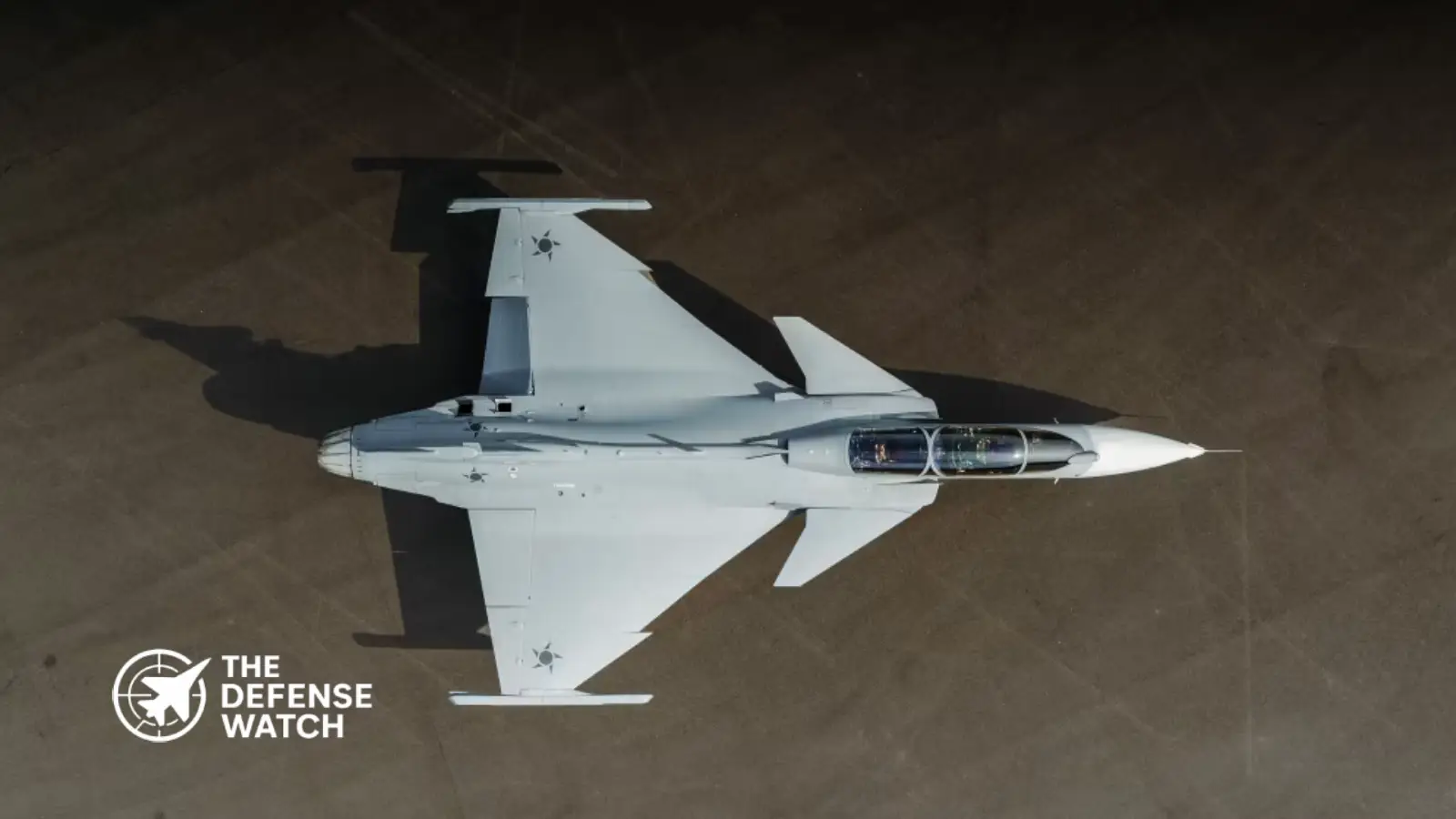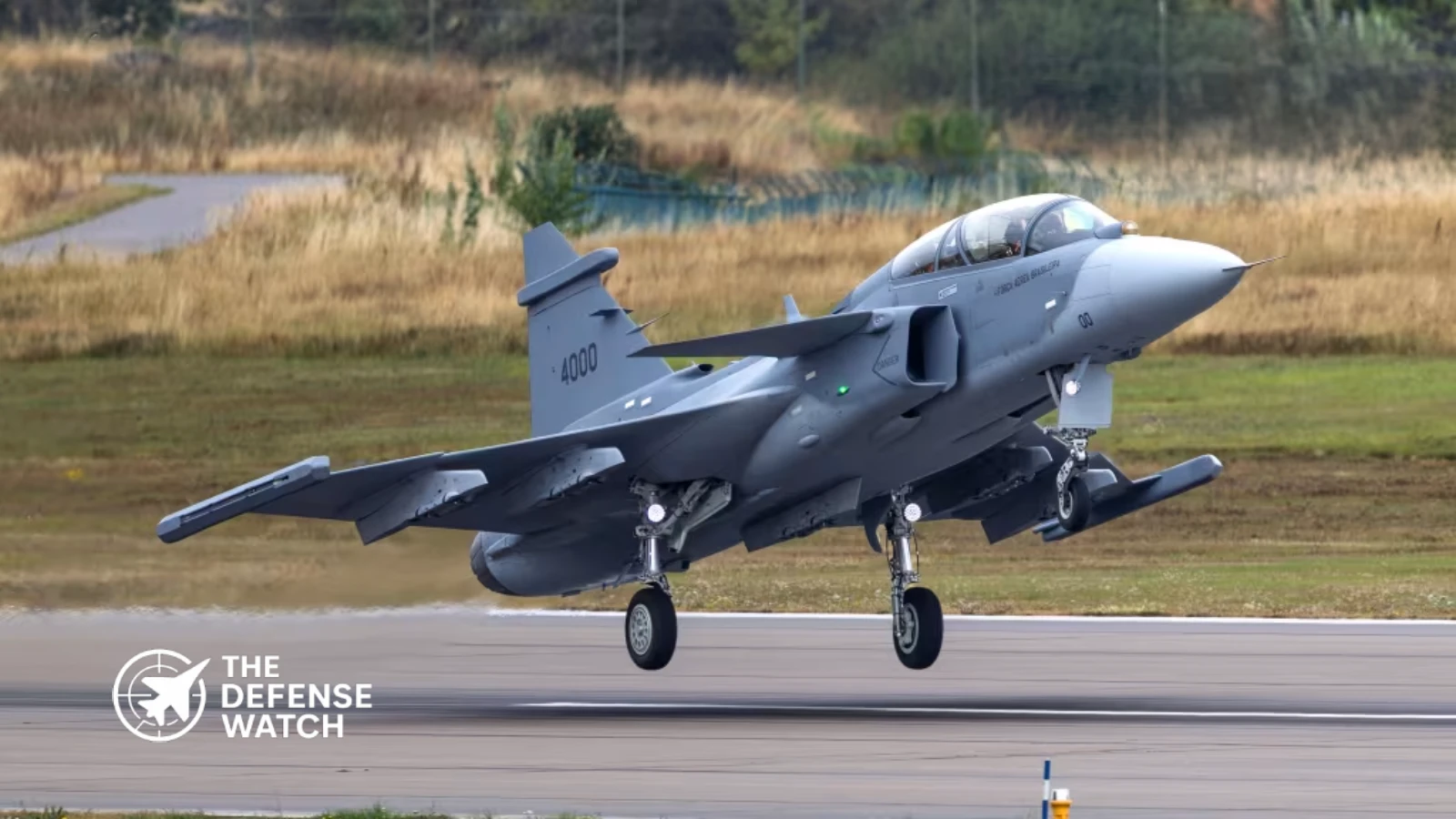
Gripen F Completes First Flight In Sweden
The Gripen F first flight has moved Saab and Brazil’s two-seat fighter program into its airborne test phase, with the aircraft completing a 40-minute inaugural sortie from Saab’s airfield in Linköping, Sweden, on August 28. Saab said the flight verified the functionality of the aircraft’s core systems and its initial flight performance.
Takeaways
Saab’s Gripen F has completed its first flight, moving Brazil’s two-seat fighter into the airborne phase of its test and acceptance program.
The flight was conducted by Saab chief test pilot Jakob Högberg and Brazilian Air Force test pilot Lieutenant Colonel Aviator Abdon de Rezende Vasconcelos. The participation of both Swedish and Brazilian pilots reflects the joint character of the aircraft’s development and its eventual operational role with the Brazilian Air Force.
From Ground Testing To The Flight Test Campaign
The first flight is an important transition in the Gripen F program because it allows Saab and Brazil to begin validating the aircraft under actual flight conditions.
Saab said the next stage will involve progressive expansion of the aircraft’s flight envelope. Testing will gradually address its limits in speed, altitude, G-load and angle of attack rather than attempting to clear the complete performance envelope at once.
The test campaign will also examine capabilities specific to the two-seat configuration. This includes tactical functions and systems associated with the rear cockpit, which is a key distinction between Gripen F and the single-seat Gripen E.
Once the planned flight activities and aircraft acceptance procedures are completed, Saab says the aircraft will be prepared for delivery to the Brazilian Air Force.
Gripen F Program At A Glance
| Item | Detail |
|---|---|
| Aircraft | Saab Gripen F |
| Configuration | Two-seat fighter |
| First flight | August 28, 2026 |
| Flight location | Linköping, Sweden |
| First flight duration | 40 minutes |
| Launch customer | Brazilian Air Force |
| Original Brazilian order | 36 aircraft |
| Gripen E | 28 aircraft |
| Gripen F | 8 aircraft |
| Development | Saab and Brazilian industry |
| Current phase | Airborne testing |
The underlying Brazilian program was established through a 2014 agreement covering development and production of 36 Gripen E/F aircraft. Saab’s current program information identifies 28 Gripen E aircraft and eight Gripen F aircraft in the original Brazilian order.
Why The Two-Seat Configuration Matters
The Gripen F is not simply a trainer version of the Gripen E. Saab describes the aircraft as a combat-capable two-seat platform designed to combine operational missions with pilot conversion and training requirements.
The second cockpit provides another crew position with its own displays and controls. Saab previously stated that the aircraft can operate in a training configuration, where one crew member receives instruction, as well as an operational configuration in which the two crew members can divide workload using different display settings.
That distinction is important for modern fighter training. A two-seat aircraft allows an instructor to accompany a pilot during more representative mission profiles while retaining the basic characteristics and systems architecture of an operational fighter.
The arrangement can also support missions in which workload management is important. Saab says the Gripen F is intended to improve operational performance through the ability of two crew members to share tasks and use different display configurations.
Brazil’s Role Goes Beyond Aircraft Procurement
The Gripen F represents one of the more significant industrial aspects of the Brazilian Gripen program. Brazil was not simply an end user of a completed foreign aircraft. It became directly involved in the development of the two-seat variant through technology transfer and industrial cooperation.
Saab says more than 350 Brazilian engineers, technicians, operators and pilots have participated in training connected with the Gripen program. The training covered areas including development, flight testing, production and maintenance.
Brazilian participation was particularly relevant to Gripen F. Saab’s technology-transfer documentation says Brazilian engineers contributed to modifications required to add the second crew position, including work involving seats, displays, controls, electrical and environmental systems, oxygen and anti-G systems, and structural and fuselage engineering.
This makes the first flight significant beyond the aircraft itself. It demonstrates the transition of a jointly developed configuration from engineering and production work into formal flight testing.
A Long-Running Brazil-Sweden Fighter Partnership
The Gripen partnership dates back to Brazil’s selection of the fighter and the 2014 agreement for 36 aircraft. Saab and Brazilian companies subsequently established a broad industrial framework involving development, production, systems integration, flight testing and maintenance.
Brazilian companies including Embraer, AEL Sistemas, Akaer and Atech have participated in the wider Gripen program. Saab has also established the Gripen Design and Development Network in Brazil, connecting Brazilian engineering activity with Saab’s development organization in Sweden.
The partnership has therefore created a domestic Brazilian capability base around the fighter rather than limiting local participation to aircraft operation and maintenance.
For Brazil, that industrial dimension is strategically relevant because the value of a fighter program extends beyond the number of aircraft delivered. Engineering expertise, systems integration experience and maintenance knowledge can influence a country’s ability to sustain and modify a combat aircraft throughout its service life.
What Happens Next For Gripen F
The immediate priority is flight-test expansion. Saab will progressively evaluate the aircraft across its planned flight envelope while simultaneously testing functions associated with the second cockpit and the aircraft’s tactical employment.
The program must then complete the relevant acceptance procedures before the aircraft can be prepared for delivery to Brazil.
The first flight therefore marks the beginning of another phase rather than the completion of the Gripen F development effort. Flight testing will provide the data needed to validate the aircraft’s systems and performance under increasingly demanding conditions.
For the Brazilian Air Force, the eventual arrival of Gripen F will add a two-seat variant to a fighter fleet built around the Gripen E family. For Saab and its Brazilian partners, the aircraft also provides a tangible result of years of joint engineering, industrial participation and technology transfer.
The significance of the August 28 flight is consequently broader than a conventional first-flight milestone. It marks the point at which the jointly developed Gripen F moves from development and production into systematic airborne evaluation, bringing Brazil’s two-seat fighter closer to operational service.
See video from the first flight here: https://saab.screen9.tv/
Executive Summary:
Saab has officially rolled out the first Gripen F twin-seat fighter aircraft for the Brazilian Air Force during a ceremony at the company’s facility in Linköping, Sweden, on June 2, 2026. Developed jointly by Saab and Brazilian industry, the aircraft combines advanced pilot training capabilities with full operational combat functionality, representing a significant milestone in Brazil’s Gripen modernization program.
Saab Rolls Out First Gripen F Fighter For Brazilian Air Force
Saab has unveiled the first Gripen F fighter aircraft, the two-seat variant of its Gripen E multirole fighter family, during a ceremony held at the company’s production facilities in Linköping, Sweden.
The rollout marks a major milestone in the long-running defense partnership between Sweden and Brazil, which has seen extensive industrial cooperation, technology transfer, and joint development activities since the signing of the original Gripen acquisition agreement in 2014.
According to Saab, the Gripen F has been specifically designed to meet modern air force requirements by combining advanced pilot conversion training with full combat capability on a single platform.
The aircraft will now enter a dedicated flight test campaign at Saab’s Flight Test Centre before eventual delivery to the Brazilian Air Force.
Brazil’s Role In Developing The Gripen F
Unlike many export fighter programs where customers simply acquire finished aircraft, Brazil played a direct role in the development of the Gripen F.
Under the broader Gripen partnership agreement, Brazilian aerospace engineers and technicians participated in aircraft development activities through Saab’s technology transfer initiative. Hundreds of Brazilian specialists have received advanced training in fighter aircraft design, systems integration, software development, and aerospace engineering.
Saab’s Aeronautics business area head, Lars Tossman, described the aircraft as a product of long-term industrial collaboration between Saab, Brazilian industry, and the Brazilian Air Force.
The program has become one of the most significant aerospace technology transfer efforts undertaken by Brazil in recent decades, helping strengthen domestic expertise in advanced combat aircraft development.
What Makes The Gripen F Different?
The Gripen F shares the same core architecture, avionics suite, sensors, electronic warfare systems, and mission capabilities found on the single-seat Gripen E.
However, its most notable feature is the addition of a fully operational second cockpit.
Rather than serving solely as a training seat, the rear cockpit allows an instructor, mission commander, or weapons systems operator to actively participate in missions.
Key Operational Benefits
- Accelerated pilot conversion training
- Real-world mission rehearsal in operational aircraft
- Enhanced mission command and coordination
- Reduced pilot workload during complex operations
- Improved effectiveness in contested environments
- Greater flexibility for advanced tactical instruction
This approach allows pilots transitioning to the Gripen fleet to gain combat-relevant experience more rapidly than traditional training methods that rely heavily on dedicated trainer aircraft.
Gripen F Technical Overview
Specification Gripen F Aircraft Type Twin-seat multirole fighter Manufacturer Saab Primary Operator Brazilian Air Force Configuration Two-seat Combat Capability Full operational capability Radar AESA radar Electronic Warfare Integrated EW suite Data Links Advanced network-centric communications Mission Roles Air superiority, strike, ISR, training Development Partner Brazil Like the Gripen E, the Gripen F benefits from an open-architecture design that allows future software and sensor upgrades throughout its operational life cycle.
The aircraft was developed for modern network-centric warfare environments where data fusion, electronic warfare resilience, and rapid information sharing are increasingly critical.
Progress Of Brazil’s Gripen Acquisition Program
The rollout comes as Brazil continues to receive aircraft under its 2014 agreement with Saab.
The original contract covers:
Program Element Quantity Gripen E Fighters 28 Gripen F Fighters 8 Total Aircraft 36 Deliveries began in 2020.
According to Saab, 11 aircraft have already been delivered to Brazil, where they are gradually replacing older combat aircraft and expanding the Brazilian Air Force’s operational capabilities.
The Gripen program represents one of the most important modernization initiatives undertaken by the Brazilian military and forms a central component of the country’s long-term airpower strategy.
Why The Gripen F Matters Beyond Brazil
The rollout of the Gripen F carries significance beyond the Brazilian Air Force.
Many modern fighter fleets face challenges associated with pilot shortages, increasingly complex mission systems, and growing demands for advanced tactical training.
The Gripen F addresses these issues by combining operational and instructional functions within a single aircraft platform.
From a strategic perspective, the aircraft offers several advantages:
Enhanced Force Generation
Air forces can shorten pilot qualification timelines while maintaining operational readiness.
Improved Mission Effectiveness
A second crew member can assist with mission management, sensor operation, electronic warfare coordination, and tactical decision-making.
Lower Training Costs
Operators may reduce dependence on separate advanced jet trainer fleets by conducting portions of pilot conversion training in frontline aircraft.
Export Potential
The aircraft’s dual-role design broadens its appeal among nations seeking a cost-effective solution for both training and combat operations.
This export potential is already evident. Saab has confirmed additional Gripen F orders from Thailand and Colombia, indicating growing international interest in the two-seat variant.
Strategic Implications For The Global Fighter Market
The rollout highlights Saab’s broader strategy of positioning the Gripen family as a flexible and affordable alternative within the global fighter market.
While larger competitors continue to focus heavily on fifth-generation platforms, Saab has emphasized adaptability, lower operating costs, advanced electronic warfare capabilities, and rapid upgrade potential.
For emerging and mid-sized air forces, the Gripen F may offer a particularly attractive balance between operational capability and training efficiency.
The aircraft also demonstrates how defense industrial partnerships can extend beyond procurement into collaborative development and technology transfer, a model increasingly sought by nations seeking to strengthen domestic defense industries alongside military modernization.
As the aircraft enters flight testing, the Gripen F moves one step closer to operational service, adding a new capability to Brazil’s growing Gripen fleet while reinforcing Saab’s position in the competitive global fighter aircraft market.