An unidentified drone briefly crossed into Latvian airspace near the country’s eastern border on November 27, prompting NATO fighter aircraft to respond and Latvian forces to deploy an interceptor drone. Ground-based air defense units were also placed on readiness as authorities monitored the situation.
The incident occurred overnight on November 26-27 in eastern Latvia, near the municipalities of Ludza and Balvi. Latvia’s National Armed Forces confirmed that the unmanned aircraft was detected close to the state border before briefly entering Latvian territory.
The military did not identify the drone’s country of origin, operator, model or intended destination. It also did not report that the aircraft had been intercepted or destroyed.
How the Latvian response unfolded
According to the Latvian Ministry of Defence, the first airspace threat warning was issued in Ludza municipality at 2:30 a.m. local time.
Authorities activated an orange-level warning after detecting the unmanned aircraft inside Latvian territory. The warning was lifted at 2:55 a.m. as the immediate threat assessment changed.
A separate possible air threat warning was issued for Balvi municipality, further north. Both warnings were subsequently cancelled.
Latvia’s response involved three elements:
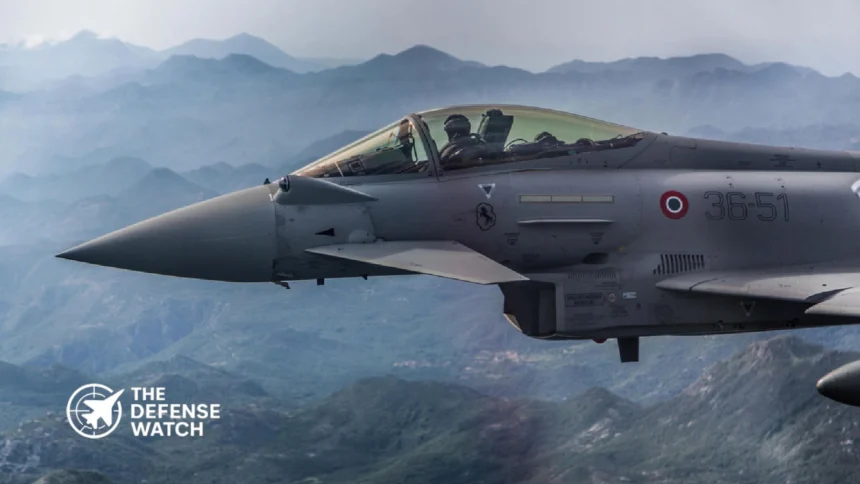
- NATO fighter aircraft: Fighters assigned to the Baltic air-policing mission were activated to respond to the airspace threat.
- National interceptor drone: Latvian forces launched an unmanned interceptor aircraft, which returned to its launch site after completing its flight.
- Ground-based air defense: Latvian air defense units remained ready to respond if the threat escalated.
The Latvian military did not disclose whether the interceptor established contact with the unidentified drone. It also did not specify the interceptor’s manufacturer or designation.
Why Latvia is combining fighter aircraft with interceptor drones
The incident illustrates the different roles of manned fighter aircraft and smaller unmanned interceptors in protecting national airspace.
NATO fighter aircraft provide a rapid-response capability against unidentified aircraft approaching or entering allied airspace. Their crews can investigate potential violations, establish visual identification and, when authorized, engage hostile targets.
However, using advanced fighter aircraft against relatively inexpensive drones creates an economic and operational challenge. Aircraft operating from distant airbases also have to cover large areas and remain available for other air-defense missions.
Interceptor drones offer another response option. They can be deployed locally against identified unmanned threats, potentially reducing the need to use expensive fighter aircraft or surface-to-air missiles for every encounter.
Their effectiveness nevertheless depends on detection, target identification, communications, command authorization and the ability to reach the incoming aircraft. The November 27 incident does not establish whether Latvia’s interceptor engaged the target or demonstrated a successful interception.
NATO’s air defense posture in the Baltic region
Latvia, Estonia and Lithuania rely on allied aircraft to support the protection of their airspace.
NATO established its Baltic Air Policing mission in 2004, following the three countries’ accession to the alliance. Participating NATO members rotate fighter detachments and crews to support the mission.
There has been an important change in the arrangement during 2026. NATO says the Baltic Air Policing framework has transitioned toward a more comprehensive air defense posture, while the rotational deployment of allied fighter aircraft continues. Additional allied assets can also reinforce the region.
The November 27 response therefore involved an existing multinational air-defense framework rather than a newly created emergency deployment.
The incident also demonstrates why air surveillance and counter-drone systems have become increasingly important along NATO’s eastern flank. A small unmanned aircraft can cross a national border without presenting the same radar and identification profile as a conventional military aircraft.
Latvia is expanding its counter-drone capabilities
Latvia has been developing a layered air defense system that combines surveillance, electronic warfare, conventional air defense and counter-unmanned aircraft technologies.
In December 2025, the Latvian Ministry of Defence outlined plans to strengthen its eastern-border drone detection network. The program included acoustic detection, additional surveillance radars and domestically developed counter-drone technologies.
The ministry also reported that interceptor-drone testing had taken place at the Selonia military training area, with domestically manufactured systems intended for deployment in border regions.
Latvia has subsequently continued to expand its air defense development program. Its Ministry of Defence identifies the IRIS-T medium-range air defense system and RBS 70 NG short-range air defense systems among the capabilities being developed or procured.
These systems address different parts of the air threat spectrum. Interceptor drones are intended to provide another option against unmanned aircraft, while conventional air defense systems provide broader protection against aircraft and other aerial threats.
The country is also participating in NATO’s Layered Counter UAS Initiative, which includes testing sensors and effectors to improve the detection and defeat of unmanned aircraft. An October 2026 Latvian government announcement identified counter-drone technology trials as one of three main areas of NATO’s defense technology experimentation in the country.
A pattern of drone incidents near NATO territory
The latest incursion follows several drone-related incidents involving Latvia and neighboring countries during 2026.
On November 11, Latvia’s National Armed Forces reported that three unmanned aircraft entered or approached Latvian airspace during overnight activity. Two briefly crossed the eastern border, while another entered from Lithuania and continued north toward Estonia.
Latvian forces activated interceptor drones, air defense units and NATO fighter aircraft in response.
Earlier, on August 14, NATO fighter aircraft shot down an unmanned aircraft over Latvia’s Balvi municipality. Latvian authorities subsequently identified it as a Ukrainian drone that had entered from Belarus, most likely under the influence of Russian electronic warfare, according to the Latvian military.
These incidents show that drone incursions do not necessarily establish deliberate attacks against NATO territory. Aircraft involved in the Ukraine war can cross borders because of navigation errors, electronic warfare interference, operational failures or other circumstances.
The November 27 aircraft has not been attributed to any country, and there is currently insufficient public evidence to determine why it entered Latvian airspace.
The incident occurred as Russia’s Leningrad region was responding to a Ukrainian drone attack. Regional governor Alexander Drozdenko said more than 40 drones had been shot down. The timing provides relevant context, but it does not establish a connection between that attack and the aircraft detected over Latvia.
What the incident reveals about counter-drone defense
For NATO’s eastern members, the challenge is no longer limited to detecting conventional military aircraft or responding to large-scale missile threats.
Small drones introduce a different set of operational problems. They can be difficult to identify, may operate at low altitudes and can create uncertainty over whether an airspace violation is accidental or deliberate.
A layered response requires several capabilities to work together:
- Detection: Surveillance radars and other sensors must identify suspicious aerial activity.
- Identification: Military authorities need to establish the aircraft’s origin, behavior and potential threat.
- Command and control: National forces and NATO units must coordinate their response.
- Interception: Commanders must select an appropriate response, ranging from monitoring to fighter interception or ground-based counter-drone engagement.
Latvia’s November 27 response brought allied fighter aircraft, a national interceptor drone and ground-based air defense readiness into the same incident.
However, the available information does not establish whether the unidentified aircraft was tracked after leaving Latvian airspace, whether it was damaged or whether any interception attempt occurred.
The immediate air threat warnings were lifted, and Latvia confirmed that its interceptor drone returned to its launch site. The aircraft’s identity and the circumstances of the incursion remain unresolved.
Enjoying our coverage?
Make The Defense Watch a preferred source on Google to see more of our geopolitical and defense insights when relevant to you.