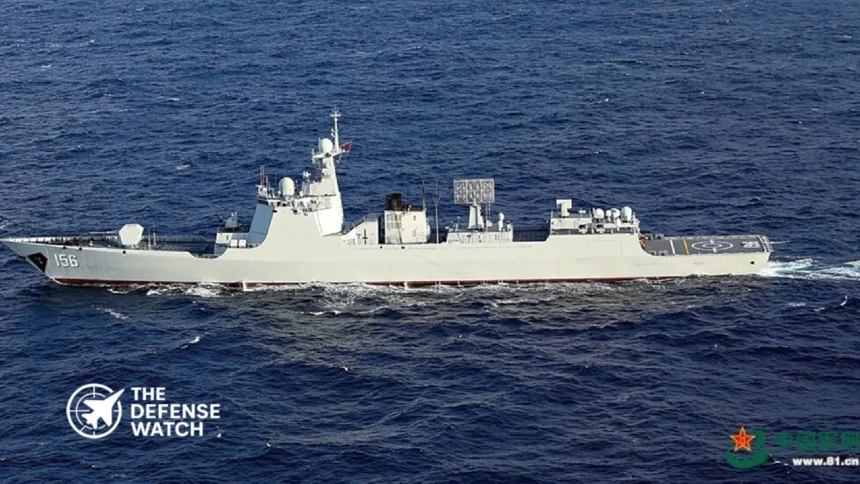
China’s People’s Liberation Army (PLA) is expanding access to its maritime training areas to bring Navy, Air Force and Rocket Force personnel into more closely coordinated exercises. The initiative is intended to improve how the three services plan and conduct operations involving naval air defense, aerial attacks and maritime targets.
The effort was described in a November 23 report by the state-run Global Times, citing an account published by the PLA Daily. One example involved the PLA Navy guided-missile destroyer Zibo, where Air Force personnel participated in an exercise review and helped naval crews examine their defensive arrangements from the perspective of an attacking aircraft.
The initiative provides a practical example of China’s continuing effort to move beyond separate service-based training toward operations in which different military branches can coordinate their capabilities through shared planning, communications and command arrangements.
A naval exercise exposes coordination gaps
During a maritime exercise aboard the Zibo, naval personnel reportedly identified weaknesses in detecting very-low-altitude targets under certain sea conditions and electronic jamming scenarios.
These conditions are important for naval air defense. Low-flying aircraft and missiles can present difficult detection problems because the curvature of the Earth, sea clutter and radar interference can reduce the time available to identify and respond to an incoming threat.
Air Force officer Wei Yufeng participated in the exercise as a cross-service staff officer. Drawing on his experience from the perspective of an aerial attacker, he advised the destroyer’s personnel on air-defense positioning and the timing of fire coordination.
His involvement allowed the naval crew to assess its defensive procedures against a different service’s operational perspective, rather than relying exclusively on internal naval evaluations.
The exercise also reflects a broader training requirement: a warship’s air-defense effectiveness depends not only on its own radar and weapons but also on how effectively it receives, interprets and acts on information from other military units.
Why China is opening naval training areas to other services
According to the PLA Daily account, maritime training areas that were previously used primarily by the Navy are increasingly being made available to Air Force aircraft and Rocket Force units.
This approach gives participating services opportunities to train in a common operational environment. It also helps address problems that may not become apparent during exercises conducted independently by each service.
Previous joint exercises reportedly exposed difficulties in coordinating air strikes with naval air-defense operations. They also identified problems with directing timely attacks against maneuvering maritime targets.
These are important operational challenges because the services have different responsibilities and planning requirements.
- PLA Navy: Provides maritime surveillance, surface warfare, naval air defense and fleet operations.
- PLA Air Force: Contributes aerial surveillance, air combat and strike capabilities.
- PLA Rocket Force: Operates China’s land-based conventional and nuclear missile forces, although the Global Times report does not identify specific Rocket Force weapons or units involved in the maritime exercises.
The objective is to make these capabilities work together within a coordinated operational framework.
The training arrangement also involves a formal process for sharing resources. According to the report, the participating naval task force incorporates its annual training plan into a wider joint-training program.
It submits information about available maritime training areas, scheduling, electromagnetic environments, simulated opposing forces and support resources to higher-level authorities. Other services can then request access to particular training opportunities, with a dedicated team responsible for coordinating their participation.
This arrangement is significant because joint training requires more than simply bringing personnel from different services into the same exercise. It requires common planning, compatible procedures and a clear understanding of each participant’s operational responsibilities.
Joint planning is as important as equipment
The training initiative addresses a problem that cannot be solved simply by adding more advanced ships, aircraft or missiles.
Modern military operations require information to move between sensors, command centers and weapon systems quickly enough for different forces to act on a shared understanding of the battlefield.
For example, an aircraft operating over a maritime area may identify a threat that affects a naval formation. The Navy must be able to receive and assess that information, coordinate its defensive response and avoid interfering with friendly aircraft or other units operating in the same area.
Similarly, a coordinated maritime strike could require naval forces, aircraft and land-based missile units to operate according to a common plan. The effectiveness of such an operation depends on communication, target identification, command authority and timing.
The PLA’s training program appears intended to improve these practical relationships by exposing personnel to the operational requirements and limitations of other services.
The Global Times report also quoted military commentator Song Zhongping, who said that improved information systems, data links and command structures were essential for bringing different services together during operations.
However, the report did not identify a new command-and-control system, disclose technical improvements to military data links or provide measured results from the exercises.
China’s wider military modernization program
The emphasis on joint operations is part of a longer restructuring effort within the PLA.
The Congressional Research Service (CRS), in its July 22, 2026 update to China Primer: The People’s Liberation Army, describes joint operations as one of the central objectives of China’s military reforms initiated under President Xi Jinping in 2015.
The reforms sought to reorganize the military so its services could operate more effectively together rather than function primarily through separate service structures. CRS also describes the effort as a continuing process rather than a completed transformation.
China’s modernization targets include accelerating military informatization and intelligentization by 2027, achieving basic modernization by 2035 and building a world-class military by 2049.
These objectives require more than expanding individual service capabilities. They also require the PLA to improve the systems that connect its forces, including communications, intelligence sharing, logistics and operational command.
The PLA’s 2024 organizational restructuring provides another example of this approach. China dissolved its Strategic Support Force and established the Aerospace Force, Cyberspace Force and Information Support Force under the Central Military Commission.
The Information Support Force has an important role in providing strategic information and communications support, while the Aerospace and Cyberspace forces contribute capabilities in their respective domains. These changes form part of the PLA’s wider effort to support joint operations through integrated information capabilities.
The latest maritime training initiative complements these structural changes by focusing on how personnel from different services work together during practical exercises.
What the exercise reveals, and what remains unclear
The reported training offers useful evidence of how the PLA is trying to identify and address coordination problems.
There are three particularly relevant observations.
First, the involvement of Air Force personnel in naval exercise planning gives ship crews an opportunity to assess their defensive arrangements against the tactics of a potential aerial opponent.
Second, opening maritime training areas to other services creates opportunities to practice coordination under shared environmental conditions, including electronic interference and complex sea conditions.
Third, the reported process for allocating training areas and resources suggests that the initiative is not limited to informal exchanges between individual officers. It involves a more organized mechanism for coordinating participation across services.
There are nevertheless important limitations to what can be concluded.
The Global Times report does not disclose the number of exercises conducted, the frequency of Rocket Force participation, the aircraft or missile systems involved, or the extent to which the participating units used shared operational networks.
It also does not provide independent evaluations showing whether the training has improved reaction times, target identification or overall combat effectiveness.
The Rocket Force’s inclusion in the broader initiative is particularly important, but the available account does not establish that its units participated in the specific destroyer exercise involving the Zibo.
These distinctions matter because participation in joint training does not automatically demonstrate the ability to conduct complex, integrated operations under combat conditions.
The July 2026 CRS assessment similarly cautions that the extent to which the PLA can effectively employ its capabilities in a coordinated manner remains unclear. It also identifies organizational and command-related challenges that could affect operational effectiveness.
Implications for regional military planning
For military planners in the Indo-Pacific, the PLA’s emphasis on cross-service training deserves attention because coordinated operations can make China’s existing military capabilities more effective.
In a potential regional conflict, naval forces could operate alongside land-based missile units and aircraft to support maritime surveillance, air defense and strike missions. Better coordination could help the PLA use these forces within a more coherent operational plan.
This is relevant to Taiwan-related contingencies and China’s broader maritime security interests. However, the reported exercise should not be interpreted as evidence that the PLA has achieved a fully integrated capability for a particular conflict scenario.
The United States and its regional partners also place considerable emphasis on joint operations, interoperability and integrated command arrangements. The challenge for the PLA is not simply to bring its services together during exercises, but to sustain coordination when communications are disrupted, information is incomplete and units face rapidly changing operational conditions.
The reported work aboard the Zibo addresses one part of that challenge: ensuring that naval personnel understand how other services operate and how their own defensive arrangements appear from an opposing perspective.
Whether these training changes translate into consistently effective joint combat operations remains an open question. The available reporting demonstrates an effort to improve coordination, not proof that all the underlying operational challenges have been resolved.
Enjoying our coverage?
Make The Defense Watch a preferred source on Google to see more of our geopolitical and defense insights when relevant to you.