US Army vs Marines: What Readers Are Really Asking
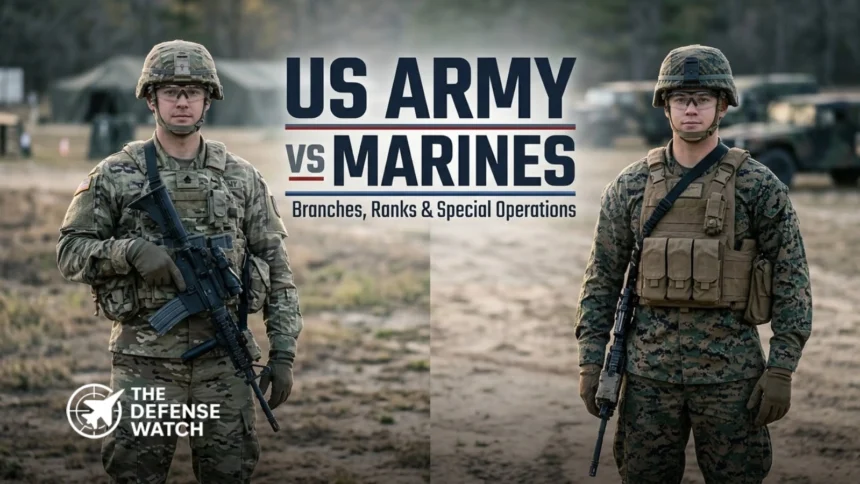
The U.S. Army and the U.S. Marine Corps both fight on land, but they are separate services with different parent departments, missions, and sizes. The Army is the nation’s largest service and its primary land-warfare force. The Marine Corps is a much smaller expeditionary force that sits inside the Department of the Navy and is built to operate from naval shipping.
Congress authorized 454,000 active-duty soldiers and 172,300 active-duty Marines for fiscal year (FY) 2026, according to the Congressional Research Service (CRS). That 2.6-to-1 gap is only the start of the comparison. This guide also covers the questions that tend to travel with it: how the Army differs from the Navy, how the Army Reserve differs from the National Guard, how Rangers differ from Green Berets, how Delta Force differs from Navy SEAL Team Six, and why an Army corporal and an Army specialist are not the same thing.
Scope and data cutoff. This article compares the Army and Marine Corps as services, including their reserve components and the special operations units they contribute to U.S. Special Operations Command (USSOCOM). The Navy and Air Force appear only where their capabilities change the picture, such as amphibious lift or strategic airlift. Personnel figures are FY2026 enacted authorized end strength (the legal ceiling on service size as of September 30, 2026) unless labeled otherwise. FY2027 numbers are requests. Data cutoff: November 21, 2026.
I deliberately do not compare tank, aircraft, or artillery inventories here. The services do not publish platform-level readiness data, and an inventory count says little about what a force can deploy and sustain. That question deserves a dedicated article.
The Branches at a Glance
| Category | U.S. Army | U.S. Marine Corps | U.S. Navy |
|---|---|---|---|
| Parent department | Department of the Army | Department of the Navy | Department of the Navy |
| FY2026 authorized active end strength | 454,000 | 172,300 | 344,600 |
| FY2026 reserve component end strength | 328,000 Army National Guard + 172,000 Army Reserve | 33,600 Marine Corps Reserve | 57,500 Navy Reserve |
| FY2027 requested active end strength | 469,000 | 173,700 | 356,600 |
| Primary domain | Sustained land warfare | Expeditionary and amphibious operations | Maritime and sea control |
| Key external dependency | Air Force strategic airlift | Navy ships and sealift | Not applicable to this comparison |
Sources: CRS FY2026 and FY2027 NDAA end-strength reports (February and August 2026). FY2027 active figures match the President’s request and both the House (H.R. 8800) and Senate (S. 4784) versions as tracked by CRS on August 12, 2026. This article did not verify whether an FY2027 NDAA has since been enacted, so treat those numbers as requested.
Two cautions apply. First, authorized end strength is a ceiling set by law, not a headcount. CRS notes that actual strength usually lands within the authorized range but can fall short when recruiting and retention lag. Secondary reporting built on Defense Manpower Data Center data put actual active Army strength at 458,080 on March 31, 2026, slightly above the 454,000 authorization, which the law permits within a limited variance.
Second, the figures include everyone in the service, not just combat troops. A large share of any service is logistics, medical, intelligence, and administrative personnel.
One data conflict is worth flagging. A Military.com article from January 2026 lists the Navy’s FY2026 active strength as 334,600, but the CRS table shows 344,600, and the stated increase of 12,300 over the FY2025 figure of 332,300 confirms the CRS number. This article uses CRS.
Army vs Marines: Mission, Size, and Structure
Different parents, different jobs
The Marine Corps is not part of the Navy, despite the common shorthand. Both are separate military services within the Department of the Navy, which is led by the Secretary of the Navy. The Army has its own department.
The Army’s role, as the Heritage Foundation’s 2026 Index of U.S. Military Strength describes it, is to conduct land warfare for the nation. The Marine Corps’ defining capability, per a long-cited U.S. Naval Institute formulation, is amphibious and related land operations as part of a fleet or naval expeditionary task force. In practice, that means the Army is organized for long campaigns on land, while the Marines are organized to arrive from the sea, seize or hold ground, and operate alongside the Navy.
Both services are reorganizing
Neither service is static. The Army is executing the Army Transformation Initiative (ATI), launched after an April 30, 2025 Secretary of Defense memorandum. According to the Army’s own May 2025 “Letter to the Force” and CRS analysis, the plan includes:
- Cutting one aerial cavalry squadron from each active-component Combat Aviation Brigade.
- Fielding uncrewed systems and launched effects in every division by the end of 2026.
- Putting counter-drone capability into every maneuver platoon in 2026 and every maneuver company in 2027.
- Reducing the Security Force Assistance Brigades, with advisory missions shifting toward a new Western Hemisphere Command, according to Military Times.
Heritage also reports that infantry brigade combat teams are being converted to “Mobile Brigade Combat Teams.” The Army’s FY2027 request adds 15,000 active soldiers, reversing the pattern of flat or declining end strength in earlier years.
The Marine Corps is midway through Force Design, begun in 2020 to prepare for contested environments in which adversary missiles and sensors threaten ships and landing forces. In June 2026 the Corps released a Ground Combat Element 2040 roadmap for further changes to its infantry forces, and CRS summarized it in July. Its near-term phase (2026 to 2030) focuses on refining current Force Design efforts and countering the drone threat. Federal News Network reported in June 2026 that a Marine Corps force design review completed in May could grow the Corps roughly 5 percent by 2032. Congress still has to fund any growth year by year.
Army vs Navy: different domains, shared vocabulary traps
The Army and Navy are not competing for the same mission. The Navy controls the sea and moves forces across it; the Army fights on land. The practical overlap is in joint operations: the Army relies on Air Force airlift to reach distant fights, a dependency a Heritage analysis of the FY2027 budget calls out directly, and Marines rely on Navy amphibious ships to deploy.
The real confusion between the Army and Navy is in the ranks, which the ranks section below untangles.
Army Reserve vs National Guard vs Active Duty
These three categories differ in who controls the troops, who pays them, and what they can legally do.
| Component | FY2026 end strength | Normal command authority | Key point |
|---|---|---|---|
| Active Army | 454,000 | The President, through the chain of command | Full-time service, available for worldwide assignment |
| Army Reserve | 172,000 | Federal only | Exclusively a federal organization, per CRS |
| Army National Guard | 328,000 | Governors in peacetime; the President when federalized | Dual state and federal role |
The National Guard Bureau describes three duty statuses for Guard members:
- Title 10 (federal status). Federally controlled and federally funded, and equivalent to active-duty status. This covers overseas mobilizations and national-defense missions.
- Title 32 (federal-state status). Under the governor’s command but federally funded and regulated. A traditional Guard member’s monthly weekend drill and annual training happen in this status, and most full-time Guard cadre serve in it.
- State Active Duty. Under the governor and paid by the state, typically for disasters and civil emergencies.
The distinction matters in several concrete ways. Military.com reports that Title 32 or State Active Duty may allow a Guard member to perform law-enforcement functions in some circumstances, whereas federal law generally bars that under Title 10 unless Congress authorizes it. MOAA and USAA both note that VA benefit eligibility depends on federal service (Title 10 or Title 32), so State Active Duty does not qualify.
Army Reserve members, by contrast, answer only to the federal chain of command and can be ordered to active duty under federal mobilization authorities, which CRS describes. CRS also notes there are 54 separate National Guards (the states, territories, and the District of Columbia), which is why the Guard is not a single force the way the Army Reserve is.
For FY2027 the Pentagon requests 331,300 for the Army National Guard (up 3,300) and a flat 172,000 for the Army Reserve.
Special Operations: How the Units Fit Together
“Special Forces” is not a synonym for “special operations”
In strict U.S. military usage, “Special Forces” means the Army’s Green Berets. The broader community is called Special Operations Forces (SOF), and it spans all services. Forces News, a British outlet, makes the same distinction for foreign readers, noting that overseas audiences often use “special forces” more loosely.
USSOCOM, established April 16, 1987, oversees U.S. special operations. CRS’s November 2026 primer, drawing on the 2026 USSOCOM Fact Book, puts the whole enterprise at roughly 70,000 people, of whom about 3,500 are in the headquarters.
| Component | Approx. personnel | Service | Notes |
|---|---|---|---|
| U.S. Army Special Operations Command (USASOC) | ~36,000 | Army | Green Berets, Rangers, special operations aviators, Civil Affairs, Psychological Operations, and support |
| Naval Special Warfare Command | ~11,000 | Navy | SEALs, Special Warfare Combatant-craft Crewmen, and support |
| Air Force Special Operations Command | ~17,000 | Air Force | Aviators, Special Tactics airmen, and support |
| Marine Forces Special Operations Command (MARSOC) | ~3,500 | Marine Corps | Marine Raiders and support; established February 24, 2006 |
Source: CRS Defense Primer IF10545, updated November 3, 2026. These are allocated strengths that include support personnel, not counts of operators.
The Joint Special Operations Command (JSOC) is a USSOCOM sub-unified command. Public reporting describes its special mission units as including Delta Force and the Navy’s Naval Special Warfare Development Group (DEVGRU, popularly SEAL Team Six). The Defense Department does not publicly detail these units, and USSOCOM public affairs has declined to discuss Delta in particular, so much of what circulates online is reconstructed from secondary reporting.
Rangers vs Green Berets
These Army units share a parent command (USASOC) and almost nothing else.
| 75th Ranger Regiment | Army Special Forces (Green Berets) | |
|---|---|---|
| Core role | Light-infantry raids, airfield seizure, forcible entry | Unconventional warfare, foreign internal defense, special reconnaissance, direct action, counterterrorism |
| Typical element | Company and battalion-sized formations | 12-man Operational Detachment Alpha (ODA) |
| Orientation | Short, intense strike operations | Long-duration work with partner and indigenous forces |
| Selection | Ranger Assessment and Selection Program (RASP) | Special Forces Assessment and Selection and a long qualification pipeline |
Sources: Army.mil on the Ranger Regiment; Military.com on Special Forces missions; secondary comparison from ClimbTheLadder on team size.
One common mix-up: wearing the Ranger tab means a soldier graduated Ranger School, an Army leadership course. It does not mean the soldier serves in the 75th Ranger Regiment. The Army states that all Regiment members passed RASP, while Ranger School is not a prerequisite to join.
The Regiment has three Ranger battalions and a Special Troops Battalion. Public sources do not establish a reliable current headcount, so this article does not give one.
Delta Force vs Navy SEAL Team Six
Both are JSOC special mission units focused on counterterrorism, hostage rescue, and direct action. The differences are mainly in parentage and entry.
- Delta Force is an Army unit founded in 1977 by Green Beret officer Charlie Beckwith, according to Business Insider’s special operations reporting. Secondary reporting says operators typically come from experienced soldiers, often from the Ranger Regiment or Special Forces.
- DEVGRU is a Navy unit. Its members are drawn from the wider SEAL community, and public sources do not describe its selection in reliable detail.
Both operate under JSOC, both are heavily classified, and the “who is better” debate in popular media is not something public evidence can settle. The more useful framing is that they come from different services and traditions and are tasked by the same command.
Rangers vs Navy SEALs, and Marines vs Rangers
Rangers and SEALs are not mirror images. The 75th Ranger Regiment is Army light infantry specialized in raids and airfield seizures. SEALs belong to the Navy’s special warfare force, and the Navy’s component has roughly 11,000 people including support. The units overlap in direct-action work but differ in service culture, typical environments, and structure.
“Marines vs Army Rangers” is a category mismatch. The Marine Corps is a service of about 172,000 active members; the Rangers are a single Army regiment. The comparable Marine unit is MARSOC, whose roughly 3,500 people sit inside USSOCOM. A fair comparison sets MARSOC against the Ranger Regiment or Army Special Forces, not the Corps against the Regiment.
Army Ranks: Corporal vs Specialist and Major vs Captain
Corporal vs specialist
Both are pay grade E-4, and the difference is leadership status. A corporal is a junior noncommissioned officer (NCO) with supervisory responsibility over lower-ranking soldiers. A specialist is not an NCO and is typically valued for technical proficiency in a job. Soldiers are generally promoted to specialist first, and per Chron’s summary of Army guidance, moving to corporal requires completing the Basic Leader Course and a recommendation. Within the same pay grade, a corporal outranks a specialist, and both draw the same basic pay.
The rank exists for historical reasons. From 1959 to 1968, the Army’s specialist ranks ran from E-4 up to E-9. They narrowed over the years until, by 1985, only the E-4 specialist remained.
The Marine Corps has no specialist. A Marine corporal is an E-4 NCO, and a 2005 Marine Corps officer’s paper in the Defense Technical Information Center archive argued the Corps should adopt an Army-style split at E-4 to preserve NCO prestige. That is an argument, not policy.
Captain vs major
| Rank | Service | Pay grade | Category |
|---|---|---|---|
| Captain | Army, Marine Corps, Air Force | O-3 | Company-grade (junior) officer |
| Major | Army, Marine Corps, Air Force | O-4 | Field-grade officer |
| Captain | Navy | O-6 | Senior officer, equivalent to a colonel |
| Commander | Navy | O-4 | Equivalent to a major |
The Navy trap is the one most readers miss: a Navy captain is far senior to an Army captain, and the Navy has no rank called major. Sources differ on typical promotion timing. Secondary sources generally cite about four years of service to reach captain and about ten to reach major, but they disagree on minimum time in grade. Promotion to major is selective, and timing is set by boards and service policy. Anyone planning a career should check current guidance with Army Human Resources Command rather than relying on a general explainer.
Which Force Fits Which Mission?
These are analytical comparisons based on stated roles, not predictions of any conflict.
- Sustained land campaigns. The Army is built for this: it is the larger force, with a large reserve component, and its doctrine centers on prolonged ground operations. Its dependence on Air Force airlift is a real constraint on getting there fast.
- Naval expeditionary crises. The Marine Corps is designed for this and is closely integrated with the Navy, but it is dependent on available amphibious shipping and, by its own planning documents, increasingly focused on contested environments and drones.
- Domestic disaster response. The National Guard has the clearest advantage because it answers to governors and can serve in state status.
- Partner training and long-term advising. Army Special Forces are the specialized fit, though the Army’s reduction of Security Force Assistance Brigades shows how that mission is being restructured.
- Counterterrorism raids. JSOC special mission units from the Army and Navy cover this, with Rangers acting as a larger raid force.
- Drone-heavy battlefields. Both services are adapting. The Army is fielding counter-drone gear down to the platoon, and the Marines name the drone threat in their near-term plan. Public sources do not show either service ahead.
Strengths and Limitations
Army. Its scale, depth in the reserve components, and doctrine for large-scale land warfare are its clearest advantages. Its limits include reliance on Air Force strategic airlift and the demands of a restructuring that is cutting some formations while it builds drone and counter-drone capability. Which of those changes will deliver on schedule is not something public sources can show yet.
Marine Corps. Its integration with Navy shipping and its expeditionary focus are its defining strengths. Its limits are small size, dependence on naval lift, and an ongoing transformation whose Ground Combat Element roadmap is still in its early phase.
National Guard and Reserves. They add depth and local presence. Their constraints are legal: Guard status determines authorities, funding, and benefits, so mission planners have to account for it.
Special operations units. They provide capabilities no conventional force replicates, but public data is thin, and the classified nature of the most elite units means claims about their relative quality are not verifiable.
Overall Assessment
There is no honest single winner. The Army has the larger force and the deeper land-warfare structure. The Marine Corps has the sharper expeditionary and naval-integration role. The Guard and Reserve answer different legal questions than the active force, and the special operations units fill niche roles that make direct ranking misleading.
Public data limits this analysis. Authorized end strength is not actual strength, headcounts are not readiness, and the units readers most want to compare are the ones the Pentagon discusses least.
Frequently Asked Questions
Yes. For FY2026, Congress authorized 454,000 active-duty soldiers and 172,300 active-duty Marines, according to CRS. Including reserve components, the Army’s authorized total is about 954,000 (active, Guard, and Reserve combined), while the Marine Corps adds 33,600 reservists.
Not exactly. The Marine Corps and Navy are separate services under the same department, the Department of the Navy. The Marines depend heavily on Navy ships and medical support for expeditionary operations.
The Army Reserve is exclusively federal. The Army National Guard has a dual role: governors command it in state and Title 32 status, and the President commands it when it is federalized under Title 10.
No. Rangers (75th Ranger Regiment) are light infantry specialized in raids and airfield seizure. Green Berets (Special Forces) work in 12-man teams and focus on unconventional warfare and training foreign forces. Both fall under USASOC.
Yes. Both are E-4, but a corporal is a noncommissioned officer and a specialist is not.
No. A Navy captain is an O-6, equivalent to an Army colonel. An Army captain is an O-3.
Enjoying our coverage?
Make The Defense Watch a preferred source on Google to see more of our geopolitical and defense insights when relevant to you.