Google Selects Blue Origin for 2029 Launch of AI Computing Satellites
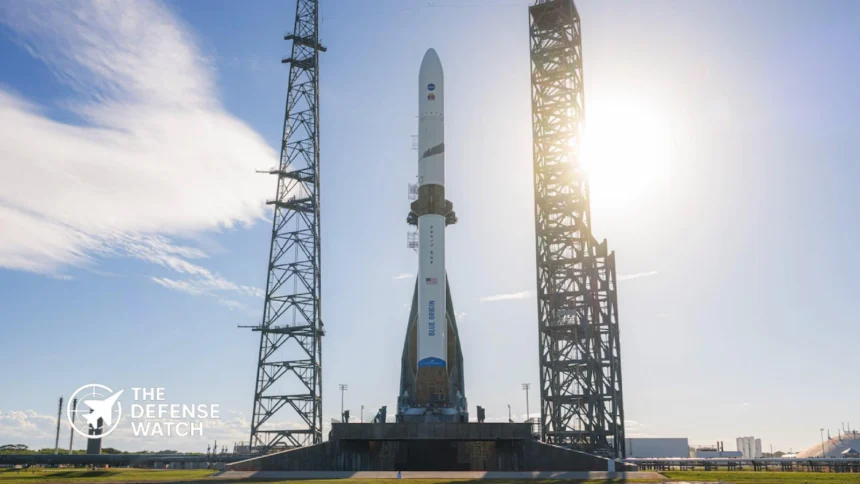
Google has selected Blue Origin’s New Glenn heavy-lift rocket to deploy a new generation of experimental computing satellites in 2029, expanding a research program that could eventually move parts of artificial intelligence infrastructure beyond Earth’s atmosphere.
The mission, planned for the first quarter of 2029, will support Google’s Project Suncatcher, an initiative investigating whether solar-powered satellites equipped with artificial intelligence processors can operate together as an orbital computing network.
The agreement gives Blue Origin another major commercial customer for New Glenn while placing the launch company in a developing market that connects heavy-lift space transportation with advanced computing infrastructure.
Google announced the partnership on November 19, 2026. Blue Origin separately confirmed that the companies had entered into a launch services agreement. Neither company disclosed the financial value of the agreement.
New Glenn selected for Google’s orbital computing mission
New Glenn will carry several computing satellites into sun-synchronous orbit, where they can receive near-continuous sunlight under the orbital conditions targeted by Google.
According to Google’s announcement, each spacecraft will carry computing capacity approximately equivalent to a conventional data center server rack.
The satellites will use Google’s Tensor Processing Units (TPUs), specialized processors developed to accelerate machine learning workloads.
The planned mission will be Google’s first dedicated heavy-lift launch for Project Suncatcher. It follows an earlier demonstration mission conducted with Planet Labs and SpaceX.
The selection also provides Blue Origin with a future mission for its heavy-lift launch vehicle as the company seeks to expand its commercial launch business.
However, the 2029 target remains a planned milestone rather than a confirmed operational deployment date.
Project Suncatcher moves beyond conventional satellite operations
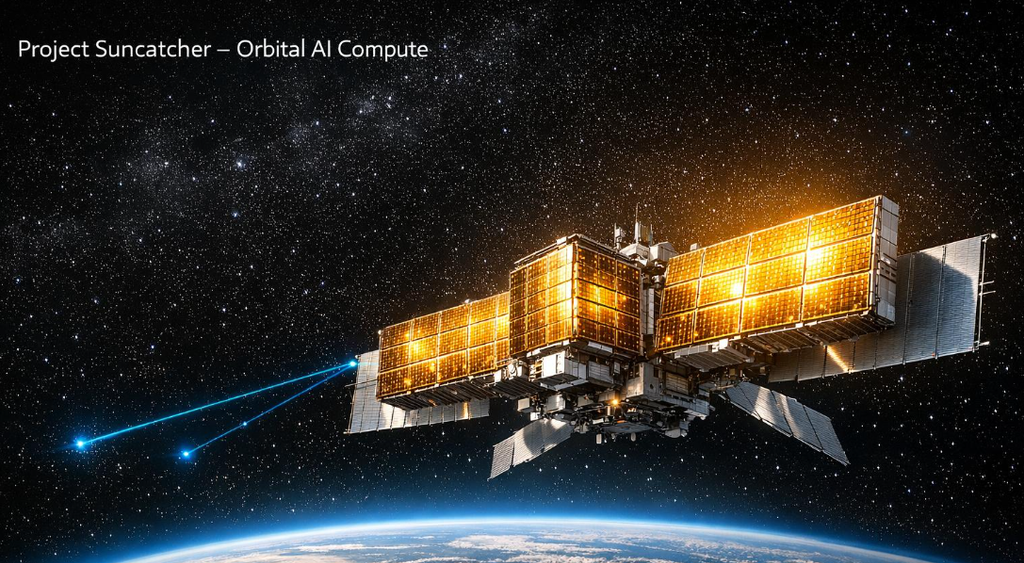
Project Suncatcher differs from conventional satellite programs because its primary purpose is not Earth observation, communications or navigation.
Instead, Google wants to investigate whether multiple spacecraft can function as interconnected computing platforms, processing artificial intelligence workloads directly in orbit.
The concept uses three main technologies:
- Solar power: Satellite-mounted solar arrays would provide electricity without depending on terrestrial power infrastructure.
- AI processing: Google’s TPUs would execute machine learning workloads onboard the spacecraft.
- Optical communications: High-bandwidth laser links would connect satellites, allowing them to exchange computing data.
Google’s 2025 research paper, Towards a Future Space-Based, Highly Scalable AI Infrastructure System Design, outlines an architecture based on smaller satellites flying in close formation rather than a single large orbital data center.
The research describes an illustrative configuration involving 81 satellites operating as a coordinated cluster. This is a proposed architectural model, not an announced deployment plan for the 2029 mission.
The paper also discusses dawn-to-dusk, sun-synchronous low Earth orbit as a potential operating environment because it can provide favorable solar exposure.
Google’s first orbital AI demonstration provides an early test
The New Glenn mission builds on an important milestone achieved in October 2026.
On October 1, Google launched its first Project Suncatcher prototype satellite in partnership with Planet aboard SpaceX’s Transporter-18 rideshare mission.
Google subsequently confirmed that the spacecraft had established contact with ground stations and was operating as expected.
On October 30, the company announced that its prototype had successfully generated an artificial intelligence response using an onboard Google TPU.
The satellite ran Google’s Gemma 4 open model and returned a generated response following a prompt transmitted from a ground station.
This demonstrated that the onboard computing hardware could execute an initial AI workload in orbit.
However, the experiment did not establish that a network of orbital satellites could operate as a commercially viable data center.
Google said additional testing would examine radiation exposure, thermal performance and the reliability of its computing hardware. The company’s next identified milestone involves testing two interconnected satellites in 2027.
The engineering problems are more difficult than launching the satellites
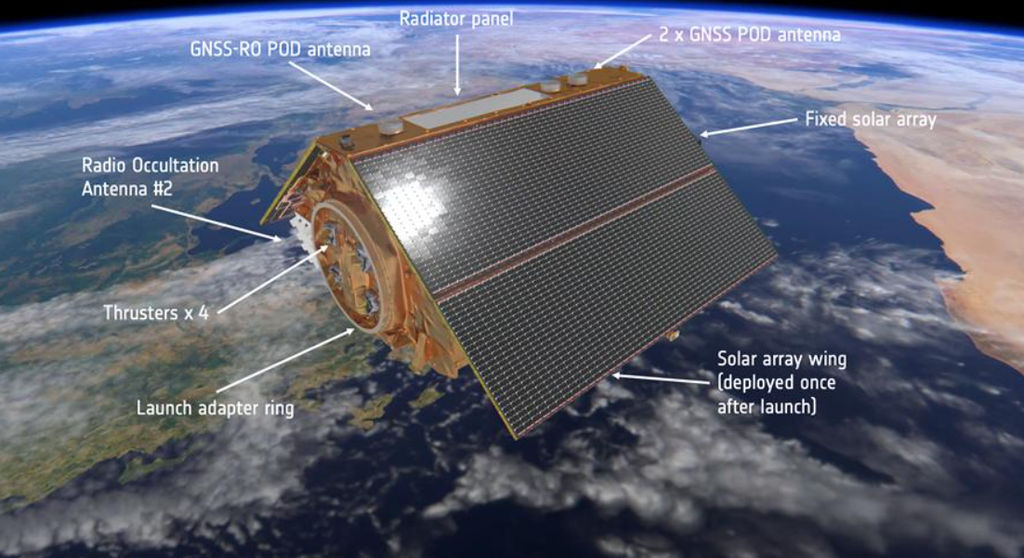
Moving computing hardware into orbit solves only part of the problem. Operating data center equipment in space introduces technical challenges that do not exist in conventional terrestrial facilities.
1. Radiation protection
Electronic processors must withstand radiation from the space environment, including energetic particles that can produce data errors or damage electronic components.
Google has conducted ground-based radiation testing of its TPUs, but sustained orbital operation remains an important part of the research.
2. Thermal management
Conventional data centers use air conditioning and liquid cooling systems to remove heat from processors.
Spacecraft operate in a vacuum, where conventional air-based cooling is unavailable. Google is investigating heat pipes and radiator panels to transfer excess heat away from computing hardware.
3. Satellite communications
Artificial intelligence workloads often require substantial data exchange between processors.
Google’s proposed architecture therefore depends on high-bandwidth optical links between closely positioned satellites.
Its research paper identifies inter-satellite communications as a major engineering requirement. Maintaining accurate positioning and stable optical connections between moving spacecraft will be necessary for the network to function.
4. Launch and replacement costs
Orbital computing infrastructure must compete economically with terrestrial data centers.
Launch costs, spacecraft manufacturing, maintenance and eventual replacement could determine whether the concept becomes commercially practical.
Google’s research paper identifies launch economics as a central factor in the feasibility of a large orbital computing network.
Why the Blue Origin agreement matters to the space industry
The agreement has implications beyond Google’s artificial intelligence research.
New Glenn is being positioned for missions requiring substantial payload capacity and volume. Securing a dedicated Project Suncatcher launch gives Blue Origin an additional commercial mission involving a new category of spacecraft.
For Google, access to a heavy-lift launch vehicle provides an opportunity to move beyond individual technology demonstrations toward testing a larger orbital computing architecture.
The partnership also illustrates growing commercial interest in space-based data infrastructure.
Companies including SpaceX and Starcloud are exploring related concepts, although their proposed architectures and development approaches are not necessarily identical.
The broader commercial question is whether the benefits of continuous solar exposure and reduced dependence on terrestrial land and electricity infrastructure can offset the costs and technical difficulties of operating computing systems in orbit.
Potential implications for military and national security space infrastructure
Project Suncatcher is a commercial research initiative. Google and Blue Origin have not announced a military application for the 2029 mission.
Nevertheless, its underlying technologies are relevant to the wider development of national security space infrastructure.
The ability to process data onboard spacecraft rather than transmitting all raw information to ground facilities is already an important consideration in satellite architecture.
For military users, onboard processing could potentially support faster analysis of satellite imagery, sensor information and other collected data. Distributed computing architectures could also reduce dependence on continuously available ground-based processing facilities.
These are potential applications of the broader technology, not capabilities demonstrated by Project Suncatcher.
The program also raises questions about satellite resilience, orbital congestion, communications security and the protection of space-based computing infrastructure.
As commercial companies explore more complex satellite networks, military planners will have to consider how increasingly sophisticated commercial space systems interact with national security requirements.
Commercial orbital data centers remain a long-term proposition
Google’s selection of New Glenn establishes a launch partnership and a planned 2029 mission. It does not mean that orbital data centers are ready to compete with terrestrial computing facilities.
The technology must still demonstrate reliable operation, effective thermal management, high-speed satellite networking and economically sustainable launch and replacement arrangements.
Google’s initial prototype has established an important starting point by successfully running an AI workload in orbit. The planned 2027 interconnected satellite demonstration and 2029 New Glenn mission will provide further opportunities to test the architecture.
For Blue Origin, the agreement adds a significant future mission to New Glenn’s commercial prospects. For the wider space industry, it provides another indication that orbital infrastructure is being considered for purposes extending beyond traditional satellite services.
Whether those systems eventually become practical computing platforms will depend on engineering results and economics, not launch announcements alone.
Enjoying our coverage?
Make The Defense Watch a preferred source on Google to see more of our geopolitical and defense insights when relevant to you.