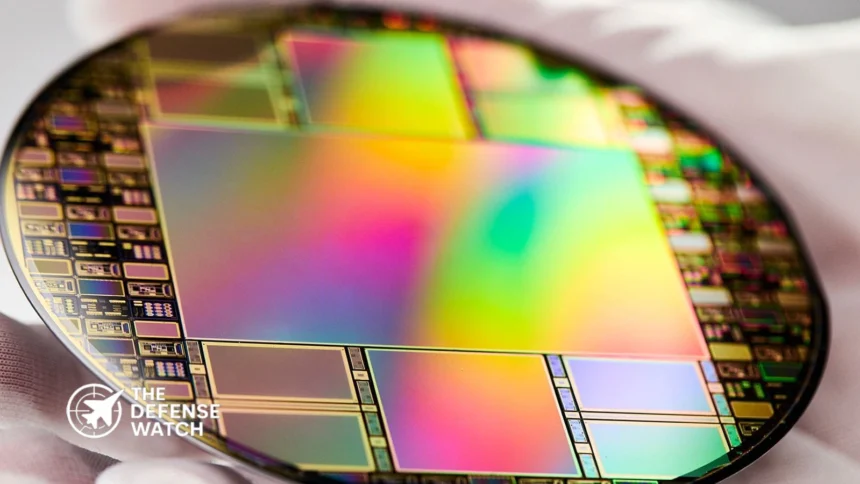
Raytheon has secured a Phase One contract from the Defense Advanced Research Projects Agency (DARPA) to develop photonic integrated circuits capable of processing signals entirely using light. The research falls under DARPA’s Photonic Integrated Circuit Architectures for Scalable System Objectives (PICASSO) program, which aims to address technical barriers limiting the expansion of large-scale optical computing and signal-processing systems.
Announced by RTX on November 3, 2026, the effort will be led by Raytheon’s Advanced Technology team. The company will work with Synopsys, which will provide design and simulation tools for the development of the new photonic circuits.
The proposed technology targets a problem in conventional photonic processing: optical signals frequently have to be converted into electrical signals before they can undergo further processing. Raytheon intends to develop circuits that keep signal processing within the optical domain, potentially reducing the need for these intermediate conversions.
Why DARPA Is Investing in All-Optical Processing
Photonic integrated circuits use light to transmit and manipulate information through optical components integrated onto a chip. They offer potential advantages in signal transmission, bandwidth and processing efficiency, but scaling these systems introduces technical challenges.
DARPA identifies signal degradation and accumulated noise as major obstacles when optical signals travel through increasingly complex processing chains. Scattering and back-reflections can also affect signal quality. Existing systems often address these problems by converting optical signals into electrical form, processing them electronically, and converting them back into optical signals.
That approach introduces additional conversion stages and can reduce some of the advantages offered by photonic technology.
DARPA’s PICASSO program seeks to address these limitations through circuit-level design approaches rather than concentrating exclusively on improvements to individual photonic components. Its stated objective is to establish the foundations for very large-scale photonic integration, with more predictable performance as circuits become larger and more complex.
Raytheon’s Role and Synopsys Partnership
Under the Phase One effort, Raytheon will design and demonstrate photonic circuit technology that processes signals using light rather than electricity.
The company’s work will draw on its existing experience in photonics process development, radio-frequency engineering and military systems. These areas provide a technical foundation for exploring how optical processing could eventually support defense applications.
Synopsys will contribute design and simulation tools. Such tools are important for developing and evaluating complex integrated circuits before physical demonstrations, particularly when researchers need to assess interactions between multiple optical components.
However, RTX has not disclosed the detailed technical architecture, demonstration schedule or specific performance targets associated with Raytheon’s work.
The company also has not identified a particular operational system that will receive the technology.
Potential Defense Applications
The military relevance of all-optical processing extends beyond faster data transmission. Processing signals without repeated optical-to-electrical conversion could eventually support systems that need to handle large volumes of sensor information with limited delays.
Potential areas of interest include:
- Radar systems: Processing complex radar signals while preserving information quality.
- Electronic warfare: Supporting the analysis of electromagnetic signals in contested environments.
- Missile warning and tracking: Improving the processing of information from distributed sensing systems.
- Military communications: Supporting optical information-processing architectures for future defense networks.
- Advanced sensing: Enabling more complex photonic systems for detecting and analyzing signals.
These are potential application areas, not confirmed Raytheon deliverables. Neither RTX nor DARPA has identified a specific operational platform for the company’s Phase One effort.
DARPA’s program documentation also makes clear that proposed applications are not restricted to a single military domain. Instead, the agency evaluates proposals according to their expected benefits for U.S. government applications and their ability to improve system-level performance.
The Technical Challenge Goes Beyond Processing Speed
Removing intermediate electrical conversions is only part of the challenge.
As photonic circuits become larger, maintaining signal quality across multiple processing stages becomes increasingly difficult. Optical signals can experience losses, noise, unwanted reflections and interactions between different optical modes.
These effects can limit the number of functions a circuit performs before its signal quality becomes inadequate.
DARPA’s January 2026 PICASSO question-and-answer document specifically identifies signal processing and signal integrity preservation as requirements for the program’s photonic circuits.
The document also identifies hardware demonstration and characterization as program-level technical milestones. This indicates that the initiative is intended to progress beyond theoretical circuit designs toward physical demonstrations.
However, these are overall PICASSO program requirements, not a published schedule or confirmed milestone list for Raytheon’s individual contract.
What Remains Undisclosed
RTX’s announcement provides limited information about the technical and commercial details of the award.
The company has not publicly specified:
- The financial value of Raytheon’s Phase One contract.
- The exact circuit architecture being developed.
- Processing speeds or latency targets.
- Optical bandwidth and power-efficiency figures.
- The expected date of the first hardware demonstration.
- Whether the technology will transition into a specific military platform.
Consequently, the contract should be viewed as an advanced research and development effort rather than evidence that an operational all-optical military processor is ready for deployment.
For Raytheon, the immediate objective is to demonstrate whether more complex signal-processing functions can be performed within photonic circuits while maintaining adequate signal integrity. Any transition into operational radar, electronic warfare or other defense systems will depend on the results of that work and subsequent development.