The U.S. Air Force has awarded Air Space Intelligence Federal Inc. a $26.02 million purchase order for commercial licenses of its Flyways Artificial Intelligence platform, adding a commercial aviation software capability to the command-and-control environment of the 618th Air Operations Center.
The five-year award covers the use and customization of the company’s cloud-hosted software at Scott Air Force Base, Illinois. The contract was awarded on September 28, 2026, with the Department of War publicly announcing it on November 9.
The purchase order, identified as FA4452-26-P-0019, is a firm-fixed-price acquisition. The Air Force selected Air Space Intelligence through a sole-source procurement, according to the official contract announcement.
The award has a total value of $26,020,100, but the Air Force is initially obligating $5 million from fiscal 2026 Transportation Working Capital Funds. The remaining contract value should not be interpreted as funding already obligated at the time of award.
Work is scheduled for completion by September 28, 2031. The 763d Enterprise Sourcing Squadron at Scott AFB is managing the acquisition.
Why the 618th Air Operations Center Needs Advanced Data Tools
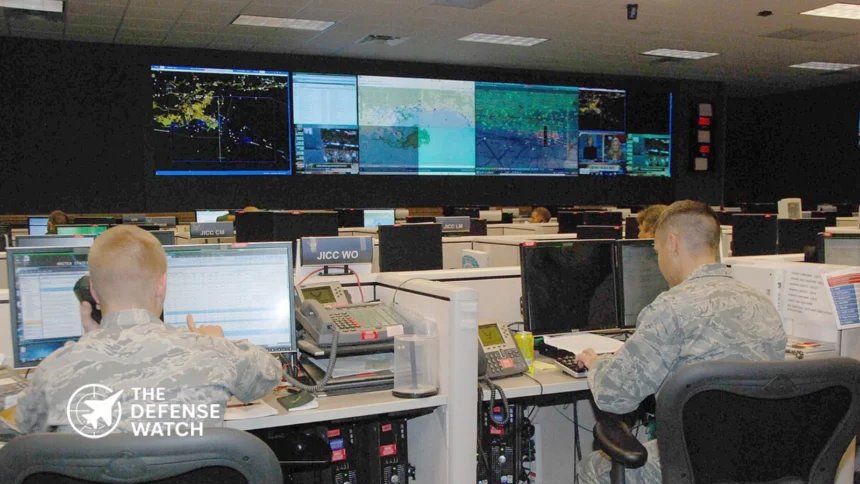
The 618th Air Operations Center, also known as the Tanker Airlift Control Center, is a central command-and-control organization within Air Mobility Command.
Its responsibilities extend well beyond coordinating individual transport aircraft. The center plans, schedules, directs and assesses global air mobility operations, including strategic airlift, aerial refueling, combat delivery and aeromedical evacuation.
According to the Air Force, the organization commands a fleet of nearly 1,100 mobility aircraft and supports operations across all U.S. geographic combatant commands. Its work requires coordination among aircraft, aircrews, operational units, airfields and other organizations operating across different regions and time zones.
That mission creates a demanding information-management problem. Aircraft availability, weather conditions, route restrictions, operational priorities and changing mission requirements can all affect how air mobility resources are allocated.
Software capable of combining operational data and forecasting changes in airspace conditions could help planners evaluate alternatives before they affect mission execution.
However, the contract announcement does not identify the specific military workflows that Flyways AI will support or quantify expected improvements in mission planning.
What Flyways AI Brings to Air Operations
Flyways AI is designed to help aviation organizations understand changing airspace conditions and anticipate traffic-management problems.
According to Air Space Intelligence, the platform uses AI-enabled airspace simulation to forecast demand and capacity imbalances. It can combine information on aircraft movements, weather, wind conditions and other operational factors to provide decision-makers with a forward-looking view of the airspace.
The company’s published capabilities include:
- Airspace prediction: Modeling anticipated air traffic and environmental conditions.
- Traffic flow optimization: Identifying potential congestion and recommending traffic-management measures.
- Data integration: Combining information from multiple aviation and government data feeds.
- Operational coordination: Providing a shared information environment for different aviation management teams.
These capabilities are described by the manufacturer for its aviation customers. The Air Force has not publicly confirmed which individual features will be configured for the 618th AOC.
The distinction matters because military air mobility operations involve requirements beyond conventional airline traffic management. Mission priorities, military airspace restrictions, refueling requirements, operational security and coordination with combatant commands can create additional planning challenges.
The purchase order’s provision for customization suggests that the Air Force intends to adapt the commercial platform to its operational requirements. However, the announcement does not disclose the extent of that customization.
Sole-Source Procurement and Contract Funding
The Air Force selected Air Space Intelligence through a sole-source acquisition rather than a competitive procurement.
The published award notice does not explain the justification for the sole-source decision. It also does not identify competing vendors, technical evaluation results or the specific integration requirements that led to the selection.
The initial $5 million obligation represents funding made available at the time of award, not the full contract value. The remaining amount is associated with the purchase order’s total value and should not be treated as already obligated.
The five-year performance period gives the 618th AOC time to use and customize the platform within its existing command structure. Nevertheless, the award announcement provides no detailed implementation schedule, software acceptance milestones or operational performance targets.
A Commercial AI Platform Enters a Military Planning Environment
Air Space Intelligence’s selection reflects an approach in which the Department of War can acquire commercially developed software rather than rely exclusively on systems developed specifically for military customers.
This approach can provide access to established commercial technology and shorten the path toward deploying new data-management capabilities. It can also introduce integration challenges when commercial software must operate within military networks, security requirements and established command-and-control systems.
For the 618th AOC, the potential benefit lies in improving the information available to planners managing a large and geographically dispersed mobility fleet.
The center’s mission depends on coordinating aircraft, crews and operational requirements across a global network. Better forecasting and data integration could help personnel identify scheduling conflicts and evaluate alternative mission arrangements earlier.
There are, however, important questions that remain unanswered. The Air Force has not disclosed the platform’s military network architecture, cybersecurity arrangements, data-access controls or whether it will connect directly with existing operational command systems.
Nor has the service published a baseline against which the software’s effectiveness can be measured.
The $26 million purchase order therefore establishes a long-term procurement commitment, but it does not yet demonstrate a measurable improvement in air mobility performance. That assessment will depend on implementation details and results from operational use.