Hegseth Orders 33 Reforms to Reshape U.S. Military Education
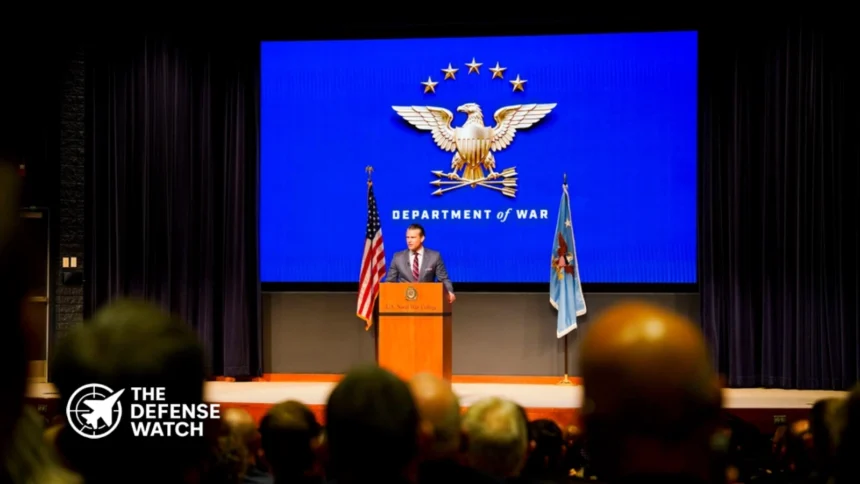
U.S. Secretary of War Pete Hegseth has ordered 33 changes to the Pentagon’s Professional Military Education (PME) system, directing military colleges to place greater emphasis on combat leadership, joint-force operations, artificial intelligence-assisted wargaming and the study of recent military campaigns.
The reforms were announced on November 9, 2026, during Hegseth’s visit to the U.S. Naval War College in Newport, Rhode Island. They follow a review of military education institutions launched in March and led by Under Secretary of War for Personnel and Readiness Anthony Tata.
An eight-page memorandum accompanying the announcement establishes 33 implementation requirements covering curriculum, faculty arrangements, student assessment, classified training facilities and institutional oversight.
Hegseth said military education should be evaluated according to whether it prepares officers to lead American forces and achieve victory in future conflicts.
The changes affect the department’s senior service colleges and Intermediate Level Education institutions, placing greater emphasis on practical military decision-making rather than traditional academic approaches alone.
AI Wargaming to Replace Traditional Capstone Theses
One of the most significant changes concerns how senior military officers demonstrate their knowledge at the end of their education.
Hegseth announced that lengthy theoretical theses would no longer serve as the primary capstone requirement at senior service colleges. Instead, the department will introduce competitive, AI-assisted wargaming exercises and high-pressure decision-making scenarios.
The objective is to evaluate how officers respond to complex operational situations, including adversary actions, changing battlefield conditions and decisions involving multiple military services.
The Naval War College has already conducted two wargames supported by what the department describes as superintelligence-enhanced technology during 2026. Hegseth cited those exercises as an example of the approach he wants expanded across military education institutions.
The new assessment framework will also change how students receive their final grades.
According to USNI News, revised grading policies will require the majority of final grades to come from individually assessed experiential learning activities, formal writing assignments and examinations. Seminar participation will receive less emphasis.
This does not mean written assignments are being eliminated. Instead, the department is shifting the central capstone assessment toward practical decision-making and competitive operational exercises.
More Operational Experience in Military Classrooms
The reforms also seek to change the balance between military and civilian expertise within senior service colleges.
Under the new requirements, each senior college will establish designated Warfighter Chair positions. These positions will be filled by experienced O-5 and O-6 officers with recent operational deployment experience.
The purpose is to bring practical lessons from military operations directly into academic instruction, strategic planning exercises and discussions about emerging threats.
The initiative could strengthen the connection between operational experience and military doctrine, particularly as U.S. forces adapt to developments in autonomous systems, electronic warfare, long-range precision weapons and contested logistics.
However, operational experience alone cannot replace the academic and technical expertise required to understand complex military problems. The effectiveness of the new positions will depend on how experienced commanders work alongside civilian researchers and specialist instructors.
Changes to Civilian Faculty Employment
Hegseth has also ordered changes to employment arrangements for newly hired civilian faculty.
Under the announced policy, new civilian faculty members will not receive lifetime tenure or emeritus status. Instead, they will work under three-year, performance-based contracts assessed against teaching effectiveness and national security research.
The policy is intended to give military education leadership greater control over faculty performance and curriculum priorities.
Importantly, the announced restriction concerns newly hired civilian faculty. It should not be interpreted as confirmation that all existing civilian faculty members will immediately lose their positions or employment protections.
Classified Facilities and Realistic Operational Planning
Another important part of the overhaul involves expanding access to classified military information during professional education.
Hegseth directed accelerated investment in Sensitive Compartmented Information Facilities (SCIFs) at war college campuses. These facilities provide secure environments for handling classified information and conducting activities that cannot take place on ordinary academic networks.
The stated objective is to allow officers to examine sensitive intelligence, study adversary capabilities and conduct more realistic military planning exercises.
This requirement reflects a practical challenge in modern military education. Officers preparing for senior command positions need to understand how intelligence, operational planning, communications and classified threat assessments interact during military campaigns.
Unclassified case studies remain valuable, but they cannot provide access to every detail needed to examine sensitive operational plans or intelligence assessments.
The reforms also call for a permanent inter-college wargaming architecture, allowing senior service colleges to conduct competitive exercises that involve multiple military services.
This is particularly relevant to joint operations involving the Army, Navy, Air Force, Marine Corps and Space Force, where successful planning requires coordination across different command structures and operational domains.
Pentagon Targets the Study of Recent Military Failures
The directive also addresses what Hegseth described as insufficient attention to recent American military setbacks and strategic failures.
During his Naval War College address, he criticized military education programs for avoiding politically sensitive subjects and called for more rigorous examination of previous decisions.
Examples raised during his speech included:
- The U.S. withdrawal from Afghanistan in 2021.
- Military decisions and policies during the COVID-19 pandemic.
- Questions surrounding civil-military relations and the actions of former Chairman of the Joint Chiefs of Staff General Mark Milley.
The memorandum also requires formal case studies examining recent operational and ethical successes and failures at senior service colleges. According to USNI News, institutions have 90 days to report how these studies are being incorporated into their curricula.
Studying unsuccessful military operations is an established part of professional military education. The value of such analysis depends on examining operational evidence, command decisions, intelligence assessments and institutional weaknesses rather than treating politically contested interpretations as settled findings.
For future commanders, understanding why previous campaigns failed can be as important as studying successful operations.
What the Reforms Mean for U.S. Military Readiness
Professional Military Education is an important part of the U.S. military’s officer development system.
It prepares officers for responsibilities beyond their immediate service specialties, including joint command, national military strategy, operational planning and the management of complex military organizations.
The statutory framework for Joint Professional Military Education under Title 10 of the U.S. Code identifies national military strategy, joint planning, doctrine, command and control, and joint force development among its core subjects.
A 2020 Government Accountability Office report also described PME as a means of preparing military personnel for complex contingencies and major conflicts involving multiple services. It distinguished service-specific education from joint education, which prepares officers to operate as a coordinated force.
Hegseth’s reforms seek to strengthen this practical dimension through competitive wargaming, operationally experienced instructors and greater exposure to classified information.
There are several potential benefits.
First, AI-assisted wargaming could expose officers to a wider range of operational scenarios and allow them to test decisions under changing conditions.
Second, experienced operational commanders could help connect classroom instruction with lessons from recent deployments.
Third, expanded SCIF capacity could improve the use of classified intelligence and threat assessments in military education.
However, these measures will not automatically translate into better battlefield performance.
AI-assisted simulations depend on the quality of their underlying data, assumptions and opposing-force models. A poorly designed exercise can reinforce incorrect conclusions rather than improve decision-making.
Similarly, competitive wargames cannot fully reproduce the uncertainty, human factors, logistical pressures and political constraints of actual combat.
The military will also need to retain sufficient expertise in strategy, history, technology, international security and civil-military relations. These subjects help commanders understand not only how to fight but also the wider consequences of military decisions.
The central challenge will be balancing operational training with the independent analysis and intellectual debate required for senior military leadership.
Implementation Across Military Education Institutions
The November 9 memorandum calls for immediate implementation of its directed reforms across the department’s educational institutions.
The Under Secretary of War for Personnel and Readiness, Anthony Tata, has responsibility for tracking implementation requirements.
The department has also ordered reviews of the boards of visitors associated with senior service colleges. According to USNI News, service secretaries have 120 days to submit recommendations, membership audit results and proposed implementation timelines.
The wider implementation effort will involve changes to academic programs, faculty arrangements, assessment methods, infrastructure and institutional oversight.
The exact costs of the reforms, the total investment required for SCIF expansion and the full schedule for completing every directive have not been established in the publicly available reporting reviewed for this article.
The results will ultimately depend on whether the changes improve the quality of military leadership, joint operational planning and strategic decision-making, rather than simply changing the way military colleges organize their academic programs.
For the Pentagon, the task is to ensure that future commanders can translate military knowledge into sound decisions under the pressures of modern warfare.