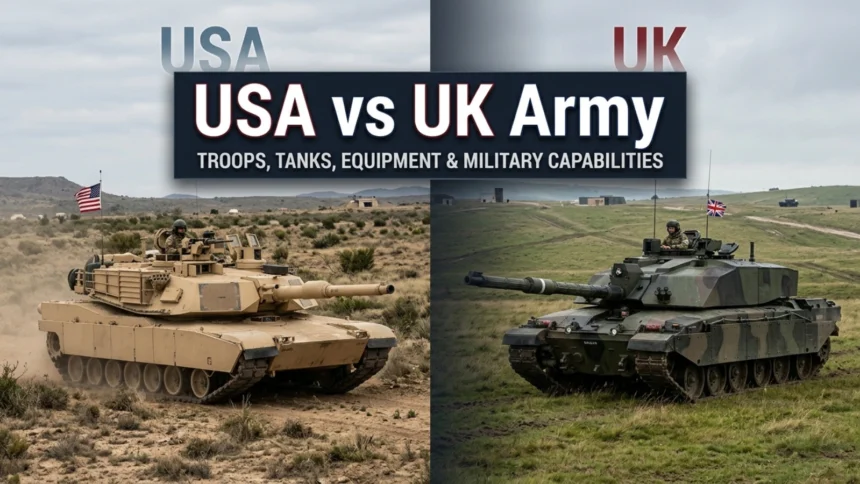
The U.S. Army fields roughly six times as many regular soldiers as the British Army and operates thousands of armored vehicles where the UK is still bringing its first modern fleets into service. Those gaps are real, but they describe inventory and budgets. They do not say what each force can deploy, sustain and fight with today.
This USA vs UK Army comparison covers land forces only: the U.S. Army (Regular Army, Army National Guard and Army Reserve) and the British Army (Regulars, Gurkhas and the Army Reserve). It leaves out the Marine Corps, Royal Marines, air forces and navies, and flags joint or national capabilities where they matter. The data cutoff is November 7, 2026.
USA vs UK Army at a glance
| Category | U.S. Army | British Army |
|---|---|---|
| Regular personnel | 454,000 authorized (FY2026 enacted); 469,000 requested for FY2027 | 73,660 UK Regulars (July 1, 2026); 70,950 full-time trade-trained |
| Reserve personnel | Army National Guard 328,000 and Army Reserve 172,000 authorized (FY2026) | Army Reserve trained strength about 23,740 (Jan. 1, 2026); total Army strength 108,780 including all categories (July 1, 2026) |
| Major formations | 31 Regular and 27 National Guard brigade combat teams; 11 combat aviation brigades (Heritage, FY2025 data) | Two deployable divisions (1st and 3rd UK) within NATO’s Allied Rapid Reaction Corps construct |
| Main battle tanks | About 2,640 Abrams, all variants (Heritage estimate); M1E3 in prototype | Challenger 2 fleet reported at 157 operational (2023), 213 (2024) and 288 (late 2025); 148 Challenger 3 on order, none confirmed in service |
| Infantry vehicles | About 4,500 Bradley and 4,500 Stryker (Heritage estimate) | Boxer: 100 delivered of a 623 requirement; Ajax: 185 delivered of 589 ordered (early 2026) |
| Self-propelled artillery and rockets | About 300 M109A7 and 368 HIMARS (Heritage estimate) | 14 interim Archer howitzers; 72 RCH 155 ordered; 61 M270 launchers being upgraded |
| Air defense | 15 Patriot battalions, 7 THAAD batteries (Heritage estimate); Stryker-based M-SHORAD | Sky Sabre, roughly six to seven systems before a 2025 order for six more Land Ceptor launchers |
| Attack helicopters | About 750 Apache, all variants (Heritage estimate) | 50 AH-64E |
| Budget | FY2027 Army request of $252.8 billion (request, not enacted) | Land domain: £19.2 billion over FY2026/27 to FY2029/30 under the Defence Investment Plan |
Read the table with care. U.S. equipment counts are estimates of total inventory, not operational or deployable numbers. UK fleet figures come from ministerial answers and press reporting, and the Challenger 2 numbers alone show how much the count depends on the year and the definition. Budget lines are not like-for-like: the U.S. figure is a request for the whole Army, while the UK figure covers one domain’s share of a four-year plan.
Personnel and organization
The U.S. Army’s authorized active strength was 454,000 for FY2026, and the FY2027 request would raise it by 15,000 to 469,000, according to the Congressional Research Service. Including the Army National Guard and Army Reserve, Army budget documents show a requested total strength of 972,300 in FY2027. The British Army’s regular strength was 73,660 at July 1, 2026, per Ministry of Defence statistics, which is a different definition from U.S. end strength and covers a far smaller force.
British Army manning is stabilizing rather than growing quickly. The Strategic Defence Review set a goal of at least 76,000 full-time soldiers in the next Parliament, and an independent Full Fact analysis noted that fully trained Army regulars, defined narrowly, were at their lowest level in more than two centuries. The Army Reserve is also thin: trained strength was about 23,740 in January 2026, which is a small fraction of the roughly half-million U.S. Guard and Reserve soldiers.
Organization matters as much as headcount. The U.S. Army builds around brigade combat teams of roughly 4,000 to 4,700 soldiers, and Heritage counts 31 Regular and 27 National Guard teams. The British Army is organized around two deployable divisions that mostly belong to a NATO-first posture. The Strategic Defence Review itself says most of the Army’s deployable capability would be committed to NATO in a war, as reported by European Security & Defence.
Both armies are restructuring. The U.S. Army Transformation Initiative cuts staff and some aviation units, converts infantry brigades to “mobile” brigades and shifts money toward drones, long-range missiles and counter-drone systems. Heritage reports that 83 percent of Regular brigade combat teams were at the highest tactical readiness levels in a July 2023 Army report, but the Army has not published comparable goals recently, so that figure should be treated as dated.
Armor and mounted combat
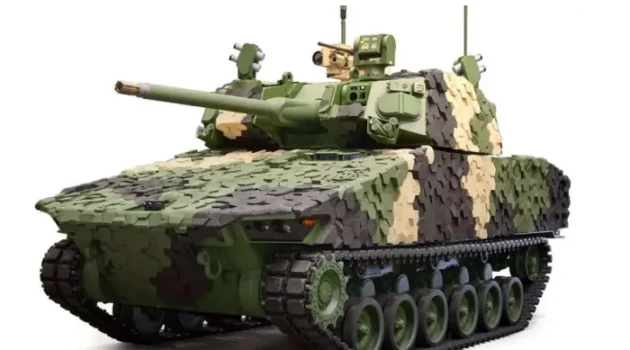
The U.S. Army still relies on platforms fielded in the 1980s and upgraded since. Heritage estimates about 2,640 Abrams and 4,500 Bradley vehicles in inventory, with the Army expecting to keep the Abrams, Bradley and Stryker in service beyond FY2028. The M1E3 Abrams is in the prototype stage: CRS reports that one platoon of M1E3 tanks was due to join a division in 2026, with testing at the National Training Center continuing through March 2027. The Bradley replacement, the XM30, is targeting a first unit equipped in FY2030 according to the FY2027 budget request.
The Army has also cancelled or capped several programs. The M10 Booker light tank was cancelled, Stryker production orders ended and the Armored Multi-Purpose Vehicle was cut to a minimum sustainment rate, according to Breaking Defense reporting on the 2025 transformation orders.
The British Army’s armored picture is less settled. The Challenger 3 program upgrades Challenger 2 hulls with a new turret and a 120 mm smoothbore gun under an £800 million contract for 148 tanks. It completed its first crewed live firing in December 2025, and a ministerial answer on October 19, 2026 confirmed seven prototypes delivered. Trials are due to finish by the end of 2026, and the MoD says the program is under a reapproval process expected in FY2026-27. The Defence Investment Plan sets aside £1.1 billion to complete production, per Janes.
Ajax is the harder story. As of early 2026, General Dynamics had delivered 185 of 589 ordered vehicles. The MoD declared initial operating capability in November 2025 and then reversed it in January 2026 amid safety investigations, and a minister now points to full operational capability by the end of 2029. Parliamentary answers show 227 Ajax accepted as of September 15, 2026, though the MoD does not break that down by variant.
Boxer is the bright spot. The 100th UK-built Boxer was delivered to the MoD on June 25, 2026, though Army Recognition reports only 19 had been fielded in January, and the Defence Investment Plan allocates £2.2 billion. Warrior, however, is leaving service without a funded successor, which analyst Nicholas Drummond calls a deferred gap in the plan.
Artillery and long-range fires
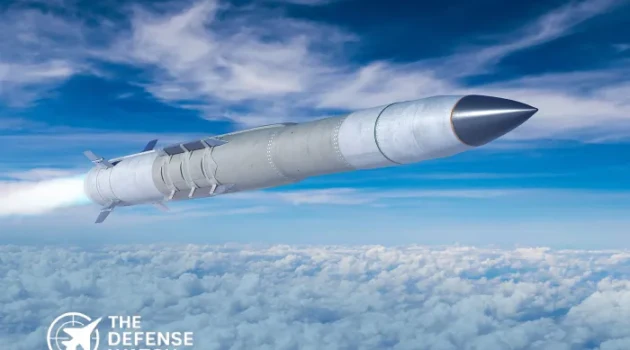
The U.S. Army holds about 300 M109A7 self-propelled howitzers and 368 HIMARS launchers by Heritage’s estimate, and it has added new long-range systems. These include the Precision Strike Missile, with a reported range above 310 miles, the Typhon mid-range launcher and the Dark Eagle hypersonic weapon. Heritage also notes setbacks in the self-propelled howitzer modernization effort.
The British Army has a gap. It donated its entire AS90 fleet to Ukraine, leaving 14 interim Archer howitzers and, according to Army Technology, 126 L118 light guns. In May 2026 the UK announced a nearly £1 billion order for 72 RCH 155 Boxer-based howitzers, with first deliveries expected from 2028, though earlier official statements pointed to initial capability in 2029. The M270 rocket fleet is being upgraded to the A2 standard, with 61 launchers and 8 recovery vehicles due to finish by 2029.
The UK is also buying into U.S. missile technology. The Defence Investment Plan commits £190 million to the PrSM program, which Janes says would roughly triple the Army’s strike range to 499 kilometers. The same plan sets £1.3 billion for close support artillery and £590 million for long-range rocket artillery over four years.
Air defense and counter-drone capability
Army-operated air defense in the U.S. spans Patriot, THAAD, Stryker-based M-SHORAD and, in planning, new indirect fire protection battalions. CRS reports that the Army originally planned 144 M-SHORAD vehicles for four battalions, with fielding under way in Germany and at Fort Sill and more units in progress. The Army’s FY2027 request emphasizes expanding missile and interceptor production, including Patriot, THAAD and PrSM, per the Department of War budget document.
The British Army’s medium-range layer is Sky Sabre. The MoD has described a £118 million contract for six new Land Ceptor launchers that it says doubles the deployable Sky Sabre capability, and reporting puts the existing fleet at roughly six to seven systems. The Defence Investment Plan funds ground-based air defense at £1.5 billion over four years, which Drummond argues is thin against the drone threat the plan itself describes.
Neither army has an interceptor inventory sized for a drone-saturated, prolonged fight. Both are pursuing cheaper counter-drone options, but the evidence for fielded scale on either side is limited.
Army aviation and uncrewed systems
The U.S. Army operates large helicopter fleets by Heritage’s estimates: about 750 Apache, 2,100 Black Hawk and 465 Chinook helicopters. The transformation plan cuts one aerial cavalry squadron per combat aviation brigade and retires AH-64D models. The FY2027 request also cuts new-helicopter procurement sharply, dropping Apache funding from roughly $361.7 million to about $1.5 million, a move senators challenged at a May 2026 hearing. Congress was still reshaping FY2027 spending plans as of the sources reviewed.
The British Army is simpler. It flies 50 AH-64E Apaches, all delivered, and will start retiring its 34 Wildcat AH1 helicopters in 2027, with uncrewed systems meant to take over reconnaissance. The Defence Investment Plan funds Project NYX, a £220 million armed-drone effort to operate alongside Apaches, and surveillance drones to replace Watchkeeper. Those are plans, not fielded capability.
Training, doctrine and technology
The U.S. Army’s doctrine rests on “transforming in contact,” in which units adopt new technology during training and operations. The FY2027 request maintains 22 BCT-level combat training center rotations. Heritage argues training miles have declined since FY2019, but that is one think tank’s reading of budget data.
The British Army is moving toward a “recce-strike” approach, with Project ASGARD funded at £370 million to link sensors and shooters. Drummond reports that ASGARD has cut sensor-to-shooter timelines from hours to minutes in Estonia, and he describes a planned force mix of survivable, attritable and consumable systems. These are the Army’s own ambitions as relayed by an analyst, not independently verified battlefield results.
On training quality, public sources do not support a ranking of which army’s soldiers are better trained, and this article does not make one.
Logistics, sustainment and industrial capacity
This is where the comparison is most useful. Inventory is what an army owns. Operational means available to fight, deployable means ready to move and sustainable means it can be supplied with fuel, spares and munitions for months. Public data rarely covers all four.
U.S. artillery ammunition. The Pentagon’s goal was 100,000 155 mm rounds per month by October 2025. The Department of War Inspector General reported the Army was producing about 36,000 per month in March 2026 and that projectile metal-part production was the limiting factor. A $500 million-class plant in Mesquite, Texas had not produced usable components, and the IG estimated the three existing metal-part facilities could reach only about 71,000 per month. A new Iowa load-and-fill complex designed for 432,000 rounds per year is under construction. These figures describe production rates, not stockpiles, which are not publicly disclosed.
U.S. interceptors and missiles. The 2026 Iran campaign, Operation Epic Fury, exposed limits. CSIS estimated roughly 2,330 Patriot interceptors in inventory before the war and later judged that about two-thirds had been used, after an earlier estimate near half. The Pentagon disputed shortage characterizations. CRS notes the DoD Inspector General cited strategic inventory shortfalls, and press estimates of PrSM use range from dozens to most of the stock. Lockheed Martin delivered about 620 PAC-3 MSE in 2025, and a seven-year framework targets about 2,000 per year by the end of 2030, which is a target, not current output.
UK ammunition and energetics. BAE Systems claimed in 2025 that a new Glascoed explosive-filling facility would deliver a sixteen-fold increase in 155 mm shell capacity, but it was due in summer 2025 and a February 2026 Guardian report, relayed through an aggregator, said it had not opened. I could not confirm its current status. The UK also gave Ukraine much of its artillery ammunition, and UK stockpile levels and current monthly output are not publicly disclosed. The Strategic Defence Review pledged new munitions and energetics factories, and GMLRS replenishment deliveries were due to begin in the second quarter of 2026, with extended-range rockets from 2028.
Dependencies. Several key British land capabilities, including GMLRS rockets, M270 launchers, Apache helicopters and PrSM, come from U.S. industry. That means U.S. production limits can also constrain the UK, and that is an analytical inference rather than a published finding. The U.S. Army, for its part, depends on Air Force and Navy lift to move forces, as Heritage emphasizes.
Budgets and defense spending
The Army’s FY2027 request is a record $252.8 billion, according to the Army budget documents reported by Stars and Stripes, within a $1.5 trillion national defense request. Of that national total, $350 billion depends on reconciliation legislation, per CSIS, and Army procurement of $54.7 billion includes $18.8 billion from that source, per Breaking Defense. This article did not verify whether Congress has enacted the final FY2027 numbers.
The UK’s Defence Investment Plan, published June 30, 2026, commits £298 billion over four years, taking annual defense spending from about £54 billion to nearly £80 billion by 2029. The government says NATO-qualifying spending reaches 2.7 percent of GDP from 2027-28, while ICAEW puts core defense spending nearer 2.2 to 2.3 percent on a narrower definition. The Land domain receives £19.2 billion, according to Janes. Because currencies, definitions and time spans differ, readers should not divide one figure by the other.
How each army fits different environments
These are analytical comparisons, not predictions.
High-intensity armored warfare. The U.S. Army has far more fielded armor, aviation, artillery and sustainment. The British Army’s heavy contribution is limited while Challenger 3 and Ajax are unresolved and Warrior leaves service.
Expeditionary and coalition operations. The U.S. Army can deploy at scale but depends on joint lift, and most of the force is based in the continental United States. The British Army’s planned Boxer-based wheeled division is meant for rapid NATO deployment but is still being built.
Counter-drone environments. Both armies are investing, and both say layered defenses are essential. Neither has shown fielded scale sufficient for a prolonged peer fight.
Long-duration operations. The U.S. industrial base is far larger, but its own missed targets and Epic Fury expenditure show strain. The UK’s smaller base, undisclosed stockpiles and U.S. dependencies make prolonged sustainment the more uncertain question.
Strengths and limitations
U.S. Army strengths: scale, a large modern fires and air defense inventory, large Guard and Reserve components, and a much larger industrial base and budget.
U.S. Army limitations: aging core vehicles, unmet ammunition production targets, drawdown of high-end interceptors and missiles, a force Heritage argues is stretched across many theaters, and reliance on joint lift.
British Army strengths: deep NATO integration, a funded drone and recce-strike push, new Boxer and Apache fleets and a growing domestic armored vehicle industry.
British Army limitations: small size, a thin reserve, an artillery gap through this decade, delayed Challenger 3 and Ajax, limited air defense and uncertain munitions capacity.
Overall assessment
Category Advantage Qualification Force scale U.S. Army, by a wide margin Definitions differ; scale is spread across more missions Fielded armor and fires U.S. Army Core designs are decades old and some programs were cut Air defense U.S. Army in fielded systems Interceptor stocks strained in 2026 Deployable heavy combat power U.S. Army UK’s heavy division depends on delayed programs Industrial capacity U.S. industry in absolute size Missed targets; UK output undisclosed Alliance integration Both UK is NATO-first by design The evidence supports a clear advantage for the U.S. Army in scale and fielded capability. It does not support a simple ranking. Both armies are mid-transformation, and the sustainment of high-end munitions is the weakest link on each side.
Frequently Asked Questions
Is the U.S. Army larger than the British Army?Yes. The U.S. Army’s FY2026 authorized active strength was 454,000, against 73,660 UK Regulars in July 2026. Adding reserves widens the gap, but the two countries define strength differently.
How many tanks do the U.S. and UK armies operate?Heritage estimates about 2,640 Abrams in the U.S. inventory. The UK’s Challenger 2 fleet has been reported at 157 operational (2023), 213 (2024) and 288 (late 2025), and 148 are being upgraded to Challenger 3, so those numbers overlap rather than add.
Which country spends more on defense?The United States, by a wide margin. The FY2027 request is $1.5 trillion for national defense, including an Army request of $252.8 billion, while the UK plans £298 billion over four years. These are requests and plans, not equivalent measures.
How do the two armies differ in equipment?The U.S. Army fields large fleets of older, upgraded designs plus new long-range fires. The British Army is replacing much of its equipment at once, with Boxer arriving, Challenger 3 and Ajax delayed and artillery rebuilding.
Does the British Army operate independently of NATO?Not entirely, but its planning is NATO-first. The Strategic Defence Review says most of its deployable capability would be committed to NATO in a war, while national tasks continue, such as a Sky Sabre system deployed to the Falkland Islands.
Which army has greater global deployment capability?The U.S. Army, because of its size and sustainment base, though it relies on Air Force and Navy lift. Overseas bases do not by themselves guarantee combat effectiveness.