India Tests Pralay Quasi-Ballistic Missile as Induction Moves Closer
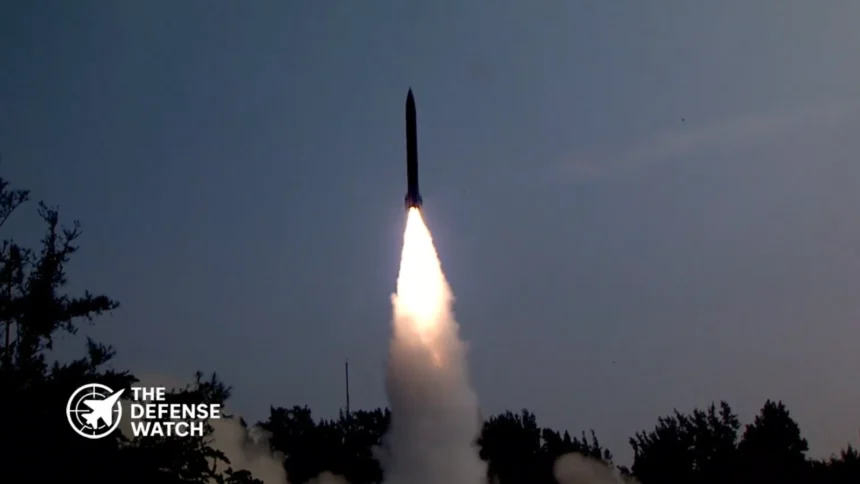
India’s Defence Research and Development Organisation (DRDO) has successfully flight-tested the Pralay quasi-ballistic missile, advancing a program intended to strengthen the country’s conventional ground-launched strike capabilities.
The missile was launched at approximately 11:10 a.m. local time on November 5, 2026, from Dr APJ Abdul Kalam Island off the Odisha coast. India’s Ministry of Defence confirmed that all test objectives were achieved, based on flight data collected by instruments operated by the Integrated Test Range (ITR), Chandipur.
The trial formed part of the armed forces’ user evaluation process. Senior DRDO officials, industry representatives and members of the Defence Forces attended the test, indicating that the program has moved beyond its earlier development phase and is progressing toward military acceptance.
The Ministry of Defence said the successful trial makes the missile’s induction into service imminent. However, it did not announce a formal induction date, initial delivery schedule or the number of missiles planned for deployment.
DRDO and Bharat Dynamics Advance the Pralay Program
Pralay has been developed by Research Centre Imarat (RCI), Hyderabad, working with other laboratories within DRDO.
Bharat Dynamics Limited (BDL), one of the program’s Development-cum-Production Partners, manufactured the missile system used in the program. The arrangement connects government-led missile research and development with India’s domestic defense manufacturing sector.
The program also involves a wider industrial and technical network. In its July 2025 announcement, the Ministry of Defence identified the Defence Research and Development Laboratory, Advanced Systems Laboratory, Armament Research and Development Establishment, High Energy Materials Research Laboratory and several other DRDO facilities among the organizations contributing to development. Bharat Electronics Limited and additional industrial partners were also identified.
This industrial structure is important as the program approaches induction. Developing a missile prototype and establishing a dependable production system are different challenges. Operational deployment requires manufacturing consistency, quality assurance, launcher integration, maintenance arrangements and trained military personnel.
BDL’s production role therefore provides an important link between the development program and potential series production.
What Makes Pralay a Quasi-Ballistic Missile?
Pralay is an indigenously developed, solid-propellant, surface-to-surface missile designed for conventional strike missions.
Unlike a conventional ballistic missile that follows a largely predictable ballistic flight path after its powered phase, a quasi-ballistic missile is designed to follow a lower and potentially maneuverable trajectory.
Such flight characteristics can complicate an opposing air-defense system’s interception calculations. However, maneuverability alone does not make a missile impossible to detect or intercept. Its actual survivability depends on factors including flight profile, sensor coverage, defensive reaction time and the capabilities of the opposing interception system.
The Indian government confirmed the missile’s solid-propellant propulsion, navigation technology and mobile-launch capability in its December 2021 announcement.
At that time, DRDO publicly disclosed a range of 150 to 500 kilometers. This remains an important official reference for understanding the missile’s intended reach, although the November 5, 2026, announcement did not disclose the specific range, payload configuration or flight profile used during the latest trial.
The missile’s mobile-launch capability also gives it a different operational role from fixed-site missile systems. Road-mobile launchers can provide greater flexibility in positioning and deployment, although their effectiveness depends on supporting vehicles, communications, logistics and command arrangements.
A Series of Trials Has Brought the Missile Closer to Service
Pralay’s development and evaluation have progressed through several publicly announced test campaigns.
- December 22, 2021: DRDO conducted the missile’s maiden flight test. The Ministry of Defence reported that it followed the intended quasi-ballistic trajectory and reached its designated target.
- July 28 and 29, 2025: DRDO conducted two consecutive flight tests as part of user evaluation trials. The stated objective was to validate the system’s maximum- and minimum-range capabilities.
- November 5, 2026: DRDO completed another successful user evaluation flight test, with the Ministry confirming that all objectives were met.
The July 2025 trials were particularly relevant because they addressed performance across the missile’s intended engagement envelope rather than simply demonstrating another successful launch.
The November 2026 test adds another positive result to that evaluation process. However, the government has not publicly identified the exact technical parameters examined during this latest flight.
The available announcements also do not establish whether all remaining acceptance requirements have been completed.
Why Pralay Matters to India’s Conventional Strike Capability
Pralay is intended to provide India’s armed forces with a ground-launched precision-strike option between shorter-range artillery and rocket systems and longer-range strategic missile capabilities.
Its publicly disclosed 150-to-500-kilometer range could allow military commanders to engage selected targets beyond the reach of many conventional artillery systems.
Potential operational applications for a conventional missile in this category include attacks against military infrastructure, command facilities and other high-value targets. These are general mission possibilities, not confirmation of specific Pralay targeting assignments or operational deployments.
The system also has relevance to India’s security environment along its borders with China and Pakistan. Both regions present different geographical and operational requirements, including the need to position mobile strike assets while maintaining supporting logistics and command networks.
A mobile quasi-ballistic missile could give Indian Army planners another option for conventional deterrence and long-range battlefield operations.
However, the actual military value of Pralay will depend on more than its advertised range. Targeting intelligence, communications, launcher availability, stockpile size, training and the ability to operate under electronic warfare conditions will all influence its effectiveness.
The missile’s conventional role should also be distinguished from India’s nuclear-capable strategic missile forces. The November 2026 announcement did not identify the tested configuration’s payload, and the program should not be characterized as a nuclear deployment based on the available evidence.
Induction Is the Next Important Milestone
The latest test strengthens the case that Pralay is approaching operational service, but the distinction between successful user evaluation and formal induction remains important.
The Ministry of Defence has described induction as imminent, but has not provided a specific timetable. It has also not disclosed the initial number of missiles, the planned regiment structure, production capacity or the distribution of systems between the Indian Army and Indian Air Force.
Those details will help establish the scale of the capability entering service.
For now, the November 5 flight test provides further evidence of progress in India’s domestic missile development effort. The next significant indicators will be an official induction announcement, production orders, delivery information and confirmation of the units that will operate the system.