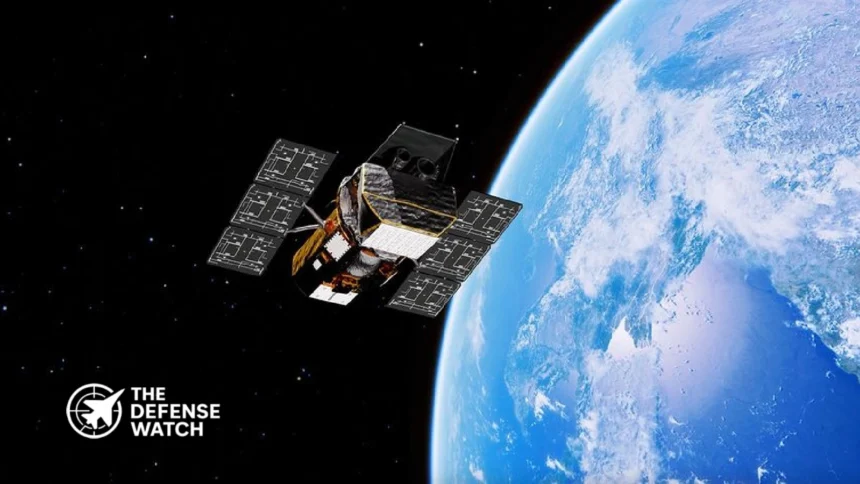
NASA’s Neil Gehrels Swift Observatory reentered Earth’s atmosphere over northern Sumatra, Indonesia, on November 4, ending nearly 22 years of operations studying gamma-ray bursts, supernovae and other high-energy events across the universe.
The U.S. Space Force confirmed that the spacecraft reentered at approximately 7:39 a.m. Eastern Standard Time, at a location near 3.4 degrees north latitude and 98.6 degrees east longitude, according to NASA.
The spacecraft weighed approximately 3,200 pounds (1,450 kilograms). NASA expected most of its structure to burn up during atmospheric reentry, although some components could survive and reach the Earth’s surface.
The reentry concluded a mission originally designed to last just two years. Swift remained operational for more than a decade beyond its planned service life, producing scientific observations that contributed to thousands of research publications.
A Two-Year Mission That Lasted Nearly 22 Years
Launched on November 20, 2004, Swift was developed to detect and investigate gamma-ray bursts, among the most energetic explosions in the universe.
The observatory combined three scientific instruments:
- Burst Alert Telescope (BAT): Detects gamma-ray bursts and identifies their approximate positions.
- X-Ray Telescope (XRT): Examines X-ray emissions from cosmic events and helps refine their locations.
- Ultraviolet/Optical Telescope (UVOT): Observes the optical and ultraviolet emissions associated with astronomical targets.
The combination allowed Swift to detect transient cosmic events and rapidly redirect its instruments toward their locations.
Its rapid response capability was particularly important because gamma-ray bursts can fade quickly. Swift could detect an event, transmit its location to other observatories and reposition its instruments to study the resulting emissions.
NASA reported that the observatory typically completed this response process in approximately one minute.
Over its operational lifetime, Swift observed more than 2,000 gamma-ray bursts and studied more than 1,400 supernova explosions. Its observations also contributed to research involving black holes, active galaxies, stellar activity, asteroids and comets.
NASA estimates that scientific data from the mission contributed to approximately 7,000 published research papers.
The mission was renamed the Neil Gehrels Swift Observatory in 2018, honoring its first principal investigator following his death.
Why the Satellite Could No Longer Remain in Orbit
Swift’s return to Earth followed years of orbital deterioration.
The spacecraft operated in low Earth orbit, where even the extremely thin upper atmosphere produces drag. That resistance gradually reduces a satellite’s orbital altitude, eventually increasing atmospheric drag and accelerating its descent.
In Swift’s case, increased solar activity intensified the problem.
NASA explained that recent solar activity increased atmospheric drag, causing the spacecraft to lose altitude more rapidly than anticipated.
By October 20, 2026, Swift had descended to approximately 171 miles (275 kilometers) above Earth. At this altitude, increased drag prevented the observatory from maintaining stable pointing toward its astronomical targets.
The spacecraft entered safe mode, and its operations team subsequently sent a command to end scientific operations in preparation for reentry.
NASA had previously suspended some science activities to reduce atmospheric drag and preserve the spacecraft’s remaining orbital lifetime while a commercial servicing mission was being prepared.
Failed Commercial Rescue Mission Exposed Satellite Servicing Challenges
Before accepting Swift’s eventual reentry, NASA pursued an attempt to extend the observatory’s operational life through commercial spacecraft servicing.
The agency partnered with Arizona-based Katalyst Space Technologies to develop the LINK spacecraft, which was intended to approach Swift, capture it and raise its orbit.
The effort was particularly relevant to the development of commercial in-space servicing capabilities.
If successful, the mission would have demonstrated a way to extend the operational lives of existing satellites without requiring their replacement.
However, the rescue attempt encountered technical problems.
NASA announced on August 19, 2026, that LINK would not capture or boost Swift because of an ongoing spacecraft attitude-control problem. The agency instead planned to use the remaining mission to demonstrate rendezvous and proximity-operation technologies.
LINK had launched on July 3 aboard a Northrop Grumman Pegasus XL rocket from Kwajalein Atoll in the Pacific Ocean. Following initial communications and orbital checks, the spacecraft experienced attitude-control difficulties.
The failed rescue attempt did not extend Swift’s orbital lifetime, but NASA said the mission generated technical experience relevant to future satellite servicing programs.
For the commercial space industry, the effort demonstrated the challenges involved in approaching, navigating around and physically interacting with an existing spacecraft in orbit.
These capabilities could eventually support satellite inspection, repair, refueling and orbital repositioning.
Reentry Risk and the Possibility of Surviving Debris
NASA had warned before the reentry that not every component of the spacecraft would necessarily burn up in the atmosphere.
Some denser components could survive the descent, although the agency expected most of the spacecraft to disintegrate through atmospheric heating.
Before the confirmed reentry, the U.S. Space Force estimated the probability of harm to an individual on Earth at approximately one in 2,100.
NASA also identified a restricted geographic corridor for potential surviving debris because of Swift’s relatively low orbital inclination.
The spacecraft’s reentry over northern Sumatra subsequently confirmed the end of its orbital flight. However, the possibility that individual components survived should not be confused with confirmation that debris reached populated areas.
What Swift’s Retirement Means for NASA’s Space Science Missions
Swift’s retirement removes a dedicated observatory that played an important role in the rapid detection and investigation of gamma-ray bursts.
Its contribution extended beyond collecting astronomical images. The spacecraft helped establish a rapid-response approach in which one observatory identifies a short-lived cosmic event and alerts other facilities to conduct follow-up observations.
That approach remains important for modern astrophysics, particularly when studying transient events that cannot be predicted accurately in advance.
NASA has said it is examining ways to use existing space telescopes and other capabilities to maintain rapid responses to cosmic events following Swift’s retirement.
The agency also retains Swift’s extensive scientific archive. NASA estimates that the dataset contains approximately 12 terabytes of observations, including nearly 22 years of brightness measurements, multiwavelength spectra and more than 1.5 million images from its Ultraviolet/Optical Telescope.
The loss of the spacecraft therefore does not mean the end of its scientific contribution. Researchers can continue analyzing its archived observations to investigate phenomena that may not have been fully understood during the mission.
Swift’s final chapter also offers a practical lesson for satellite operators. Extending the life of aging spacecraft requires more than maintaining their onboard instruments. Orbital control, propulsion, servicing access and the ability to perform complex rendezvous operations can determine whether a satellite remains useful.
For NASA, the unsuccessful LINK effort and Swift’s eventual reentry provide experience that may inform future commercial servicing projects.