Four suspected KJ-3000 airborne early warning and control aircraft have been identified in commercial satellite imagery at a Chinese aviation complex, prompting renewed questions about the program’s progress toward production.
The imagery, captured on October 5, 2026, by satellite imagery provider Vantor, shows three aircraft near Xi’an Aircraft Company facilities at Xi’an-Yanliang in Shaanxi province. A fourth was observed at the nearby China Flight Test Establishment, according to reporting by The War Zone published on October 22.
The aircraft are associated with China’s emerging KJ-3000 program, also referred to as the KJ-20 in open-source reporting. The platform is based on the Y-20B heavy transport aircraft and is intended to provide airborne early warning and control capabilities.
However, the images do not establish whether the four aircraft are production examples, prototypes, or a mixture of both. The distinction matters because the number of aircraft visible at an industrial facility does not, by itself, demonstrate that a program has entered serial production.
China has not officially announced the KJ-3000’s production status, service-entry schedule or detailed operational specifications, according to the available reporting.
What the satellite imagery reveals
The October imagery provides evidence that several KJ-3000 airframes are present at locations associated with aircraft manufacturing and flight testing.
J. Michael Dahm, a senior fellow at the Mitchell Institute for Aerospace Studies, assessed the concentration of aircraft as an indication that the program may have entered serial production. Chinese military aviation analyst Andreas Rupprecht offered a more cautious interpretation, noting that the aircraft could be previously identified prototypes gathered at the same complex.
Both explanations remain possible based on the publicly described evidence.
Three aircraft near manufacturing facilities could be consistent with an early production phase, but their presence does not reveal whether they are newly assembled, undergoing modifications or awaiting further testing. The fourth aircraft at the flight-test establishment could also be a prototype rather than an additional production airframe.
Evidence that would help establish the program’s status includes clearer identification of individual aircraft, repeat satellite observations showing additional airframes, and official information about production or deliveries.
For now, the imagery supports the assessment that the program has progressed beyond its earliest publicly observed stages. It does not establish a production rate, a confirmed aircraft inventory or the date when the People’s Liberation Army Air Force might begin operating the type.
Why China needs a larger airborne radar aircraft
The KJ-3000 is significant because airborne early warning and control aircraft perform a different function from conventional fighters and ground-based radar systems.
Operating at altitude, these aircraft can detect and track airborne activity beyond the direct line of sight available to many ground-based sensors. They can also help military commanders build a broader air picture and coordinate aircraft across an operational area.
The practical value depends on more than the radar itself. Sensor performance, data processing, communications, crew procedures and integration with other military units all influence how effectively an airborne early warning aircraft supports operations.
A larger aircraft can also accommodate substantial mission equipment and potentially support longer-duration missions. However, the KJ-3000’s actual radar performance, detection ranges, tracking capacity and endurance have not been publicly established in authoritative technical documentation.
Its design nevertheless indicates China’s interest in developing a larger airborne surveillance platform around an airframe that the country already manufactures domestically.
The Y-20B provides the foundation
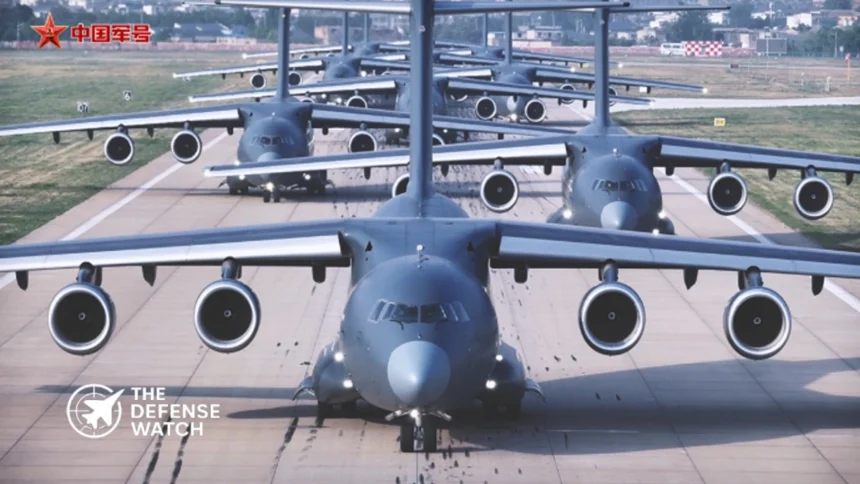
The KJ-3000 is based on the four-engine Y-20B transport aircraft, an improved member of China’s Y-20 family.
The visible features reported by The War Zone include a large circular radar dome mounted above the fuselage, a series of antennas on the forward fuselage, an aerial refueling probe above the cockpit and an intake near the base of the tailfin that analysts believe is associated with cooling the onboard electronics.
These features are consistent with the requirements of a large airborne surveillance platform. The radar dome houses the aircraft’s principal radar equipment, while the additional antennas and specialized equipment support its mission systems.
The refueling probe is particularly relevant because aerial refueling can extend time away from a home airfield when suitable tankers and operational support are available. The presence of a probe, however, does not establish the aircraft’s achievable endurance or its compatibility with specific tanker types.
The Y-20B also uses China’s domestically developed WS-20 turbofan engines, according to reporting on the aircraft’s configuration. This gives the KJ-3000 program a foundation that does not depend on acquiring additional Russian-built transport airframes for each aircraft.
That distinction has implications for long-term fleet development, although the number of Y-20B airframes available for conversion and the resources allocated to KJ-3000 production remain undisclosed.
Replacing the limitations of the KJ-2000
China’s existing large airborne early warning fleet provides important context for the new aircraft.
The older KJ-2000 was developed using the Russian-built Ilyushin Il-76 transport aircraft as its platform. According to The War Zone, only four KJ-2000 aircraft have been completed, with the program constrained by the availability of suitable airframes and continued reliance on Russian supply chains.
Using the domestically produced Y-20B gives China an alternative foundation for expanding its large-aircraft surveillance fleet.
| Attribute | KJ-2000 | KJ-3000 |
|---|---|---|
| Aircraft platform | Russian-built Il-76 transport | Chinese Y-20B transport |
| Propulsion | Based on the Il-76 platform | Four WS-20 turbofan engines |
| Radar installation | Large dorsal radome | Large dorsal radome |
| Development context | Older Chinese airborne early warning aircraft | Newer platform observed in flight-test and satellite imagery |
| Production status | Existing aircraft in service | Serial production has not been officially confirmed |
| Detailed operational specifications | Limited public information | Limited public information |
The comparison is based on publicly available reporting. Detailed specifications for the KJ-3000 remain unavailable, and the table should not be interpreted as a verified comparison of radar performance.
The principal advantage of the newer design is the potential to expand the fleet without depending on the same imported airframe supply that constrained the earlier program.
Domestic production could also give Chinese manufacturers greater control over maintenance, structural modifications and future upgrades. Those advantages would still depend on manufacturing capacity, component availability, testing requirements and the maturity of the aircraft’s mission systems.
A larger aircraft inventory would not automatically guarantee superior operational performance. Training, maintenance, communications and integration with other aircraft and command networks would remain essential.
How the KJ-3000 could affect China’s air operations
If China fields the KJ-3000 in meaningful numbers, the aircraft could strengthen the People’s Liberation Army Air Force’s ability to coordinate operations across a large area.
Airborne early warning aircraft can provide an elevated surveillance perspective, helping commanders detect and track airborne targets that may be difficult for ground-based radar to observe because of terrain or the radar horizon.
They can also serve as airborne command and control nodes, distributing information to participating aircraft and helping coordinate responses to changing conditions.
These functions are relevant to operations in the Western Pacific, where military aircraft may operate across large distances and where surveillance, communications and coordination can influence how effectively forces work together.
The KJ-3000 could eventually complement China’s smaller airborne early warning aircraft rather than replace the entire existing fleet. Different aircraft classes can serve different operational requirements, with smaller platforms potentially providing flexibility while larger jets offer greater space for mission equipment and support systems.
However, publicly available evidence does not establish the KJ-3000’s intended fleet size, operational deployment locations or precise role within China’s command architecture.
Its appearance at the factory is therefore an indication of program activity, not proof that the aircraft has already changed the balance of airpower in the region.
The implications for U.S. airborne surveillance
The KJ-3000’s development also has relevance for the United States, which faces its own challenges in maintaining and modernizing airborne battle management capabilities.
The U.S. Air Force operates the E-3 Sentry airborne warning and control system aircraft and has pursued the E-7 Wedgetail as a successor capability. The transition has faced program and procurement challenges, creating concerns about the timing of future airborne command and surveillance capacity. The War Zone discussed these issues in its October 22 report on China’s new aircraft.
The comparison should not be reduced to which country has the newest aircraft. Effective airborne surveillance depends on the complete system, including radar performance, data fusion, secure communications, electronic protection, crew training and integration with other military assets.
Aircraft numbers also matter. A fleet must have enough serviceable aircraft to support operational commitments, training and maintenance. A small number of sophisticated platforms cannot sustain continuous coverage everywhere they may be needed.
If the KJ-3000 progresses into regular production, China could gradually increase the number of large airborne surveillance aircraft available to its military. That would provide a stronger industrial foundation for expanding the capability, although the scale and pace of any expansion remain uncertain.
For U.S. planners, the relevant question is not simply whether China has built another large radar aircraft. It is whether Beijing can turn the platform into a reliable, adequately supported fleet that improves the surveillance and coordination of its wider air force.
What remains unconfirmed
Several important questions remain unanswered.
First, production status. The satellite imagery shows four aircraft, but it does not establish whether serial production has begun. The aircraft could include prototypes undergoing further development.
Second, operational performance. Publicly available reporting does not establish the KJ-3000’s radar detection range, target-tracking capacity, electronic warfare resistance or ability to operate in a heavily contested electromagnetic environment.
Third, fleet size and delivery schedule. China has not publicly disclosed a confirmed production target, delivery timetable or operational inventory for the aircraft.
Fourth, service entry. The presence of aircraft at manufacturing and test facilities does not establish that the type has completed qualification or entered operational service.
These gaps are important because the transition from a prototype to a fielded military capability requires more than producing an airframe. Mission-system testing, software development, operational evaluation, crew training and support infrastructure can all affect the time required to introduce a new aircraft.
Further satellite imagery, identifiable production aircraft and official announcements could help clarify the program’s progress.
For now, the KJ-3000 is best understood as a developing Chinese airborne early warning platform whose potential significance is clear, but whose production status and operational capabilities remain only partly documented.